Showing posts with label education. Show all posts

Friday, June 12, 2026

Friday Afternoon Links

Assorted content to end your week.

- Caitlin Johnstone writes about the reality that the whole of humanity is largely being used solely as a profit-generating machine for the benefit of a wealthy few. And Paul Waldman comments on Elon Musk's SpaceX IPO as the ultimate juxtaposition of greed and hate, while Tom Goldsmith discusses how the mere possibility of an individual accumulating a trillion dollars represents an indictment of our political and economic systems. 

- Ann Larson writes about the impact of inequality on workers in U.S. grocery stores - including seniors forced to stay in menial roles far past retirement age in order to try to eke out a living. James Chappel's review of Samuel Moyn's Gerontocracy points out the problem with trying to portray fundamental issues of oligarchic hoarding of wealth along lines other than class. And Sam Freedman discusses how pouring additional resources into a fundamentally imbalanced system won't resolve inequality in education. 

- Janetta McKenzie points out new polling showing that while the UCP and its political cousins try to paint utter obeisance to oil tycoons as a must to keep Alberta in Canada, the fact is that most Albertans reject their demand for guaranteed profits at the expense of everybody else. And Energy Live News highlights survey data showing broad UK interest in installing solar panels as a means of reducing dependency on volatile fossil fuel supplies. 

- Finally, Geoff Dembicki and Jen St. Denis discuss how Mark Carney's push for AI data centres is specifically aimed at exacerbating the extraction and burning of fossil gas. And Darren Major reports on Carney's decision to eliminate the Canadian Ombudsperson for Responsible Enterprise who offered the sole means of monitoring the human rights abuses of resource extraction firms around the globe. 

Saturday, April 25, 2026

Saturday Afternoon Links

Assorted content for your weekend reading.

- Rita Bhowmick writes about the importance of care services both in keeping people healthy and ensuring equitable work opportunities. And Steven Lewis examines the dishonesty and gaslighting behind the destruction of public Medicare in by the UCP, while Kaylene Duttchen and Paul Parks point out the consistent body of evidence showing that private and for-profit medicine only draws resources away from the care people actually need.  

- Runting Li et al. study (PDF) the connection between the proliferation of microplastics and nanoplastics, and the proliferation of brain tumours. 

- Donal Gill offers a warning about the dangers of making political and social decisions to serve the interests of tech giants pushing AI propaganda rather than people. Jessica Winter highlights the community efforts to keep AI from take over education systems. And Nilay Patel discusses how "software brain" is causing immense changes without people recognizing what's happening. 

- The New York Times' editorial board rightly warns that the return of measles presages far worse diseases making a comeback due to the anti-science attack on vaccinations. And the Boston Globe reports on the growing number of Americans suffering from long COVID. 

- Finally, Heather Scoffield reports on the false promise of Canada's disability tax credit which (along with associated supports) has been designed to be unavailable to most people who actually qualify.  

Wednesday, March 18, 2026

Wednesday Afternoon Links

Miscellaneous material for your mid-week reading.

- Anne Applebaum weighs in on the inevitable recognition by any remotely rational actor that it's pointless to offer Donald Trump any respect or trustworthiness that he's fundamentally incapable of reciprocating, while Andrew Egger rightly highlights how Trump has lost friends and alienated people. But Pooja Misra reports that Pierre Poilievre is determinated to be the sucker who bets Canada's future on the preposterous theory that Trump can be trusted both to bargain in good faith, and hold up his end of any deal. 

- Jake Grumbach discusses the longstanding awareness that extreme inequality is incompatible with a functional political system and constitutional order. And Roberta Lexier writes about the feedback loop between capitalist accumulation and fascist politics - along with the need to fight back against both. 

- Jen Deerinwater and Jesse Deer In Water discuss the Indigenous pushback against the environmental damage and cultural theft wrought by gigantic data centres. Brian Merchant explores how AI is undermining post-secondary education in the U.S. And Emily Tate Sullivan examines how AI slop is particularly harmful to children's brains which are still developing. 

- Finally, Nora Loreto examines the connections between military culture and white supremacism in Quebec City. 

Friday, October 17, 2025

Friday Morning Links

Assorted content to end your week.

- Ryan Cooper and David Dayen discuss how Donald Trump is managing to combine the worst abuses of every British monarch who helped contribute to revolts up to and including the American Revolution. Andrew Egger highlights the Trump regime's assault on free speech from anybody who doesn't trumpet his agenda (coupled with its normalization of violence and bigotry from supporters). And Andy Kroll writes about Russell Vought's tenure as acting shadow president, both in consolidating power and destroying any functional government which remained. 

- Meanwhile, David Climenhaga reports on the latest politicized review which the UCP has used to inject MAGA talking points into Alberta politics. 

- Antoine Trepanier reports on Mark Carney's refusal to live up to his promise of "elbows up" even as Trump continues to impose arbitrary tariffs which undermine any reason to think any negotiated agreement will last longer than Trump's next social media outburst. John Michael McGrath rightly wonders what the plan is for an auto sector which the Libs seem content to leave at the U.S.' mercy. And Amanda Follett Hosgood discusses the potential dangers from a U.S. government takeover of critical mineral interests in Canada (even as the Libs cheerlead for it).

- Ayurella Horn-Miller writes about new research documenting a connection between global warming and increased sugar consumption, providing yet another instance of public health dangers amplifying each other. 

- Finally, Simon Enoch notes that Canada Post would have plenty of options to provide better service for less cost if it weren't shackled by rules designed to protect corporate interests. 

Tuesday, October 14, 2025

Tuesday Morning Links

This and that for your Tuesday reading.

- Don Moynihan examines the Trump regime's steps to build a police state whose only loyalty is to their mad king, while Andrew Egger recognizes that guilt by association is the new standard being applied to anybody who doesn't have a personal in with the administration. Sarah Kendzior highlights the challenges of trying to achieve change through disruptive collection action against a president who's perfectly happy to see things destroyed if it helps cement his power. And David Falk reports on Danielle Smith's coziness with the Heritage Foundation and other authors of Trump's fascist plans. 

- Meanwhile, in case there were any doubt that the UCP is cribbing policy directly from the rankest Republican antisocialism, Ximena Gonzalez reports on its combination of free money for exclusive private education and hostility toward public schools. 

- Fatma Ozdogan notes that the risks and problems we choose to focus on have an inevitable impact on what we prepare for. Paige Bennett discusses the multi-trillion dollar costs of the climate crisis. And Alexander Villegas reports on a new study showing that deforestation is even worse than predicted due to both deliberate destruction and the spread of wildfires, while Matthew Taylor and Helena Horton report that the UK is facing the abandonment of entire towns due to regular flooding of areas which were previously safe. 

- Finally, Ole Hendrickson warns that Mark Carney's plan to build big with little regard for environmental impacts may serve only to make matters worse. And Emily Sanders reports on a new study confirming that fossil fuel operators aren't part of the solution in seeking a clean or prosperous future. 

Wednesday, September 03, 2025

Wednesday Morning Links

Miscellaneous material for your mid-week reading.

- David Lurie writes about the Trump regime's Potemkin populism - as well as the increasing speed with which his fabrications are coming undone. Sarah Kendzior discusses the importance of finding meaning and purpose in ways that can't be undermined by a mafia state. And Sam Bagenstos highlights the importance of a plan for what comes after the civil service has been destroyed.

- Meanwhile, George Monbiot points out the continued failure of centrist parties and politicians to offer any hope when that's exactly what stands to motivate citizens who don't see anybody working toward anything better. And Andrea Houston talks to Linda McQuaig about Mark Carney's betrayal of voters who expected a defence of progressive Canadian values rather than a collaborationist Conservative government in Lib clothing. 

- Oliver Milman and Dharna Noor report on the work done by dozens of top climate scientists to refute the denialist propaganda of the Trump regime. And Alexandra Keeler warns that while our research system may not have been wholly hijacked for political purposes, it's still under threat from fake science. 

- Kevin Anderson, Chris Jones and Gaurav Gharde discuss the deep failures of climate policy in the UK which are only being exacerbated by a spate of dirty energy-based policies. Jonathan Watts highlights Tzeporah Berman's work on a fossil fuel phaseout treaty to stop every dirty energy producer from insisting it will be the last to stop. Russel Norman writes about the rise of insurance costs in New Zealand due to the ongoing climate breakdown. And Nina Lakhani reports on the rise of indoor heat deaths in Arizona as a result of extreme heat, while Marc Fawcett-Atkinson notes that tree-planting efforts which are pitched as emission mitigation measures haven't been able to keep up with the effects of wildfires.

- Josh Robertson, Michael Slezak, Jack Fisher and Mark Doman report on the decades-long cover-up of a massive methane leak from a major Australian gas project. And Martha Pskowski and Mark Olalde report on Texas' reflexive approval of greenhouse gas releases. 

- Finally, Richard Larouche discusses how the safety and freedom of children has been sacrificed in the name of prioritizing cars over bike lanes. Trevor Goodyear points out the UCP's attacks on the safety of LGBTQ+ children and other marginalized youth based on the theory that kids are nothing more than parents' property. And Dave Cournoyer writes that Alberta's teachers are standing up for children's well-being and education as the Smith government looks to undermine their classroom conditions and access to books.

Friday, February 21, 2025

Friday Morning Links

Assorted content to end your week.

- Paul Krugman discusses how Donald Trump is eviscerating financial regulation and consumer protection just when it's most needed, while Henry Farrell points out how the undermining of government intersects with the polycrisis which Trump refuses to even acknowledge let alone address. And Bryan Mena reports on new polling showing that U.S. consumers are recognizing the dangers of Trump's regime. 

- Brian Beutler writes about the futility of trying to work with people who have resolved to engage in as much criminal behaviour as they can get away with. Ian Dunt notes that Trump's flagrant lies about Russia's invasion of Ukraine represent the most clear attack yet on epistemic reality. And Zeynep Tufecki examines how the theft of private information may be used to entrench Elon Musk's power both inside and outside of government. 

- Niall Harney and Jon Milton write that Amazon's union-busting should be a wakeup call for Canada's labour movement. Adam King reports on an attempt by Toronto's business lobby to take away paid days off for retail workers. And Marc Lee calls out the gross overstatement of the effects of supposed interprovincial barriers in an effort to undermine regulation in the public interest - while offering a reminder that there's a readily-available mechanism to deal with any barriers which are actually identified. 

- Taylor Noakes discusses how the U.S.' disruption of existing trade patterns gives us a golden opportunity to build a clean energy society. But David Moscrop writes that Mark Carney is offering nothing more than business as usual, complete with austerity, corporate handouts and illusory climate policy. 

- Finally, Ricardo Tranjan and Ryan Romand point out how Ontario's provincial election has involved little attention to the province's desperate need to collect revenue to be used for public services. And Saima Desai discusses the how Ontario's education system is falling apart after two terms of Doug Ford slashing what were already insufficient funding levels. 

Tuesday, November 26, 2024

Tuesday Morning Links

This and that for your Tuesday reading.

- John Woodside reports on the pitiful excuse for climate finance advanced by developed countries at COP29. Kate Dooley highlights how the carbon trading scheme set up at COP29 falls far short of both actually reducing carbon pollution, and accounting for other environmental and social harms caused by credit-generating activities. Patrick Greenfield notes the absurdity of governments and businesses claiming credit for natural carbon sinks as somehow offsetting new carbon pollution. And Nancy Stauffer discusses how existing emission promises rely in particular on implausible assumptions about the viability and impact of carbon removal.

- Trevor Tombe and Jennifer Winter study the price impact of carbon pricing on Canadian food, and find that it's a fraction of the added cost imposed on consumers by corporate profiteering. And Andre Picard writes that the recent cluster of cases of scurvy in La Ronge reflects a far broader issue of poverty and food insecurity in northern regions. 

- Meanwhile, Cheryl Jahn interviews Alex Hemingway about the immense opportunity cost of offering boutique tax cuts rather than investing in underresourced public services. And Wency Leung reports on the dire state of Ontario's public education system as a result of decades of austerity. 

- Simon Spichak points out that recommendations being supported by the Public Health Agency of Canada may actually worsen the effects of long COVID, including by recommending exercise when it's strongly inadvisable. 

- Finally, Ricardo Tranjan discusses how to make rent regulation effective to ensure that housing is both available and affordable. 

Sunday, September 22, 2024

Sunday Afternoon Links

This and that for your Sunday reading.

- Tarique Niazi discusses some of the geopolitical implications of the intensifying climate crisis. Aaron Whetty offers a reminder that the joint effort by the Libs and Cons to treat a consumer carbon tax as the sole point of climate policy worth discussing missed the much bigger picture. And Nick Hedley notes that a rapid and successful transition to renewable energy in China stands to reduce global demand for fossil fuels far faster than previously projected.

- John Lavis and Mathieu Ouimet highlight how decision-makers would be expected to apply scientific knowledge to deal with a global polycrisis if they had any interest in acknowledging and responding to it. And the University of Plymouth takes note of the scientific consensus on the need to tackle the dispersion of microplastics.

- Kiran Stacey reports on a new study showing that a corporate tax giveaway in the UK is costing three times as much in revenue as it stands to produce in investment. And Sharon Graham asks what a Labour party is for if the UK's version is bent on starving the public while serving the interests of the corporate class.

- Wing Li rightly argues that the UCP shouldn't be using Alberta's public money to build private schools - particularly when it's responsible for failing to maintain public educational infrastructure. 

- Finally, Richard Murphy discusses the need to re-re-brand private equity with its previous title of "asset stripping" - and match that more accurate description with public policy aimed at limiting the harm it can do to functional economic vehicles.

Monday, April 01, 2024

Monday Afternoon Links

Miscellaneous material to start your week.

- Aaron Wherry discusses the deadly-serious consequences of climate denialism which is driven by frivolous rhetoric. And Andre Mayer points out the numerous ways in which the climate breakdown is actually responsible for the increased cost of living which is being used as an excuse to stall what little action has been planned to try to combat change. 

- Sachi Mulkey reports on new research showing that methane from landfills represents just one more area in which we're spewing more carbon pollution than previously documented (or taken into account in climate change plans). And Ben Webster reports on a carbon capture project which ExxonMobil isn't bothering to complete after trumpeting it as an excuse for fossil fuel expansion.  

- Hugo Daniel reports on the misinformation and denialism from a major asbestos supplier which has continued to pollute information flows long after the dangers of asbestos use were widely known. And Maureen Tkacik discusses how Boeing purged its organization of people who knew how to build safe airplanes in order to maximize short-term profits. 

- Candice Odgers reviews Jonathan Haidt's The Anxious Generation - and in the process points out that anybody genuinely concerned about children's well-being should be working primarily on alleviating real-world stressors, rather than focusing solely and conveniently on social media. And Emine Saner discusses how Estonia's focus on fostering a supportive environment for children and teachers alike has resulted in better educational performance. 

- Finally, Katya Schwenk reports on how large corporates are funneling dark money into buying extreme firepower for police forces - making them both more likely to pursue extreme violence, and biased to direct it against people without the same level of wealth or power. And Doug Cuthand highlights how prisons have replaced residential schools as the main institution used to impose control on Indigenous people. 

Tuesday, March 12, 2024

Tuesday Morning Links

This and that for your Tuesday reading.

- Brishti Basu reports on the ill effects of WorkSafeBC's decision to push people back to work while they continue to suffer from long COVID. And Alex Skopic calls out the CDC's choice to direct people back to work while they're still infected with COVID-19, while Reina Sultan talks to experts who point out the obvious and avoidable risks to others including workers and customers arising from that guideline. 

- Anita Hofschneider writes about the looming prospect that the effects of a climate breakdown will include the exposure of nuclear waste. And Mari Yamaguchi reports that 13 years after the Fukushima nuclear disaster, authorities still have little idea of the condition of the damaged reactors or the status of the fuel waiting inside. 

- Meanwhile, Joseph Winters reports on the push to ban detergent pods due to their propensity to release microplastics into the environment - as well as the reality that the problem with microplastics generated by clothing goes far deeper. 

- Mouhamad Rachini discusses how teachers across Canada are barely getting by (while administrators have put more and more unqualified babysitters in charge of children as a substitute for providing adequate education resources). And Megan Ogilvie highlights how Ontario has been driving family doctors out of the profession while funneling money toward impersonal corporate substitutes. 

- Finally, Paul Willcocks rightly questions why a supposedly austerian Vancouver mayor and council are funneling tens of millions of dollars to a single private school. Jennifer Lee reports on the $97 million price tag to reverse the effects of the UCP's ideological decision to push lab services into the corporate sector. And Adam King points out the much higher cost of Doug Ford's attempt to suppress public-sector wages. 

Friday, February 16, 2024

Friday Afternoon Links

Miscellaneous material to end your week.

- Amy Peng et al. examine the profound positive impact of mask mandates in reducing the spread of COVID-19 in Ontario. And Sheena Cruickshank warns about the avoidable harm we can expect as so many respond to the political and social signals to abandon all precautions in the midst of an ongoing pandemic. 

- Luis Guanter et al. document an immense methane leak from a single well blowout in Kazakhstan. Michael Barnard offers a reminder that the definition of a carbon capture and storage "success story" is the release of 25 times more carbon pollution than is captured.

- Zoe Yunker reports on the federal government's choice to scrap pipe supply and testing requirements for a particularly treacherous stretch of the Trans Mountain pipeline. Fatima Syed discusses how the Ford government has suppressed a study which shows how the climate crisis endangers numerous facets of life in Ontario. And Raidin Blue and Betsy Again study (PDF) how bottlenecks in labour and material supplies are among the obstacles to making buildings more energy-efficient - making clear that the price of subsidizing dirty energy expansion is to divert the resources needed to transition to a cleaner economy. 

- Matthew Kurtz examines the problems with making educational institutions beholden to capital investments.

- Finally, Erika Shaker writes that trans children deserve far better than to be used as pawns in the right's culture wars. Rob Reiner discusses how hostility toward diversity is behind the willingness of U.S. religious nationalists to support Donald Trump. And Laura Woodward reports on the appalling demand by a Saskatoon church to shut down support services for homeless people - and how it's being echoed in Sask Party policy. 

Tuesday, February 06, 2024

Tuesday Morning Links

This and that for your Tuesday reading.

- Cordell Jacks writes about the need for an economic model which evolves beyond the short-term exploitation of people and the planet. And Jessica McKenzie interviews Charlotte Kukowski about the importance of reprioritizing in the context of readily-apparent feedback loops between inequality and the climate crisis. 

- Daria Shapovalova reports on a landmark court decision determining that oil companies won't be able to avoid answering for downstream emissions in environmental assessments in Norway. But sadly, both Canada and the UK are continuing to rush through as much extraction and export as possible before anybody applies that standard to their fossil fuel sectors. 

- Marcus Baram reports on new legislation under consideration in New York which would ensure that large-scale wage thieves lose the privilege of doing business. 

- Adam King writes about the fight of Saskatchewan's teachers for tolerable working and learning conditions - and the Moe government's determination to avoid providing anything of the sort. 

- Aaron Wherry asks whether Justin Trudeau is reaching the point of regretting not keeping his promise of a fair and proportional electoral system. 

- Finally, Luke LeBrun points out that Stephen Harper's International Democrat Union has quietly scrubbed its links to Narendra Modi’s Bharatiya Janata Party - though the main news appears to be that  there exists a level of authoritarianism that even the IDU will disclaim. 

Tuesday, January 02, 2024

Tuesday Afternoon Links

This and that for your Tuesday reading.

- David Macdonald highlights yet another record-breaking year of Canadian CEO income compared to the pay of the average worker. 

- Lisa Young's wish for the new year is for better public health - though the hostility to the concept from Danielle Smith (as well as Scott Moe) doesn't bode well for that hope. Andrew MacLeod examines the politics of privatized health care in British Columbia as Telus keeps taking over the role of care providers. Rachel Cohen highlights how mental health treatment looks radically different for the rich compared to the poor. And Rebecca Watson warns that that the same private equity ghouls who have put numerous major retailers out of business through leveraged buyouts are turning their attention to the medical system. 

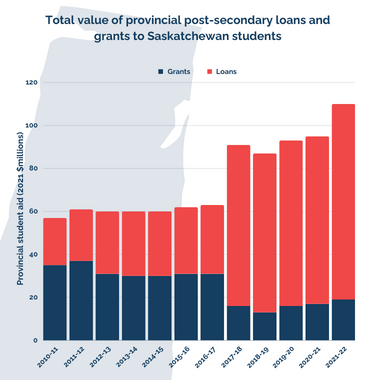
- Asia Fields and Becca Savransky examine what happens when a government chooses not to maintain its education system. And the CCPA offers up its favourite graphs of 2023 - including this depiction of how Saskatchewan students are taking on massive amounts of debt to pay higher fees in the face of slashed grant funding:

- Raymond Zheng discusses the scientific debate as to whether global warming is merely happening as projected based on the continued spewing of carbon pollution, or increasing due to unanticipated feedback effects. And Daphne Ewing-Chow points out which foods are facing the greatest risks due to the climate breakdown. 

- Finally, Leigh Stickle and Luke Mari respond to a baseless attack on housing density by pointing out that more housing and increased park space are entirely compatible when they're both designed to be inclusive rather than fenced-off. 

Wednesday, October 11, 2023

Wednesday Afternoon Links

Miscellaneous material for your mid-week reading.

- Sameer Elsayed offers a primer on what people need to know about current COVID-19 risks. Mary Van Beusekom discusses the likelihood that long COVID is being underdiagnosed in children who may not have either the same symptoms as adults, or the vocabulary to describe them. And Theocharis Kromidas et al. examine the incidence of long COVID by occupation, with education and care workers facing a higher risk of long-term effects. 

- Juan Cole theorizes that lawsuits against fossil fuel conglomerates could make for a turning point in the fight against climate breakdown. But Christopher Pollon warns that Canada's resource extraction sector offers a blueprint for corporate exploiters to avoid paying for the damage they inflict on our planet. 

- Cory Doctorow discusses the information imbalance which makes it impossible for citizens to hold corporate wrongdoers to account. And Brewster Kahle writes that U.S. libraries are facing twin threats from greedy publishers and anti-knowledge extremists. 

- But on the bright side, Amanda Marcotte points out how parents are pushing back against the bigoted right's attempted takeover of public schools. 

- Finally, Jennifer Liu highlights how workers are bearing the massive cost of being pushed back to the office even after it's been proven they can work just as effectively through alternate arrangements. 

Tuesday, September 26, 2023

Tuesday Afternoon Links

This and that for your Tuesday reading.

- Saima Iqbal discusses new research showing how much of the COVID-19 virus people emit while contagious. And Erica Edwards reports on the development of blood tests to help confirm the biological basis of long COVID. 

- Emile Torres warns that the chaotic and catastrophic summer of 2023 may seem mild compared to the climate effects we'll experience in the years to come. And Katharine Sanderson reports on temperature monitoring which shows that we've likely already exceeded the 1.5 degree barrier which the Paris accord was intended to avoid breaching. 

- Gordon Brown points out the obvious reality that fossil fuel extractors rolling in windfall profits need to be contributing to the cost of fighting the climate crisis. But Valeri Volcovici reports on Antonio Guterres' recognition that their naked greed is what's gotten us into the mess in the first place, while Natasha Bulowski reports on the rare call for Suncor's CEO to answer for his plan to push dirty tar sands developments even as the planet burns.  

- Lucas Powers reports that Doug Ford's promise that deregulation and the elimination of rent controls would somehow make affordable housing more available has predictably proven false. 

- Finally, David Prisciak reports on the Saskatchewan Human Rights Commission's finding that actual vulnerable children are being utterly neglected by the Moe government when it comes to providing resources to address reading disabilities. 

Friday, September 22, 2023

Friday Afternoon Links

Assorted content to end your week.

- Stephanie Soucheray discusses new research showing how people with existing health problems are at substantially higher risk of long COVID. And Helen Floersh points out a new study on how different COVID-19 variants are adapting to evade immunity. 

- George Monbiot writes about the oil industry's constant lobbying and propaganda aimed at keeping us addicted to fossil fuels even as they poison us and destroy our living environment. And Gary Fuller points out how the trend toward larger vehicles results in more pollution and more dangerous roads. 

- Bryan Walsh notes that on a global scale, any gains against extreme poverty have slowed to a crawl (even as the top-end wealth accumulation which is spun as helping the cause of raising lower-level incomes continues to accelerate). 

- Oshan Jarow highlights how the US was able to put a massive dent in child poverty in the midst of a pandemic by lifting restrictions on access to social benefits - only to push children back into deprivation at the first available opportunity. And Connie Mason and Leah Hamilton examine the roots of the "parents' rights" language being used as a pretext for attacking and outing vulnerable children. 

- Finally, Thomas Zimmer discusses how a "polarization" frame gives cover to the cultivation of violent extremism on the right. 

Wednesday, September 13, 2023

Wednesday Afternoon Links

Miscellaneous material for your mid-week reading.

- Mary Van Beusekom discusses new research showing that a quarter of COVID-19 survivors are still facing impaired lung function (among other health problems) a year after infection. And Prakash Nagarkatti and Mitzi Nagarkatti write about the CDC's approval of new vaccines better targeted toward current variants, while Beth Mole reports on its concurrent recommendation that everybody get a booster this fall. 

- Scott Denning makes the point that we shouldn't call a broken climate a "new normal" when we have no idea how to navigate it, while Al Jazeera reports on Volker Turk's warning that a dystopian future is already here. And Thora Tenbrink discusses how perceptions of the climate threat vary from place to place - particularly in a rural-urban divide. 

- Meanwhile, Michael Keller reports on a new research tool showing the consistent acidification of oceans as another example of the degradation of vital environmental systems. 

- Penny Daflos exposes the parasitic extraction of health funding by private staffing agencies. And Dayne Patterson reports on the Moe government's refusal to accept a donation of money to buy an MRI machine to operate in Estevan - presumably in large part because resources allowing essential services to be publicly performed would limit the ability of Sask Party donors to profit from them. 

- Finally, Doug Cuthand calls out the Moe government for trying to reduce access to sex education and inclusive learning in a province which desperately needs to work on improving both. 

Thursday, September 07, 2023

Thursday Morning Links

This and that for your Thursday reading.

- Tess Finch Lee writes about the importance of doing everything we can to protect children (and indeed the general population) from COVID-19. But Thomas Piggott laments that instead of taking a lesson in interdependence and the need for social care, we've been pushed to avoid learning anything from the pandemic. 

-  Meanwhile, Isaac Callan and Colin D'Mello report on the Ontario health care facilities which are being left to crumble while the Ford government focuses on handing out riches to developers. 

- Erika Shaker points out how the cruel and coordinated conservative attacks on trans students also serve as an assault on public education generally. And Michael Harris discusses Mike Roman's place in the importation of Republican fascist politics and anti-democratic activity into Canada's right-wing parties. 

- Tyler Austin Harper and Leif Weatherby highlight how billionaires determined to sacrifice a liveable environment to the pursuit of short-term wealth hoarding are the ultimate existential threat to human survival. And The Juice Media offers a an Honest Government Ad from the government of Canada on its complete subserviance to fossil fuel tycoons in particular:

- Finally, Yvette D'Etremont reports that half of Nova Scotia's working-age population is strugging to get by on less than a living wage. And Cory Doctorow writes about the prospects of the U.S. labour movement being strengthened by a restored precedent from the National Labor Relations Board which ensures that employers can't cheat their way to union avoidance. 

Wednesday, August 30, 2023

Wednesday Afternoon Links

Miscellaneous material for your mid-week reading.

- Sascha Pare reports on the growing recognition that methane emissions could trigger "termination" events which see tundra turn into tropical savannah. And Robson Fletcher reports on a drop in wheat production caused by drought which may make staple foods far more expensive. 

- Dharna Noor reports on Fossil Free Future's work to point out how the oil industry continues to push us toward civilizational catastrophe in the name of an insatiable addiction to short-term profit. But Simon Black, Ian Parry and Nate Verson chart how dirty energy subsidies are hitting record levels even as the consequences of a climate breakdown become increasingly clear. 

- Arya Rao and Shira Hornstein point out the related effects of climate change and poor housing on public health. Stephanie Swensrude reports on the City of Edmonton's recognition that suburban sprawl is worse for citizens from the standpoint of direct cost as well as health and community. And Michael Gorman reports on a review of Nova Scotia's housing situation which has flagged the need to enforce landlord compliance - which has apparently been buried for reaching that inconvenient conclusion. 

- April Short discusses how models based on free and shared goods are surviving and thriving, even as public policy is oriented solely at favouring conspicuous consumption and corporate profits. 

- Finally, David Climenhaga examines how social conservatives are pushing to take over Alberta's education system (which is of course mirrored across Canada). And Emma Brown and Peter Jamison report on the U.S.' experience with "parental rights" being used by socons to take over and destroy public education.