Showing posts with label mental health. Show all posts

Wednesday, February 25, 2026

Wednesday Afternoon Links

Miscellaneous material for your mid-week reading.

- Casey Newton notes that repeated studies showing the distorting effects of X and other social media sites are making it impossible to pretend that major tech platforms deserve the protection of a presumption of neutrality. And Raphael Satter and Alexandra Alper report on the Trump regime's demand that other countries avoid asserting any protection for data integrity or public privacy where its tech giants think there's something to be exploited.

- Rory White investigates the consultants looking to overwhelm political conversations with AI talking points. And Brett McKay reports on the right-wing astroturf entities who are skirting or deliberately violating Canadian election laws in order to flood the airwaves with election ads without providing timely (or in some cases any) disclosure of who's funding them. 

- A.R. Moxon discusses why toxic masculinity is damaging to the people who succumb to it, while recognition of others' humanity is necessary to the flourishing of one's own. And Kelly Hayes writes that it's no surprise that people who have been systematically isolated are unable to understand the connections being made in Minnesota where people are building support networks. 

- Finally, Sharlene Gandhi examines data from 211 calls which shows that housing and mental health are the most glaring unmet needs among people calling for crisis support. And Simon Enoch discusses Saskatchewan's continued place as the province with the highest rates of child poverty - which is only becoming both broader and deeper under the Sask Party. 

Friday, February 20, 2026

Friday Afternoon Links

Assorted content to end your week.

- Sarah Sloat discusses how the collapse of democracy in the U.S. is producing severe mental health problems for the people living through it. And Natalie Brender writes about the need to treat violent extremism as a threat to public health as well as safety.  

- Graham Readfearn experiences the effects of the type of extreme heat that the climate breakdown is imposing on increasingly large numbers of people, while the Associated Press reports on a new study again finding that the climate crisis is increasing the dangers caused by wildfires. And Disha Shetty highlights new research demonstrating how air pollution contributes to poor mental health. 

- Linda McQuaig weighs in on Mark Carney's plans to further entrench the corporate domination of Canada by placing any favoured businesses above the law. And Ariel Rabinovitch reports on the pitiful fine applied to Superstore for false "Product of Canada" displays. 

- Meanwhile, Justin Ling writes about the moral cost of relying (selectively) on military spending as the primarily mechanism for domestic industrial development. 

- Finally, Markham Hislop argues that Danielle Smith is an even more severe threat to Canada than Donald Trump - though the bigoted "authoritarian libertarianism" which rightly concerns him seems largely of a piece with what's happened in the U.S. And Emmett MacFarlane writes that Smith's plans to render Canada dysfunctional may be even worse than mere secession. 

Thursday, August 21, 2025

Thursday Morning Links

This and that for your Thursday reading.

- Hamilton Nolan discusses the multiple crises facing labor in the U.S., as a failure to organize produces particularly catastrophic results in hostile political and legal environments.  The Star's editorial board calls out Mark Carney's attempt to nullify the labour rights of Air Canada workers contrary to overwhelming public opinion - though the ultimate result offers a lesson in the value of maintaining solidarity. And Nora Loreto points out that the systematic suppression of workers' bargaining power under a system intend to reflect a peaceful compromise of interests is virtually certain to lead to far stronger tactics. 

- Vitoria Barreto discusses Brazil's Pix instant payment system - which is naturally drawing fire from bankers and billionaires for providing people of all income levels with financial services without exploitation. 

- Will Noel details the immense amount of renewable energy which has been scrapped due to the UCP's attacks on wind and solar power. And Eugene Ellman reports that U.S. investors are recognizing there's no future in dirty energy despite the Trump regime's determination to try to keep extracting profits for his oil tycoon donors. 

- Finally, Euan Thomson reports on Alberta's sudden abandonment of a private mental health data harvesting app after news has started to emerge about its dangers. 

Monday, June 30, 2025

Monday Morning Links

Miscellaneous material to start your week.

- Kelsey Ables reports on the latest Oxfam study showing that the world's wealthiest few could end poverty dozens of times over by paying their fair share in taxes, while Avi Bryant implores Canada to apply higher tax rates to himself and other people who can afford them. 

- But BIpasha Dey, Harshita Meenaktshi and Promit Mukherjee report on the G7's choice to grant preferential treatment to U.S. corporations. Lloyd Axworthy rightly laments the cringeworthy concessions numerous countries are offering to Donald Trump in the theoretical pursuit of agreements which he'll never consider enforceable. And Emmett MacFarlane writes that Mark Carney's decision to capitulate to Trump on the digital services tax passed years ago represents the end of any hope that he'll stand up for Canada, while Arlene Dickinson highlights how a small amount of tax on tech giants' digital rents is entirely needed as a matter of public policy. 

- Serah Louis reports on the Competition Bureau's needed warning about collusion among landlords to goose rental prices at the expense of people's ability to find housing. 

- Jeremy Appeal reports on the UCP's choice to turn mental health and addictions services into a cash cow Shoppers Drug Mart rather than a source of care for people who need it. 

- Finally, Margot Sanger-Katz and Emily Badger report that the Trump Republicans' plans to rob from the poor to give to the rich include imposing the type of red tape they'd decry in business regulation for the sole purpose of making sure people can't collect benefits which they'd otherwise qualify to receive. And Robert Reich discusses how Zohran Mamdani's genuine desire to ensure people's basic needs are met makes him a threat to corporate interests in both U.S. parties. 

Monday, May 05, 2025

Monday Morning Links

Miscellaneous material to start your week.

- Jason Furman discusses how Donald Trump's economic obsessions are in fundamental conflict with one another - meaning that the only result of trying to pursue all of them will be to make matters worse for the U.S. And Brian Tyler Cohen notes that Trump's ultimate concession of defeat to Maine Governor Janet Mills reflects just one more example of the value of pushing back against him. 

- Jason Sattler writes that Americans have no way to avoid being sucked into Elon Musk's surveillance vortex as he steals their data wherever it's controlled by a government agency. And Lauren McGaughy and Berenice Garcia report on Musk's being handed a city of his own based solely on votes from his own employees. 

- Joe Wilkins reports on Sarah Wynn-Williams' revelation that Facebook's ad algorithms included the exploitation of "moments of psychological vulnerability", including by targeting beauty product ads to teen girls who had merely deleted a selfie. And Dean Blundell writes that female travelers are particularly at risk as the U.S. hands unchecked power (and arbitrary quotas) to immigration officials. 

- Gil Barndollar and Rajan Menon discuss how the U.S. is throwing away the strategic advantage of friendly neighbours throug Trump's constant attacks on Mexico and Canada. But David Pugliese points out one of the complications in Canada's effort to extricate itself from U.S. control, as spare parts for the F-35s we've already committed to buy will be controlled by the U.S. government even after they've been delivered.  

- Finally, Euronews reports on now research showing how more trees in cities could save large numbers of lives by limiting heat-related deaths. And Jessica Wildfire discusses how any preparation for a climate breakdown (or other predictable disaster) needs to account for the mental health effects of a deteriorating living environment. 

Monday, March 03, 2025

Monday Morning Links

Miscellaneous material to start your week.

- Alberto Toscano and Brenna Bhandar discuss how the new Trump regime is governing based on the business model of a slumlord. Joshua Zeitz writes about the rise of another gilded age, while Robert Reich points out how that's reflected in the ownership of the media. Joey Roulette and Valerie Volcovici report on the firing of employees working on managing satellite traffic in space, while Andrew Perez and Asawin Suebsaeng expose the direct order to steal FAA money for Elon Musk's Starlink.  And Rebecca Solnit notes that there's reason to think the arrogance and selfishness of the Trump regime will ultimately backfire. 

- Taylor Noakes writes that Canada needs to be reorienting its foreign relations away from reliance on the U.S., including by disinviting Trump from the upcoming G7 summit to work on an alternative. And Andrew Phillips questions why the federal government isn't working on a plan to buy Canadian even as the public unites behind the principle. 

- Alexandra Tempus offers a reminder that there's no escape from the threat of a climate breakdown, even as John Woodside notes that the firehose of fossil fuel propaganda is putting a dent in public recognition of climate change. 

- David Wallace-Wells discusses how the most cautious people have been right about COVID-19 all along. And Kathryn Bromwich reports on the long COVID patients who are facing severely shortened lifespans and compromised standards of living due to a disease which has largely been excised from any policy discussion, while the Radiological Society of America highlights new research showing hidden lung abnormalities in children with long COVID. 

- Finally, Stephanie Soucheray discusses new CDC data showing severe brain damage appearing in chidlren who died of the flu. And Suzanne O'Sullivan writes about the rise of mental health and behavioural conditions - albeit while going out of her way to argue to ignore them rather than recognizing that they require assessment and support.

Tuesday, October 22, 2024

Tuesday Morning Links

This and that for your Tuesday reading.

- Will Hutton discusses how the growing gap between the rich and everybody else is eating away at Britain's collective well-being, while Phillip Inman warns the new Labour government of the problems with serving the business sector at the expense of the general public. And 350.org responds to the Cons' sloganeering with a campaign to stop allowing wealthy oil companies from dictating Canadian public policy. 

- Euan Thomson warns that a punitive approach to addictions and mental health is now being treated as received wisdom by right-wing parties across Canada - though there's some reason for optimism that voters are rejecting it along with other elements of the conservative culture war. Nik Barry-Shaw notes that Pierre Poilievre is parroting the talking points of big pharma in seeking to deny people access to affordable medication through pharmacare. Adam King points out how more and more health resources are being diverted to for-profit nursing agencies. And Kristina Olson, G.F. Raber and Natalie Gallagher study the results of gender-affirming medical care and find overwhelmingly positive outcomes. 

- Lora Kelley interviews Elaine Godfrey about the conditions which have facilitated the spread of election conspiracy theories. And Dave Karpf writes that Elon Musk's strategy as the outsourced voter turnout director for Donald Trump is to blatantly commit crimes such as making cash payments to voters - with what seems to be an entirely correct expectation that he'll never face any consequences. 

- Finally, David Angus Ness makes the case to build based on the principle of sufficiency which ensures that people have enough of what they need.

Monday, May 27, 2024

Monday Morning Links

Assorted content to start your week.

- Leslie Sattler discusses new research showing that carbon concentrations are continuing to increase by record amounts. David King writes about the immediate and large-scale changes needed to avert an imminent climate catastrophe. And Mohammed Muizzi writes about the existential threat facing the Maldives and other low-lying areas as a result of carbon pollution from wealthier countries.

- Cynthia McCormick Hibbert points out a new study suggesting that the environmental harms of microplastics may include reducing the ability of oceans to absorb atmospheric carbon. Zoe Schlanger discusses Maine's attempt to respond to the ubiquitous threat of PFA "forever chemicals" in water. And Sattler also notes that sandwich bags are rife with PFAs. 

- Meanwhile, Carl Meyer reports on the attempt by the tar sands-based Pathways Alliance to both evade any environmental assessments for planned megaprojects, and help itself to massive amounts of public money in the process. 

- Caitlin Owens discusses the mental health crisis which may have been exposed by the COVID-19 pandemic, but which continues to hamper wide swaths of people. And Jonathan Ore writes about the "great exhaustion" arising out of a combination of work and social stressors.  

- Aaron Wherry writes about Food Banks Canada's report card indicating that the Libs are barely treading water in ameliorating poverty (while right-wing provincial governments are doing no better and the Cons are bent on making matters even worse). And Thom Hartmann highlights the U.S. Republicans' "mudsill" theory which relies on a trapped underclass of labour to further enrich the already-wealthy. 

- Finally, Timothy Cooke writes about Josh Chernofsky's escape from the alt-right's cult. 

Friday, March 08, 2024

Friday Afternoon Links

Assorted content to end your week.

- Oshan Jarow discusses Sapien Labs' work measuring mental health levels around the globe - and the resulting conclusion that "conveniences" including smartphones and ultra-processed foods may contribute to a lower level of mental wellness. And Michelle Gamage writes about the plummeting life expectancy of Indigenous people in British Columbia, along with the solutions based in ethics of care and community. 

- Julia-Simone Rutgers writes about the damage global warming is causing to the ice roads which have historically served as vital lifelines for Canada's North. And Arthur Zhang and Anna Kanduth discuss the readily-available options to shift Canada to a cleaner electrical grid and reduce our ongoing carbon pollution. 

- Meanwhile, Charles Rusnell reports on the lengths the UCP is going to to prevent Alberta from knowing how little support their is for their plan to hijack CPP funds to be handed to dirty energy operators. 

- Brittany Trang discusses a new study showing how nursing home operators are able to hide the majority of their profits in order to paper over higher prices and deteriorating care. And Cory Doctorow calls out the NHS' choice to pay massive amounts of money to corporate operators - and share of sensitive personal health information with them - rather than setting up secure open-source research databases. 

- David Moscrop offers a warning about Pierre Poilievre's intention to impose "ordered liberty", with the primary intention and effect of ensuring the freedom of those with more wealth and power to control and exploit anybody with less privilege. 

- Finally, Linda McQuaig makes the case for Canada to support and sign onto the G20's plan to ensure billionaires can't avoid paying taxes. 

Tuesday, January 02, 2024

Tuesday Afternoon Links

This and that for your Tuesday reading.

- David Macdonald highlights yet another record-breaking year of Canadian CEO income compared to the pay of the average worker. 

- Lisa Young's wish for the new year is for better public health - though the hostility to the concept from Danielle Smith (as well as Scott Moe) doesn't bode well for that hope. Andrew MacLeod examines the politics of privatized health care in British Columbia as Telus keeps taking over the role of care providers. Rachel Cohen highlights how mental health treatment looks radically different for the rich compared to the poor. And Rebecca Watson warns that that the same private equity ghouls who have put numerous major retailers out of business through leveraged buyouts are turning their attention to the medical system. 

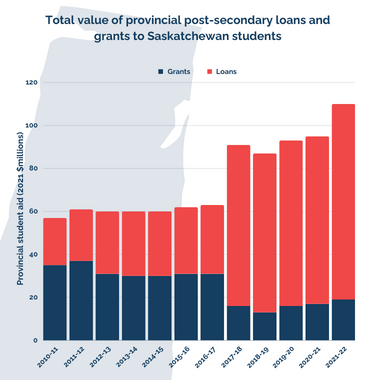
- Asia Fields and Becca Savransky examine what happens when a government chooses not to maintain its education system. And the CCPA offers up its favourite graphs of 2023 - including this depiction of how Saskatchewan students are taking on massive amounts of debt to pay higher fees in the face of slashed grant funding:

- Raymond Zheng discusses the scientific debate as to whether global warming is merely happening as projected based on the continued spewing of carbon pollution, or increasing due to unanticipated feedback effects. And Daphne Ewing-Chow points out which foods are facing the greatest risks due to the climate breakdown. 

- Finally, Leigh Stickle and Luke Mari respond to a baseless attack on housing density by pointing out that more housing and increased park space are entirely compatible when they're both designed to be inclusive rather than fenced-off. 

Wednesday, August 23, 2023

Wednesday Afternoon Links

Miscellaneous material for your mid-week reading.

- The Associated Press reports on how the climate breakdown is producing every form of extreme weather everywhere all at once, while E.M. Fischer et al. study how even more intense heat waves are an imminent possibility. And Brishti Basu points out how younger people are trying to cope with a future steeped in climate anxiety, while Kiffer George Card and Kalysha Closson warn of the problems with letting a climate calamity drive people apart. 

- Meanwhile, Michelle Woodhouse highlights how we don't need Line 5 and other dangerous fossil fuel infrastructure to meet our energy needs. 

- Erika Morris reports that every single developer in Montreal has chosen to pay a fee rather than meeting standards for affordable housing - signaling how futile it is to pretend that profit-motivated corporations are any part of the solution to the provision of human needs. Ximena Gonzalez writes about Calgary's failure to implement recommendations to encourage the supply of affordable homes. And Zane Woodford reports on the particularly callous comments from one Lower Sackville councillor that ending homelessness just isn't going to happen - though it's hard to see much distinction between that position and the policy choices of Regina and other municipalities. 

- Finally, Marcus Baram reports on the tens of millions of dollars in unpaid wage assessments in New York which are still outstanding due to a lack of enforcement capacity. And Zak Vescera reports on the B.C. government's choice to shut down its fair wage commission even in the face of strong recommendations that its work is far from done. 

Wednesday, March 01, 2023

Wednesday Morning Links

Miscellaneous material for your mid-week reading.

- David Wallace-Wells discusses how the U.S. is woefully unprepared to deal with the real prospect of another pandemic (particularly on top of the ongoing COVID-19 pandemic which is the subject of a policy of denial). 

- Peter Frankopan writes that climate is a crucial aspect of history which we ignore at our own peril both in assessing past events, and planning for our own futures. Tessa Koumoundouros reports on new modeling showing that the melting of large ice sheets may result in a far more rapid climate breakdown feedback loop than already anticipated. And Jamey Keaten reports on Antonio Guterres' rightful opprobrium toward climate-wrecking corporations.
 
- Meanwhile, Susan O'Donnell and M.V. Ramana write that New Brunswick (and other governments) shouldn't give in to the demands of nuclear operators seeking to lock down massive funding for projects which will almost certainly fall short of being worth their immense cost.  

- Joel Lexchin offers a reminder of the cozy relationship between the Canadian government and big pharma which has once again been leveraged to prevent any action to make needed medications more affordable. And Lyndsay Armstrong reports on the concern by Nova Scotia social workers that one-time access to for-profit counselling represents more of a corporate recruitment strategy than a plan to help citizens. 

- Finally, Trish Hennessy introduces the latest issue of Monitor Mag with a reminder as to the importance of income inequality and the options available to tackle it. And D.T. Cochrane makes the case for a minimum tax on corporate book profits to limit corporate tax avoidance and fund social priorities. 

Friday, January 13, 2023

Friday Morning Links

Assorted content to end your week.

- Oscar Grenfell discusses how Australia is among the countries which has seen a declining life expectancy due to COVID-19 - with a distinct trend based on when it chose to let the pandemic run rampant. Jonathan Shaw examines the evidence showing greater risks of more severe outcomes arising out of reinfections. And Ollie Williams reports on arbitral decisions out of the Northwest Territories rejecting government arguments to dispense with COVID leave merely because it has chosen to lift any declaration of a public health emergency while the pandemic rages on. 

- Meanwhile, Chandra Philip reports on the continuing crisis at Saskatchewan's children's hospital which is having to warehouse patients in spaces not intended for care. And Parry Winsa reports on research showing that patients who try to address their conditions with virtual "walk-in" clinics - which privateering governments and corporations are pushing instead of funding primary physicians - are twice as likely to end up in the emergency room as those who are able to consult with a family doctor. 

- Colin McKerracher reports on the increase in electric vehicle sales over the past few years, while David Wallace-Wells points out that a fuller picture needs to include an even more substantial movement toward electric bikes. And Emily Pointecorvo discusses how a transition process will require far more electricians - which represents a challenge in meeting the new need, but also an obvious opportunity to create new skilled jobs (where the fossil fuel sector is relentlessly slashing them even while pocketing massive profits). 

- Bill McKibben and Oliver Milman each examine the latest revelations about Exxon's detailed knowledge of the global warming caused by fossil fuel use even as it spent massive amounts of money on lobbying and disinformation to prevent any action to combat it. And Aliaksandr Herasimenka et al. study the public-facing funding and infrastructure behind vaccine misinformation. 

- Ram Singh studies (PDF) the systemic gap between reported income and wealth among the wealthiest few - signaling that documented income inequality far underestimates the real disparity in resources.  

- Finally, Akansha Batra, Kaitlyn Jackson and Rita Hamad find that the U.S.' 2021 child tax credit expansion which put a substantial dent in poverty rates also had a marked positive effect on mental health. And Elaine Power, Jennifer Brady and Dian Day write that while a national school food policy would be a plus, it would cover only a small part of the need for support for lower-income families. 

Saturday, December 10, 2022

Saturday Afternoon Links

Assorted content for your weekend reading.

- Richard Smith highlights how there's no general connection between the cost of health care and patient incomes across different models of funding and delivery, but an obvious connection between profit motives and increased expenses which don't produce improved outcomes. 

- Meanwhile, K.J. Aiello discusses how increased discussion about the importance of mental health has all too often excluded the people facing the most severe illnesses.

- Jason Warick reports that the Moe government has chosen a program with a 26% graduation rate as the basis for online instruction across the province, signaling once again that it's more interested in promoting cronies' failures than anybody's successes. Jeremy Simes reports on the reality that a provincial tax agency will create increased costs for businesses and the province alike, with little apparent purpose other than to ensure that giveaways to the fossil fuel sector aren't rolled back through federal action. And Martin Been writes about the folly of eliminating both jobs and profits from public liquor stores in the name of an ideological crusade against non-corporate economic activity.

- Marc Lee discusses how the combination of higher consumer prices and higher interest rates is creating devastating effects on household finances (while capital takes advantage of both phenomena to goose its own returns).

- Finally, Emily Leedham exposes how the Globe and Mail's "top employer" awards represent little other than pay-to-play self-promotion which overlooks workplace abuse and even death to reward corporate sponsors. And it should be no surprise that the most notorious examples are found in the fossil fuel sector given its pattern of disinformation and deception in the name of preserving profits.

Saturday, September 24, 2022

Saturday Afternoon Links

Assorted content for your weekend reading.

- Andrew Nikiforuk writes about immunologist Chris Goodnow's belated recognition that COVID isn't over only after he was hit with acute myocarditis, while Korin Miller discusses new research showing an elevated risk of blood clots for a year after a COVID infection. And Jessica Wildfire discusses how businesses making money off of COVID are all too motivated to keep the pandemic going - though it's worth noting that even the theory about commercializing prevention and treatment is falling apart as far too many people choose to do nothing from what they've been told is no longer a problem, rather than paying to protect themselves.

- Amal Abdulrahman points out that the availability of medication is a necessary element of any plan for mental health. And Dan Darrah writes about some of the open questions still to be answered about dental care under the NDP/Lib confidence agreement.

- Alex Hemingway highlights why supply issues are a crucial part of the housing crisis - while recognizing that leaving the supply of a human need to for-profit developers alone only ensures that new housing isn't affordable. And Dennis Gruending writes that Saskatchewan is slipping toward a new system of serfdom as farmland falls into fewer and wealthier hands.

- Meanwhile, Christian Paas-Lang discusses how product inflation also needs to be met with a rethinking of how essential goods and services are produced and distributed. 

- Finally, Mark Rendell and Vanmala Subranamiam report on the call from Canada's labour movement to stop interest rate hikes intended to suppress wages. And Umair Haque writes about the perils of a new economic era defined by the throttling of any development which could possibly share prosperity with the working class.

Tuesday, September 06, 2022

Tuesday Afternoon Links

This and that for your Tuesday reading.

- Bruce Arthur laments the message being sent by Ontario's government that there's no need to care about other people in the face of an ongoing pandemic, while Norm Farrell discusses British Columbia's sliding back into a neglect phase. Anne Flaherty reports on the young workers losing their careers to long COVID. And Grady McGregor reports on China's development and approval of a nasal vaccine which offers the prospect of better protection to those who haven't been sacrificed to COVID-19 before it's available. 

- Meanwhile, John Michael McGrath writes that governments which have gone out of their way to eliminate COVID protections can't plausibly expect to keep any promises that schools will stay open. 

- Rosa Saba reports on the disconnect between a hot job market and the continued refusal by employers to pay people accordingly, while Nojoud Al Malles talks to labour leaders about the growing gap between stagnant (or worse) real wages and record profits. 

- Andrea Houston discusses how Canada's public health care system is being sabotaged by politicians eager to chop it up into profitable pieces. And Sanah Ashan notes that mental health - like health care generally - needs to be based on recognition of the importance of the social determinants of health. 

- Finally, John Smith writes that any hope for a better future needs to be paired with a willingness to fight for it. And Jeremy Corbyn notes that a new spokesperson doesn't serve as justification to keep repeating the same old corporatist mistakes.

Thursday, May 26, 2022

Thursday Morning Links

This and that for your Thursday reading.

- Sara Reardon discusses new research showing that vaccination has only a limited effect on the prevalance of long COVID among people who wind up getting infected, while Cindy Harnett offers a reminder that the best way to limit the likelihood of long-term symptoms is to avoid catching COVID at all. Jaela Berntsen looks for answers to some of the questions people still have about masking, including by identifying the need to keep masking after an infection. And Kay Lazar reports on research showing that people who receive Paxlovid may have a propensity to become highly contagious again after their treatment is done.  

- Bridget Kuehn examines the causes of the U.S. mental health crisis, with both the added stresses of the pandemic and a lack of clinicians adding to the burden on patients. 

- David Milstead and Susan Krashinsky Robertson report on Dollarama's doubling of CEO pay even as it slashes even the minimal benefits provided to workers during the pandemic. 

- Doug Henwood points out the increasing proportion of Americans identifying themselves as working-class or lower-class - though it's jarring to see that increase predominantly among supporters of the Republican party doing everything in its power to make conditions even worse for all but the ultra-rich. And Robert Reich discusses the similarities between the Republicans and Russia's oligarchy in using violent nationalism to distract from the systematic looting of the general public. 

- Finally, Jerome Foster, Julia Jackson and Alexandria Villaseñor write that continued dependence on fossil fuels is a threat to national security among other vital interests. And Paul Sutter discusses new research suggesting that we're much further than anticipated down the road toward chaotic behaviour in our climate system (rather than pattern-based damage which can be predicted and mitigated). 

Monday, May 16, 2022

On historical echoes

Ontario's ongoing provincial election is presenting some interesting echoes from previous campaigns - particularly the 2015 federal election which similarly involved a seemingly vulnerable Conservative majority, an NDP official opposition and a Lib attempt to jump back into default-government status. 

At the outset, I'll reiterate my longtime view that contrary to conventional wisdom, the 2015 NDP strategy - which involved focusing largely on making the case to defeat the Harper Cons, and positioning Thomas Mulcair as a broadly acceptable option in the event voters reached the judgment Justin Trudeau wasn't ready for the job of prime minister - was neither entirely unreasonable nor unsuccessful. 

The first necessary step to achieve anything was to make the case for a change in government, and Mulcair's work prosecuting Harper and his record played a huge role in achieving that. And while Trudeau's performance was beyond the NDP's control, there was a plausible path to government if he'd failed to live up to expectations. (Of course, it ultimately helped Trudeau that dismissive messaging about him lowered the bar considerably.) 

To the extent that calculation failed to achieve all of the desired outcome, it's one that Andrea Horwath's Ontario NDP seems determined not to repeat: it's rightly keeping a focus on the continuity between PC and Lib policies as representing a series of failures that need fixing. But there are also a couple of other distinguishing factors which offer the prospect of a better outcome in Ontario. 

The first is the one which was entirely outside of the federal NDP's control: following Jack Layton's death, the leader whose popularity helped boost the party into Official Opposition status was no longer around to help it take the next step into government.

It's bizarre in that context to see commentary (mostly from Lib spinners, but somewhat from others as well) suggesting that Ontario's NDP should have jettisoned its leader voluntarily after achieving its best result in a generation. But for now, the party enjoys the advantage of Andrea Horwath's relatively strong approval ratings and consistent ability to boost the NDP's standing, while the Libs have a comparatively unknown leader who remains ripe for a campaign collapse.  

Of course, that leaves the major avoidable failing of Mulcair's federal campaign, being the lack of a strong pushback against the Libs' messages about the relative progressive positioning of the two parties. That allowed Trudeau to win over far too many voters with a claim to progressivity which was entirely unwarranted based on the parties' actual platforms. 

But while the Ontario Libs are trying to similarly claim to be challenging the NDP from the left, Horwath's team has done plenty to ensure that type of attack is neither plausible nor successful.

Indeed, if there's anything that's gone glaringly unmentioned in most coverage of the Ontario election, it's the deep policy work already done (and yes, promoted) by the NDP in areas where the Libs have spent the campaign hastily cribbing a platform for themselves. 

Want to see Canada's most populous province actually be a leader in implementing a Green New Democratic Deal? The NDP has worked out how to get there (PDF). 

Think a party's commitment to increasing housing supply should be backed by a meaningful analysis of how to get there, as well as specific plans to ensure homes are available for vulnerable groups? The NDP has it covered (PDF). 

A detailed plan to bring long-term care under public control and protect residents from the neglect set up by decades of Lib and PC privatization? That's been developed (PDF) as well.

Want to see a promise to provide universal mental health care which is actually supported by a road map to get there? That's been done too (PDF). 

In each case, the NDP's detailed plans - supported by significant research and analysis - have been copied in part by the Libs in two- to four-page platform entries. But there's little room for dispute both as to which party has the more progressive policies, and which has put meaningful thought and analysis into how to implement them. 

Unfortunately, those plans won't amount to much if the broader electorate isn't convinced to vote the PCs out and the NDP in. But that's where it's essential to let people know that there is a viable alternative - and that it's ready to fix the most important issues facing Ontario if given the chance.  

Thursday, April 28, 2022

Thursday Morning Links

This and that for your Thursday reading.

- Peter Smits et al. examine some of the risk factors which tend to produce particularly severe breakthrough cases of COVID-19. The Economist summarizes what we know so far - and still have left to learn - about long COVID. Mark Lieberman discusses the particularly high concentration of long COVID cases among educators in the U.S. And Melanie Borrelli reports on new research showing that children's mental health is primarily harmed by the spread of COVID rather than by public health measures to stop it. 

- Kelsey Langston makes the case for the Moe government to start funding harm reduction - though the next indication that it cares a whit about saving lives will be the first. And Zak Vescera reports on the Saskatchewan Party's appalling insistence that it won't bother to do anything to work on suicide prevention even after it passed legislation confirming the ongoing need for a strategy. 

- Clement Nocos offers a backgrounder on how to implement universal mental health care in Ontario (in advance of an election campaign where that's on the table thanks to the NDP). And Catherine Carstairs discusses why dental care remains outside of the universal health care system despite its obvious connection to health and welfare. 

- Meanwhile, Armine Yalnizyan, Pat Armstrong, Marjorie Griffin Cohen and Laurell Ritchie warn of the dangers of instead allowing the Ford PCs and other right-wing government to privatize needed care services. Philip Mirowski warns that the death of neoliberalism has been greatly exaggerated - as the mere fact that its promises have proven false doesn't mean there's a lack of corporate servants willing to keep pushing it. And Tom Perkins examines how corporations have been price-gouging consumers even while using their own greed as an excuse to try to impose public austerity. 

- Finally, Lori Culbert and Dan Fumano highlight how far Vancouver has to go in allowing families' needs to be met. And Leif Gregersen writes about the gross insufficiency of the resources being provided to help homeless people. 

Wednesday, April 13, 2022

Wednesday Morning Links

Miscellaneous material for your mid-week reading.

- Helen Collis reports that European governments are only now starting to acknowledge the large number of people - particularly of prime working age - faced with severely reduced functions due to long COVID. And Matt Elliott discusses how a push toward improved ventilation is needed to reduce the damage from this pandemic and the next. 

- Meanwhile, Kendall Latimer reports on the glaring lack of mental health treatment in Saskatchewan due to a desperate lack of care providers. 

- ProPublica offers a detailed look at the people with the highest incomes in the U.S. - along with the pitiful amounts of tax many pay in comparison to their distortionary fortunes. Philippe Heim and Bertrand Badre recognize that systemic inequality is ultimately a threat even to the banks and financial-sector actors who are making massive profits exploiting it. And David Macdonald highlights how Canadian workers have been seeing their incomes erode compared to inflation - even as the door is being slammed shut in response to demands to at least keep up with the added profits banked over the past two years. 

- Molly Taft examines the role of carbon removal in the effort to avert climate breakdown, along with the risk that it will be used by denialists and fossil fuel interests to delay any transition to a sustainable society. Amy Westervelt reports on corporate polluters' interference in any attempt to pursue global climate action. Cloe Logan calls out the inexcusable choice of federal regulators to ignore the carbon emissions caused by the products of oil and gas projects in order to approve them. And Lucie Edwardson reports on the overbuilding of Alberta's electrical grid which has resulted in consumers paying more to put assets in the hands of private utilities. 

- Finally, John Michael McGrath discusses the need for progressive parties to develop responses to Pierre Poilievre's attempt to turn a complaint about "gatekeepers" generally into an excuse to turn over housing policy entirely to private developers. [Update: And John Lorinc rightly calls out the flaws in Poilievre's rhetoric - though it's worth noting that the answer can't merely be to go far out of people's way to implausibly assert that government is helpless, particularly when Lorinc himself recognizes available policy choices to actually improve the availability of housing.]