Showing posts with label peter julian. Show all posts

Friday, August 13, 2021

Which you can do by one-three thousand, three hundred and thirty-thirds

Peter Julian highlights exactly how little the Liberals have done with the promise of Pharmacare in the course of two terms in government before precipitating an election:

That means that if Justin Trudeau were to pick up his pace of Pharmacare announcements to match the PEI commitment every week, it would take...a mere 64 years to finally reach full funding. (Of course, that ignores the inevitable inflation of drug costs in the meantime.) And even an equal announcement every single day would leave the Libs short of a universal pharmacare plan through two more full terms in power. 

So voters will have the choice between national pharmacare in the next Parliament under a NDP government...or only three thousand photo-ops later if Trudeau gets to choose the pace. 

Sunday, October 01, 2017

Leadership 2017 Reference Page (Now Unpinned)

A one-stop source for general links on the 2017 NDP leadership campaign, to be updated as the race progresses. Please feel free to add additional suggestions in comments. (And note that new posts will appear below this one.)

General Information
NDP Constitution (PDF)
Leadership Rules (PDF) - Voting Process
NDP Leadership 2017
Leadership Debates: Ottawa (March 12) - Montreal (March 26) - Sudbury (May 28) - St. John's (June 11) - Saskatoon (July 11) - Victoria (August 2) - Montreal (August 27) - Vancouver (September 10)
Leadership Showcase: Hamilton (September 17)

Candidate Information
Candidate Website Twitter Profile Platform Ranking
Charlie Angus CharlieAngusNDP.ca @CharlieAngusNDP Profile Analysis 2
Niki Ashton NikiAshton2017.ca @NikiAshton Profile Analysis 4
Guy Caron GuyCaron.ca @GuyCaronNPD Profile Analysis 3
Jagmeet Singh JagmeetSingh.ca @theJagmeetSingh Profile Analysis 1

Other Resources
Wikipedia
National Post Leadership Tracker
CPAC In Focus
IPolitics Inside the NDP Leadership Race
Chatelaine Cheat Sheet
NDP McGill Blog
NDPLeaderVote
Karl Nerenberg Candidate Profiles
Ishmael Daro Candidate Interviews
National Observer Candidate Interviews 
Toronto Star Profiles (Alex Ballingall)
CTV Meet the Candidates 

Posts
All Posts By Label
Candidate Rankings - August 6 - August 13 - August 27 - September 3 - September 10

Discussion
Babble threads: 1 - 2 - 3 - 4
Peter Julian Forum
Twitter: #ndp - #ndpldr

Saturday, July 22, 2017

Leadership 2017: The Quebec Question

Don MacPherson has joined the many commentators whose main take on the federal NDP's leadership race is to zero in on how Quebec voters might react to Jagmeet Singh's Sikh background and head covering. And Adam Radwanski has rightly challenged the pundits' consensus to some extent.

But (as noted in part by Ian Capstick) the narrow issue of Singh's religion misses a much bigger picture as to the considerations facing the NDP in Quebec. And there may be a case for any of the four candidates in the race as the best-positioned to build support.

With that in mind, let's take a look at a few theories as to what's necessary for a federal leader to win Quebec support, and how the current leadership candidates stack up.

The Native Son

One of the cardinal rules of Canadian politics (and one at least arguably consistent with the results of every federal election dating back 150 years) is that no national leader without substantial Quebec connections beats out another national leader with more substantial roots in the province.

Of course, there are a couple of recent examples which might challenge the theory. In 2004, Stephen Harper's Conservatives managed to top Paul Martin's Libs in the Quebec vote count - though both were far behind Gilles Duceppe and the Bloc. And in 2011, Duceppe saw his party's Quebec-centred message fall to pieces in the face of Jack Layton's surge of support - which again might be distinguished based on one's view of Layton's Quebec connections, and/or the question of whether provincially-based parties such as the Bloc require a separate line of analysis.

If NDP members accept this theory while seeing Quebec success as the primary concern in a new leader, the result isn't merely to rule out Singh as an option, but to turn the campaign into a coronation for Guy Caron. (Again, Peter Julian was the one other candidate who might have made a claim to sufficient links to Quebec to benefit from the rule - but he's now out of the race.)

That said, even taking this theory at its highest, Quebec roots can only be seen as a necessary but not sufficient condition for winning over voters: just ask Stephane Dion, Tom Mulcair, and others who were each merely one among multiple candidates on the stage with Quebec roots. And with Justin Trudeau not looking to leave the scene anytime soon, the NDP can't expect to secure any advantage on this front alone.

Any vote based on the native son theory would thus require not only considering it to be accurate, but viewing Caron as a sufficiently strong option to wrest the title of Quebec's favourite son away from Trudeau. And it doesn't offer a basis for distinction among the remaining candidates: to the contrary, it would imply that if Caron doesn't win the leadership, the NDP may as well focus elsewhere for want of a reasonable hope of challenging the Libs in Quebec.

Needless to say, I'd hope leadership voters will have a much more optimistic view of the NDP's prospects than that (as Layton did when he built up his own connection to Quebec). Which brings us to...

Le Bon Jack

The 2011 Orange Wave offers a rare example of a leader managing to win a plurality of Quebec voters and majority of seats by appealing to them over a leader based in the province. And there's little doubt that Layton's persona was a crucial part of that success.

If members are looking for the candidate who can most plausibly mirror Layton's political skills, then Charlie Angus likely has the best claim to the title. In addition to being stylistically similar to Layton, he's also done the most to match Layton's organizational skills in building up membership and fund-raising support under the radar.

That said, after winning the NDP's leadership Layton put in a large amount of effort to build up both his personal recognition and his comfort level in Quebec over a period of nearly a decade. And it took four election cycles before he was finally able to break through with more than a single seat.

Angus might project to have a reasonable chance to develop as Layton did. But it's far from certain whether leadership voters will want to allow that much of a development phase. And members focused on holding and winning seats in the near term may have reason to wonder about his ability to speak to Quebec voters by 2019.

The Movement Leader

Meanwhile, if French language skills in particular are going to be an issue, then Niki Ashton looks to be the next-strongest candidate after Caron. And while her most favourable model won't find many federal analogues (aside from arguably the Bloc), she can point to the provincial scene as offering some useful examples to follow.

It's been well documented how a single popular leader connected to a movement which sees itself as underrepresented in politics can drastically change Quebec's political landscape - with prominent recent examples including the rise of the ADQ and its evolution into the CAQ over the past decade-plus.

Of course, the precise groups of voters who have shifted allegiances to back those parties probably aren't among the ones likely to turn to Ashton in the near future. But the latest example of a movement turning into a political force is one which could very plausibly rally behind an Ashton-led NDP: Quebec Solidaire has been hitting new heights in provincial polling due in no small part to the arrival of student leader Gabriel Nadeau-Dubois as one of its spokespersons.

Ashton may not start with the level of public familiarity Nadeau-Dubois has earned in Quebec. But there's a case to be made that her plan for a national movement can work with and incorporate the same activists who seem to be transforming the province's provincial scene.

The Precedent Setter

If all of the other candidates can point to Quebec precedents for a plan to build up NDP support, Singh may have to look further afield. But he figures to be able to adapt the strategies which have helped break down barriers before.

In particular, it's questionable that numbers which refer to a personal trait rather than a particular leader can be expected to hold up if they clash with perceptions of that candidate. It's one thing for poll respondents to express a view based on only one attribute, particularly if they're not frequently exposed to people who share it; it's quite another to make a decision about a person for whom that attribute is just one part of a well-developed persona.

On that front, I'll point to Charles Franklin's look at similar polling in the U.S. - which shows the largest jump in willingness to vote for any particular trait arising after John F. Kennedy became the first Catholic President. And while the numbers which would have influenced Kennedy's candidacy start from a higher baseline, that may be based in part on more friendly wording (i.e. emphasizing that the candidate is qualified and of the same party as the respondent.)

To the extent there is a need to change minds about whether a single characteristic affects one's ability to lead, the first step in changing minds will be to call out and challenge whatever embedded assumptions may otherwise have resulted in any discomfort. And Singh is already doing a stellar job on that front (with a particular emphasis on connecting to Quebec voters).

But even among voters who aren't won over by messages about Singh's background in particular, the best way to challenge preconceived assumptions about the leadership of a person wearing a head covering is for a leader to be effective while wearing a head covering. Which means that NDP members who otherwise recognize Singh's strengths shouldn't see perceived public opinion about his religion as a meaningful reason to vote against him.

Conclusion

In sum, I don't see much basis to single out any one of the leadership candidates for a different test in evaluating how Quebec voters are likely to respond.

Each will face a great deal of work to be done - and some daunting historical precedents to overcome - in winning over voters in Quebec and across Canada. And for each, the strengths which help to connect and win over NDP members should be effectively the same factors which contribute to the NDP's success down the road.

Thursday, July 06, 2017

On graceful exits

Last time fund-raising numbers were released from the federal NDP's leadership campaign, I noted the possible significance of Peter Julian's relative lack of donations. And the problem looked to be a double whammy for Julian: while any candidate would have reason for concern in not being able to fund a campaign as intended, it was especially problematic for a candidate whose brand included organizational superiority.

Today, Julian cited fund-raising as the main issue in departing from the race - presumably meaning he'd run through another quarter of disappointment.

And the race will be weaker for his leaving on a couple of fronts. First, Julian made important contributions to the issues within the campaign, notably by ensuring that all candidates thought through and clarified their positions on pipeline issues.

And second, Julian was the lone candidate with a substantial connection to British Columbia. That means the other candidates will have new opportunities to seek first-choice support in a province with a large number of members. But it also creates a risk that less people will be motivated to participate at all - and it's possible that other candidates who might have seen Julian's supporters as a source of down-ballot support will be worse off for his leaving the race.

Monday, July 03, 2017

Leadership 2017 Links

The latest from the federal NDP's leadership campaign.

- Jagmeet Singh offered a must-read Multiculturalism Day take on the extra challenges faced by people fighting negative stereotypes, while also announcing his first caucus endorsement from Randall Garrison.

- However, Andrew Jackson chimed in with a note of caution about Singh's plan to fold Old Age Security into an income-tested benefit for seniors. 

- Guy Caron stepped forward to critique Phillipe Couillard's attempt to conflate Muslim faith with terrorism. And Niki Ashton proposed a health care plan which includes adding dental care and other preventative care (along with a focus on the social determinations of health) to Canada's national medicare system.

- Jeremy Nuttall's report on the latest debate (hosted by the United Steelworkers and addressing labour issues in particular) focused on the strategic voting issue. Meagan Gilmore highlighted the candidates' support for labour while noting a few areas of developing disagreement. And Christo Aivilis reviewed the candidates' performances while emphasizing the importance of winning support for the NDP in particular, not merely running against pone or more right-wing competitors.

- Campaign Research's latest polling shows Singh slightly ahead in the general public, and Charlie Angus with a narrow lead among NDP supporters and self-declared members - though the most important finding is the modest public awareness of the candidates.

- Finally, Adam Radwanski points out both the rewards and the risks in front of NDP members due to the diversity of plausible winners in the race. Tim Harper notes that all of the leadership candidates are staking out distinctly progressive positions to at least some extent, rather than limiting themselves to centrist platitudes. Tom Parkin argues that instead of making a concerted push in any particular direction for strategic purposes, the leadership candidates (and NDP members choosing between them) should place a priority on authenticity and trust. And Duncan Cameron highlights the importance of presenting a positive vision for change.

Thursday, June 15, 2017

New column day

Here, on the current state of the federal NDP's leadership race - and how the potential outcomes would figure to affect Canada's broader political scene.

For further reading...
- L. Ian MacDonald discusses how the NDP's campaign (unlike the Conservatives') is actually offering meaningful debate and choices. 
- Eric Grenier takes a look at what we know about the state of the race so far - though the unknowns looks to dominate the picture for the moment.
- Finally, Dan Hancox examines how UK Labour's movement politics helped to radically reshape the existing electoral map. And Colin Horgan wonders whether the UK's election signals an end to the perceived effectiveness of microtargeted ads as a means of winning over voters.

Saturday, May 20, 2017

Leadership 2017 Links

The latest from the federal NDP's leadership campaign...

- I'll start by specifically pointing out NDPLeaderVote as an excellent resource for news as it develops. Because it's largely tracking what's happening in the media and on candidates' announcements, I won't be using these links posts to do the same to the same extent for the duration of the campaign.

- The big news is obviously Jagmeet Singh's public announcement that he's joining the race - with a launch that included what seems to be the largest show of support for any candidate so far. And the media also seems to be paying more attention to Singh than to the other candidates on their own, with Duncan Cameron, Chantal Hebert, Martin Regg Cohn, Adam Radwanski and Evan Solomon among the prominent commentators dedicating columns to his announcement and its impact on the federal political scene. 

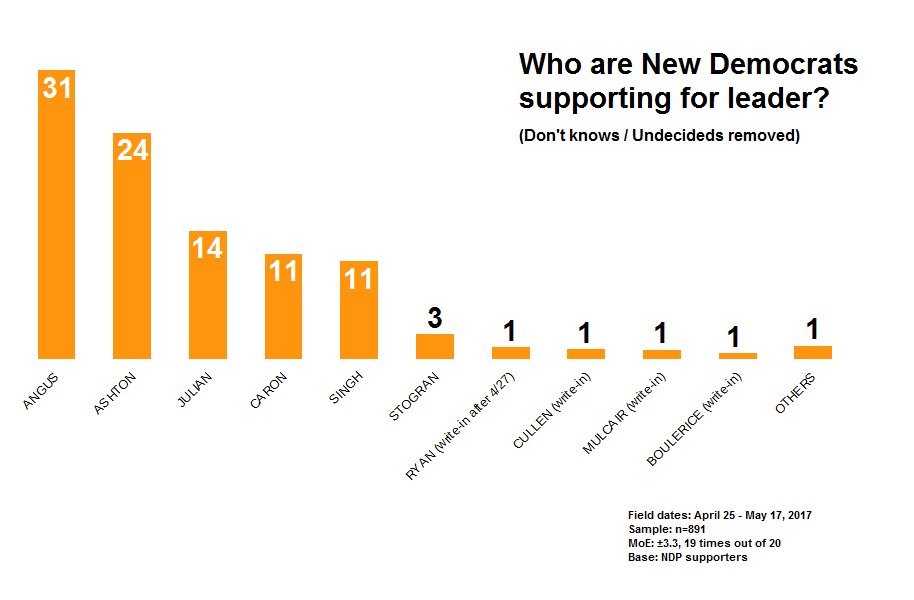
- Probit has released what appear to be the first significant poll results of the campaign. They likely miss the impact of Singh's arrival, but show a very strong start for Niki Ashton in comparison to both her fellow MPs and her results from the last campaign, as well as another indication that Peter Julian's strong organization isn't yet translating into the support he'll need:

- And this despite Ashton's early-campaign propensity for drawing loud criticism for what should be absolute non-issues in the leadership race - following the previous brouhaha over quoting a Beyonce lyrics with a new complaint about her appearing in the same photo as a sign.

- Finally, the NDP has slightly tweaked its debate schedule, including by adding one in Victoria in August.

Sunday, May 07, 2017

Leadership 2017 Links

The latest from the federal NDP's leadership campaign.

- Several of the candidates have been doing plenty of touring over the past week. And while not all the stops have included media coverage, you'll find features about Charlie Angus from Timmins, Sudbury (X2), North Bay, and Red Deer, along with Weyburn This Week's report on Niki Ashton's visit and the Hill Times' interview with Guy Caron.

- Meanwhile, Peter Julian has been very active in British Columbia's provincial campaign as it draws to a close.

- Joan Bryden's report on fund-raising at the federal level features a look at the early returns from the leadership campaign - including the surprising fact that Julian is in a fairly distant fourth place to date despite seemingly being ahead of the game in most other aspects of campaign organization:
New Democrat leadership contenders raised an additional $252,664. Of the four declared candidates so far, Charlie Angus led the pack with $110,765, followed by Niki Ashton with $65,521, Guy Caron with $57,235 and Peter Julian with $19,143.
- And Beatrice Britneff and Kyle Duggan follow up with a look at who's donated so far.

- Tom Parkin discusses the populist outsider element being brought to the campaign by Pat Stogran. And Marcel Nelson examines the relationship between populism and the NDP, while raising some questions about whether it represents the best choice for the party.

- Supriya Dwivedi offers some suggestions for Jagmeet Singh in building a national campaign that accounts for Quebec voters. And Parkin offers his take (along with advice from Brian Topp and Sally Housser) on how the next leader can earn support in Western Canada.

- Finally, Brittany Andrew-Amofah suggests that whatever the results of the leadership race, the NDP should be able to unite behind the theme of calling out the Libs' faux progressivism.

Saturday, April 29, 2017

Leadership 2017 Links

The latest from the federal NDP's leadership campaign.

- Sid Ryan's endorsement of Niki Ashton both answers one of the more persistent questions as to possible additional entries into the race, and offers some helpful institutional support for Ashton's campaign.

- Mick Sweetman interviews each of the MPs in the race about their plans in general, and for Toronto in particular. And Charlie Angus discusses the need for Canadians to benefit more from the resources extracted from our country.

- Karl Belanger asks whether Pat Stogran fits the bill for an outsider candidate in the race, while Gloria Galloway examines how Stogran might change the course of the campaign.

- Finally, Tom Parkin discusses how the leadership campaign fits into a wider pattern of NDP momentum across Canada. And Murray Dobbin examines the NDP's role in movement-building rather than mere partisan interactions, while lamenting the lack of a stronger set of social movements today:
In this context it is interesting to watch the NDP leadership race to test for signs that the candidates understand what they are up against in rebuilding the party. Two of them, Niki Ashton and Peter Julian, have spoken of the importance of social movements in creating a newly robust progressive party...

The difficulty with this recognition of social movements is that it comes too late. The sad reality is that there are almost no social movements in Canada...

Simone Weil wrote that "[t]o be rooted is perhaps the most important and least recognized need of the human soul." The lesson here for the NDP leadership candidates genuinely open to "social movements" is the need to shift their attention inwards: a renewed NDP must itself become a movement rooted in community (like its predecessor, the CCF), going beyond a list of policies and pledging to help build a society which offers people meaning in their lives.
[Edit: fixed wording.]

Saturday, April 22, 2017

Leadership 2017 Links

The latest from the NDP's federal leadership campaign.

- The Canadian Press reports on Pat Stogran's official campaign launch. And Alex Ballingall highlights Stogran's criticism of Justin Trudeau's empty-suit governance, while Jeremy Nuttall focuses on his message about challenging politics as usual.

- Charlie Smith interviews Peter Julian about his "just transition" energy policy and its appeal to MPs from Quebec and elsewhere. Niki Ashton writes about the importance of economic justice - both as a campaign theme, and a focus for activism. Ben Leeson talks to Guy Caron about his plan for the NDP to set a different path and deliver on the change promised (but not delivered) by the Trudeau Libs. And Liam Casey reports on Charlie Angus' continued work to ensure a safe home for the Kashechewan First Nation in the wake of another evacuation.

- Tom Parkin argues that there's a need for the leadership candidates to tell a stronger story as to how many Canadians are being left behind by economic structures designed to benefit the few.

- And finally, Ian Capstick talks to Libby Davies about her experience working with Jack Layton as the NDP's leader, as well as her hopes for the new candidates to match both his authenticity and his interest in working with others.

Saturday, April 15, 2017

Leadership 2017 Links

The latest from the NDP's federal leadership campaign. (As always, see the reference page for general information.)

- Mylene Crete reports on Alexandre Boulerice's endorsement of Peter Julian - which offers another important piece of evidence that the party's contingent of Quebec MPs and organizers sees Julian as a viable candidate to succeed in the province.

- Cory Collins talks to Niki Ashton about the need to build Canada's progressive social movement as one of the NDP's key priorities. And in the process, Ashton answers some of the foreign policy questions which Yves Engler still wants included in the party's debates.

- Meanwhile, Eleanor Davidson interviews Ibrahim Bruno El-Khoury about his outsider perspective on the state of Canadian democracy.

- Elliot Ferguson reports on Charlie Angus' rallying for pay equity (among other elements of fair employment). Guy Caron participated in OCAP's debate on a basic income - and his side seems to have moved opinions in its favour. Jagmeet Singh introduced legislation to better protect temp agency workers in Ontario. Ashton stopped into Alberta (including Red Deer) on her Economic Justice tour. And Julian has been encouraging supporters to work on helping British Columbia's NDP win the ongoing provincial election.

- Finally, Engler also wonders whether there should be more bold ideas being discussed in the NDP's campaign - though I'd hardly share his view that the Cons' example of being offensively extreme for its own sake is one worth following.

Saturday, April 01, 2017

Leadership 2017 Links

The latest on the NDP's leadership campaign.

- Karl Nerenberg sees the youth debate in Montreal as having shown more differences in style than substance, while Christo Aivalis identifies some more clear distinctions. And James Munson examines the candidates' positions on economic development, innovation and the social safety net.

- The Tyee interviews Charlie Angus about the long road he's taking toward the leadership. And Cory Collins interviews Peter Julian about his plans for the leadership campaign and beyond.

- Speaking of which, Julian announced his plans for a Just Transition to clean energy (going a long way toward clarifying the previous brouhaha over pipelines), while also earning Erin Weir's endorsement.

- Meanwhile, the PBO has caught the Libs fudging the numbers on Guy Caron's private member's bill on small businesses.

- Finally, L. Ian MacDonald contrasts the Cons' comically childish excuse for a leadership race against the NDP's adult conversation.

Sunday, March 26, 2017

Leadership 2017 Candidate Profile: Charlie Angus

If Peter Julian's leadership campaign has been surprising in its relatively push toward controversy, Charlie Angus may be defying expectations in the opposite direction - as the punk rocker has been the most serene figure in the race so far.

Strengths

Rather than spending much of the first two debates on a soapbox, Angus has thus far positioned himself as the comparatively happy warrior of the leadership campaign. His interjections so far have been measured, upbeat and personally compelling compared to those of his competitors - and members looking for an attitude and tone reminiscent of Jack Layton's leadership may find it in Angus.

Meanwhile, even while choosing not to deal much with policy specifics for the moment, Angus has proven comfortable dealing with whatever issues come up - at least as long as he's able to respond in English.

Weaknesses

One of the key questions for Angus at the start of the leadership campaign was his strength in speaking French. So far, he's been functional in reading prepared statements while struggling with quick responses - and it will be worth watching whether Angus can improve his communications over the course of the campaign.

The more lasting issue may be the flip side of Angus' choice to punt on policy for the moment. If his personal appeal falls short, there currently isn't much else for his campaign to fall back on in seeking to win over potential supporters. And each of Angus' main areas of advocacy (First Nations, ethics and poverty) is being targeted by at least one other candidate, leaving a risk that Angus might not be seen as the voice for a single key policy theme.

Key Indicator

Angus' personal appeal looks to be the crucial factor in the end. But in a campaign of violent agreement where few candidates will be under the microscope (and there may not be much distinction in approval/disapproval to monitor), I'll be watching early on for examples of institutional support which might provide him the resources to take advantage of positive perceptions later.

In particular, if Angus can assemble some support from within organized labour and/or Jack Layton's previous NDP team, that will take him a long way toward pushing for a Layton-style result - and he may be the one candidate with a chance to win a first-ballot majority.

Key Opponent

In order to get there, however, Angus would almost certainly need a strong majority outside of Quebec. And that's where the strength of Peter Julian's campaign may be critical: Julian is likely both the candidate in the best position to hold Angus short of an early-ballot victory, and the one who most stands to benefit if early-ballot Quebec support for other candidates ends up being divided up later on. 

Plausible Outcomes

Best-case: First-ballot victory based on personal appeal
Worst-case: Moderate first-ballot finish and little subsequent growth for want of a clear campaign theme

Leadership 2017 Candidate Profile: Peter Julian

I'll start my series of NDP leadership candidate profiles with the first to enter the leadership race - and the one who's likely done the most to shape the campaign so far.

I've noted before my surprise at the choices made so far by Peter Julian's campaign: a candidate who could have portrayed himself as the safest of consensus choices has instead generated a great deal of polarization. But Julian nonetheless looks to be an extremely strong contender.

Strengths

Again, the primary advantage held by Julian is his experience as an NDP activist and organizer, and it's showing so far in the campaign. He's been ahead of the field from day one in putting his infrastructure in place and winning caucus endorsements, and his diverse experience in Parliament and elsewhere makes him comfortable talking about nearly any issue.

Beyond that, there are advantages to being seen taking the strongest position in the campaign on the hot-button issue of pipelines. In addition to giving Julian a ready applause line, that choice also makes him a natural beneficiary of an already-energized group of activists both inside and outside the party. 

Weaknesses

At the start of the campaign, I'd have expected Julian's largest concern to be whether he could speak powerfully enough on the stump and in debates to win first-choice support from members with plenty of options.

Having chosen to sidestep that potential issue through sharp issue messaging, Julian instead faces the challenge of defending himself from fossil-fueled vitriol now that he's become a lightning rod for criticism of any strong environmental policy. If Julian can hold up under those circumstances, he could position himself ideally to take the same message forward as the NDP's leader - but he'll face a lot more direct attacks now than he might have otherwise.

Key Indicators

The key indicators for Julian will then be second-choice support and negative perceptions. I'd fully expect Julian to rank at the top of many ballots, but a first-ballot win is likely not within reach - meaning that he needs to leave himself some room to add votes as other candidates are eliminated.

Key Opponent

To the extent Julian's campaign may turn on pipelines, Charlie Angus is currently positioned as the most distinct voice for facilitating (if not outright supporting) pipeline development. And Angus' handling of the issue could well turn the race in either direction.

If Angus decides he too can win first-choice support by firming up his own position contrary to Julian, the result may be to push perceptions further against Julian than he can afford, particularly if the position is echoed enough from outside the party. But it's also possible that strategy could set up a ballot question where Julian would pick up exactly the later-ballot boost he needs from Guy Caron and Niki Ashton supporters.

Plausible Outcomes

Best-case: First-place showing on the first ballot based on environmental and institutional support, followed by a relatively quick win
Worst-case: Moderate placement on the first ballot followed by little subsequent growth

Leadership 2017 Links

A few notes worth a look in advance of today's youth-focused debate...

- Kyle Duggan reports on Pat Stogran's imminent entry into the race. And The View Up Here features an extended interview to introduce Stogran as a candidate, while CTV offers a shorter interview.

- Anishinabek News examines Charlie Angus' focus on First Nations issues. Robert McCarthy offers an endorsement of Niki Ashton. And Jean-Philippe Langlais takes note of Guy Caron's analysis that the Libs' underwhelming budget only highlights the need for a progressive economic vision, while Tereza Verenca reports on Peter Julian's disappointment in the delay on housing in particular. 

- Lawrence Martin theorizes that the NDP needs to stick to what he perceives to be Jack Layton's script. But in addition to his questionable reading of the 2015 campaign, he noticeably omits Layton's track record as a progressive activist from any explanation of what led to his success.

- And finally, Nora Loreto offers her take on the campaign, while Eric Grenier previews the debate.

Sunday, March 19, 2017

On pipelines to nowhere

I'll be taking a look at the individual candidates in the NDP's leadership race over the next little while. But before I start into that review, I'll pause to discuss the most bizarre development of the leadership campaign so far.

As I noted in reviewing the first debate, Peter Julian's choice to brand himself largely through his opposition to the Kinder Morgan and Energy East pipelines figured to turn what could otherwise have been a broadly acceptable campaign into a highly polarizing one. And a combination of nonsensical reactions to Julian's message and a lack of pushback on his part has taken the division to extremes which look highly dangerous for the NDP as a whole.

At the outset, here's Julian's position on pipelines in the context of resource development generally (emphasis added):
Mr. Julian said it is “very clear” to him that the NDP must oppose pipelines and work towards transitioning to clean energy.

Mr. Julian says the government should refine and upgrade raw bitumen from the oilsands in Canada, instead of exporting it. The risk of spilling the diluted bitumen the pipelines carry was not worth the reward, he said. 
...
Mr. Julian said building refineries and using the resulting product in Canada would create more jobs than pipeline construction ever would, and it would decrease Canada’s dependency on oil imports. It would also eliminate the need for pipelines, he said.
The same article notes that both Guy Caron and Niki Ashton are also opposed to Kinder Morgan and Energy East, and that the comparatively pro-pipeline position among the current candidates is found in Charlie Angus' slightly different emphasis as to the balance between the interests of pipeline operators and the people whose territory they use.

Somehow, that modest different in positions - coupled with Julian's emphasis on pipelines as an issue - has led to outbursts from NDP supporters which would fit far more comfortably within a Wildrose Party policy debate.

In one case, that's consisted of the classic capital-friendly position that any questioning of a business' wishes is predominantly an attack on the labour share of the resulting economic activity.

On that front, pipelines offer less wage bang for the buck of profit stashed away than nearly any other type of development Canada could pursue. And Noah Evanchuk's form of the theory is also false in attributing a hatred of refineries to Julian when he's the one candidate actually proposing to encourage more of them.

Even worse, the latest criticism of Julian from Doug O'Halloran has sunk to the level of echoing Ezra Levant's tired theme that some fabricated difference between "our oil" and "their oil" trumps the problems with locking ourselves into a future of burning carbon generally.

Unfortunately, Julian himself doesn't seem to have done much to set the record straight. And that might make sense for his campaign: to the extent he's trying to paint himself as the top choice for environmental voters (defined by opposition to pipelines), he may well have more to gain than to lose by allowing those attacks to stand unchallenged. 

But from the standpoint of talking responsibly about resource management, it could be disastrous for the NDP if its leadership debate serves to legitimize exactly the messages the party is trying to fight in the wider political scene. And hopefully the candidates who are trying to downplay the pipeline question will make that fact clear - and push both Julian and his critics toward the right balance.

Thursday, March 16, 2017

Thursday Morning Links

This and that for your Thursday reading.

- Erica Johnson reports that the problem of bank employees being pushed to fleece customers (legality be damned) is common to all of Canada's major banks. And Lisa Wright reports that the result will be a national investigation. But it's appalling that it took anonymous reports to the media for systemic abuses to be noticed and addressed - particularly when an obvious alternative to leaving personal finances in the hands of a privileged few has been summarily dismissed without explanation.

- James Tapper discusses how the privatization of the UK's power market resulted in soaring rates for the public, and massive profits for the lucky (and well-connected) corporations involved.

- Meanwhile, Martyn Brown offers a detailed set of ideas to clean up British Columbia's pay-to-play political scene. And Matt Robinson reports on Christy Clark's refusal to protect renters from being gouged by her wealthy donors.

- Jacob Swenson-Lengyel argues that progressives shouldn't limit our scope to building a response to right-wing fringe movements when the general public is broadly in agreement with our values. And the Broadbent Institute introduces its Change the Game project to chart a course for social democracy in Canada.

- Finally, Chantal Hebert compares the Cons' leadership race built on anger and chaos to the NDP's developing on a foundation of shared values and policy choices. Jordan Foisy also reviews the NDP's first debate. And Peter Julian's contribution to the Ottawa Citizen focuses on the need to make Canada work for everybody, not only for elites.

Monday, March 13, 2017

Leadership 2017: First Debate Review

One of the most important renewed challenges facing the federal NDP in the wake of its drop to third in Canada's party standings is that of earning positive public attention. And for the candidates and the party alike, yesterday's inaugural leadership debate served primarily as an important introduction.

Many viewers may have been relatively unfamiliar with the contenders. And they should have been able to develop a fairly strong idea where they're starting from in the leadership campaign.

Niki Ashton was obviously the most comfortable with the format (presumably helped by her having run in the 2012 race as well). And she presented an effective case for movement politics as a response to neoliberal economics, if leaving plenty of room for discussion as to what that will ultimately mean.

Guy Caron's campaign launch has focused on policy (particularly a basic income). But the first debate highlighted how that will fit into a wider campaign: he had a ready answer for many of the economic questions being raised, leaving him ample time to also level pointed criticism at the Trudeau Libs.

In contrast, Charlie Angus elected not to pursue the leader-of-the-opposition position which seemed a natural fit. Instead, he stayed soft-spoken, positive and folksy to good effect - raising the question of whether he may be able to run as the most likeable spokesperson for the values shared by all of the candidates.

And most interestingly, Peter Julian looks to have started the campaign by emphasizing what may be some relatively polarizing issues around pipelines. On paper, Julian looked to have the best chance of winning as everybody's second choice - but his specific criticism of Kinder Morgan and Energy East seems likely to both improve his first-choice support from environmental voters, and limit his voter pool in the case of multiple ballots.

Naturally, we can expect future debates to involve a bit more direct clash between the candidates once their opening themes have had a chance to sink in. And there's certainly ample room for another candidate or two to join the fray.

But for now, members and other viewers were able to see four candidates who check all the boxes for an effective potential leader, while being able to decide among some contrasts in policy and style.

For more, see what Marie-Danielle Smith, John Geddes and Aaron Wherry had to say.

Thursday, March 02, 2017

New column day

Here, on the first few steps of the federal NDP's leadership race.

For further reading...
- CBC News reported on Peter Julian's campaign launch, while Alex Ballingall covered Charlie Angus' and Aaron Wherry wrote about Guy Caron's. And Mia Rabson reports that Niki Ashton will officially announce her candidacy next week.
- So far Peter Julian looks to be the only candidate with an active leadership website, which is worth a visit particularly for its forum for policy discussion.
- John Paul Tasker also took a general look at the campaign. Chantal Hebert discussed the importance of a focus on policy, while Ed Broadbent offered some advice for the candidates.
- And finally, Susan Delacourt expands on the role Caron's basic income proposal may play in the wider political scene.

Sunday, February 26, 2017

NDP Leadership 2017 Opening Comments

The consensus list of prospective candidates in this year's federal NDP leadership race seems to be set, with Peter Julian and Charlie Angus having already declared their intention to run, and Guy Caron, Niki Ashton and Jagmeet Singh looking likely to do so as well. And with the leadership campaign now starting in earnest, I'll be starting to comment regularly on how it develops.

For now, though, I'll offer a few thoughts on what's most noticeably absent from the slate of candidates so far. 

As part of my analysis of the 2012 campaign, I started off by discussing the issues and voter pools the NDP figured to need to target. And as I'll discuss in future posts, the five apparent candidates largely cover the field on both fronts (though there may be room for more duplication than we're seeing so far).

But there are a couple of areas where there may be room for additional candidates to fill in gaps in the campaign as it's shaping up.

Geographically, the most noteworthy omission in the existing pool (assuming all of the above candidates join the race) is the lack of a contestant with strong links to Atlantic Canada. While Caron has handled critic responsibilities for the region since the 2015 election, it's uncertain how much of a regional profile and base of support he'd be able to carry into the leadership campaign.

The absence of an obvious magnet for Atlantic support was somewhat of a factor in 2012 as well, particularly after Robert Chisholm withdrew from the race. But with governing Liberals letting their masks slide both at the provincial and federal levels across the Atlantic provinces, we'd ideally see somebody step forward to build regional strength both during the leadership campaign and beyond.

The other obvious omission from the current slate of candidates is a substantial amount of experience in government.

The NDP's two previous leaders had substantial governing experience. And they in turn offered examples as to how that background can be a mixed blessing: Jack Layton made effective use of his profile and experience from Toronto's City Council (particularly in negotiating with other parties within minority Parliaments), while Thomas Mulcair demonstrated his mastery of the legislative chamber but was hurt by parts of his governing record during the 2015 campaign.

Now, the above shouldn't be taken as the start of a Draft Sterling Belliveau campaign: there are plenty of opportunities for the NDP to build in advance of the next federal election, both through public outreach and candidate recruitment. But it does offer some indication as to where there's room for additional candidates to step forward.