A few notes worth a look in advance of today's youth-focused debate...
- Kyle Duggan reports on Pat Stogran's imminent entry into the race. And The View Up Here features an extended interview to introduce Stogran as a candidate, while CTV offers a shorter interview.
- Anishinabek News examines Charlie Angus' focus on First Nations issues. Robert McCarthy offers an endorsement of Niki Ashton. And Jean-Philippe Langlais takes note of Guy Caron's analysis that the Libs' underwhelming budget only highlights the need for a progressive economic vision, while Tereza Verenca reports on Peter Julian's disappointment in the delay on housing in particular.
- Lawrence Martin theorizes that the NDP needs to stick to what he perceives to be Jack Layton's script. But in addition to his questionable reading of the 2015 campaign, he noticeably omits Layton's track record as a progressive activist from any explanation of what led to his success.
- And finally, Nora Loreto offers her take on the campaign, while Eric Grenier previews the debate.
Showing posts with label lawrence martin. Show all posts
Showing posts with label lawrence martin. Show all posts
Sunday, March 26, 2017

Tuesday, August 02, 2016
Tuesday Morning Links
This and that for your Tuesday reading.
- Yanis Varoufakis makes the case for an international progressive political system to ensure that social progress doesn't stop at national borders:
- Ross Finnie, Kaveh Afshar, Eda Bozkurt, Masashi Miyairi and Dejan Pavlic examine (PDF) the earnings of Canadian post-secondary education graduates, and find a gender gap in every single field studied. And Sarah Kliff discusses how the gap can be traced in substantial part to the existence of inflexible or uncertain hours of work.
- Lawrence Martin comments on the Libs' broken promise to do anything at all to ameliorate the attack on civil rights found in Bill C-51, while noting that the inaction may arise out of pure political cowardice. And the Toronto Star's editorial board makes a strong case for immediate action to rein in the excesses of the surveillance and disruption state.
- Finally, Tom Parkin points out that the Greens' cynical spreading of misleading poll information represents just one more example of the warped incentives created by a first-past-the-post electoral system.
- Yanis Varoufakis makes the case for an international progressive political system to ensure that social progress doesn't stop at national borders:
(T)raditional political parties are fading into irrelevance, supplanted by the emergence of two new political blocs.- Katie Allen reports on a new study estimating the cost of public services arising out of poverty in the UK at $78 billion every year.
One bloc represents the old troika of liberalization, globalization, and financialization. It may still be in power, but its stock is falling fast, as David Cameron, Europe’s social democrats, Hillary Clinton, the European Commission, and even Greece’s post-capitulation Syriza government can attest.Trump, Le Pen, Britain’s right-wing Brexiteers, Poland’s and Hungary’s illiberal governments, and Russian President Vladimir Putin are forming the second bloc. Theirs is a nationalist international – a classic creature of a deflationary period – united by contempt for liberal democracy and the ability to mobilize those who would crush it.The clash between these two blocs is both real and misleading. Clinton vs. Trump constitutes a genuine battle, for example, as does the European Union vs. the Brexiteers; but the two combatants are accomplices, not foes, in perpetuating an endless loop of mutual reinforcement, with each side defined by – and mobilizing its supporters on the basis of – what it opposes.The only way out of this political trap is progressive internationalism, based on solidarity among large majorities around the world who are prepared to rekindle democratic politics on a planetary scale. If this sounds Utopian, it is worth emphasizing that the raw materials are already available.Bernie Sanders’s “political revolution” in the US, Jeremy Corbyn’s leadership of the UK’s Labour Party, DiEM25 (the Democracy in Europe Movement) on the continent: these are the harbingers of an international progressive movement that can define the intellectual terrain upon which democratic politics must build.
- Ross Finnie, Kaveh Afshar, Eda Bozkurt, Masashi Miyairi and Dejan Pavlic examine (PDF) the earnings of Canadian post-secondary education graduates, and find a gender gap in every single field studied. And Sarah Kliff discusses how the gap can be traced in substantial part to the existence of inflexible or uncertain hours of work.
- Lawrence Martin comments on the Libs' broken promise to do anything at all to ameliorate the attack on civil rights found in Bill C-51, while noting that the inaction may arise out of pure political cowardice. And the Toronto Star's editorial board makes a strong case for immediate action to rein in the excesses of the surveillance and disruption state.
- Finally, Tom Parkin points out that the Greens' cynical spreading of misleading poll information represents just one more example of the warped incentives created by a first-past-the-post electoral system.
Wednesday, December 02, 2015
On balancing acts
For those wondering, I'm indeed following up on these posts and working my way through some of the factors in the NDP's federal election result. (For more on the subject, see the latest from Lawrence Martin, and Desmond Cole talking to Cheri DiNovo.)
I'll turn now to what's often been labeled the most important turning point of the campaign - that being the NDP's promise to balance the federal budget, in contrast to the Libs' commitment to run deficits. But the problem looks to me to have been less that the NDP took an unreasonable position, than that it didn't do enough otherwise to win what's come to be labeled the "progressive primary".
While I don't see DiNovo's comments in particular as accurately presenting the NDP's message (no, "austerity" was never on the table), they do reflect how the Libs managed to spin the NDP's position. And that's largely because the NDP's messaging early in the campaign was aimed at maintaining the party's consideration set with warm-and-fuzzy messages about Tom Mulcair and challenges to the Cons, sometimes at the expense of appealing to a progressive base which was apparently waiting to decide on its direction.
To be fair, the NDP may have expected its past messaging and policy work to have accomplished that task already. After all, both other major parties took the opposite side of issues including C-51, child care, and the minimum wage among others, while the Libs had seemed to run right more than left until the campaign began.
What's more, the NDP did plenty to earn the support of people who were paying attention to positions on specific issues. And while its platform didn't receive the attention it deserved (due in no small part to the party's choice to release it late and with little fanfare), it included plenty worth promoting.
Ultimately, I don't see the Libs as actually having earned the title of "more progressive" among any but a narrow subset of voters. But they did manage to confuse matters enough to ensure that values-based positioning wasn't a significant advantage for the NDP, particularly in terms of motivating its base supporters along with unaligned progressives. And that helped the Libs immensely when it came time for voters to settle on a choice based on affinity and electability.
To the extent the problem was one of muddied waters rather than clear distinctions, I have my doubts that following the Libs and announcing a willingness to run deficits would have radically changed the campaign, particularly if it seemed to be the result of calculation rather than commitment.
Instead, the problem seems to have been a single-minded focus on keeping remote connections to soft voters at the expense of motivating progressives - particularly when the primary goal should arguably have been a focus on the latter in order to facilitate the former closer to election day. And in my next post, I'll tie that choice to what looks like the core lesson to be taken from the NDP's successes and failures alike over the past few years.
I'll turn now to what's often been labeled the most important turning point of the campaign - that being the NDP's promise to balance the federal budget, in contrast to the Libs' commitment to run deficits. But the problem looks to me to have been less that the NDP took an unreasonable position, than that it didn't do enough otherwise to win what's come to be labeled the "progressive primary".
While I don't see DiNovo's comments in particular as accurately presenting the NDP's message (no, "austerity" was never on the table), they do reflect how the Libs managed to spin the NDP's position. And that's largely because the NDP's messaging early in the campaign was aimed at maintaining the party's consideration set with warm-and-fuzzy messages about Tom Mulcair and challenges to the Cons, sometimes at the expense of appealing to a progressive base which was apparently waiting to decide on its direction.
To be fair, the NDP may have expected its past messaging and policy work to have accomplished that task already. After all, both other major parties took the opposite side of issues including C-51, child care, and the minimum wage among others, while the Libs had seemed to run right more than left until the campaign began.
What's more, the NDP did plenty to earn the support of people who were paying attention to positions on specific issues. And while its platform didn't receive the attention it deserved (due in no small part to the party's choice to release it late and with little fanfare), it included plenty worth promoting.
Ultimately, I don't see the Libs as actually having earned the title of "more progressive" among any but a narrow subset of voters. But they did manage to confuse matters enough to ensure that values-based positioning wasn't a significant advantage for the NDP, particularly in terms of motivating its base supporters along with unaligned progressives. And that helped the Libs immensely when it came time for voters to settle on a choice based on affinity and electability.
To the extent the problem was one of muddied waters rather than clear distinctions, I have my doubts that following the Libs and announcing a willingness to run deficits would have radically changed the campaign, particularly if it seemed to be the result of calculation rather than commitment.
Instead, the problem seems to have been a single-minded focus on keeping remote connections to soft voters at the expense of motivating progressives - particularly when the primary goal should arguably have been a focus on the latter in order to facilitate the former closer to election day. And in my next post, I'll tie that choice to what looks like the core lesson to be taken from the NDP's successes and failures alike over the past few years.
Tuesday, September 22, 2015
Tuesday Morning Links
This and that for your Tuesday reading.
- Oxfam points out that without a major redistributive effort, hundreds of millions of people will be trapped in extreme poverty around the globe no matter how much top-end growth is generated.And Michael Valpy writes that the Cons have gone out of their way to stifle any talk of shared responsibilities and communitarian goals.
- Meanwhile, Art Eggleton discusses the urgent need for more affordable housing in Canada. And Robyn Allan writes that Canadians are getting gouged while buying gas - with an assist from the Cons who ensured that we don't have access to accurate information about who's profiting from what we pay at the pumps.
- Harvey Cashore and Frederic Zalac report on the links between the Con government and KPMG as the latter was having any assessment of its offshoring tax avoidance schemes stalled in front of the courts.
- Lawrence Martin highlights what we lose when our government considers information suppression to be one of its core values.
- Finally, PressProgress exposes Ron Liepert's belief that civil rights aren't part of the Canada we live in. And Craig Forcese and Kent Roach comment on the effect of the Cons' terror legislation:
- Oxfam points out that without a major redistributive effort, hundreds of millions of people will be trapped in extreme poverty around the globe no matter how much top-end growth is generated.And Michael Valpy writes that the Cons have gone out of their way to stifle any talk of shared responsibilities and communitarian goals.
- Meanwhile, Art Eggleton discusses the urgent need for more affordable housing in Canada. And Robyn Allan writes that Canadians are getting gouged while buying gas - with an assist from the Cons who ensured that we don't have access to accurate information about who's profiting from what we pay at the pumps.
- Harvey Cashore and Frederic Zalac report on the links between the Con government and KPMG as the latter was having any assessment of its offshoring tax avoidance schemes stalled in front of the courts.
- Lawrence Martin highlights what we lose when our government considers information suppression to be one of its core values.
- Finally, PressProgress exposes Ron Liepert's belief that civil rights aren't part of the Canada we live in. And Craig Forcese and Kent Roach comment on the effect of the Cons' terror legislation:
When enacting its 2015 security laws, the government consistently rejected the outside policy advice it received. It radically ramped up information-sharing about even marginal security threats. But it disregarded advice—from both the Privacy Commissioner and the judicial inquiry into Maher Arar’s mistreatment—to the effect that Canada’s system of independent review was partial, stuck in silos, and manifestly inadequate. The government also disregarded the advice it received from four former prime ministers and a score of other former officials urging that increased review and oversight of national security activities were necessary, and that they would improve rather than detract from security.
The architects of the new 2015 legislation also ignored the Air India Commission’s 2010 recommendations that CSIS be obliged to share intelligence about possible terrorism offences, and that its human sources not be able to veto appearing as witnesses in prosecutions (a recommendation that was echoed in a unanimous 2011 report of a Senate committee chaired by Senator Hugh Segal). In the final analysis, the 2015 “reforms” were long on rhetoric about a war against “violent jihadis” and attempts to secure partisan advantage, but woefully short on evidence and deliberation.
...
Bill C-51 in particular was drafted in a novel and provocative manner that departed from long-standing definitions of “threats to the security of Canada” or the more Charter-compliant pattern of past, similar laws—such as hate-speech laws, immigration security-certificate provisions, and the 2001 Anti-terrorism Act.
The complexity arises from the fact that most of these new provisions are not free-standing: they amend existing laws that have their own history and purposes. The most extensive amendments were made to the CSIS Act, originally enacted in response to concerns about RCMP illegalities in the wake of the October Crisis in 1970. The 1984 CSIS Act created CSIS as a civilian and largely domestic intelligence agency that would obey the law and whose mandate was limited to intelligence collection. The new laws radically change that.
Wednesday, August 05, 2015
Wednesday Morning Links
Miscellaneous material for your mid-week reading.
- Michael Hiltzik discusses how corporate apologists are trying (but failing) to minimize the existence and importance of income inequality. Lawrence Martin notes that the rest of Canada's economic indicators are similarly signalling that Conservative dogma is of absolutely no use in the real world. And Michael Geist observes that among the new "caretaker" rules is a provision allowing the Cons to keep trying to inflict the TPP as their parting shot at Canada even if their election plans are going nowhere.
- Michael Harris points out just a few of the whoppers which Stephen Harper will have to try to sell over the course of the federal election campaign. And it's well worth noting that Harper will need to do so while being trusted by virtually nobody outside his party's core supporters.
- In contrast, Antonia Zerbisias comments that Thomas Mulcair's has seemed impervious to attacks so far. (Though there's no doubt that he'll be tested more during the campaign than he has been yet.)
- Judy Shum comments on the progress made by the Housing First program in providing a secure base for previously-homeless Saskatoon residents.
- Finally, Hugh MacKenzie counters the Fraser Institute's latest attempt to pitch retirement only for the few. Noralou Roos and Evelyn Forget make the case for a guaranteed annual income to make sure everybody enjoys enough security to make choices. And CBC reports that university students in Newfoundland and Labrador are set to start receiving grants rather than being buried under a lifetime of student loan debt.
- Michael Hiltzik discusses how corporate apologists are trying (but failing) to minimize the existence and importance of income inequality. Lawrence Martin notes that the rest of Canada's economic indicators are similarly signalling that Conservative dogma is of absolutely no use in the real world. And Michael Geist observes that among the new "caretaker" rules is a provision allowing the Cons to keep trying to inflict the TPP as their parting shot at Canada even if their election plans are going nowhere.
- Michael Harris points out just a few of the whoppers which Stephen Harper will have to try to sell over the course of the federal election campaign. And it's well worth noting that Harper will need to do so while being trusted by virtually nobody outside his party's core supporters.
- In contrast, Antonia Zerbisias comments that Thomas Mulcair's has seemed impervious to attacks so far. (Though there's no doubt that he'll be tested more during the campaign than he has been yet.)
- Judy Shum comments on the progress made by the Housing First program in providing a secure base for previously-homeless Saskatoon residents.
- Finally, Hugh MacKenzie counters the Fraser Institute's latest attempt to pitch retirement only for the few. Noralou Roos and Evelyn Forget make the case for a guaranteed annual income to make sure everybody enjoys enough security to make choices. And CBC reports that university students in Newfoundland and Labrador are set to start receiving grants rather than being buried under a lifetime of student loan debt.
Friday, May 29, 2015
Friday Morning Links
Assorted content to end your week.
- Dylan Matthews reports on Joseph Stiglitz' work in studying what kinds of systemic changes (in addition to more redistribution of wealth) are needed to ensure a fair and prosperous economy. And Martin O'Neill discusses James Meade's prescient take on the importance of social assets:
- Rowan Lee points out that Bill Gates for one doesn't buy the argument that low taxes have anything to do with economic growth.
- Murray Dobbin examines the place of free trade deals in converting our commonwealth into private profits, with no room for democratic responses. And Sunny Freeman notes that Joe Oliver is trying to push countries to make it even easier for employers to shed any obligation to workers. But David Dayen offers an interesting (if only partial) fix, suggesting that trade agreements should be paired with the ability for workers to sue multinational corporations along with their international affiliates and contracting partners for abuses.
- Finally, Duncan Cameron argues that the NDP is now the obvious choice for Canadian progressive voters from both a strategic and a principled standpoint. And Lawrence Martin echoes the theme that the election may come down to the question of which opposition leader serves as the rallying point for change - with Tom Mulcair ranking as the better option.
- Dylan Matthews reports on Joseph Stiglitz' work in studying what kinds of systemic changes (in addition to more redistribution of wealth) are needed to ensure a fair and prosperous economy. And Martin O'Neill discusses James Meade's prescient take on the importance of social assets:
Meade therefore came to endorse the extension of the traditional welfare state through the parallel pursuit of both the spread of private property-ownership across all members of society – his ‘property-owning democracy’, which would involve steep taxation of inheritance and capital transfers – and at the same time building up the state’s store of democratic, public capital. If the future were to bring a shift in the sources of prosperity from labour to capital, then we would need to construct an economy in which everyone could benefit from that shift, both as individuals and collectively as democratic citizens.- And Zack Beauchamp charts Branko Milanovic's findings on the massive unfairness and inequality for workers between countries.
While Meade’s diagnosis of the central distributive problems of capitalism largely predicted Piketty’s, his proposals were in some ways rather more radical. Rather than the state having continually to keep running faster and faster to suppress growing inequality through more ambitious forms of redistributive taxation, Meade instead wanted to reform the rules of property-ownership so that trends in capitalism’s development could be made to work for all. Instead of accelerating redistribution, Meade’s proposal involved a radical form of predistribution – a reallocation of property-rights that would completely restructure each individual’s position and bargaining power within the market economy, through giving everyone both a capital stake and a non-labour source of income.
- Rowan Lee points out that Bill Gates for one doesn't buy the argument that low taxes have anything to do with economic growth.
- Murray Dobbin examines the place of free trade deals in converting our commonwealth into private profits, with no room for democratic responses. And Sunny Freeman notes that Joe Oliver is trying to push countries to make it even easier for employers to shed any obligation to workers. But David Dayen offers an interesting (if only partial) fix, suggesting that trade agreements should be paired with the ability for workers to sue multinational corporations along with their international affiliates and contracting partners for abuses.
- Finally, Duncan Cameron argues that the NDP is now the obvious choice for Canadian progressive voters from both a strategic and a principled standpoint. And Lawrence Martin echoes the theme that the election may come down to the question of which opposition leader serves as the rallying point for change - with Tom Mulcair ranking as the better option.
Wednesday, May 13, 2015
Wednesday Morning Links
Miscellaneous material for your mid-week reading.
- Andrew Nikiforuk offers his suggestions as to how Rachel Notley can improve Alberta's economy and political scene in her first term in office. And thwap comments on the right's more hysterical responses to Notley's victory.
- Meanwhile, Duncan Cameron writes that Albertans have joined the rest of Canada in rejecting a regressive tax system. And Louis-Philippe Rochon reminds us that there's still plenty more which needs to be done on that front at the federal level.
- Justin Ling discusses how C-51 fits into a wider pattern of intrusive surveillance plans - even as the U.S. reins in its own surveillance apparatus. And the Canadian Labour Congress laments the shredding of civil rights in the name of a secretive security state.
- Finally, the Star exposes the Cons' systematic purging of any watchdog who dares to live up to the title. Bruce Cheadle reports that the Cons' latest omnibus bill includes a retroactive prohibition against prosecution for what appear to have been gross violations of federal access to information legislation. And Lawrence Martin writes that the Cons can't survive an election campaign where integrity is a meaningful issue:
- Andrew Nikiforuk offers his suggestions as to how Rachel Notley can improve Alberta's economy and political scene in her first term in office. And thwap comments on the right's more hysterical responses to Notley's victory.
- Meanwhile, Duncan Cameron writes that Albertans have joined the rest of Canada in rejecting a regressive tax system. And Louis-Philippe Rochon reminds us that there's still plenty more which needs to be done on that front at the federal level.
- Justin Ling discusses how C-51 fits into a wider pattern of intrusive surveillance plans - even as the U.S. reins in its own surveillance apparatus. And the Canadian Labour Congress laments the shredding of civil rights in the name of a secretive security state.
- Finally, the Star exposes the Cons' systematic purging of any watchdog who dares to live up to the title. Bruce Cheadle reports that the Cons' latest omnibus bill includes a retroactive prohibition against prosecution for what appear to have been gross violations of federal access to information legislation. And Lawrence Martin writes that the Cons can't survive an election campaign where integrity is a meaningful issue:
There was evidence beforehand that the PMO had interfered with a Deloitte audit on the expenses of Mike Duffy and other senators. But new court documents obtained by The Globe and Mail make the case stronger. In one, Corporal Benoit Jolette says the force’s investigation learned that the audit report “had made its way to the PMO, to their office and, I guess, revisions, what they wanted to have written in the report, was done.” In addition, e-mails from PMO officials speak of plans “to protect Senator Duffy.” Nigel Wright, then Stephen Harper’s chief of staff, writes of an intent to “put him in a different bucket.”
In terms of breach of the public trust, falsifying audits ranks high. The Harper Tories have been caught at it before. There was a case involving former cabinet minister Bev Oda altering a document for CIDA funding. In another they went so far as to distort a report by former auditor-general Sheila Fraser. They used her words to make it look like she was crediting their party with prudent financial management when in fact she was crediting the Liberals.How much do they think they can get away with? Being caught once usually makes you think twice about being a repeat offender. Not these guys.Last week’s revelations produced columns with headlines such as “The Duffy trial’s smoking gun just blew up in Harper’s face.” A telltale sign of the Tory troubles on the file is that they offered no rebuttal to pointed questioning in the Commons. Instead, they had backbencher Paul Calandra stand and issue a sheaf of non-answers. This was the same Mr. Calandra who some time ago gave a tear-drenched apology for making a mockery of Question Period with such answers. Rather than show any remorse, he was now doing it again....
The Duffy disclosures (there will be more to come) will likely turn out to be the most damaging. NDP Leader Thomas Mulcair alleged in the House of Commons they constitute obstruction of justice. No such charges have been laid against PMO officials, but if they do not suffer legal consequences, there may well be political ones.Yet again we have the integrity of this government being called into question. For the Conservatives, there is now a real risk of it becoming the ballot question. If it does, they can kiss their chances of re-election goodbye.
Friday, April 10, 2015
On trial and error
It may be true - as argued by Lawrence Martin - that Mike Duffy's expense fraud trial will serve as the most prominent point of discussion about the Harper Cons' stay in power. But we should be careful not to rely on it too much as a counterweight to the Cons' self-promotion - nor to allow broader concerns about the Cons to be drowned out by the minutiae of Duffy's actions.
The need for caution arises out of the nature of the trial. It shouldn't have come as any surprise that the main points to be aired and decided involve relatively narrow issues as to Duffy's own state of mind - and while the trial will certainly shed some light on Harper and his PMO in addressing those points, it will take some substantial work to link the trial to the myriad of other outrages mentioned by Martin (though his abuse-of-power theme does seem like a useful one to take up).
More importantly, though, the fate of the trial is far beyond their control.
By all means, opposition parties and progressive Canadians need to be prepared to respond to developments - and it's possible that some might make Harper utterly toxic to voters.
But the timing and content of the trial is subject to change at any time based on how Duffy, the Crown prosecutor and the court see the trial proceeding: for example, Duffy himself could avoid taking the stand if his counsel thinks his best chance is to rely on weaknesses in the prosecution's case as to the clarity of the Senate's expense rules, or the Crown could agree to a plea bargain before the defence starts presenting its promised expose of the Harper regime. So anybody planning to build an election strategy around the expectation that the trial will result in blame sticking to Harper personally may wind up disappointed.
Again, it's worth pointing out how Duffy's sense of entitlement is just one example of the Cons' overall disdain for the law and for the interests of Canadians at large. But there's a significant danger in counting on the Duffy trial to bring to light all the issues that ought to count against Harper - and we should be working on ensuring the latter receive ample attention even if the former doesn't live up to its advance billing.
The need for caution arises out of the nature of the trial. It shouldn't have come as any surprise that the main points to be aired and decided involve relatively narrow issues as to Duffy's own state of mind - and while the trial will certainly shed some light on Harper and his PMO in addressing those points, it will take some substantial work to link the trial to the myriad of other outrages mentioned by Martin (though his abuse-of-power theme does seem like a useful one to take up).
More importantly, though, the fate of the trial is far beyond their control.
By all means, opposition parties and progressive Canadians need to be prepared to respond to developments - and it's possible that some might make Harper utterly toxic to voters.
But the timing and content of the trial is subject to change at any time based on how Duffy, the Crown prosecutor and the court see the trial proceeding: for example, Duffy himself could avoid taking the stand if his counsel thinks his best chance is to rely on weaknesses in the prosecution's case as to the clarity of the Senate's expense rules, or the Crown could agree to a plea bargain before the defence starts presenting its promised expose of the Harper regime. So anybody planning to build an election strategy around the expectation that the trial will result in blame sticking to Harper personally may wind up disappointed.
Again, it's worth pointing out how Duffy's sense of entitlement is just one example of the Cons' overall disdain for the law and for the interests of Canadians at large. But there's a significant danger in counting on the Duffy trial to bring to light all the issues that ought to count against Harper - and we should be working on ensuring the latter receive ample attention even if the former doesn't live up to its advance billing.
Wednesday, March 18, 2015
Wednesday Morning Links
Miscellaneous material for your mid-week reading.
- CBC reports on the latest research showing that Canada would save billions every year with a national pharmacare plan. And Thomas Walkom argues that politics are standing in the way of what should be a no-brainer from a policy standpoint.
- Richard Gwyn writes that most Canadians seem to be willing to put up with nearly anything in order to keep a relatively secure job - even as it's far from sure that many workers can count on that being available.
- Lawrence Martin discusses the Cons' strategy of provocation, pandering and prejudice as a substitute for running on a defensible record - though he does win a place on the list of pundits who continue to hold out for some shame from a government which has never shown a trace of it. Dan Leger writes that the latest outbreak of bigotry reflects the Cons' own extremism. And Don Lenihan asks whether truth and values still matter as long as the Cons are on the political scene, while noting that the best antidote to cynical politics is a healthy dose of reflection:
- Finally, Taylor Bendig points out the Wall government's massive - and growing - expenditures on private highway consultants.
- CBC reports on the latest research showing that Canada would save billions every year with a national pharmacare plan. And Thomas Walkom argues that politics are standing in the way of what should be a no-brainer from a policy standpoint.
- Richard Gwyn writes that most Canadians seem to be willing to put up with nearly anything in order to keep a relatively secure job - even as it's far from sure that many workers can count on that being available.
- Lawrence Martin discusses the Cons' strategy of provocation, pandering and prejudice as a substitute for running on a defensible record - though he does win a place on the list of pundits who continue to hold out for some shame from a government which has never shown a trace of it. Dan Leger writes that the latest outbreak of bigotry reflects the Cons' own extremism. And Don Lenihan asks whether truth and values still matter as long as the Cons are on the political scene, while noting that the best antidote to cynical politics is a healthy dose of reflection:
Rove’s fingerprints are all over the Harper PMO, from micro-targeting to the use of wedge issues to play one group off another. The gun registry, the crime agenda and the energy pipelines are all examples.- Michael Harris reminds us that Mike Duffy's trial figures to offer a valuable look into the manipulations of the Harper PMO just in time for the federal election. And Andrew Mitrovica worries that the same command-and-control political dynamic which has us waiting for a trial to spill the truth about the Cons has left CSIS shrouded in secrecy.
We can also include talking points, omnibus legislation, time allocation, committee interference, and media control in this bag of tricks. All are quintessential Rovian tactics.
And the abandonment of truth? Here too the Harper government has followed suit, showing a sometimes ruthless willingness to deny, discredit and even suppress evidence that conflicts with its positions. It has done so on crime and climate change, for example, and is now doing so on the new security law, C-51.
But last week may have been a turning point of some kind. The Harper government seemed to be taking this Rovian story-telling to a new level.
...
But when the three opposition leaders rose to challenge both him and Canadians to take a step back from our emotions and reflect on the nature of our political rights, a very un-Rovian thing happened.
Many commentators began arguing that Muslim women’s right to wear the niqab was more important than their feelings of suspicion and doubt.
In Rovian politics, this is not supposed to happen. The public isn’t supposed to be reflective and rational, especially when they’re scared.
Of course, these responses came mainly from members of the political class. I don’t know what would have happened if the debate had carried on. Would ordinary people also have risen to the occasion? I couldn’t help wondering what Rove would say.
The clear lesson from last week is that we have two very different views of politics in our country and they appear to be getting ready to square off.
- Finally, Taylor Bendig points out the Wall government's massive - and growing - expenditures on private highway consultants.
Wednesday, January 21, 2015
Wednesday Morning Links
Miscellaneous material for your mid-week reading.
- Frances Russell writes that NAFTA and subsequent trade agreements are designed to make it difficult for democratic governments to exercise any meaningful authority. And Rowena Mason discusses how the EU-US TTIP is particularly directed toward throwing the public to corporate wolves, while Glyn Moody notes that there are plenty more similar agreements in the works even if the TTIP fails.
- George Monbiot discusses Amanda Lang's interventions on behalf of her business connections as a prime example of how far too much of our media is trying to serve the wealthy rather than questioning power at all.
- Jonathan Sas reminds us why an entrepreneurial government is in everybody's best interest:
- Finally, Lawrence Martin writes that Thomas Mulcair is absolutely right to challenge Stephen Harper's attempt to sell fear and hate as his election platform
- Frances Russell writes that NAFTA and subsequent trade agreements are designed to make it difficult for democratic governments to exercise any meaningful authority. And Rowena Mason discusses how the EU-US TTIP is particularly directed toward throwing the public to corporate wolves, while Glyn Moody notes that there are plenty more similar agreements in the works even if the TTIP fails.
- George Monbiot discusses Amanda Lang's interventions on behalf of her business connections as a prime example of how far too much of our media is trying to serve the wealthy rather than questioning power at all.
- Jonathan Sas reminds us why an entrepreneurial government is in everybody's best interest:
A growing body of evidence, and the analyses of scholars like Mazzucato, is starting to open our eyes to the true value of government participation in innovation strategies.- And Hugh Grant, Manish Pandey and James Townsend study the consequences of privatizing public services like hospital laundry, and find that it results in the public incurring widespread costs and losses for no real benefit.
Mazzucato raises concerns that the roles of public and private sectors in countries like Canada are becoming increasingly out of balance, with the “parasitic” private sector capturing most of the benefits of public sector investments, but not adequately reinvesting to fund new waves of innovation. She characterizes a system where the risks are socialized and the rewards privatized.
...
How will governments rise to the challenges of a highly competitive global marketplace and growing income and wealth inequality? What can be done to continue changing perceptions about who should take and benefit from risks? How do we begin to articulate a clear, common agenda for smart, equitable, and innovation-led economic growth?
...
Only a different conversation about government’s role in innovation will create a new narrative — one in which Canada is reaching its full potential as a leading investor in the wealth and wellbeing of all its citizens.
- Finally, Lawrence Martin writes that Thomas Mulcair is absolutely right to challenge Stephen Harper's attempt to sell fear and hate as his election platform
Thursday, November 13, 2014
Thursday Morning Links
This and that for your Thursday reading.
- Paul Krugman discusses the U.S.' multi-decade pattern of income stagnation. David MacDonald and Kayle Hatt study the price we've paid to suit the Cons' political purposes, while Kristin Rushowy reports on two new calls for a genuine child care system. And Andrew Jackson notes that the Cons' only real end goal has been to hand free money to people who don't need it:
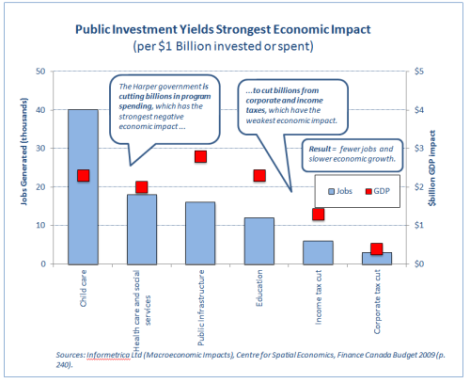
- Which isn't to say that we're lacking for areas where public money can still be put to better use, as Don Pittis writes about the billions being funneled by governments into making climate change worse.
- Alison observes that while deep integration with the U.S. has taken multiple forms, neither its goals nor its proponents have changed one bit over the past decade.
- Finally, both Frances Russell and Lawrence Martin partially explain the Cons' destructive policies by looking at Stephen Harper's insularity and refusal to allow either any real outside input into his plans, or any debate over his unilateral decisions.
- Paul Krugman discusses the U.S.' multi-decade pattern of income stagnation. David MacDonald and Kayle Hatt study the price we've paid to suit the Cons' political purposes, while Kristin Rushowy reports on two new calls for a genuine child care system. And Andrew Jackson notes that the Cons' only real end goal has been to hand free money to people who don't need it:
The government forecasts a deficit of $2.9 billion in this fiscal year, (2014-15.) Yet there would almost have been a surplus this year if the government had not decided to introduce family income splitting for the current tax year of 2014, at a cost of $2.4 billion in the fiscal year 2014-15 in terms of reduced revenues.- Meanwhile, Toby Sanger highlights how austerity has undermined Canada's economy over the past few years by replacing efficient public investment with useless tax baubles:
...
The big winners are high income, single earner families where the higher earner has an income of at least $75,000 per year. They will receive tax refund cheques of $2,000 on the eve of the 2015 election.
In the context of rapidly rising income and wealth inequality, it is outrageous that the Conservative government’s priority is to introduce a tax measure that will actually worsen inequality and do nothing to lower child poverty or to fund a badly needed child care program.
- Which isn't to say that we're lacking for areas where public money can still be put to better use, as Don Pittis writes about the billions being funneled by governments into making climate change worse.
- Alison observes that while deep integration with the U.S. has taken multiple forms, neither its goals nor its proponents have changed one bit over the past decade.
- Finally, both Frances Russell and Lawrence Martin partially explain the Cons' destructive policies by looking at Stephen Harper's insularity and refusal to allow either any real outside input into his plans, or any debate over his unilateral decisions.
Tuesday, August 19, 2014
Tuesday Morning Links
This and that for your Tuesday reading.
- John Abraham and Dana Nuccitelli discuss the worrisome spread of climate change denialism, particularly around the English-speaking developed world. But lest we accept the theory that declining public knowledge is independent of political choices, Margaret Munro reports that the Cons are suppressing factual scientific information about Arctic ice levels to avoid the Canadian public being better informed, while Tom Korski exposes a particularly galling example of their vilifying top scientists for reporting their results. And John O'Connor reminds us what's been done to anybody who's dared to speak out about the effect of unfettered tar sands development on local residents.
- Jim Bronskill reports that Transport Canada had been directly warned that safety standard exemptions granted to MMA would put workers and the public at risk in advance of last year's explosion in Lac-Megantic. And Bruce Campbell offers another study (summarized here) as to how regulatory failure was behind the disaster.
- Bloomberg reports that the U.S.' recovery has seen stagnant wages for most workers compared to gains at the top. And Henry Blodget highlights the even more glaring gap between corporate profits and earned incomes:
- Finally, the Ottawa Citizen calls for a renewed investigation into Robocon in light of Michael Sona's conviction. And Lawrence Martin points out the most important question left unanswered by the finding that Sona was just one part of a larger scheme to defraud voters:
- John Abraham and Dana Nuccitelli discuss the worrisome spread of climate change denialism, particularly around the English-speaking developed world. But lest we accept the theory that declining public knowledge is independent of political choices, Margaret Munro reports that the Cons are suppressing factual scientific information about Arctic ice levels to avoid the Canadian public being better informed, while Tom Korski exposes a particularly galling example of their vilifying top scientists for reporting their results. And John O'Connor reminds us what's been done to anybody who's dared to speak out about the effect of unfettered tar sands development on local residents.
- Jim Bronskill reports that Transport Canada had been directly warned that safety standard exemptions granted to MMA would put workers and the public at risk in advance of last year's explosion in Lac-Megantic. And Bruce Campbell offers another study (summarized here) as to how regulatory failure was behind the disaster.
- Bloomberg reports that the U.S.' recovery has seen stagnant wages for most workers compared to gains at the top. And Henry Blodget highlights the even more glaring gap between corporate profits and earned incomes:
There's no "law of capitalism" that says that companies have to pay their employees as little as possible. There's no law of capitalism that says companies have to "maximize short-term profits." That's just a story that America's owners made up to justify taking as much of the company's wealth as possible for themselves.- Michael Butler examines the readily foreseeable effects of the leaked CETA text in detail - with particular emphasis on its potential damage to Canadian health care.
Ironically, this short-term greed on the part of America's owners is likely reducing their long-term wealth: Companies can't grow profits by cutting costs forever, because their profits can't grow higher than their revenues. At some point, revenue growth needs to accelerate. But that won't happen until companies start sharing more of the wealth they create with the folks who create it — their employees.
- Finally, the Ottawa Citizen calls for a renewed investigation into Robocon in light of Michael Sona's conviction. And Lawrence Martin points out the most important question left unanswered by the finding that Sona was just one part of a larger scheme to defraud voters:
The term “vote suppression” is a euphemism. When a member or members of a political party run an operation to prevent citizens from voting for another party, it’s tantamount to trying to fix an election result. It’s attempted vote-rigging.
For corrupt political acts, you can’t get much worse. It’s certainly more egregious than abusing housing allowances or misusing government planes, the kinds of allegations that have brought down some prominent politicians lately.
...
So who else was there? Was the operation carried out with the knowledge or input of any of Prime Minister Stephen Harper’s top lieutenants? Will we ever find out?
Mr. Sona, with whom I have had several conversations, did not testify at his own trial. But he is considering whether to come forward in coming weeks or months with what he knows about the whole sordid business. If it’s true that others were involved, he should name them.
Tuesday, May 06, 2014
Tuesday Morning Links
This and that for your Tuesday reading.
- Polly Toynbee writes about the continued spread of privatization based solely on corporatist dogma even in the face of obvious examples of its harm to the public:
- Amber Hildebrandt discusses how Canadian employers became addicted to temporary foreign workers - though as Tim Harper notes, the Cons' consistent pushing of cheap labour at the expense of Canadian youth has played a major role. And Mike Moffatt wonders why there's been an explosion of temporary foreign workers in southwestern Ontario (among other regions with plenty of available workers).
- Diana Ziomislic reports on the manifestation of inequality through differences in Ontario children's dental health - while pointing out that a universal dental care system would represent an obvious means of closing that particular health gap.
- Finally, Andrew Coyne muses about Stephen Harper's degeneration and lack of impulse control - visible most recently in his choice to gratuitously pick a fight with Chief Justice of Canada Beverley McLachlin. But Lawrence Martin observes that there's nothing new either in Harper focusing maniacally on his enemies list, and including public servants on that list for absolutely no justifiable reason:
- Polly Toynbee writes about the continued spread of privatization based solely on corporatist dogma even in the face of obvious examples of its harm to the public:
In the Royal Mail debacle, shares sold at £1.7bn rose to £2.7bn. The 16 investors chosen as "long-term" custodians included the most wolfish hedge funds, who sold the shares at once. Let's hope that ends any pretence that shareholders look after companies. What's more, the investment arm of Lazards, key adviser to Vince Cable, was also given "priority" status. But Lazard Asset Management sold its entire stake within a week at a profit of £8m. Likewise Goldman Sachs, employed to facilitate the sale, told its investors share prices would hit 610p a month after advising the government to float at 330p. How well these companies deserved their tongue-lashing from Margaret Hodge: "You all know each other. You work together. You trade with each other. You are part of this little clique and we the ordinary taxpayer lose out on it." This is a case of caveat vendor.- David Dayen contrasts the IRS' public message about cracking down on tax cheats against its actions in giving tax evaders two more years to keep free-riding.
We should beware the inherent asymmetry when the state sells contracts and assets. On the government side, this is negotiating with a political gun at the head, conducted by inexperienced civil servants told to secure complex objectives, unable to walk away from already announced sell-offs. On the market side is rat-like native cunning impelled by profit, willingness to give mendacious assurances with one easy objective – to make money. Governments will always need to deal with markets for procurement and regulation – but that needs a strong, experienced civil service with equal cunning, not one cut by 30%, losing memory of past errors.
...
There is no evidence about how well contracting and privatising work: the best experts can find is 1980s assessments of early contracts for simple local services. At the very least, there should always be a state comparator. NHS contracting is galloping ahead, with no centrally gathered monitoring for comparison. Other privatisations rush on – probation and the court fines collection service – while companies built by cashing in from the state, such as G4S, A4E and Serco, are in disgrace. While Serco is being investigated by the Serious Fraud Office after overcharging on tagging, it emerges that its finance director sold £2.7m shares two months before the share price tanked on a profits warning.
This is the world David Cameron assumes always does better than public service, as a matter of unproven conviction. Laying out his Open Public Services policy, he said everything was up for sale, with "a new presumption" that "public services should be open to a range of providers competing to offer a better service". When he said: "The old narrow, closed state monopoly is dead," he forgot to say that services sold or contracted would become private monopolies making handsome profits at our expense. The dogma driving these privatisations wilfully ignores past experience.
- Amber Hildebrandt discusses how Canadian employers became addicted to temporary foreign workers - though as Tim Harper notes, the Cons' consistent pushing of cheap labour at the expense of Canadian youth has played a major role. And Mike Moffatt wonders why there's been an explosion of temporary foreign workers in southwestern Ontario (among other regions with plenty of available workers).
- Diana Ziomislic reports on the manifestation of inequality through differences in Ontario children's dental health - while pointing out that a universal dental care system would represent an obvious means of closing that particular health gap.
- Finally, Andrew Coyne muses about Stephen Harper's degeneration and lack of impulse control - visible most recently in his choice to gratuitously pick a fight with Chief Justice of Canada Beverley McLachlin. But Lawrence Martin observes that there's nothing new either in Harper focusing maniacally on his enemies list, and including public servants on that list for absolutely no justifiable reason:
(T)hese Conservatives constitute what might be called Ottawa’s first real wedge government. Other governments, including Tory ones, have sought to be more representative. With this one, it’s divide and conquer. It’s less about broadening the tent than hardening the attitudes of those within. Others are seen as enemies at the gate.
But the antagonism is fuelled by more than strategic political imperatives. I recall interviewing David Emerson, who had a unique perspective because he served in both the cabinets of Paul Martin and Stephen Harper. There were things he preferred about the Harper operation. But one difference that alarmed Mr. Emerson was the degree of visceral contempt he saw from Mr. Harper and his top lieutenants toward those opposed to their beliefs. He’d never seen anything like it. How could they harbour, he wondered, so much venom?
The combination – a wedge government driven by such a degree of animosity – makes for a potent mix. It’s why the enemies list has kept growing. It’s why a woman as honourable as the Chief Justice of our Supreme Court is now on it.
Monday, April 28, 2014
Monday Morning Links
Miscellaneous material to start your week.
- Alex Himelfarb and Jordan Himelfarb comment on the dangers of failing to talk about taxes:
- Marc Zwelling points out the challenge facing progressive voices in discussing poverty, as the general public is willing to respond to the issue when prompted while having little history of considering it as a top-of-mind concern.
- Lawrence Martin responds to the commentators who have tried to treat the failed Elections Canada investigation into Robocon as a retroactive basis to question whether electoral fraud should have been covered in the media. And Michael Harris sees Robocon as the sign of a democracy in decay based on the near-impossibility of holding fraudsters accountable:
- Alex Himelfarb and Jordan Himelfarb comment on the dangers of failing to talk about taxes:
The tax debate is often muddied by disagreement about whether taxes have actually gone up or down. As the economy grows, so too do tax revenues and spending, which is why many (though not all) prefer to measure tax as a percentage of the economy (GDP). The only good data on this come from StatsCan in a survey discontinued in 2008. These numbers show a decline in the scale of tax and spending over the last several decades, as do international comparisons. And using the federal government’s own projections, the scale of federal tax and spending will, over the next years, fall to lows not seen for seven decades.- Marc Taliano writes that rather than solving any problems arising out of limited public resources, privatization only exacerbates the problem of public dollars being diverted to corporate purposes. And Paul Krugman notes that Cliven Bundy represents a perfect example of an anti-social businessman portraying himself as an individualist while blatantly stealing public resources.
Whether we’re taxed too much or too little is a perennial debate that now needs rebalancing. It’s all well and good to say that many Canadians want smaller government but that means nothing unless it’s based on some understanding of how this will affect our ability to pursue our shared goals. We ought to know what we’re giving up before we celebrate the next round of tax cuts.
It’s time we restored the tax debate to its rightful place within a larger conversation, which has all but vanished, about the kind of country we want and are willing to pay for.
- Marc Zwelling points out the challenge facing progressive voices in discussing poverty, as the general public is willing to respond to the issue when prompted while having little history of considering it as a top-of-mind concern.
- Lawrence Martin responds to the commentators who have tried to treat the failed Elections Canada investigation into Robocon as a retroactive basis to question whether electoral fraud should have been covered in the media. And Michael Harris sees Robocon as the sign of a democracy in decay based on the near-impossibility of holding fraudsters accountable:
What Yves Cote’s report really means is that not all elements of an offence under the Elections Act as written could be established. A big part of the reason for that is the weak investigative powers of the Commissioner rather than a shortage of skullduggery.
It really comes down to the fact that the Elections Canada Act is like a worn out pair of your grannie’s lace-ups. The commissioner can’t compel evidence, and persons of interest can decline to be interviewed by EC investigators. Cote noted that “In one instance, a person who investigators believed could have provided very relevant information declined to be interviewed.”
Many others in this investigation did the same thing. And apparently there is no such thing as attempted voter suppression. Unless a voter is actually prevented from voting, there is no offence. And that’s not all. If incorrect poll information is given out and a citizen wants to pursue a complaint it is “not sufficient to simply prove the content of the call and the identity of the caller.” It is also necessary to prove the call was made with the intention of preventing an elector from voting. The burden of proof, “is the criminal standard of proof beyond a reasonable doubt.”
Believe it or not, the same burden of proof applies to harassing calls: “To transmit false or mistaken information without the requisite intent, however objectionable it may be, is not, in itself, an offence under the Act,” Cote reports.
Think about that for a moment. Without the element of mens rea or guilty mind, a rogue robocaller is not breaking the law merely by misdirecting voters to the wrong poll. In order for an offence to take place, there are two additional requirements. The voter must prove as a result of the call, he didn’t vote; and investigators have to be satisfied that the robocaller intended his misinformation to stop the person from voting.
You see why the jails will not soon be filled with cheating robocallers. Why else would a robocaller send a person to the wrong poll — to introduce him to a part of town he’s never seen before?- Finally, Susan Delacourt nicely highlights what a tax return would look like if delivered in the same form as one of the Cons' spin-heavy, fact-free budgets.
Friday, April 11, 2014
Friday Morning Links
Assorted content to end your week.
- Linda McQuaig responds to the CCCE's tax spin by pointing out what's likely motivating the false attempt to be seen to contribute to society at large:
- Dr. Dawg discusses the Fort Chipewyan cancer cluster - and the even more cancerous attitude on the part of the Alberta government which is looking to silence the victims rather than acknowledge any health problems which might be caused by the tar sands. And David Climenhaga wonders what comes next now that we know about both the cluster and the province's disdain for those affected.
- Jason Markusoff reports on Calgary's work in figuring out the costs and benefits of new construction - which lead to the conclusion that newly-developed suburban neighbourhoods tend to be a cost sink for at least 11 years, with the cost of repaying the resulting debt eating up any tax revenues for another ensuing decade.
- Finally, Andrew Coyne weighs in again on the Cons' combined refusal to try to justify anything within the Unfair Elections Act, along with their choice to instead declare war on Elections Canada as a diversion from the bill. Anita Vandenbeld describes the bill and its ramming through Parliament as global disgraces. Lawrence Martin notes that the Cons' attacks on Marc Mayrand are mostly a matter of fear that the truth about 2011 electoral fraud is about to be revealed. And Adam Bunch nicely summarizes what's at stake as the Unfair Elections Act is considered by Parliament.
- Linda McQuaig responds to the CCCE's tax spin by pointing out what's likely motivating the false attempt to be seen to contribute to society at large:
Seemingly out of the blue this week, the head honchos of Canada's biggest companies, the Canadian Council of Chief Executives, put out a media release insisting that their taxes are not too low.- David McKie reports on the PBO's latest study - which shows that the federal government has once again been underestimating the cost of cleaning up contaminated sites by billions of dollars (which will have to be funded out of the public purse).
This defensive posture -- who mentioned murder? -- reveals they fear others may be slowly catching on to the massive transfer of wealth to the richest Canadians that's been going on for the past 14 years due to the systematic cutting of corporate tax rates.
If Canada's corporate tax rate was the same today as it was in 2000, we'd be collecting roughly an extra $20 billion a year in taxes -- enough to fund national child care, free university tuition, children's dental care or other programs that have long existed in other advanced countries but that no one here, in these lean and mean times, dares to be caught dreaming about anymore, let alone advocating out loud.
...
(T)he CBC's interview with Howlett sparked gasps of rage from the bowels of the business press, notably Terence Corcoran in the National Post -- even though a detailed description of the Cameco case and other tax avoidance schemes had just appeared in a special issue of Canadian Business under the cover headline: How to pay no taxes -- Many of Canada's largest companies pay almost no tax: What's their secret?
Of course, that report, directed towards a business audience, is seen as harmless. It's quite another matter when that information is used by the likes of Howlett to wake up the Canadian public to this wealth grab by some of our biggest corporations -- companies which pushed governments to slash taxes and then largely avoided even those lower rates by shifting their profits offshore.
- Dr. Dawg discusses the Fort Chipewyan cancer cluster - and the even more cancerous attitude on the part of the Alberta government which is looking to silence the victims rather than acknowledge any health problems which might be caused by the tar sands. And David Climenhaga wonders what comes next now that we know about both the cluster and the province's disdain for those affected.
- Jason Markusoff reports on Calgary's work in figuring out the costs and benefits of new construction - which lead to the conclusion that newly-developed suburban neighbourhoods tend to be a cost sink for at least 11 years, with the cost of repaying the resulting debt eating up any tax revenues for another ensuing decade.
- Finally, Andrew Coyne weighs in again on the Cons' combined refusal to try to justify anything within the Unfair Elections Act, along with their choice to instead declare war on Elections Canada as a diversion from the bill. Anita Vandenbeld describes the bill and its ramming through Parliament as global disgraces. Lawrence Martin notes that the Cons' attacks on Marc Mayrand are mostly a matter of fear that the truth about 2011 electoral fraud is about to be revealed. And Adam Bunch nicely summarizes what's at stake as the Unfair Elections Act is considered by Parliament.
Thursday, March 27, 2014
Thursday Morning Links
This and that for your Thursday reading.
- Thomas Walkom writes that the Cons' economic prescriptions are doomed to fail because they're based on a fundamental misdiagnosis:
- Thomas Walkom writes that the Cons' economic prescriptions are doomed to fail because they're based on a fundamental misdiagnosis:
(T)hat half of the Conservative theory is correct. There is still persistently high unemployment.- Gene Lyons rightfully labels the Koch brothers as the U.S.' most prominent oligarchs. And Paul Krugman recognizes why the need to counter the Kochs' billions has become an effective fund-raising message for the Democrats:
But the other half, the study found, does not hold water: With the possible exception of Saskatchewan, Canada does not suffer from a surfeit of unfilled jobs.
In reaching this conclusion, the parliamentary watchdog looked at evidence compiled by the Bank of Canada and the Conference Board of Canada, a centre-right think tank.
This evidence shows that an undue number of jobs went begging in the years before 2008, when the economy was booming. But that certainly is not the case now.
The problem now is that there are not enough jobs. Period.
...
Conservatives soon reverted to their old-time religion. If unemployment was high, the fault lay with the jobless. They either didn’t have the right skills or were too lazy to move to where the work was.
The answer was threefold. First, cut into employment insurance in order to give layabouts an incentive to move. Second, bring in temporary foreign workers to fill the alleged skills shortages. Third, subsidize employers so as to encourage training.
Along the way, the government also took swipes at its old nemesis, the trade union movement. And it eliminated a law requiring construction companies working on federal projects to pay fair wages.
The result was that Canada ended up with stagnant wage growth among middle-income earners, more temporary foreign workers serving coffee at doughnut shops and not much else.
- Meanwhile, David Atkins sees the tycoon funder of a campaign to secede from California as exemplifying the antisocial rich who can't even fathom the presence of humanity among their fellow elites:David Weigel reports that Democrats are finding the Koch brothers an effective fundraising tool — emails that bash the Kochs raise three times as much as emails that don’t.And you can see why: the Kochs are perfect villains. It’s not just what they are — serious evildoers who use their wealth to push hard-line right-wing, anti-environmental policies that redound very much to their own benefit. It’s also what they aren’t: they’re wealthy heirs, not self-made men, they aren’t identified with innovation (which you can at least argue for Bill Gates), they haven’t made money for other people like Warren Buffett. So focusing on the Kochs is a way to personalize a vision of conservative politics as a defense of people with unearned privilege.
It's always a big shock to selfish rich people that most other well-to-do people aren't as selfish as they are. It's important to remember that many of the very wealthy are like Warren Buffett, people who vote primarily for Democrats and aren't afraid to pay a little more in taxes to have a fruitful, stable and fairer society. It's not even the 1% that are ruining things for the rest of us; it's a very sociopathic, very energetic fraction of that 1%. And they're really shocked when other people don't behave as asininely as they do.- Finally, following up on today's column, Joe Gunn discusses why fair elections are a moral issue. Dan Lett recognizes the gap between the public interest in maximizing voter participation, and the (varied) partisan interest in suppressing it. And Lawrence Martin makes the case that voting should be compulsory.
Thursday, January 16, 2014
New column day
Here, on how Mark Adler's C-520 looks to undermine public participation in all Canadian political parties - including the Conservatives who are pushing it.
I'll add here one point which didn't make it into the column. While there's obviously a need for independent institutions to act impartially, there's also a need for them to have some familiarity with the systems they're charged with overseeing. And if the Cons succeed in ensuring that regulators can't have any personal knowledge of what they're supposed to be regulating, the result may be far more damaging than the type of unsupported assertion of partisanship that's encouraged by Adler's bill.
For further reading...
- Alex Boutilier offers an introduction to the bill.
- David Doorey writes about the lack of protection for political views in many workplaces across the country.
- And Lawrence Martin worries that the effect of the bill will be entirely partisan (at least as long as the Cons remain in office).
I'll add here one point which didn't make it into the column. While there's obviously a need for independent institutions to act impartially, there's also a need for them to have some familiarity with the systems they're charged with overseeing. And if the Cons succeed in ensuring that regulators can't have any personal knowledge of what they're supposed to be regulating, the result may be far more damaging than the type of unsupported assertion of partisanship that's encouraged by Adler's bill.
For further reading...
- Alex Boutilier offers an introduction to the bill.
- David Doorey writes about the lack of protection for political views in many workplaces across the country.
- And Lawrence Martin worries that the effect of the bill will be entirely partisan (at least as long as the Cons remain in office).
Thursday, December 19, 2013
Thursday Morning Links
This and that for your Thursday reading.
- Ed Broadbent comments on Parliament's review of inequality in Canada:
- Dene Moore reports on the imminent release of the NEB's Northern Gateway review. But I'll offer a reminder of the reality which has largely been edited out of coverage of the NEB's hearings: rather than representing a "yea or nay" evaluation, the entire process was set up by the Cons to prohibit a "nay" conclusion.
- Frances Russell discusses the spread of low-paying work in the service sector - with a particular focus on how some employers are going out of their way to force workers to work multiple McJobs rather than receiving overtime or benefits through a single workplace.
- Finally, Heather Mallick points out the importance of tax revenue to build a functional society:
- Ed Broadbent comments on Parliament's review of inequality in Canada:
In a more encouraging vein, the majority report cautiously endorses some positive proposals. Given stated support from both of the opposition parties, these could, and should, move to the top of the government agenda as we approach the 2014 federal Budget and the 2015 federal election.- Meanwhile, Martin Regg Cohn notes that Jim Flaherty is standing in the way of a secure retirement for a substantial number of Canadians while being able to look forward to multiple political pensions himself. And Lawrence Martin looks at Peter Kent's brief stay as a Harper cabinet member - but finds that Kent himself is far more critical of the media than of the government which ignored his own recommendations.
The Broadbent Institute and other witnesses highlighted the need to increase the Working Income Tax Benefit (WITB) which supplements the incomes of working poor families, thus raising earned income from low wage jobs and helping offset unnecessary barriers to moving from welfare to work.
The majority report calls on the federal government to “formally review the WITB to determine how it could be expanded or modified to further benefit Canadians.”
The majority report, again accompanied by stronger statements from the opposition parties, further calls on the federal government “to make early childhood education and child care more accessible and affordable in all areas of the country, including through increased support for affordable early childhood and education and care programs.”
Such programs are key to removing barriers to work by single parents, mainly women, and are also important to expanding lifetime opportunities for low income children. However, the key question to ask of the Conservatives is whether they are actually prepared to fund income supports for the working poor and early childhood programs. After all, their stated priorities, following elimination of the deficit, are to cut income taxes by introducing family income splitting and by raising contribution limits for Tax Free Savings Accounts.
- Dene Moore reports on the imminent release of the NEB's Northern Gateway review. But I'll offer a reminder of the reality which has largely been edited out of coverage of the NEB's hearings: rather than representing a "yea or nay" evaluation, the entire process was set up by the Cons to prohibit a "nay" conclusion.
- Frances Russell discusses the spread of low-paying work in the service sector - with a particular focus on how some employers are going out of their way to force workers to work multiple McJobs rather than receiving overtime or benefits through a single workplace.
- Finally, Heather Mallick points out the importance of tax revenue to build a functional society:
I am a tax eccentric. I like taxes and frequently rejoice at what they give me: highways, air traffic control, emergency rooms, the tracking of the emerald ash borer, abortion rights, traffic lights, schools, food safety, the RCMP’s terrific boots, policing, regulating, licensing, autopsies, compassion, all the things that make us an organized and rational nation that is a pleasure to live in. I don’t trip over small corpses on the way home. It’s rather nice.
Conservatives, on the other hand, enjoy these services while abusing taxes as the necrotizing flesh disease of Canadian life.
...
(T)axing is more complicated than that, as essayist Jim Stanford says. “Governments decide, in the context of the conflicting and contradictory political pressures they face, what programs they will provide. Then they figure out how to fund those programs.”
Neo-liberals cut taxes first, Stanford says, while the programs exist, thus creating a deficit that is used to justify further cuts. We are manipulated. For example, we are told that we can’t afford pensions. Neither can we raise payroll taxes to raise CPP benefits for the future.
But we can pay them if we choose to.
Tuesday, September 24, 2013
Tuesday Morning Links
This and that for your Tuesday reading.
- Charles Campbell discusses Robert Reich's work to highlight the importance of a fair and progressive tax system. And while Lawrence Martin is right to lament the systematic destruction of Canada's public revenue streams under the Libs and Cons alike, his fatalistic view that nobody can stem the tide doesn't seem to match the evidence that the public - in Canada and the U.S. alike - sees inequality as a problem to be solved rather than a fair result of corporate-friendly policies.
- Mark Taliano writes about the Harper Cons' distaste for evidence-based policy. And even the New York Times takes note of Stephen Harper's desperate attempts to suppress science when it comes to the tar sands:
- And Paul Wells responds to selective leaks about the Cons' supposed reset by looking back at past throne speeches:
- Charles Campbell discusses Robert Reich's work to highlight the importance of a fair and progressive tax system. And while Lawrence Martin is right to lament the systematic destruction of Canada's public revenue streams under the Libs and Cons alike, his fatalistic view that nobody can stem the tide doesn't seem to match the evidence that the public - in Canada and the U.S. alike - sees inequality as a problem to be solved rather than a fair result of corporate-friendly policies.
- Mark Taliano writes about the Harper Cons' distaste for evidence-based policy. And even the New York Times takes note of Stephen Harper's desperate attempts to suppress science when it comes to the tar sands:
- Meanwhile, Tim Naumetz reports on Con rail safety spin which bears a striking resemblance to that on climate change: point to long-broken promises and not-yet-drafted regulations as "action", and hope nobody notices the difference between that and actual progress.Science is the gathering of hypotheses and the endless testing of them. It involves checking and double-checking, self-criticism and a willingness to overturn even fundamental assumptions if they prove to be wrong. But none of this can happen without open communication among scientists. This is more than an attack on academic freedom. It is an attempt to guarantee public ignorance.It is also designed to make sure that nothing gets in the way of the northern resource rush — the feverish effort to mine the earth and the ocean with little regard for environmental consequences. The Harper policy seems designed to make sure that the tar sands project proceeds quietly, with no surprises, no bad news, no alarms from government scientists. To all the other kinds of pollution the tar sands will yield, we must now add another: the degradation of vital streams of research and information.
- And Paul Wells responds to selective leaks about the Cons' supposed reset by looking back at past throne speeches:
(G)etting righteous on behalf of consumers would have the virtue of novelty. If this government stands up for consumers, it has until now been bashful about saying so. The most recent Throne Speech, only 25 months ago, contained no mention of the word “consumer.” Previous Throne Speeches—there have been six in total from various Harper governments up to now—contained hardly any more language on consumers’ rights. But those old speeches make fun reading today anyway, for their mix of forced rhetoric, policy dead ends and, here and there, a few real portents of what Harper had in store.- Finally, Duncan Cameron takes a look at the goals of each Canadian political party for this fall and beyond.
On Oct. 16, 2007, Michaëlle Jean delivered the Harper government’s second Throne Speech. It contained one reference to consumers. “Our government shares the concern of parents about the safety of consumer products and food.” It also promised “binding national regulations on greenhouse-gas emissions across all major industrial sectors—with requirements for emissions reductions starting this year.” Six years later, there are still no regulations for the oil sands.
On Nov. 19, 2008, after Harper’s first re-election, everyone was back in the Senate for another big speech. “Our government will follow through with legislation providing better oversight of food, drug and consumer products,” Jean said. The government also promised to “respect the jurisdiction of the provinces and territories and . . . enshrine its principles of federalism in a charter of open federalism.” That didn’t happen.
The 2008 Speech’s odes to Parliament’s greatness read a little funny in retrospect. “Parliament is Canada’s most important national institution . . . Parliament should be an expression of our highest ideals and deepest values, our greatest hopes and grandest dreams for the future of our children.” Two weeks later, the three opposition parties tried to give Harper’s job to Stéphane Dion. Harper promptly petitioned the GG to prorogue the session, thereby saving his bacon. Rarely since has Parliament expressed anyone’s values or hopes. Even Harper prefers to express his values and hopes as far from the Commons as he can get.
Thursday, July 18, 2013
Thursday Morning Links
This and that for your Thursday reading.
- Plenty more commentators are weighing in on the Harper Cons' enemy list, including the Star, the Globe and Mail, and Lawrence Martin. But Robyn Benson makes the most important comment about the Harper with-us-or-against-us mentality that's being applied to the federal government apparatus just as much as the Cons as a political party:
- Andrew Livingstone reveals the use of impoverished and hungry First Nations Canadians as lab rats to determine what food and health services people could do without. And Dr. Dawg diagnoses part of the problem as being the perception of people as objects for experimental purposes.
- Rafe Mair notes that in trashing B.C. Hydro, the Clark Liberals are destroying what should be a proud part of that province's legacy of responsive right-wing government.
- And finally, George Monbiot discusses how the tobacco lobby is merely channeling money and PR into other forms to evade restrictions on direct advertising and warp the political system in its favour.
- Plenty more commentators are weighing in on the Harper Cons' enemy list, including the Star, the Globe and Mail, and Lawrence Martin. But Robyn Benson makes the most important comment about the Harper with-us-or-against-us mentality that's being applied to the federal government apparatus just as much as the Cons as a political party:
The common denominator here is a fundamental lack of trust in other people, approaching paranoia, combined with a mean authoritarian streak that defines anyone who thinks differently, not as a fellow-citizen, but as an enemy to be eliminated. Such people, once in power, display a cynical shrewdness and a fetish for secrecy. They instinctively prefer the dark to the light. And theirs is an iron rule, or at least as iron a rule as they are permitted to get away with.- Meanwhile, CTV reports on the latest in the Cons' Clusterduff - an apparent refusal to provide central records to the RCMP. (And no, "you didn't ask for exactly the right document in exactly the right way with exactly the right secret password" isn't a valid excuse, especially from a PMO shouting from the rooftops that it's cooperating with the investigation.)
Those of us who are fundamentally opposed to the values and philosophy of the current government, or even question them, are not “enemies.” We believe in the democratic process: spirited debate, the exercise of our Charter rights to dissent, strong and organized political opposition. A government that defines us as enemies is itself an enemy of democracy.
And democracy in Canada is fragile enough as it is. The Prime Minister is granted powers that a US President would envy—the unilateral right to appoint members of the Senate, judges, and members of various boards and commissions, for example. Or to shut down Parliament when it gets inconvenient. With the increasing concentration of power in the Prime Minister’s Office, the consequent lack of democratic accountability to the electorate becomes more and more a fact of Canadian political life. And when it reaches the point that the PMO becomes more or less an arm of a specific political party, running dirty tricks against opposition leaders, a line has been crossed, and it will not be easy to walk that one back.
- Andrew Livingstone reveals the use of impoverished and hungry First Nations Canadians as lab rats to determine what food and health services people could do without. And Dr. Dawg diagnoses part of the problem as being the perception of people as objects for experimental purposes.
- Rafe Mair notes that in trashing B.C. Hydro, the Clark Liberals are destroying what should be a proud part of that province's legacy of responsive right-wing government.
- And finally, George Monbiot discusses how the tobacco lobby is merely channeling money and PR into other forms to evade restrictions on direct advertising and warp the political system in its favour.
Subscribe to:
Posts (Atom)