This and that for your Thursday reading.
- Following up on this post, it was Terry Glavin who broke the story about refugee children dying after being refused admission into Canada. And the Guardian recognizes that the tragic image of Aylin Kurdi represents only a reminder of a a long-running human tragedy.
- Which is why Canada's treatment of newcomers was already emerging as a significant issue - with Harsha Walia rightly slamming the Cons' policy of jailing refugees and favouring temporary immigration. And Jason Kenney's response was to offer spin which was readily debunked by his government's own numbers.
- Zi-Ann Lum reports on another international embarrassment for Canada, as Barack Obama and John Kerry are calling out the Cons for refusing to take climate change seriously.
- Jeremy Nuttall examines how a recession and continued economic stagnation will affect different segments of Canadian society. And Trish Hennessy offers ten reasons why nobody should be taking Stephen Harper's economic advice, while Andrew Jackson makes the case for more investment as the best way to move us back toward real development.
- Finally, Frances Russell repurposes the Cons' "Stand Up for Canada" slogan as a compelling reason to vote Harper and company out of office.
Showing posts with label frances russell. Show all posts
Showing posts with label frances russell. Show all posts
Thursday, September 03, 2015

Wednesday, June 17, 2015
Wednesday Afternoon Links
Miscellaneous material for your mid-week reading.
- Elias Isquith talks to David Madland about the connection between increasing inequality and the breakdown of trust in the U.S. political system. CBC and Larry Elliott follow up on the IMF's findings about the economic damage done by income and wealth disparities. And Philip Longman thoroughly examines the cross-generational inequality which is putting every generation after the Baby Boomers at a severe disadvantage:
- Ryan Meili interviews Harry Leslie Smith about the realities of life without a universal health care system, and the importance of preserving and improving the one we now enjoy.
- Katie Valentine looks at research showing a connection between environmental consciousness by legislators and cleaner air. And Geoff Dembicki notes that the Cons' environmental negligence is leading Canadian civil society to start taking action.
- Finally, Frances Russell writes that the Cons are looking to block Canadians' votes in the upcoming federal election. And Evan Leeson makes the case for voting for what we want, rather than allowing "strategic" arguments to push us toward the world of all possible worlds:
- Elias Isquith talks to David Madland about the connection between increasing inequality and the breakdown of trust in the U.S. political system. CBC and Larry Elliott follow up on the IMF's findings about the economic damage done by income and wealth disparities. And Philip Longman thoroughly examines the cross-generational inequality which is putting every generation after the Baby Boomers at a severe disadvantage:
Start, for example, with the twentysomethings of 1979. They had a lower real income in 1979 than twentysomethings did in 1969. And as fiftysomethings now, they not only make less money than they did when they were fortysomething, they are also far worse off as a whole than were the fiftysomethings of 2005. This generalization applies to white members of this cohort and even more so to those who are African American or Hispanic.- Meanwhile, Adnan Al-Daini comments on the futility of pretending that government budgeting is comparable to that of a household.
Today’s fiftysomethings may be part of the first generation in American history to experience this kind of lifetime downward mobility, in which at every stage of adult life, they have had less income and less net wealth than did people who were their age ten years before. Yet these mid-wave Baby Boomers shouldn’t feel too sorry for themselves. That’s because, as we shall see, they were far better off as twentysomethings than were subsequent cohorts of Generation X twentysomethings, and especially better off than today’s Millennials.
These vastly different economic trajectories experienced by today’s living generations are basically unprecedented. Throughout most of our history, inequality between generations was large and usually increasing, to be sure, but for the happy reason that most members of each new generation far surpassed their parents’ material standard of living. Today, inequality between generations is increasing for the opposite reason. Though much more productive and generally better educated, most of today’s workers are falling farther and farther behind their parents’ generation in most measures of economic well-being.
If it were just a matter of the old getting richer while the young get poorer, it would not necessarily be so bad. Under that scenario, most of us might struggle financially until we grew old, but we could at least look forward to realizing a variant of the American Dream in retirement. But that’s not how these trends are playing out. The downward mobility of today’s younger Americans leads to the downward mobility of tomorrow’s older Americans, making the problem of growing generational inequality truly dire. It’s time to get clear about just what’s been going on and what we can do about it.
- Ryan Meili interviews Harry Leslie Smith about the realities of life without a universal health care system, and the importance of preserving and improving the one we now enjoy.
- Katie Valentine looks at research showing a connection between environmental consciousness by legislators and cleaner air. And Geoff Dembicki notes that the Cons' environmental negligence is leading Canadian civil society to start taking action.
- Finally, Frances Russell writes that the Cons are looking to block Canadians' votes in the upcoming federal election. And Evan Leeson makes the case for voting for what we want, rather than allowing "strategic" arguments to push us toward the world of all possible worlds:
In the Canadian context strategic voting is anachronistic because it seeks to STOP HARPER. Again, we didn’t. You can’t stop a train after it has left the station and arrived at the destination. The opportunity is gone and strategic voting in this sense is living in the past and refusing to come to terms with where we have arrived.Strategic voting creates a negative frame because it takes the seed of positive creative energy in people who want change and plants it in negativity and fear. It says: “If we don’t vote together to stop Harper he will do bad stuff”. That’s negative and fearful. Plus, he already did.In fact, the Unstoppable One has now turned his attention to making sure that he can stop us. He wants to ensure the things he did cannot be undone aka retroactively stopped. Bill C-51 is a big part of that. C-51 is about locking it in....Here’s the thing about strategic voting. Things are different now. We can’t stop Harper. We can’t stop him because he’s accomplished his goals. Stick a fork in us. He’s done.So, enough with defining our future in the negative. What we need now is a new Prime Minister and new governing party with a plan and a mandate to build Canada anew.So what is the new approach?It’s simple, really. I believe hope is better than fear. I’m voting from the heart. I’m voting for what I believe in. I’m voting for the Canada I want. I hope you will too.
Thursday, April 16, 2015
Thursday Morning Links
This and that for your Thursday reading.
- Henry Mintzberg rightly challenges the myth of a "level playing field" when it comes to our economic opportunities:
- Meanwhile, Charles Rusnell reports on both Alberta's appalling instructions forbidding workers from participating in the province's election campaign even on their own time without management notice and approval, and its hasty retreat only after the attempt to silence the province's civil servants was exposed.
- Michal Rozworski highlights the complete lack of policy merit behind the Cons' false-balance bill, while Frances Russell points to Manitoba's experience in particular as demonstrating its damaging effects. And Karl Nerenberg offers a few suggestions for alternative legislation which might actually do some good.
- Finally, Amira Elghawaby discusses why Canadian Muslims have particular reason to worry about the elimination of civil rights under the Cons' terror bill. And the Canadian Journalists for Free Expressions are keeping up the pressure against C-51.
- Henry Mintzberg rightly challenges the myth of a "level playing field" when it comes to our economic opportunities:
Let’s level with each other. What we call a “level playing field” for economic development is played with Western rules on Southern turf, so that the New York Giants can take on some high school team from Timbuktu. The International Monetary Fund prepares the terrain and the World Trade Organization referees the game. Guess who wins.- And thwap reminds us of the essential connection between democratic mechanisms and popular activism as a counterweight to the outsized influence of wealth.
The rules of this game have been written by people educated in the economic canon of the already developed West. The “developing” countries of the world are supposed to open up their markets to global corporations that stand ready to enter with their manufactured goods.
...
Now, just as the international economic agencies are waking up to the consequences of their levelling, a new set of rules is making the playing field even more level: companies can take on government themselves.
Thanks to intense lobbying, a host of bilateral trade agreements provide for special courts of arbitration that enable private companies to sue sovereign countries. This has been made necessary, so the argument goes, to protect companies from governments that renege on contracts. Fair enough.
But instead, these courts are being used by global companies to do something quite insidious: stop legislation, even on matters relating to health, culture, and environment, that they claim to reduce their current or expected profits. “Today, countries from Indonesia to Peru are facing investor-state suits.”1 In fact, companies needn’t go that far: just by threating [sic] such lawsuits, which may require legal costs the countries can’t afford, some countries have been bullied into cancelling proposed legislation. And, by the way, in this version of the game the goals are scored at only one end: governments cannot use these courts to bring claims against the companies.
- Meanwhile, Charles Rusnell reports on both Alberta's appalling instructions forbidding workers from participating in the province's election campaign even on their own time without management notice and approval, and its hasty retreat only after the attempt to silence the province's civil servants was exposed.
- Michal Rozworski highlights the complete lack of policy merit behind the Cons' false-balance bill, while Frances Russell points to Manitoba's experience in particular as demonstrating its damaging effects. And Karl Nerenberg offers a few suggestions for alternative legislation which might actually do some good.
- Finally, Amira Elghawaby discusses why Canadian Muslims have particular reason to worry about the elimination of civil rights under the Cons' terror bill. And the Canadian Journalists for Free Expressions are keeping up the pressure against C-51.
Thursday, April 09, 2015
Thursday Morning Links
This and that for your Thursday reading.
- Alison picks up on Armine Yalnizyan's important question as to whether the Cons have a Plan B other than hoping for factors beyond our control to boost oil prices. And Brad Delong argues that based on the foreseeable direction of our economy, we need a stronger public sector now than we've ever had before:
- Of course, we're being told on far too many fronts that we have to put up with just the opposite - such as in Alberta where everybody short of the massive-donor class is facing cuts and cost increases. But Jeff MacLeod and James Sawler explain why austerity represents a path to ruin rather than development, while Stella Lord addresses the connection between government cuts and individual poverty.
- Finally, Duncan Cameron writes that the Cons have gone out of their way to turn Canada into an outlaw state. Frances Russell laments that the Cons have turned contempt of Parliament into the normal state of affairs in Canadian politics. And Antonia Maioni warns Australia against following in Stephen Harper's evidence-destroying footsteps by gutting their own census.
- Alison picks up on Armine Yalnizyan's important question as to whether the Cons have a Plan B other than hoping for factors beyond our control to boost oil prices. And Brad Delong argues that based on the foreseeable direction of our economy, we need a stronger public sector now than we've ever had before:
(A)s we move into the twenty-first century, the commodities we will be producing are becoming less rival, less excludible, more subject to adverse selection and moral hazard, and more subject to myopia and other behavioral-psychological market failures.
The twenty-first century sees more knowledge to be learned and thus a greater role for education—and if there is a single sector in which behavioral-economics and adverse-selection have major roles to play, it is education. Deciding to fund education via very long-term loan-finance and thus to leave the cost-benefit investment calculations to be undertaken by adolescents has been a disaster.
The twenty-first century will see longer life expectancy, and thus a greater role for pensions. Yet here in the United States the privatization of pensions via 401k(s) has been an equally great disaster.
The twenty-first century will see health-care spending as a share of total income cross 25% if not 33%. Enough said. Sooner or later some insurance plan is going to start saying that we do indeed cover cancer treatment as part of our essential health benefits—but we believe that the proper and state-of-the-art treatment for cancer is via aromatherapy.- And Paul Krugman follows up on the reason why government intervention is valuable due to predictable and well-documented gaps between individual decision-making and social goods.
The twenty-first century will see information goods a much larger part of the total pie than the twentieth. And if we know one thing, it is that it is not efficient to try to provide information goods via a competitive market for they are neither rival nor excludible. It makes no microeconomic sense at all for services like those provided by Google to be funded and incentivized by how much money can be raised not off of the value of the services but off of the fumes rising from Google’s ability to sell the eyeballs of the users to advertisers as an intermediate good.
Infrastructure and R&D. Enough said.
- Of course, we're being told on far too many fronts that we have to put up with just the opposite - such as in Alberta where everybody short of the massive-donor class is facing cuts and cost increases. But Jeff MacLeod and James Sawler explain why austerity represents a path to ruin rather than development, while Stella Lord addresses the connection between government cuts and individual poverty.
- Finally, Duncan Cameron writes that the Cons have gone out of their way to turn Canada into an outlaw state. Frances Russell laments that the Cons have turned contempt of Parliament into the normal state of affairs in Canadian politics. And Antonia Maioni warns Australia against following in Stephen Harper's evidence-destroying footsteps by gutting their own census.
Wednesday, January 21, 2015
Wednesday Morning Links
Miscellaneous material for your mid-week reading.
- Frances Russell writes that NAFTA and subsequent trade agreements are designed to make it difficult for democratic governments to exercise any meaningful authority. And Rowena Mason discusses how the EU-US TTIP is particularly directed toward throwing the public to corporate wolves, while Glyn Moody notes that there are plenty more similar agreements in the works even if the TTIP fails.
- George Monbiot discusses Amanda Lang's interventions on behalf of her business connections as a prime example of how far too much of our media is trying to serve the wealthy rather than questioning power at all.
- Jonathan Sas reminds us why an entrepreneurial government is in everybody's best interest:
- Finally, Lawrence Martin writes that Thomas Mulcair is absolutely right to challenge Stephen Harper's attempt to sell fear and hate as his election platform
- Frances Russell writes that NAFTA and subsequent trade agreements are designed to make it difficult for democratic governments to exercise any meaningful authority. And Rowena Mason discusses how the EU-US TTIP is particularly directed toward throwing the public to corporate wolves, while Glyn Moody notes that there are plenty more similar agreements in the works even if the TTIP fails.
- George Monbiot discusses Amanda Lang's interventions on behalf of her business connections as a prime example of how far too much of our media is trying to serve the wealthy rather than questioning power at all.
- Jonathan Sas reminds us why an entrepreneurial government is in everybody's best interest:
A growing body of evidence, and the analyses of scholars like Mazzucato, is starting to open our eyes to the true value of government participation in innovation strategies.- And Hugh Grant, Manish Pandey and James Townsend study the consequences of privatizing public services like hospital laundry, and find that it results in the public incurring widespread costs and losses for no real benefit.
Mazzucato raises concerns that the roles of public and private sectors in countries like Canada are becoming increasingly out of balance, with the “parasitic” private sector capturing most of the benefits of public sector investments, but not adequately reinvesting to fund new waves of innovation. She characterizes a system where the risks are socialized and the rewards privatized.
...
How will governments rise to the challenges of a highly competitive global marketplace and growing income and wealth inequality? What can be done to continue changing perceptions about who should take and benefit from risks? How do we begin to articulate a clear, common agenda for smart, equitable, and innovation-led economic growth?
...
Only a different conversation about government’s role in innovation will create a new narrative — one in which Canada is reaching its full potential as a leading investor in the wealth and wellbeing of all its citizens.
- Finally, Lawrence Martin writes that Thomas Mulcair is absolutely right to challenge Stephen Harper's attempt to sell fear and hate as his election platform
Thursday, January 08, 2015
Thursday Morning Links
This and that for your Thursday reading.
- Duncan Exley points out that the UK has nothing to be proud of when it comes to income inequality. And Bill Curry reports on the Cons' full awareness that the temporary foreign worker program was both taking jobs away from Canadian youth, and allowing employers to pay far less for foreign labour.
- DSWright highlights how Joseph Stiglitz appears to have been rejected by Republicans for a position advising on the U.S. financial system solely because he's dared to express the opinion that regulators shouldn't see their job as catering to the industry they're regulating.
- Meanwhile, Robert Reich discusses the dangers of the Trans-Pacific Partnership, while Patrick Caldwell is the latest to highlight how Kansas' right-wing utopia is turning into a disaster for everybody involved.
- Jeremy Nuttall expands on the Cons' censorship of websites for federal public servants.
- Frances Russell wonders what Tommy Douglas would have thought of the federal government's decreasing role in building a healthy Canada. And Linda McQuaig worries that the Harper Cons are getting away with destroying our medicare system:
- Duncan Exley points out that the UK has nothing to be proud of when it comes to income inequality. And Bill Curry reports on the Cons' full awareness that the temporary foreign worker program was both taking jobs away from Canadian youth, and allowing employers to pay far less for foreign labour.
- DSWright highlights how Joseph Stiglitz appears to have been rejected by Republicans for a position advising on the U.S. financial system solely because he's dared to express the opinion that regulators shouldn't see their job as catering to the industry they're regulating.
- Meanwhile, Robert Reich discusses the dangers of the Trans-Pacific Partnership, while Patrick Caldwell is the latest to highlight how Kansas' right-wing utopia is turning into a disaster for everybody involved.
- Jeremy Nuttall expands on the Cons' censorship of websites for federal public servants.
- Frances Russell wonders what Tommy Douglas would have thought of the federal government's decreasing role in building a healthy Canada. And Linda McQuaig worries that the Harper Cons are getting away with destroying our medicare system:
(T)he prime minister’s apparent contempt for the democratic process has been so outrageous it’s sucked all the political oxygen out of the room.- And finally, John Cartwright offers some suggestions as to what we need to talk about in order to take back our country from the Cons and the corporate lobby in 2015.
In our distraction, we’ve barely noticed something else important going on. In addition to sabotaging our democracy, Harper has been restructuring our country in a fundamental way — something that will be hard to reverse and, incidentally, very pleasing to Canada’s elite.
...
The essence of the Harper makeover of Canada has been the deep slashing of taxes, putting serious constraints on what government is able to provide in public programs and services.
...
(F)ew Canadians seem to realize that, as things stand, our medicare system — an institution cherished by millions — faces serious spending cuts starting in 2017.
At that point, we’ll be told we can no longer afford a public health care system. What we won’t be told is that the revenue to pay for a public health care system has been spent already — in tax cuts.
Harper appears to have figured out how to discreetly undermine and eventually end medicare. This shouldn’t surprise us, since he once headed up the National Citizens Coalition — an organization established in the 1960s with the goal of killing medicare.
Wednesday, December 10, 2014
Wednesday Morning Links
Miscellaneous material for your mid-week reading.
- Scott Clark and Peter DeVries remind us that any fiscal problems Canada has faced under the Cons have been entirely of Stephen Harper's making:
- Andrew Jackson notes that it's silly to think that markets can address climate change without some strong public policy leadership. But of course, for the Cons (and other petro-politicians), the only acceptable time to consider the well-being of the planet is never. And indeed, Mychaylo Prystupa reports that the Cons' kangaroo-court National Energy Board is positively bragging about its elimination of any public voices from regulatory decisions about pipelines.
- Adrian Morrow reports on the Ontario Auditor-General's findings that public-private partnerships have cost that province upwards of $8 billion in public money compared to simple public management.
- Finally, Frances Russell points out how the Cons go out of their way to eliminate precisely the voices which would ensure that public policy benefits everybody, rather than only the privileged few:
- Scott Clark and Peter DeVries remind us that any fiscal problems Canada has faced under the Cons have been entirely of Stephen Harper's making:
Harper needed a deficit problem; the fact that the previous government neglected to leave him one was just a short-term inconvenience. From the very beginning his fiscal strategy has been driven by a commitment to his Conservative base and ideology — which demand smaller government by any means — and by a desire to show that he had ‘what it takes’. He desperately wanted to be seen by history as a better fiscal manager than his predecessors.- Meanwhile, Brent Patterson points out how another of the Cons' "economic management" themes - that of constantly pushing trade agreements which entrench corporate power at the expense of the public - seems designed to prevent the development of an effective national pharmacare plan.
Harper and Flaherty both believed — as do most modern Conservatives — that smaller government inevitably leads to stronger economic growth. Unfortunately, stubborn reality has once again refused to cooperate with an impractical theory.
The evidence is clear: Cutting deficits does not by itself generate economic growth. The Conservative “growth friendly austerity” strategy has failed consistently, whenever and wherever it has been applied — in the U.S. under Republican administrations, in the eurozone in recent years, by the G20 after 2010 … and in Canada since 2010.
Cutting the GST by two points will go down in Canadian fiscal history as one of the worst public finance decisions ever. It served no useful purpose — apart from giving the prime minister the cover he needed to impose a neo-liberal fiscal orthodoxy that diminished the federal government while failing to generate growth and jobs.
All Canadians paid the price for securing Mr. Harper’s legacy. We’ll go on paying it for while.
- Andrew Jackson notes that it's silly to think that markets can address climate change without some strong public policy leadership. But of course, for the Cons (and other petro-politicians), the only acceptable time to consider the well-being of the planet is never. And indeed, Mychaylo Prystupa reports that the Cons' kangaroo-court National Energy Board is positively bragging about its elimination of any public voices from regulatory decisions about pipelines.
- Adrian Morrow reports on the Ontario Auditor-General's findings that public-private partnerships have cost that province upwards of $8 billion in public money compared to simple public management.
- Finally, Frances Russell points out how the Cons go out of their way to eliminate precisely the voices which would ensure that public policy benefits everybody, rather than only the privileged few:
Harper now faces a wide swath of civil society groups opposed to his government on everything from shockingly mean-spirited assistance to wounded veterans to wanton disregard for the environment to authoritarian disdain – and deep antagonism -towards the forms and traditions of parliamentary democracy.
Never content with just opposing his adversaries, Harper enjoys pre-empting them, beating them up with a totally unexpected attack.
As prime minister, he frequently uses private members bills to begin the softening up process.
Take, for example, the Conservatives’ visceral – and obviously intensely personal – antagonism to organized labour. Harper is moving swiftly to destabilize and disempower Canada’s trade unions. Using the ruse of a backbench Conservative MP’s private member’s bill as the cover, the legislation will force unions to publicly disclose the names and salaries of all employees earning more than $100,000 a year and reveal how much of their time each spends on political activities, lobbying and other non-labour relations work.
Noticeably missing from this purported concern for union members is any actual changes to ensure workplace rights and protection for Canadian workers. And, of course, there is not the remotest indication of similar disclosures being required from the corporate side of the economy.
What better way to try to weaken, divide and destabilize Canada’s House of Labour than perpetrating a Hobbesian war of all against all by stirring up internal strife between leaders and members and between unions with strong and progressive collective agreements and those struggling with weaker and less robust ones forced to exist on the fringes?
With the Harper Conservatives, it’s always win-win for corporations and the well-to-do and lose-lose for everyone else.
Wednesday, November 26, 2014
Wednesday Morning Links
Miscellaneous material for your mid-week reading.
- Hadrian Mertins-Kirkwood discusses the close connection between the energy sector and inequality in Canada - with the obvious implication that policies dedicated to unduly favouring the former will inevitably produce the latter:
- Evan Radford reports on the appalling state of child poverty in Saskatchewan, with over a quarter of the province's children living below the poverty line. And Sara Mojtehedzadeh points out that child poverty is common even in households with one or more working parents.
- Tom Sullivan notes that at least a few U.S. governments are trying to keep employers from exploiting precarious workers, only to face a predictably self-absorbed response from the corporate sector. And Michelle Chen examines the $1 billion in tax loopholes exploited every year by Wal-Mart alone.
- Both Ryan Meili and Vivek Goel discuss the absurdity of trying sever public health from broader public policy.
- And finally, Brent Patterson looks at one of the more novel abuses of free trade agreements, as corporate Canada is warning the federal government against cracking down on corruption lest it interfere with profit-making opportunities.
- Hadrian Mertins-Kirkwood discusses the close connection between the energy sector and inequality in Canada - with the obvious implication that policies dedicated to unduly favouring the former will inevitably produce the latter:
(T)he real story from last week’s Stats Can report isn’t that Canada is turning the tide on inequality, but that the energy sector is a key driver of income inequality in Canada. Massive investment in the oil sands has benefited the wealthiest earners to the exclusion of most other Canadians, and those immense gains have simply been slightly reduced from their 2006 high.- But then, as Frances Russell writes, attacking the poor to benefit the rich is par for the course for the Cons. And Bruce Cheadle reports that Stephen Harper has chosen to make reckless cuts to the public service with full knowledge as to how they undermine desperately needed programs.
The long-term trend in Canada is still towards greater inequality, as a new TD Bank report explains (PDF), and Alberta is still the most unequal province, which is exacerbated by new oil sands investments.
In other words, what’s good for the oil sands is good for Canada’s wealthy—and vice versa. However, no such connection exists with the incomes of the bottom 99%, even in cities like Calgary. Does that really justify such incredible investment in the oil sands? It’s a debate we should be having.
- Evan Radford reports on the appalling state of child poverty in Saskatchewan, with over a quarter of the province's children living below the poverty line. And Sara Mojtehedzadeh points out that child poverty is common even in households with one or more working parents.
- Tom Sullivan notes that at least a few U.S. governments are trying to keep employers from exploiting precarious workers, only to face a predictably self-absorbed response from the corporate sector. And Michelle Chen examines the $1 billion in tax loopholes exploited every year by Wal-Mart alone.
- Both Ryan Meili and Vivek Goel discuss the absurdity of trying sever public health from broader public policy.
- And finally, Brent Patterson looks at one of the more novel abuses of free trade agreements, as corporate Canada is warning the federal government against cracking down on corruption lest it interfere with profit-making opportunities.
Thursday, November 13, 2014
Thursday Morning Links
This and that for your Thursday reading.
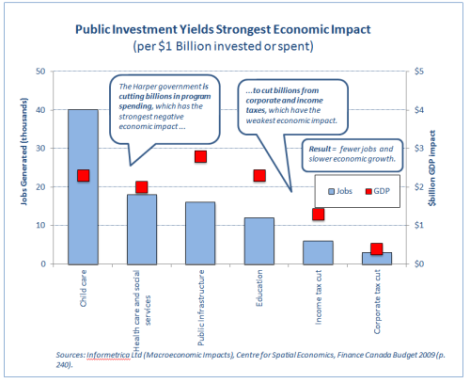
- Paul Krugman discusses the U.S.' multi-decade pattern of income stagnation. David MacDonald and Kayle Hatt study the price we've paid to suit the Cons' political purposes, while Kristin Rushowy reports on two new calls for a genuine child care system. And Andrew Jackson notes that the Cons' only real end goal has been to hand free money to people who don't need it:
- Which isn't to say that we're lacking for areas where public money can still be put to better use, as Don Pittis writes about the billions being funneled by governments into making climate change worse.
- Alison observes that while deep integration with the U.S. has taken multiple forms, neither its goals nor its proponents have changed one bit over the past decade.
- Finally, both Frances Russell and Lawrence Martin partially explain the Cons' destructive policies by looking at Stephen Harper's insularity and refusal to allow either any real outside input into his plans, or any debate over his unilateral decisions.
- Paul Krugman discusses the U.S.' multi-decade pattern of income stagnation. David MacDonald and Kayle Hatt study the price we've paid to suit the Cons' political purposes, while Kristin Rushowy reports on two new calls for a genuine child care system. And Andrew Jackson notes that the Cons' only real end goal has been to hand free money to people who don't need it:
The government forecasts a deficit of $2.9 billion in this fiscal year, (2014-15.) Yet there would almost have been a surplus this year if the government had not decided to introduce family income splitting for the current tax year of 2014, at a cost of $2.4 billion in the fiscal year 2014-15 in terms of reduced revenues.- Meanwhile, Toby Sanger highlights how austerity has undermined Canada's economy over the past few years by replacing efficient public investment with useless tax baubles:
...
The big winners are high income, single earner families where the higher earner has an income of at least $75,000 per year. They will receive tax refund cheques of $2,000 on the eve of the 2015 election.
In the context of rapidly rising income and wealth inequality, it is outrageous that the Conservative government’s priority is to introduce a tax measure that will actually worsen inequality and do nothing to lower child poverty or to fund a badly needed child care program.
- Which isn't to say that we're lacking for areas where public money can still be put to better use, as Don Pittis writes about the billions being funneled by governments into making climate change worse.
- Alison observes that while deep integration with the U.S. has taken multiple forms, neither its goals nor its proponents have changed one bit over the past decade.
- Finally, both Frances Russell and Lawrence Martin partially explain the Cons' destructive policies by looking at Stephen Harper's insularity and refusal to allow either any real outside input into his plans, or any debate over his unilateral decisions.
Thursday, October 16, 2014
Thursday Morning Links
This and that for your Thursday reading.
- Michal Rozworski responds to idealized views of Canadian equality with the reality that we fall well short of the Scandinavian model:
- Meanwhile, Justine Hunter reports that the choice to tie social funding to public approval of controversial resource projects is rather a losing proposition from a political perspective as well.
- Deirdre Fulton writes about the Center for Media and Democracy's study (PDF) into the harm done by ideological privatization of public services. And Jacob Swenson observes that in order to ensure that the public interest is protected, we need to see government as a solution (and indeed a prize) rather than a problem.
- Finally, Frances Russell laments the state of Canada's non-responsible Parliament - and the Prime Minister who's determined to make the problem worse:
- Michal Rozworski responds to idealized views of Canadian equality with the reality that we fall well short of the Scandinavian model:
Canada appears on many accounts much closer to the US than Sweden, the stand-in for a more robust social democratic and redistributive state. Indeed, looking at the three top rows of the table, there is a clear link between the higher share of income going to the top (inequality) and the higher share of taxes paid for by those at the top (redistribution a la Vox authors Martin and Hertel-Fernandez). On both of these measures Canada is roughly in the middle between the US and Sweden and slightly above the OECD-24 average.- Eric Reguly points out that we're seeing the inevitable side effects of overreliance on a commodity economy - as predictable price drops can lead to fiscal disaster when public planning is based on nothing but the bare hope that prices and associated revenues will rise in perpetuity. And Jason Fekete confirms that the Cons' destructive environmental choices are based solely on the desire to let Alberta oil operators dictate public policy.
Looking lower, however, it is clear that Sweden still easily beats both the US and Canada in terms of tax rates on the highest earners. While Sweden “recycles” more of its income through the state (total tax revenue as percentage of GDP), it does not do it without soaking the rich in the process. Sweden does not lack of high taxes but, rather, it lacks more extreme inequality. Canada, more akin to the US, gets more of its total tax income from the rich only because the rich are richer – indeed despite taxing each individual rich person less. In fact, if we take into account an interesting recent study on how Canada’s wealthiest use private corporations to avoid paying tax, it turns out that our system is even less redistributive: the official data has Canada’s top 10% taking in 32.7% of after-tax income, they are actually getting 36.5% adjusting for the effect of tax-dodging via private corporations.
The final three lines of the table show a common way to measure redistribution and these confirm that Canada is no Sweden. The Gini is a (convenient and imperfect) way to measure inequality in a single number on a scale from 0 to 1, where 0 is perfect equality and 1 is perfect inequality. The difference between the Gini of market incomes and the Gini of after-tax-and-transfer incomes shows how much redistribution is decreasing inequality. While even Sweden has a high inequality of market incomes, it redistributes quite a lot; Canada, on the other hand, is right behind the US and its comparatively paltry level of redistribution.
- Meanwhile, Justine Hunter reports that the choice to tie social funding to public approval of controversial resource projects is rather a losing proposition from a political perspective as well.
- Deirdre Fulton writes about the Center for Media and Democracy's study (PDF) into the harm done by ideological privatization of public services. And Jacob Swenson observes that in order to ensure that the public interest is protected, we need to see government as a solution (and indeed a prize) rather than a problem.
- Finally, Frances Russell laments the state of Canada's non-responsible Parliament - and the Prime Minister who's determined to make the problem worse:
The most corrosive and dangerous development in Canada’s fully Americanized parliamentary system is the highly centralized power of the PMO and cabinet with a majority government. Add the now-complete stifling of the rights of ordinary MPs to say or do anything on their own, and Canada has degenerated into a virtual dictatorship.
And that’s without including the ability of the prime minister to prorogue, recess and dissolve parliament at whim.
...
The dysfunction of the current parliament has its origins in the authoritarian mindset of the prime minister and the 100 or so individuals who staff his office. Rathgeber is merciless when it comes to describing the culture that has sprung up within it.
“The socialization and indoctrination effects of the PMO sub-culture cannot be overstated,” he writes. I have witnessed young, seemingly normal and well-adjusted college graduates enter the PMO and within six months, morph into arrogant, self-absorbed zealots, with an inflated sense of importance and ability.”
Sunday, September 28, 2014
Sunday Morning Links
Miscellaneous material for your Sunday reading.
- Frances Russell notes that the corporate sector is laughing all the way to the bank (and often an offshore one at that) after fifteen years of constant tax slashing, while Canadian citizens haven't benefited at all from the trickle-down theory. And Jordan Weissmann points out that a recent survey on CEO pay is just the latest example of Americans both severely underestimating the level of inequality in their country, and still preferring a far more equal distribution of wealth.
- Elisabeth Babcock writes that in addition to providing a reasonable standard of living, any effort to ameliorate poverty needs to include a concerted effort to overcome the individual stresses created by precarious life. And Chuk Plante reminds us how poverty and exclusion are intertwined with health and economic outcomes.
- Mitchell Anderson highlights how the FIPPA and other business-biased trade deals serve to undermine not only any hope of people-oriented policy, but also the personal and social protections enshrined in Canada's constitution:
- Finally, as part of Right to Know Week, Sean Holman unveils a new movement - and hashtag - intended to expose government secrecy in Canada.
- Frances Russell notes that the corporate sector is laughing all the way to the bank (and often an offshore one at that) after fifteen years of constant tax slashing, while Canadian citizens haven't benefited at all from the trickle-down theory. And Jordan Weissmann points out that a recent survey on CEO pay is just the latest example of Americans both severely underestimating the level of inequality in their country, and still preferring a far more equal distribution of wealth.
- Elisabeth Babcock writes that in addition to providing a reasonable standard of living, any effort to ameliorate poverty needs to include a concerted effort to overcome the individual stresses created by precarious life. And Chuk Plante reminds us how poverty and exclusion are intertwined with health and economic outcomes.
- Mitchell Anderson highlights how the FIPPA and other business-biased trade deals serve to undermine not only any hope of people-oriented policy, but also the personal and social protections enshrined in Canada's constitution:
Perhaps most importantly, the deal fails to protect aboriginal rights under the Constitution. The implications of this omission are profound. While our federal government has a duty to consult First Nations, Chinese state-owned companies can sue Canada through a secret international arbitration panel for any such accommodation that affects their economic interests.- Meanwhile, Mike De Souza reports that the Cons are once again encouraging the oil industry to flout what few environmental laws are left on the books - this time issuing a drilling permit while studiously ignoring scientific evidence about the danger the drilling would pose to endangered beluga whales. Which means that it's more than understandable that affected communities like North Bay are raising concerns about the Energy East pipeline even as it avoids some of the risks and costs of its even more controversial counterparts.
This would essentially fetter the Crown, which could be successfully sued by either Chinese interests or First Nations depending on whether they respect aboriginal title or not. Put another way, while the FIPA does not specifically override First Nations Charter protections, it could make providing those protections prohibitively expensive. The Hupacasath First Nation on Vancouver Island challenged the FIPA in court based on exactly these concerns and their decision at the Federal Court of Appeal is expected any day.
...
With the prospect of a change in government in 2015, many Canadians are hoping for a period of rebuilding public institutions. The FIPA, however, could lock in Harper’s draconian cuts to federal environmental laws for almost eight electoral cycles — effectively an eternity by political standards.
Future governments could revisit the legislative changes by the Harper government, but if they affect Chinese interests in comparison to what is on the books now, we have to pay. How much? According to the terms just agreed to by Ottawa, the sky’s the limit.
Harper famously proclaimed, “You won’t recognize Canada when I’m through with it.” He has made surprising progress on that dubious goal, and like most politicians I’m sure would like to keep it that way long after he has left office.
This trade deal will persist for as long as we’ve had the Charter. But unlike the Charter, which was the result of months of good-faith negotiations between opposing political parties, the FIPA seems instead an undemocratic and underhanded endgame to lock in our prime minister’s ideological legacy.
- Finally, as part of Right to Know Week, Sean Holman unveils a new movement - and hashtag - intended to expose government secrecy in Canada.
Sunday, September 21, 2014
Sunday Morning Links
This and that to end your weekend.
- Paul Krugman notes that a concerted effort to combat climate change could be as beneficial economically as it is important for the future of our planet:
- Which is to say that Naomi Klein's call for a climate health movement arising out of civil society rather than government seems all the more important in Canada:
- Finally, Michael Harris writes that the Cons' plan for 2015 involves little more than deflection and distraction. And Frances Russell highlights the contrast between Harper's lofty rhetoric about democracy in the Ukraine and his consistent attacks on anything worthy of the title at home.
- Paul Krugman notes that a concerted effort to combat climate change could be as beneficial economically as it is important for the future of our planet:
- But Mike De Souza documents what the Harper Cons have chosen to do in blocking any progress whatsoever. And Josh Wingrove reports that they've been similarly unwilling to see tar sands operators held to their legal obligations when it comes to polluting rivers, while Sean Holman points out how the mining sector has similarly been held to be above the law in British Columbia.Where is the new optimism about climate change and growth coming from? It has long been clear that a well-thought-out strategy of emissions control, in particular one that puts a price on carbon via either an emissions tax or a cap-and-trade scheme, would cost much less than the usual suspects want you to think. But the economics of climate protection look even better now than they did a few years ago.On one side, there has been dramatic progress in renewable energy technology, with the costs of solar power, in particular, plunging, down by half just since 2010. Renewables have their limitations — basically, the sun doesn’t always shine, and the wind doesn’t always blow — but if you think that an economy getting a lot of its power from wind farms and solar panels is a hippie fantasy, you’re the one out of touch with reality.On the other side, it turns out that putting a price on carbon would have large “co-benefits” — positive effects over and above the reduction in climate risks — and that these benefits would come fairly quickly. The most important of these co-benefits, according to the I.M.F. paper, would involve public health: burning coal causes many respiratory ailments, which drive up medical costs and reduce productivity.
- Which is to say that Naomi Klein's call for a climate health movement arising out of civil society rather than government seems all the more important in Canada:
What is most terrifying about the threat of climate disruption is not the unending procession of scientific reports about rapidly melting ice sheets, crop failures and rising seas. It’s the combination of trying to absorb that information while watching our so-called leaders behave as if the global emergency is no immediate concern. As if every alarm in our collective house were not going off simultaneously.
Only when we urgently acknowledge that we are facing a genuine crisis will it become possible to enact the kinds of bold policies and mobilize the economic resources we need. Only then will the world have a chance to avert catastrophic warming.
It’s not simply that our leaders aren’t leading us – at an appropriate gallop – away from fossil fuels and towards the renewable energy revolution that is both technologically and economically feasible. It’s that most of them are doubling down on the very energy sources that are most responsible for the crisis, cheering on the extractive industries as they dig up the most greenhouse gas-intensive fossil fuels on the planet: oil from the tar sands, gas from fracking, extra-dirty lignite coal.
...- Frank Graves comments on the economic stagnation facing large numbers of Canadians, while Benjamin Lanka reports on the connection between poverty and educational success. But the good news is that we're not lacking for some available solutions, as Nathaniel Downes notes that a $15 minimum wage in Seatac, Washington has led to both greater economic growth as well as a far better life for the workers who can now take home a living wage.
Naming climate change as a clear and present danger is not a solution in itself, of course. But it is the critical first step. Forcefully expressing our collective sense of urgency will help us resist the next attempt to tell us that some manufactured economic imperative is more important than the stability of the planet – whether it’s the supposed need for more government austerity, or the need to grow the economy at any cost. That sustained sense of urgency will allow us to demand the kinds of bold action required to get off fossil fuels, and move to a regenerative economy, in the brief window we have left.
- Finally, Michael Harris writes that the Cons' plan for 2015 involves little more than deflection and distraction. And Frances Russell highlights the contrast between Harper's lofty rhetoric about democracy in the Ukraine and his consistent attacks on anything worthy of the title at home.
Thursday, August 21, 2014
Thursday Morning Links
This and that for your Thursday reading.
- Olga Khazan writes about the connection between lower incomes and obesity in the U.S. And Truthout discusses how poverty and other stressors can directly affect individual and communal genetics for generations:
- Jordan Weissmann questions whether the spin about reduced global inequality making up for increased country-level inequality is the least bit accurate - particularly since it relies on ignoring unreported wealth.
- Meanwhile, Marc-Andre Gagnon suggests that a national pharmacare program could provide both economic and health benefits. But Nick Fillmore contrasts the public's actual concerns about higher drug prices and other consequences of the CETA against the media's eagerness to declare that nobody can possibly question more corporate-friendly trade deals.
- The Montreal Gazette's editorial board weighs in on the need to put public safety first when it comes to regulating dangerous business activity. But we can instead expect plenty more policies at the federal and provincial levels alike aimed at letting business do what it likes in the pursuit of short-term profits, regardless of the obvious dangers to the public - combined with the occasional gratuitous swipe at public servants in order to distract from corporate giveaways.
- And finally, Frances Russell wonders whether the Cons' fraudulent vote suppression in 2011 is only a prelude to a wider, more desperate attempt to keep power in 2015.
- Olga Khazan writes about the connection between lower incomes and obesity in the U.S. And Truthout discusses how poverty and other stressors can directly affect individual and communal genetics for generations:
(A) study by researchers at University College London's Institute of Child Health found that, thanks to epigenetics, children whose parents and grandparents were born into poverty can, themselves, carry the scars of that past poverty with them for the rest of their lives. That's because children born to families who've lived generations in poverty inherit genes configured to help them survive that poverty, but as the researchers pointed out, turning those genes on can make those children more susceptible to health conditions like heart disease, diabetes and cancer when they're adults.- And Rachel Malena-Chan highlights how much more an individual can both benefit personally and contribute to the community with a basic income in place to meet essential needs.
And epigenetic changes - genetic changes caused by the circumstances of life - have previously been linked to a variety of mental disorders too, including bipolar disorder and schizophrenia.
...
Because of epigenetics, whenever there's war, violence, poverty, famine or just about any other stressful situation, not only are our bodies changing, but those of future generations will, too.
That's why it's so important that we do everything possible to protect future generations by making the world work well today.
- Jordan Weissmann questions whether the spin about reduced global inequality making up for increased country-level inequality is the least bit accurate - particularly since it relies on ignoring unreported wealth.
- Meanwhile, Marc-Andre Gagnon suggests that a national pharmacare program could provide both economic and health benefits. But Nick Fillmore contrasts the public's actual concerns about higher drug prices and other consequences of the CETA against the media's eagerness to declare that nobody can possibly question more corporate-friendly trade deals.
- The Montreal Gazette's editorial board weighs in on the need to put public safety first when it comes to regulating dangerous business activity. But we can instead expect plenty more policies at the federal and provincial levels alike aimed at letting business do what it likes in the pursuit of short-term profits, regardless of the obvious dangers to the public - combined with the occasional gratuitous swipe at public servants in order to distract from corporate giveaways.
- And finally, Frances Russell wonders whether the Cons' fraudulent vote suppression in 2011 is only a prelude to a wider, more desperate attempt to keep power in 2015.
Wednesday, August 13, 2014
Wednesday Morning Links
Miscellaneous material for your mid-week reading.
- George Monbiot discusses how a market-based society makes people unhealthy in a myriad of ways - and how it's worth maintaining our innate reluctance to value everything and everybody around us solely in terms of dollar values:
- Douglas Skinner points out that major U.S. companies are increasingly obsessing over the extraction of cash (both through repurchases and dividends) at the expense of any sustainable development. And digby links the obscene profits for the U.S.' privileged few to the excessive borrowing required of anybody else wanting to live what's seen to be a normal life.
- Alexander Knight traces the incestuous relationship between oil money and political power across Canada. Fern Hill focuses in particular on Enbridge's apparent attempt to buy favour with police departments in communities which are likely to see opposition to its Line 9 project. And Dermod Travis connects crony capitalism to the Mount Polley tailings pond spill:
- Finally, Frances Russell weighs in on the continued clash in values between a progressive Canadian public and a hard-right Con government. But Paul Adams notes that based on current popular support, that conflict could be resolved in the next federal election by a Con collapse into third place among federal parties.
- George Monbiot discusses how a market-based society makes people unhealthy in a myriad of ways - and how it's worth maintaining our innate reluctance to value everything and everybody around us solely in terms of dollar values:
The market was meant to emancipate us, offering autonomy and freedom. Instead it has delivered atomisation and loneliness.- And Brian Bethune highlights the end of connections to neighbours (and any associated "social immune system") as an increasingly worrisome social trend in Canada.
The workplace has been overwhelmed by a mad, Kafkaesque infrastructure of assessments, monitoring, measuring, surveillance and audits, centrally directed and rigidly planned, whose purpose is to reward the winners and punish the losers. It destroys autonomy, enterprise, innovation and loyalty, and breeds frustration, envy and fear. Through a magnificent paradox, it has led to the revival of a grand old Soviet tradition known in Russian as tufta. It means falsification of statistics to meet the diktats of unaccountable power.
The same forces afflict those who can’t find work. They must now contend, alongside the other humiliations of unemployment, with a whole new level of snooping and monitoring. All this, Verhaeghe points out, is fundamental to the neoliberal model, which everywhere insists on comparison, evaluation and quantification. We find ourselves technically free but powerless. Whether in work or out of work, we must live by the same rules or perish. All the major political parties promote them, so we have no political power either. In the name of autonomy and freedom we have ended up controlled by a grinding, faceless bureaucracy.
These shifts have been accompanied, Verhaeghe writes, by a spectacular rise in certain psychiatric conditions: self-harm, eating disorders, depression and personality disorders.
...
So, if you don’t fit in, if you feel at odds with the world, if your identity is troubled and frayed, if you feel lost and ashamed – it could be because you have retained the human values you were supposed to have discarded. You are a deviant. Be proud.
- Douglas Skinner points out that major U.S. companies are increasingly obsessing over the extraction of cash (both through repurchases and dividends) at the expense of any sustainable development. And digby links the obscene profits for the U.S.' privileged few to the excessive borrowing required of anybody else wanting to live what's seen to be a normal life.
- Alexander Knight traces the incestuous relationship between oil money and political power across Canada. Fern Hill focuses in particular on Enbridge's apparent attempt to buy favour with police departments in communities which are likely to see opposition to its Line 9 project. And Dermod Travis connects crony capitalism to the Mount Polley tailings pond spill:
Since 2005, Imperial Metals has donated at least $149,890 to the BC Liberals. With a win, place and show wager, that total includes $2,500 to each of the leadership campaigns of Christy Clark, Kevin Falcon and George Abbott. It also tossed $3,000 into the kitty for Bill Bennett's 2009 re-election campaign.- Richard Brennan reports on a federal-provincial program which will provide money for affordable housing in Toronto. But as Brennan notes, the real story lies in what isn't included: the city is barred from using a dime of it for maintenance rather than new construction, meaning that the senior levels of government will maximize their photo ops while actively refusing to do anything to maintain the existing (and equally necessary) housing stock.
Mount Polley got in on the action as well, with the mine topping up donations to the Liberals by $46,720.
...
Giraud -- then vice-president, corporate affairs at Imperial Metals -- called on the B.C. government to retain the flow-through tax credits for the exploration industry, to keep the PST off capital investments for mining companies and, most importantly, to reduce the approval process for a new mine from upwards of 10 years to as little as three.
As he noted to the committee: "I think if we're really looking for some flexibility on budget in terms of the mining sector, there is perhaps some wiggle room, but it needs to be in the context of 'I'm going to build a mine in three years, so maybe I'll tolerate those additional tax rates.' People are willing to pay for certainty and for time."
Lo and behold, six months later the BC Liberal Party was promising voters that it would streamline the mining application processes, work with the federal government to ensure mining projects undergo only one environmental review process, and that it would extend the new mine allowance and other credits allowing new mines and mine expansions to receive depreciation credits of up to 133 per cent to 2020.
...
There was one last thing about Giraud's presentation that jumped out. Arguing his case for a shorter approval process, he claimed: "Nobody trusts experts anymore from an NGO or from a third party, saying: 'You know what? We don't trust what you've done.'"
After Mount Polley, that can be marked down as famous last words.
- Finally, Frances Russell weighs in on the continued clash in values between a progressive Canadian public and a hard-right Con government. But Paul Adams notes that based on current popular support, that conflict could be resolved in the next federal election by a Con collapse into third place among federal parties.
Wednesday, June 18, 2014
Wednesday Morning Links
Miscellaneous material for your mid-week reading.
- Kathleen Geier discusses the U.S.' culture of overwork and its human toll:
- Tim Harper discusses how a rigged approval process for the Northern Gateway pipeline did nothing to earn any genuine social license. Frances Russell takes a look at the role British Columbians may play in stopping the Gateway, while Bill Tieleman argues that the 2015 federal election will likely be the decisive factor in determining whether or not it it will ever be built. And PressProgress reminds us why we shouldn't trust the pro-pipeline spinmeisters.
- Finally, Michael Harris writes that Canada's Constitution seems to have earned an increasingly prominent place on the Cons' enemies list.
- Kathleen Geier discusses the U.S.' culture of overwork and its human toll:
There is abundant evidence that long working hours is incredibly dangerous from a public health perspective. Fatigued or sleep-deprived workers who drive or operate heavy machinery are an obvious menace to public safety, but there are other health costs associated with overwork as well. A 2004 Center for Disease Control report found that excessive overtime was associated with “poorer perceived general health, increased injury rates, more illnesses, and increased mortality,” and a 2008 study linked long work hours to depression and anxiety. Studies have also shown a strong association between working long hours and developing coronary heart disease.- Meanwhile, Lynn Vavreck helps to explain how wealth may lead to a perceived need for more wealth by pointing out how one's definition of "rich" changes at different income levels. The OECD has some suggestions to address the employer-heavy bias in U.S. employment law (h/t to Miles Corak). And Andre Cote comments on the difference a strong child-care system could make in Canada compared to the current alternative:
In its culture of overwork, the United States is very much an outlier, when compared to other industrially advanced nations. Unlike much of Europe, we don’t mandate paid vacations or make it illegal for employees to work more than forty-eight hours a week. The usual justification for American employers’ massive overtime requirements is that they enhance “productivity,” but evidence actually suggests that the opposite is true.
...
Americans began agitating for the right to an eight-hour workday over 200 years ago. Countless workers fought and died for that right before it was institutionalized under the Fair Labor Standards Act of 1938. But, sadly, it looks like this is one battle that we all must continue to fight.
Let’s think about the downstream implications of not funding child care.- The CP takes a look at Canadians' views on temporary foreign workers, and finds that the public shares the goal of giving easily-exploited workers the opportunity to build a life in Canada (while recognizing the need to hold employers accountable for abuses).
First, there is a big economic impact, as the lack of care tends to reduce the workforce participation rate of mothers with young children. For instance, 77% of mothers with infants work in Québec, compared with 70% in the rest of Canada. Fewer working moms is bad for businesses and for government tax revenues, which fund services…like child care. Some evidence suggests Quebec’s program actually pays for itself.
Second, we forego the educational benefits of providing child care and early learning – especially when targeted at lower-income families. The “human capital” early learning creates – i.e. more able workers later in life – pays dividends by supporting Canada’s productivity and competitiveness.
Third, it has a huge impact on the careers of parents who stay home (again, mostly women). Not only is it demotivating to go back to the office to find that your office-mates have all been promoted ahead of you, but it limits future advancement and earnings potential. For many career-oriented women, it’s a reason to delay having kids, or not to have them at all.
- Tim Harper discusses how a rigged approval process for the Northern Gateway pipeline did nothing to earn any genuine social license. Frances Russell takes a look at the role British Columbians may play in stopping the Gateway, while Bill Tieleman argues that the 2015 federal election will likely be the decisive factor in determining whether or not it it will ever be built. And PressProgress reminds us why we shouldn't trust the pro-pipeline spinmeisters.
- Finally, Michael Harris writes that Canada's Constitution seems to have earned an increasingly prominent place on the Cons' enemies list.
Wednesday, June 04, 2014
Wednesday Morning Links
Miscellaneous material for your mid-week reading.
- Neil Irwin highlights the reality that top-heavy economic growth has done nothing to reduce poverty in the U.S. over the past 40 years:
- Meanwhile, the Montreal Gazette laments the Cons' continued climate change obstruction.
- PressProgress offers ten reasons to be worried about the Cons' disregard for privacy. Colin Horgan recognizes that while the Cons' arguments against an effective census were nonsensical in that context, they would represent a strong case against the accountability-free sharing of personal information which the Cons now want to ram into law. And Michael Harris discusses how fits into Harper's Genghis Khan-like view of power.
- Frances Russell writes about Canada's descent from being internationally admired for its model democratic system, to serving as a cautionary tale.
- Finally, Seth Klein points out how modest tax increases on the wealthy could fully fund needed improvements to B.C.'s education system. But naturally, the Clark Libs are fully focused on attacking the province's teachers instead.
- Neil Irwin highlights the reality that top-heavy economic growth has done nothing to reduce poverty in the U.S. over the past 40 years:
- Kate Allen reports that 300 scientists have teamed up to call attention to the flawed assessment process applied to the Gateway pipeline, while Kai Nagata theorizes that the Cons might well scrap the project themselves. But I have my doubts about that theory in light of the Harper Cons' continued devotion to Keystone XL even as it produces a constant flow of shutdowns, leaks and spills.In Kennedy’s era, [the "rising tide lifts all boats" theory] had the benefit of being true. From 1959 to 1973, the nation’s economy per person grew 82 percent, and that was enough to drive the proportion of the poor population from 22 percent to 11 percent.But over the last generation in the United States, that simply hasn’t happened. Growth has been pretty good, up 147 percent per capita. But rather than decline further, the poverty rate has bounced around in the 12 to 15 percent range — higher than it was even in the early 1970s. The mystery of why — and how to change that — is one of the most fundamental challenges in the nation’s fight against poverty....
The 1959 to 1973 period might be an unfair benchmark. The Great Society social safety net programs were being put in place, and they may have had a poverty-lowering effect separate from that of the overall economic trends. In other words, it may be simply that during that time, strong growth and a falling poverty rate happened to take place simultaneously for unrelated reasons. And there presumably is some level of poverty below which the official poverty rate will never fall, driven by people whose problems run much deeper than economics.
But the facts still cast doubt on the notion that growth alone will solve America’s poverty problem....The reality is that low-income workers are putting in more hours on the job than they did a generation ago — and the financial rewards for doing so just haven’t increased.That’s the real lesson of the data: If you want to address poverty in the United States, it’s not enough to say that you need to create better incentives for lower-income people to work. You also have to devise strategies that make the benefits of a stronger economy show up in the wages of the people on the edge of poverty, who need it most desperately.
- Meanwhile, the Montreal Gazette laments the Cons' continued climate change obstruction.
- PressProgress offers ten reasons to be worried about the Cons' disregard for privacy. Colin Horgan recognizes that while the Cons' arguments against an effective census were nonsensical in that context, they would represent a strong case against the accountability-free sharing of personal information which the Cons now want to ram into law. And Michael Harris discusses how fits into Harper's Genghis Khan-like view of power.
- Frances Russell writes about Canada's descent from being internationally admired for its model democratic system, to serving as a cautionary tale.
- Finally, Seth Klein points out how modest tax increases on the wealthy could fully fund needed improvements to B.C.'s education system. But naturally, the Clark Libs are fully focused on attacking the province's teachers instead.
Wednesday, May 07, 2014
Wednesday Morning Links
Miscellaneous material for your mid-week reading.
- Jim Stanford writes that Tim Hudak's combination of austerity and indiscriminate tax slashing represents a recipe for less jobs rather than more:
- David Dayen responds to baseless criticisms of Seattle's new $15 minimum wage, while pointing out that the minimum should properly reflect a living wage. And Iglika Ivanova examines the need for a living wage to help combat child poverty in Vancouver.
- Sid Ryan discusses the role of unions in ensuring that the benefits of growth are shared across the population as a whole, while pointing out a few areas demanding immediate attention.
- Finally, Frances Russell argues that the Chief Justice of Canada was bound to make Stephen Harper's public enemies list at some point, while Jeffrey Simpson still sees the attack as a new low. And the CP reports on another case which figures to bring the judicial system into the Cons' cross-hairs, as the Ontario Superior Court has restored the constitutional right to vote to a million Canadians living abroad who were stripped of their say by the Harper government.
- Jim Stanford writes that Tim Hudak's combination of austerity and indiscriminate tax slashing represents a recipe for less jobs rather than more:
Mr. Hudak’s initial policy agenda is mostly a recycled business wish list: cut taxes, cut regulations, pay for training, cut energy costs, free trade. Its logic is 100% trickle-down economics: anything that’s good for business, must be good for jobs and for all of society. There is no powerful stimulative or expansionary impetus coming from any of those 5 proposals (unlike some other policies being debated in this election, like infrastructure investments and transit programs, which have a logical and direct connection to employment). And whatever positive employment gains were generated by any of those five measures would be massively swamped by the negative side-effects of the severe fiscal contraction required to achieve Mr. Hudak’s “biggest” job-creating goal: namely, simply balancing the budget.- Alex Boutilier reports on the Cons' latest laughable claim to secrecy - this time claiming cabinet confidence to withhold information about pensions from the Auditor General. And Larry Pynn highlights the frustration of one mayor with the Cons' insistence on providing total secrecy to shippers of dangerous goods - even as against the public who could be left with no warning of a potential disaster.
There is a way in which balanced budgets and job-creation are logically connected — but the direction of causation is exactly the opposite of Mr. Hudak’s argument. Ontario’s deficit today is overwhelmingly due to the downturn in employment that accompanied the 2008-09 financial crash and recession — recovery from which has been painfully slow and inadequate. (Remember, for several years before the recession hit, Ontario’s budget was balanced.) Restoring the employment rate to its 2008 level would mean 250,000 more jobs, and generate billions in additional revenues (through personal income taxes, HST revenues, growing spending, and other streams). The deficit will take care of itself, if and when we put Ontarians back to work.
- David Dayen responds to baseless criticisms of Seattle's new $15 minimum wage, while pointing out that the minimum should properly reflect a living wage. And Iglika Ivanova examines the need for a living wage to help combat child poverty in Vancouver.
- Sid Ryan discusses the role of unions in ensuring that the benefits of growth are shared across the population as a whole, while pointing out a few areas demanding immediate attention.
- Finally, Frances Russell argues that the Chief Justice of Canada was bound to make Stephen Harper's public enemies list at some point, while Jeffrey Simpson still sees the attack as a new low. And the CP reports on another case which figures to bring the judicial system into the Cons' cross-hairs, as the Ontario Superior Court has restored the constitutional right to vote to a million Canadians living abroad who were stripped of their say by the Harper government.
Friday, May 02, 2014
Friday Morning Links
Assorted content to end your week.
- Linda McQuaig discusses how the interests of big banks ended the Cons' willingness to consider postal banking which would produce both better service and more profits for the public:
- Mathew Paterson debunks the Fraser Institute's sad attempt to pretend that unregulated corporate dominance is anything but a disaster for the environment. And Andrew Flowers tests the business lobby's attempts to demonize unions in the name of "competition" - and finds that countries with greater union density are actually better placed to compete internationally.
- Frances Russell laments how even Canada's elections rules (along with budgets and other policy decisions) are being developed based solely on the Cons' partisan calculations. And Althia Raj points out that the Unfair Elections Act is designed to give special advantages to wealthier candidates.
- Finally, Carol Goar discusses the total lack of accountability or morality among Canada's right-wing political leaders - and recognizes what's needed to end the culture of cult conservatism:
- Linda McQuaig discusses how the interests of big banks ended the Cons' willingness to consider postal banking which would produce both better service and more profits for the public:
(C)ompetition is the last thing the banks want. And given their power (straddling the very heart of the Canadian establishment) and their wealth (record profits last year topping $30 billion), the banks tend to get what they want from the Harper government.
This could explain the government’s otherwise baffling decision last fall to reject an option that would have allowed a serious competitor to enter the banking sector, offering financial services to hundreds of thousands of Canadians who currently lack a bank account and often end up paying triple-digit interest rates to payday lenders (otherwise known as loan sharks).
Canada Post had put together a lengthy file supporting the case for “postal banking.” Under such a scheme, Canada Post would offer banking services through its 6,400 postal outlets — stepping into the vacuum left after the big banks closed more than 1,700 branches across the country in the last two decades, leaving hundreds of rural and remote communities without a bank.
What’s more, by entering the lucrative field of financial services, the publicly-owned postal service could have earned significant profits. A management report done for Canada Post concluded that postal banking was a “win-win” strategy.
...
The Harper government’s resistance to the idea is at least partly ideological. Postal banking would essentially create a public banking system — something that would be repugnant to hard-right Conservatives who have spent years dismantling Canada’s public systems and turning them over to the private sector.- Meanwhile, the Winnipeg Free Press concludes that the CPP represents by far the best option to offer Canadians improved income security in retirement. Which naturally means that the Cons are instead planning to demolish any form of defined-benefit plan, to be replaced by more risky plans intended to be run - and exploited - by the private sector.
- Mathew Paterson debunks the Fraser Institute's sad attempt to pretend that unregulated corporate dominance is anything but a disaster for the environment. And Andrew Flowers tests the business lobby's attempts to demonize unions in the name of "competition" - and finds that countries with greater union density are actually better placed to compete internationally.
- Frances Russell laments how even Canada's elections rules (along with budgets and other policy decisions) are being developed based solely on the Cons' partisan calculations. And Althia Raj points out that the Unfair Elections Act is designed to give special advantages to wealthier candidates.
- Finally, Carol Goar discusses the total lack of accountability or morality among Canada's right-wing political leaders - and recognizes what's needed to end the culture of cult conservatism:
There is nothing new about scandal in Canadians politics. History is replete with tales of ministers on the take, greedy public officials and corrupt mayors.
What has changed is that wrongdoers are no longer required — or even expected — to take responsibility for their actions. They don’t offer to resign. They don’t acknowledge they forfeited the confidence of the public. What they do instead is lash out at the government watchdogs who caught them, the journalists who exposed their malfeasance and the judges who applied the brakes.
To maintain this state of affairs, three conditions are necessary:
The first is an unprecedented level of secrecy or obfuscation by public officials.
The second is a sizable bloc of voters that can be counted on to support a besmirched leader no matter what he or she does.
The third is an electorate so unconcerned — or jaded — that it does nothing.
All three of these conditions currently exist in Canada; not in every jurisdiction but in several of the most prominent centres of government.
The antidote to what ails the body politic is obvious: eradicate the conditions that allow it to thrive.
Demand straight answers from those who are paid to serve the public and make it clear their jobs are on the line. Summon up the will to outvote the “bedrock supporters” who keep discredited politicians in power. Care a little more about Canada.
Wednesday, April 23, 2014
Wednesday Morning Links
Miscellaneous material for your mid-week reading.
- Frances Russell writes about the corrosive effects of inequality. And Robert Reich points out one creative option California is considering to address inequality at the firm level: tying corporate tax levels to wage parity, under the theory that shareholders will then have an incentive to push for a fair distribution of wages.
- Peter Richardson reviews Matt Taibbi's The Divide:
- And one of the more important factors needed to hold governments to account is accurate information about what they're doing. Which means there's all the more reason for concern about the Cons' pattern of refusing to release public data and covering up their own actions. But on the bright side, the NDP's push to make government information public by default offers a much-needed contrast.
- Finally, Tim Harper suggests that the temporary foreign worker program is beyond fixing. And
the CP discusses the obvious alternative: rather than binding helpless temporary workers to a single employer for the sole purpose of suppressing their wages and working conditions, we should look to fill with immigrants who can hope to make a future in Canada.
- Frances Russell writes about the corrosive effects of inequality. And Robert Reich points out one creative option California is considering to address inequality at the firm level: tying corporate tax levels to wage parity, under the theory that shareholders will then have an incentive to push for a fair distribution of wages.
- Peter Richardson reviews Matt Taibbi's The Divide:
Taibbi explores why Wall Street bankers are seemingly exempt from criminal prosecution, even as New York City targets petty crime — much of it manufactured by police in minority neighborhoods — more aggressively than ever. He cites statistics to make his argument, but mostly he reports on specific cases. One involves a working-class black man who finally decided to fight a misdemeanor charge for blocking pedestrian traffic — that is, standing on the sidewalk in front of his home. Taibbi also considers the zeal with which government agencies investigate and humiliate welfare recipients and undocumented residents for trying to provide for their families during hard times — times made all the harder because of unprosecuted crimes at the top of the economic food chain.- And David Dayen also discusses the consequences of a culture of impunity for the financial sector, with a particular focus on a home-seizure complex which has neither any incentive nor any apparent means to figure out whether a given claim to enforce a mortgage has any basis in fact:
Everyone knows the rich receive special treatment in this country, especially in court. But Taibbi concludes that the government now offers a sliding scale of civil and criminal protection to U.S. residents. At one end of the spectrum, the very rich are virtually beyond accountability, no matter how massive and destructive their crimes may be. At the other end, the nation’s most vulnerable residents face unremitting investigation and prosecution by bureaucracies determined to find them guilty of something.
Taibbi also surfaces a new set of targets: Justice Department prosecutors who seek settlements for even the most outrageous white-collar scams. Many of them are recruited from law firms whose clients include the largest Wall Street banks. Lanny Breuer, who headed the department’s criminal division when the financial meltdown occurred, is Taibbi’s poster boy for this conflict of interest. Both he and Attorney General Eric Holder were partners at Covington & Burling, which represents JPMorgan Chase, Bank of America, Citigroup and Wells Fargo. All too often, Taibbi argues, the prosecutors have continued to behave like defense attorneys. When Holder was a Clinton administration official, for example, he wrote a memo arguing that prosecutors should consider “collateral consequences” when determining whether to charge persons or corporations. If a criminal prosecution would unduly harm innocent shareholders and employees, the logic went, it made more sense to settle. But once bankers realized they were beyond criminal prosecution, the incentives to transgress increased dramatically.
...
“The Divide” marks a shift in Taibbi’s tone. More Lincoln Steffens than Hunter Thompson, Taibbi drops most of the histrionics to reveal the corruption and injustice at hand. He even goes out of his way to be reasonable. He acknowledges that prosecuting financial cases can be expensive and risky, especially when the alleged crimes are complex and the defendants have vast legal resources at their disposal. That fact motivates prosecutors to settle such cases rather than try them in criminal court. He also concedes that many disadvantaged neighborhoods may benefit from tough policing. But he maintains that when combined, the two law-enforcement strategies add up to a glaring injustice. He also notes that it’s far too easy to introduce jurisdictional complications in financial cases that would never be allowed in less consequential cases. To make that point, he recounts a horrific case in which high-profile Wall Street financiers escaped punishment after trying to destroy a company they bet against as well as harassing its executives and their family members.
(D)espite the fact that the nation’s courtrooms remain active crime scenes, with backdated, forged and fabricated documents still sloshing around them, state and federal regulators have not filed new charges of misconduct against Bank of New York, Deutsche Bank, U.S. Bank or any other mortgage industry participant, since the round of national settlements over foreclosure fraud effectively closed the issue.
Many focus on how the failure to prosecute financial crimes, by Attorney General Eric Holder and colleagues, create a lack of deterrent for the perpetrators, who will surely sin again. But there’s something else that happens when these crimes go unpunished; the root problem, the legacy of fraud, never gets fixed. In this instance, the underlying ownership on potentially millions of loans has been permanently confused, and the resulting disarray will cause chaos for decades into the future, harming homeowners, investors and the broader economy. Holder’s corrupt bargain, to let Wall Street walk, comes at the cost of permanent damage to the largest market in the world, the U.S. residential housing market.
By now we know the details: During the run-up to the housing bubble, banks bought up millions of mortgages, packaged them into securities and sold them around the world. Amid the frenzy, lenders failed to follow basic property laws, which ensure legitimate transfers of mortgages from one legal owner to another. When mass foreclosures resulted from the bubble’s collapse, banks who could not demonstrate they owned the loans got caught trying to cover up the irregularities with false documents. Federal authorities made the offenders pay fines, much of which banks paid with other people’s money. But the settlements put a Band-Aid over the misconduct. Nobody went in, loan by loan, to try to equitably confirm who owns what.
...- Don Lenihan responds to Lawrence Martin's suggestion that key PMO staffers be elected by Parliament by pointing out that there's more to democratic accountability than intermittent elections.
There was another solution available here, if Holder’s Justice Department didn’t throw up its hands and settle. Judges could have disassembled the broken mortgage system, and appointed a special master to handle all loans in question. It may have taken years, but the preservation of the public property system makes the time and expense worth it. Unless you would rather kneel to the wishes of the financial industry to keep everything rolling, and let the wound fester.
If you or I pick the lock on a house and try to steal everything in it, we’d probably go to jail. But if I were a bank, and I wrote down on a piece of paper that I simply owned that house, I’d get away with it. That’s the sad legacy of trying to cover up massive fraud instead of dealing with it.
- And one of the more important factors needed to hold governments to account is accurate information about what they're doing. Which means there's all the more reason for concern about the Cons' pattern of refusing to release public data and covering up their own actions. But on the bright side, the NDP's push to make government information public by default offers a much-needed contrast.
- Finally, Tim Harper suggests that the temporary foreign worker program is beyond fixing. And
the CP discusses the obvious alternative: rather than binding helpless temporary workers to a single employer for the sole purpose of suppressing their wages and working conditions, we should look to fill with immigrants who can hope to make a future in Canada.
Wednesday, April 09, 2014
Wednesday Morning Links
Miscellaneous material for your mid-week reading.
- David Dayen discusses how prepaid debit cards are turning into the latest means for the financial sector to extract artificial fees from consumers. And Matt Taibbi reports on the looting of public pension funds in the U.S.:
- And on the subject of the value of public services being gifted to corporate cronies, Simon Enoch highlights the Wall government's broken promise not to privatize Saskatchewan's Crowns - most obvious lately in their elimination of rural liquor stores in favour of corporate-owned replacements.
- Meanwhile, Karen Kamp points out the dangers of allowing for massive corporate funding of political messages to go undisclosed until it's too late.
- Jason Koblovsky catches Con insider Geoff Norquay admitting that the Unfair Elections Act is intended as "vengeance" against Elections Canada for doing its job in investigating the Cons' in-and-out scandal. And Frances Russell takes a look at some of the ways undue restrictions on voting rights may be unconstitutional.
- Finally, Duncan Cameron and Chantal Hebert weigh in on the results of this week's Quebec election. Paul Wells muses about the illusory attraction of the "star candidate". And John Conway focuses on how the PQ's shift in focus from progressive economic policies to reactionary social ones earned it a miserable defeat.
- David Dayen discusses how prepaid debit cards are turning into the latest means for the financial sector to extract artificial fees from consumers. And Matt Taibbi reports on the looting of public pension funds in the U.S.:
Nor did anyone know that part of Raimondo's strategy for saving money involved handing more than $1 billion – 14 percent of the state fund – to hedge funds, including a trio of well-known New York-based funds: Dan Loeb's Third Point Capital was given $66 million, Ken Garschina's Mason Capital got $64 million and $70 million went to Paul Singer's Elliott Management. The funds now stood collectively to be paid tens of millions in fees every single year by the already overburdened taxpayers of her ostensibly flat-broke state. Felicitously, Loeb, Garschina and Singer serve on the board of the Manhattan Institute, a prominent conservative think tank with a history of supporting benefit-slashing reforms. The institute named Raimondo its 2011 "Urban Innovator" of the year.
The state's workers, in other words, were being forced to subsidize their own political disenfranchisement, coughing up at least $200 million to members of a group that had supported anti-labor laws. Later, when Edward Siedle, a former SEC lawyer, asked Raimondo in a column for Forbes.com how much the state was paying in fees to these hedge funds, she first claimed she didn't know. Raimondo later told the Providence Journal she was contractually obliged to defer to hedge funds on the release of "proprietary" information, which immediately prompted a letter in protest from a series of freaked-out interest groups. Under pressure, the state later released some fee information, but the information was originally kept hidden, even from the workers themselves.
...
Today, the same Wall Street crowd that caused the crash is not merely rolling in money again but aggressively counterattacking on the public-relations front. The battle increasingly centers around public funds like state and municipal pensions. This war isn't just about money. Crucially, in ways invisible to most Americans, it's also about blame. In state after state, politicians are following the Rhode Island playbook, using scare tactics and lavishly funded PR campaigns to cast teachers, firefighters and cops – not bankers – as the budget-devouring boogeymen responsible for the mounting fiscal problems of America's states and cities.
Not only did these middle-class workers already lose huge chunks of retirement money to huckster financiers in the crash, and not only are they now being asked to take the long-term hit for those years of greed and speculative excess, but in many cases they're also being forced to sit by and watch helplessly as Gordon Gekko wanna-be's like Loeb or scorched-earth takeover artists like Bain Capital are put in charge of their retirement savings.
...
(T)he "unfunded liability" crisis had nothing to do with the systemic unsustainability of public pensions. Thanks to a deadly combination of unscrupulous states illegally borrowing from their pensioners, and unscrupulous banks whose mass sales of fraudulent toxic subprime products crashed the market, these funds were out some $930 billion. Yet the public was being told that the problem was state workers' benefits were simply too expensive.
In a way, this was a repeat of a shell game with retirement finance that had been going on at the federal level since the Reagan years. The supposed impending collapse of Social Security, which actually should be running a surplus of trillions of dollars, is now repeated as a simple truth. But Social Security wouldn't be "collapsing" at all had not three decades of presidents continually burgled the cash in the Social Security trust fund to pay for tax cuts, wars and God knows what else. Same with the alleged insolvencies of state pension programs. The money may not be there, but that's not because the program is unsustainable: It's because bankers and politicians stole the money.[Update: And just in time for the C.D. Howe Institute to sell the same kind of snake oil in Canada.]
- And on the subject of the value of public services being gifted to corporate cronies, Simon Enoch highlights the Wall government's broken promise not to privatize Saskatchewan's Crowns - most obvious lately in their elimination of rural liquor stores in favour of corporate-owned replacements.
- Meanwhile, Karen Kamp points out the dangers of allowing for massive corporate funding of political messages to go undisclosed until it's too late.
- Jason Koblovsky catches Con insider Geoff Norquay admitting that the Unfair Elections Act is intended as "vengeance" against Elections Canada for doing its job in investigating the Cons' in-and-out scandal. And Frances Russell takes a look at some of the ways undue restrictions on voting rights may be unconstitutional.
- Finally, Duncan Cameron and Chantal Hebert weigh in on the results of this week's Quebec election. Paul Wells muses about the illusory attraction of the "star candidate". And John Conway focuses on how the PQ's shift in focus from progressive economic policies to reactionary social ones earned it a miserable defeat.
Subscribe to:
Comments (Atom)