Abbas Rana's revelation that the Cons have decided to protect all of their incumbent MPs from any internal accountability seems to have received relatively little attention. But it's particularly worth paying attention to it given how many Cons have gone out of their way to demonstrate they're not up to their current jobs.
Surely voters should have at least some option other than to be stuck with a representative signing on to a grossly ignorant and inflammatory separatist manifesto.
Surely constituents should have an opportunity to challenge an MP trying to push anti-abortion legislation through Parliament, or undermining decades of progress in respect for the LGBTQ community.
And surely citizens should be able to question whether a failed leader reduced to ranting about children's TV shows deserves to represent them on the ballot.
But the Cons have declared they don't want anybody who to have better choices than the utter embarrassments currently in their ranks - whether based on what they've done so far, or what they continue to do while holding positions of public trust. And that should speak volumes as to the party's institutional unfitness for office.
Showing posts with label unfitness for office. Show all posts
Showing posts with label unfitness for office. Show all posts
Monday, March 02, 2020

Friday, August 14, 2015
On points of agreement
Let's see if we can turn Stephen Harper's otherwise laughable spin on his PMO's widespread cover-up into a couple of points we can all agree on.
First, the ultimate responsibility for lies and cover-ups lies with superiors rather than subordinates - inHarper's own words
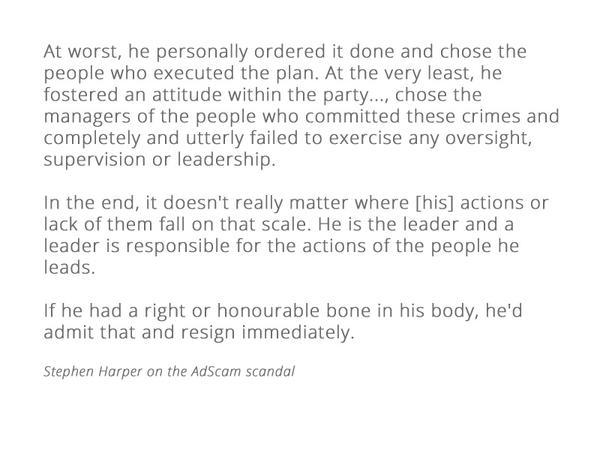 Second, exactly one person fits bears that responsibility when it comes to the unethical actions of the Prime Minister's Chief of Staff and central advisors.

And there are plenty of Conservatives ready to shout down anybody who tries to suggest otherwise.
Update: As Alison notes here, the quote attributed to Harper above originated elsewhere. So for a less well-written variation of the same theme, let's go with this:
First, the ultimate responsibility for lies and cover-ups lies with superiors rather than subordinates - in
And there are plenty of Conservatives ready to shout down anybody who tries to suggest otherwise.
Update: As Alison notes here, the quote attributed to Harper above originated elsewhere. So for a less well-written variation of the same theme, let's go with this:
(I)t was Mr. Martin's decision to turn a blind eye to it all when he was minister of finance.
Do Canadians really believe that the No. 2 man in a government now under a cloud of corruption, is the person to clean up that mess today?
...
And do you really believe that the Liberals will ultimately prosecute themselves and hold their own to account?
I don't believe that. I don't think you believe that.
Thursday, August 13, 2015
Thursday Morning Links
This and that for your Thursday reading.
- Vanessa Houlder reports on the OECD's call for countries to make far more of an effort to ensure tax compliance among their wealthiest individuals.
- Scott Gilmore discovers the abusiveness of the payday loan industry by accident due to a lender's confusion between him and an actual borrower:
- Warren Bell lays bare the Cons' attempt to make myths overpower facts in Canada's election campaign. And Jeff Sallot writes that Canadians are rightly rejecting the Cons' steady diet of fearmongering.
- Finally, Zi-Ann Lum reports that if the Cons are pretending not to enforce a gag order on people attending their campaign events, they're certainly going out of their way to eliminate any opportunity to share their opinions by expelling anybody who dares to air them. And Tim Harper discusses how Mike Duffy's trial is showing us just how obsessed the Cons are with political calculation at the expense of competent governance.
- Vanessa Houlder reports on the OECD's call for countries to make far more of an effort to ensure tax compliance among their wealthiest individuals.
- Scott Gilmore discovers the abusiveness of the payday loan industry by accident due to a lender's confusion between him and an actual borrower:
Regulations vary. Manitoba limits prices at $17 for every $100 borrowed. In Ontario it is $21. It sounds reasonable, but that is an annual percentage rate of over 540%, twice the traditional vig charged by loan sharks. Stan Keyes, the former federal cabinet minister and now the president of the Canadian Payday Loan Association, argues that it is unfair to calculate the interest rate this way, since the loans are typically for only two weeks. However, he concedes that many borrowers take out multiple loans over the course of the year.- Meanwhile, Thomas Walkom reminds us of Stephen Harper's efforts to undermine pensions of any kind (other than his own).
It gets worse. A quarter of the loans initially default. Lenders actually want this. For an additional fee they happily extend the loan for another two weeks. Week after week, borrowers are slowly bled dry, often paying back several times more than they borrowed. What other business profits from keeping their customers down and out? Is there a more morally bankrupt industry?
The impact is immense. When people fall behind in their payments, the fees add up creating a painful financial drain for those who can least afford it. The stress this creates is immense. A recent study by St. Michael’s Hospital in Toronto found a relationship between the number of payday lenders in a neighbourhoods, and premature mortality.
- Warren Bell lays bare the Cons' attempt to make myths overpower facts in Canada's election campaign. And Jeff Sallot writes that Canadians are rightly rejecting the Cons' steady diet of fearmongering.
- Finally, Zi-Ann Lum reports that if the Cons are pretending not to enforce a gag order on people attending their campaign events, they're certainly going out of their way to eliminate any opportunity to share their opinions by expelling anybody who dares to air them. And Tim Harper discusses how Mike Duffy's trial is showing us just how obsessed the Cons are with political calculation at the expense of competent governance.
Friday, November 21, 2014
Friday Morning Links
Assorted content to end your week.
- Dennis Raphael and Toba Bryant write about the devastating health effects of income inequality in Canada:
- And we shouldn't be suckered into believing that austerity happens only through relatively transparent budgeting processes. In fact, recent reports show that the Cons have simply chosen not to bother with approved funding both for veterans at home, and for the world's poorest people abroad - imposing massive cuts from the amounts approved by our elected representatives without any debate.
- Carol Goar discusses how Canada is losing allies around the world due to the Cons' obstinate refusal to do anything - or even allow anything to be done - to meaningfully fight climate change.
- And finally, Michael Den Tandt comments on the Cons' disreputable politics - with Michael Sona's sentence (and the Cons' refusal to acknowledge jail-worthy wrongdoing within their own ranks) serving as just the latest example.
- Dennis Raphael and Toba Bryant write about the devastating health effects of income inequality in Canada:
Imagine the response, from industry, government and the public, if a plane was crashing every day. If there were something that killed as many people in a day as this kind of disaster, you’d expect it to provoke a similarly concentrated response.- Meanwhile, Seumas Milne notes that the UK Cons are continuing to push pointless austerity even as its damage to the economy becomes inescapable.
A recent report by Statistics Canada highlights a preventable cause of premature death that is having exactly that kind of impact. This study demonstrates that income inequality is associated with the premature death of 40,000 Canadians a year. That’s equal to 110 Canadians dying prematurely each day. To put that into context, imagine a Bombardier CS-100 jet airplane full of passengers falling out of the sky every day for a year.
...
The Statistics Canada report also makes clear that these differences in health outcomes are primarily due to the material living circumstances and the associated psychosocial stresses associated with not being as well off as the wealthiest 20% of Canadians: “Income influences health most directly through access to material resources such as better quality food and shelter.” Income inequality is not only bad for our quality of life and economic productivity, it is directly related to the deaths of Canadians on an almost unimaginable scale.
Canadians are increasingly concerned about growing income inequality and are becoming more aware of its health effects. It’s time for a serious response from policy-makers, media and the public. Otherwise we’ll simply continue to watch 110 Canadians falling out of the sky every day, each day, 365 days a year.
- And we shouldn't be suckered into believing that austerity happens only through relatively transparent budgeting processes. In fact, recent reports show that the Cons have simply chosen not to bother with approved funding both for veterans at home, and for the world's poorest people abroad - imposing massive cuts from the amounts approved by our elected representatives without any debate.
- Carol Goar discusses how Canada is losing allies around the world due to the Cons' obstinate refusal to do anything - or even allow anything to be done - to meaningfully fight climate change.
- And finally, Michael Den Tandt comments on the Cons' disreputable politics - with Michael Sona's sentence (and the Cons' refusal to acknowledge jail-worthy wrongdoing within their own ranks) serving as just the latest example.
Saturday, November 01, 2014
Saturday Morning Links
Assorted content for your weekend reading.
- Chris Matthews takes note of the gross growth of inequality in the U.S. Dean Baker notes that much of the wealth built on what's branded as "innovation" reflects little more than successful attempts to evade health, safety and consumer protection laws. And Mike De Souza explores how the notorious ALEC pushes climate denial and other anti-social policies with an alarming amount of support from businesses who (once challenged) claim not to know who they're funding.
- Meanwhile, Digby points out that the corporatist right is downright eager to work people to the point where they have to focus on bare survival rather than improving their lot in life. And Lana Payne warns us that the Cons are turning retirement into a luxury good rather than a reasonable expectation for most workers:
- Mitch Jones points out that privatized water markets figure to do nothing but damage as we try to ensure the continued availability of a vital (and increasingly scarce) resource.
- Andrew Jackson reminds us that commodity markets are inevitably boom-and-bust - while recognizing that the Cons' obsession with pushing an oil-only economy has exposed Canada to dangerous risks as prices drop. And Mychaylo Prystupa reports that Kinder Morgan is SLAPPing Burnaby residents concerned about the effect of a pipeline expansion on their community.
- Finally, the Telegram slams the Cons for their continued contempt for election law - as well as their refusal to take responsibility for what's now a consistent, multiple-election pattern of illegality in their party. And Gerald Caplan writes that we should distinguish between mere members of Parliament and those who earn the title of "parliamentarian".
- Chris Matthews takes note of the gross growth of inequality in the U.S. Dean Baker notes that much of the wealth built on what's branded as "innovation" reflects little more than successful attempts to evade health, safety and consumer protection laws. And Mike De Souza explores how the notorious ALEC pushes climate denial and other anti-social policies with an alarming amount of support from businesses who (once challenged) claim not to know who they're funding.
- Meanwhile, Digby points out that the corporatist right is downright eager to work people to the point where they have to focus on bare survival rather than improving their lot in life. And Lana Payne warns us that the Cons are turning retirement into a luxury good rather than a reasonable expectation for most workers:
More and more Canadians believe they will never be able to retire, giving whole new meaning to the phrase “work till you drop.”- But of course, the Cons are instead more interested in handing free money to families wealthy enough that they can already afford to have a parent stay home voluntarily. And even the Cons aren't pretending that income splitting could possibly offer meaningful help to households without a high-income worker - using that fact as an excuse to avoid offering any similar advantage for single-parent families.
...
(A) full 60 per cent (of Canadians) do not believe they have saved enough to retire in comfort. Not surprisingly, women and lower-income earners were even less likely to have saved enough.
Shockingly, one in five Canadians reported that they will never retire. In addition, nearly one-third of those surveyed said they didn’t know when they’d be able to retire. Stagnant wages are coming home to roost.
The survey also found that over 40 per cent of employers surveyed said their employees are overly optimistic with respect to their assessment of when they will be able to retire.
That is rather astonishing, considering the dreary outlook so many Canadians seem to hold about their ability to retire in comfort. Yet even Canadians’ low expectations about retirement are considered optimistic.
...
CARP, the Canadian Association of Retired Persons, also supports enhancing CPP and notes the majority of Canadians agree. Indeed, the vast majority of CARP members see it as a ballot box question.
“We need federal and provincial governments willing to work together on a national solution to the national retirement savings problem,” CARP said in a statement.
It is clear that this won’t happen as long as the Harper Conservatives are in power.
We may as well add retirement income crisis to their legacy of neglect. Harper has been quoted as saying we won’t recognize Canada when he is done.
But damage can be undone, just as a new federal government can address the looming retirement crisis.
- Mitch Jones points out that privatized water markets figure to do nothing but damage as we try to ensure the continued availability of a vital (and increasingly scarce) resource.
- Andrew Jackson reminds us that commodity markets are inevitably boom-and-bust - while recognizing that the Cons' obsession with pushing an oil-only economy has exposed Canada to dangerous risks as prices drop. And Mychaylo Prystupa reports that Kinder Morgan is SLAPPing Burnaby residents concerned about the effect of a pipeline expansion on their community.
- Finally, the Telegram slams the Cons for their continued contempt for election law - as well as their refusal to take responsibility for what's now a consistent, multiple-election pattern of illegality in their party. And Gerald Caplan writes that we should distinguish between mere members of Parliament and those who earn the title of "parliamentarian".
Thursday, October 16, 2014
Thursday Morning Links
This and that for your Thursday reading.
- Michal Rozworski responds to idealized views of Canadian equality with the reality that we fall well short of the Scandinavian model:
- Meanwhile, Justine Hunter reports that the choice to tie social funding to public approval of controversial resource projects is rather a losing proposition from a political perspective as well.
- Deirdre Fulton writes about the Center for Media and Democracy's study (PDF) into the harm done by ideological privatization of public services. And Jacob Swenson observes that in order to ensure that the public interest is protected, we need to see government as a solution (and indeed a prize) rather than a problem.
- Finally, Frances Russell laments the state of Canada's non-responsible Parliament - and the Prime Minister who's determined to make the problem worse:
- Michal Rozworski responds to idealized views of Canadian equality with the reality that we fall well short of the Scandinavian model:
Canada appears on many accounts much closer to the US than Sweden, the stand-in for a more robust social democratic and redistributive state. Indeed, looking at the three top rows of the table, there is a clear link between the higher share of income going to the top (inequality) and the higher share of taxes paid for by those at the top (redistribution a la Vox authors Martin and Hertel-Fernandez). On both of these measures Canada is roughly in the middle between the US and Sweden and slightly above the OECD-24 average.- Eric Reguly points out that we're seeing the inevitable side effects of overreliance on a commodity economy - as predictable price drops can lead to fiscal disaster when public planning is based on nothing but the bare hope that prices and associated revenues will rise in perpetuity. And Jason Fekete confirms that the Cons' destructive environmental choices are based solely on the desire to let Alberta oil operators dictate public policy.
Looking lower, however, it is clear that Sweden still easily beats both the US and Canada in terms of tax rates on the highest earners. While Sweden “recycles” more of its income through the state (total tax revenue as percentage of GDP), it does not do it without soaking the rich in the process. Sweden does not lack of high taxes but, rather, it lacks more extreme inequality. Canada, more akin to the US, gets more of its total tax income from the rich only because the rich are richer – indeed despite taxing each individual rich person less. In fact, if we take into account an interesting recent study on how Canada’s wealthiest use private corporations to avoid paying tax, it turns out that our system is even less redistributive: the official data has Canada’s top 10% taking in 32.7% of after-tax income, they are actually getting 36.5% adjusting for the effect of tax-dodging via private corporations.
The final three lines of the table show a common way to measure redistribution and these confirm that Canada is no Sweden. The Gini is a (convenient and imperfect) way to measure inequality in a single number on a scale from 0 to 1, where 0 is perfect equality and 1 is perfect inequality. The difference between the Gini of market incomes and the Gini of after-tax-and-transfer incomes shows how much redistribution is decreasing inequality. While even Sweden has a high inequality of market incomes, it redistributes quite a lot; Canada, on the other hand, is right behind the US and its comparatively paltry level of redistribution.
- Meanwhile, Justine Hunter reports that the choice to tie social funding to public approval of controversial resource projects is rather a losing proposition from a political perspective as well.
- Deirdre Fulton writes about the Center for Media and Democracy's study (PDF) into the harm done by ideological privatization of public services. And Jacob Swenson observes that in order to ensure that the public interest is protected, we need to see government as a solution (and indeed a prize) rather than a problem.
- Finally, Frances Russell laments the state of Canada's non-responsible Parliament - and the Prime Minister who's determined to make the problem worse:
The most corrosive and dangerous development in Canada’s fully Americanized parliamentary system is the highly centralized power of the PMO and cabinet with a majority government. Add the now-complete stifling of the rights of ordinary MPs to say or do anything on their own, and Canada has degenerated into a virtual dictatorship.
And that’s without including the ability of the prime minister to prorogue, recess and dissolve parliament at whim.
...
The dysfunction of the current parliament has its origins in the authoritarian mindset of the prime minister and the 100 or so individuals who staff his office. Rathgeber is merciless when it comes to describing the culture that has sprung up within it.
“The socialization and indoctrination effects of the PMO sub-culture cannot be overstated,” he writes. I have witnessed young, seemingly normal and well-adjusted college graduates enter the PMO and within six months, morph into arrogant, self-absorbed zealots, with an inflated sense of importance and ability.”
Tuesday, May 06, 2014
Tuesday Morning Links
This and that for your Tuesday reading.
- Polly Toynbee writes about the continued spread of privatization based solely on corporatist dogma even in the face of obvious examples of its harm to the public:
- Amber Hildebrandt discusses how Canadian employers became addicted to temporary foreign workers - though as Tim Harper notes, the Cons' consistent pushing of cheap labour at the expense of Canadian youth has played a major role. And Mike Moffatt wonders why there's been an explosion of temporary foreign workers in southwestern Ontario (among other regions with plenty of available workers).
- Diana Ziomislic reports on the manifestation of inequality through differences in Ontario children's dental health - while pointing out that a universal dental care system would represent an obvious means of closing that particular health gap.
- Finally, Andrew Coyne muses about Stephen Harper's degeneration and lack of impulse control - visible most recently in his choice to gratuitously pick a fight with Chief Justice of Canada Beverley McLachlin. But Lawrence Martin observes that there's nothing new either in Harper focusing maniacally on his enemies list, and including public servants on that list for absolutely no justifiable reason:
- Polly Toynbee writes about the continued spread of privatization based solely on corporatist dogma even in the face of obvious examples of its harm to the public:
In the Royal Mail debacle, shares sold at £1.7bn rose to £2.7bn. The 16 investors chosen as "long-term" custodians included the most wolfish hedge funds, who sold the shares at once. Let's hope that ends any pretence that shareholders look after companies. What's more, the investment arm of Lazards, key adviser to Vince Cable, was also given "priority" status. But Lazard Asset Management sold its entire stake within a week at a profit of £8m. Likewise Goldman Sachs, employed to facilitate the sale, told its investors share prices would hit 610p a month after advising the government to float at 330p. How well these companies deserved their tongue-lashing from Margaret Hodge: "You all know each other. You work together. You trade with each other. You are part of this little clique and we the ordinary taxpayer lose out on it." This is a case of caveat vendor.- David Dayen contrasts the IRS' public message about cracking down on tax cheats against its actions in giving tax evaders two more years to keep free-riding.
We should beware the inherent asymmetry when the state sells contracts and assets. On the government side, this is negotiating with a political gun at the head, conducted by inexperienced civil servants told to secure complex objectives, unable to walk away from already announced sell-offs. On the market side is rat-like native cunning impelled by profit, willingness to give mendacious assurances with one easy objective – to make money. Governments will always need to deal with markets for procurement and regulation – but that needs a strong, experienced civil service with equal cunning, not one cut by 30%, losing memory of past errors.
...
There is no evidence about how well contracting and privatising work: the best experts can find is 1980s assessments of early contracts for simple local services. At the very least, there should always be a state comparator. NHS contracting is galloping ahead, with no centrally gathered monitoring for comparison. Other privatisations rush on – probation and the court fines collection service – while companies built by cashing in from the state, such as G4S, A4E and Serco, are in disgrace. While Serco is being investigated by the Serious Fraud Office after overcharging on tagging, it emerges that its finance director sold £2.7m shares two months before the share price tanked on a profits warning.
This is the world David Cameron assumes always does better than public service, as a matter of unproven conviction. Laying out his Open Public Services policy, he said everything was up for sale, with "a new presumption" that "public services should be open to a range of providers competing to offer a better service". When he said: "The old narrow, closed state monopoly is dead," he forgot to say that services sold or contracted would become private monopolies making handsome profits at our expense. The dogma driving these privatisations wilfully ignores past experience.
- Amber Hildebrandt discusses how Canadian employers became addicted to temporary foreign workers - though as Tim Harper notes, the Cons' consistent pushing of cheap labour at the expense of Canadian youth has played a major role. And Mike Moffatt wonders why there's been an explosion of temporary foreign workers in southwestern Ontario (among other regions with plenty of available workers).
- Diana Ziomislic reports on the manifestation of inequality through differences in Ontario children's dental health - while pointing out that a universal dental care system would represent an obvious means of closing that particular health gap.
- Finally, Andrew Coyne muses about Stephen Harper's degeneration and lack of impulse control - visible most recently in his choice to gratuitously pick a fight with Chief Justice of Canada Beverley McLachlin. But Lawrence Martin observes that there's nothing new either in Harper focusing maniacally on his enemies list, and including public servants on that list for absolutely no justifiable reason:
(T)hese Conservatives constitute what might be called Ottawa’s first real wedge government. Other governments, including Tory ones, have sought to be more representative. With this one, it’s divide and conquer. It’s less about broadening the tent than hardening the attitudes of those within. Others are seen as enemies at the gate.
But the antagonism is fuelled by more than strategic political imperatives. I recall interviewing David Emerson, who had a unique perspective because he served in both the cabinets of Paul Martin and Stephen Harper. There were things he preferred about the Harper operation. But one difference that alarmed Mr. Emerson was the degree of visceral contempt he saw from Mr. Harper and his top lieutenants toward those opposed to their beliefs. He’d never seen anything like it. How could they harbour, he wondered, so much venom?
The combination – a wedge government driven by such a degree of animosity – makes for a potent mix. It’s why the enemies list has kept growing. It’s why a woman as honourable as the Chief Justice of our Supreme Court is now on it.
Monday, May 05, 2014
Monday Morning Links
Miscellaneous material to start your week.
- David Atkins highlights how public policy and corporate strategy have both instead been directed toward squeezing every possible dime out of the public:
On that front, Geoff Leo reports on a TFW broker's advice to employers that it use the threat of deportation to prevent new workers from developing expectations that they might be allowed to have some life outside of work; Kathy Tomlinson finds workers being subjected to death threats and coercion while effectively trapped in indentured servitude; and Claire Brownell exposes the use of the TWFP to create a massive, underground migrant economy in agricultural workers. But I'm sure the CFIB will be happy to tell us the real problem is that Canadian workers aren't willing to accept that type of abuse for themselves.
- Jacob Soll notes that a propensity to destroy impartial oversight (in the form of reliable and well-resourced auditing) is equally obvious in the U.S.' corporate and government establishments. And Jared Milne points out that there's plenty of reason for concern about the Cons' fiscal mismanagement even based on what's been revealed publicly.
- Michael Harris discusses Stephen Harper's attacks on the Supreme Court as just the latest example of a government bent on eliminating any possible checks on absolute power:
- David Atkins highlights how public policy and corporate strategy have both instead been directed toward squeezing every possible dime out of the public:
The less noticed but potentially more consequential way that policymakers across the industrialized world set about accomplishing this goal was to push their middle classes to invest their wealth into assets, especially stocks and real estate, then use the levers of public policy to inflate the values of those assets in order to disguise the inevitable declines in wages. There was also a concerted effort to hide wage losses by lowering the prices of non-perishable goods — even if doing so meant domestic job losses. These goals were accomplished in several ways...
All of these moves toward increasing the value of assets do directly benefit the wealthy. But more important, they have served to create a more purely capitalist society, hide the decline of the middle class and mitigate public discontent over stagnant wages. There are many problems with this, of course. The first is that the vast preponderance of wealth will accrue to the very top incomes in an economy where assets inflate while wages deflate. The second is that a purely asset-based economy is bubble-prone, deeply unstable and given to sharp and painful boom-bust cycles. The story of the last half-decade is in part the removal of the blindfold that has been hiding wage losses over the last half-century. Housing prices have skyrocketed beyond the ability of most people under 40 to afford, even as household debt nears record highs. Nearly half of Americans have no retirement savings at all, while much of the rest of the developed world faces a pension obligation crisis.
The tools policymakers have used to distract the public from the raw deal of low wages are no longer working. And that may more than anything else help usher in a new era of populist progressivism in the U.S. — if, that is, the Democratic Party can shift itself away from reinforcing the asset-based economy toward rebuilding a sustainable model that encourages wage growth and a strong labor market.- Of course, that proposed theme is utterly antithetical to the Cons and their corporate benefactors. Which means it's no surprise they're continuing to defend - and indeed try to further push - the temporary foreign worker model in the face of more and more stories of abuse.
On that front, Geoff Leo reports on a TFW broker's advice to employers that it use the threat of deportation to prevent new workers from developing expectations that they might be allowed to have some life outside of work; Kathy Tomlinson finds workers being subjected to death threats and coercion while effectively trapped in indentured servitude; and Claire Brownell exposes the use of the TWFP to create a massive, underground migrant economy in agricultural workers. But I'm sure the CFIB will be happy to tell us the real problem is that Canadian workers aren't willing to accept that type of abuse for themselves.
- Jacob Soll notes that a propensity to destroy impartial oversight (in the form of reliable and well-resourced auditing) is equally obvious in the U.S.' corporate and government establishments. And Jared Milne points out that there's plenty of reason for concern about the Cons' fiscal mismanagement even based on what's been revealed publicly.
- Michael Harris discusses Stephen Harper's attacks on the Supreme Court as just the latest example of a government bent on eliminating any possible checks on absolute power:
The train wreck of the Harper government continues to roll down the mountainside, crushing body after body, yet no one utters the right word. Allow me. Canada is a dictatorship in the making.- Finally, Stephen Maher weighs in on the Cons' continued refusal to do anything about the 1,186 missing or murdered aboriginal women in Canada.
Did you ever know a person who just kept taking more and more from a relationship until you had to draw a line? A person for whom there are no rules, just a bottomless appetite to have it all their own way?
If so, you know exactly what I’m talking about. I give you our prime minister — a man who needs to be stopped before he starts appearing on the money. Either that, or we all better practise the curtsey.
Friday, March 28, 2014
Friday Morning Links
Assorted content to end your week.
- The Star-Phoenix discusses how the Cons are systematically attacking the independent institutions which are necessary to ensure a functioning democratic system:
- And Newfoundland and Labrador's new budget offers one example of that type of policy - as the governing PCs have taken up the NDP's proposal to shift from student loans to grants.
- If we needed any further indication that constant tar-sands cheerleading is a loser if exposed to the light of day, the Cons have sunk to the level of pretending that their highly visible, publicly-funded ad campaign didn't happen. And the U.S. loudly announced sorely-needed regulations governing the shipment of explosive oil products by rail - only to gut them quietly only nine days later.
- Finally, Paul Dechene reports on the Regina Public School Board's determination to shutter Connaught School - while Stephen Whitworth looks at how some parents are pushing back.
- The Star-Phoenix discusses how the Cons are systematically attacking the independent institutions which are necessary to ensure a functioning democratic system:
When a handful of Conservative MPs from Saskatchewan attacked the integrity of the province's electoral boundaries commissioners last year in an attempt to subvert the democratic process, it may have seemed to be a rogue act of an outlier group of politicians concerned with their electoral future.- Meanwhile, Jeffrey Simpson notes that Canada's other federal party leaders - along with the occasional Con MP - can agree to iVote's view that we need to foster broad political participation by youth in particular. But Simpson is also right to note that parties will need to do more to speak to the long-term interest of younger voters.
But when you consider the tactics of the MPs, who accused Justice Ronald Mills and political scientist Prof. John Courtney on the commission of attempting to gerrymander the boundaries, as well as the Conservative party's illegal use of robocalls, push polls and misleading mass mail-outs in the context of its other attempts to pull end runs around Canada's democratic institutions, it creates a chilling narrative.
...
Unlike the government's poor handling of such things as grain transportation, for which Canada was told at a recent international conference that it's no longer considered a reliable global supplier, these attempts to undermine democracy aren't simple cases of mismanagement. They suggest a pattern of behaviour detrimental to the very foundation of Canadian democracy.
- And Newfoundland and Labrador's new budget offers one example of that type of policy - as the governing PCs have taken up the NDP's proposal to shift from student loans to grants.
- If we needed any further indication that constant tar-sands cheerleading is a loser if exposed to the light of day, the Cons have sunk to the level of pretending that their highly visible, publicly-funded ad campaign didn't happen. And the U.S. loudly announced sorely-needed regulations governing the shipment of explosive oil products by rail - only to gut them quietly only nine days later.
- Finally, Paul Dechene reports on the Regina Public School Board's determination to shutter Connaught School - while Stephen Whitworth looks at how some parents are pushing back.
Sunday, March 02, 2014
Sunday Morning Links
Assorted content to end your weekend.
- Nick Kristof writes that the growing gap in income reflects a similarly growing gap in social perception - and that there's plenty of need to reduce both:
- Meanwhile, Suzanne Mettler discusses how a university system increasingly tied to connections and wealth is serving to reinforce class barriers in the U.S.
- Stephen Maher comments on the creeping and creepy authoritarism of the Cons' selective ethnic preferences. And Scott Stelmaschuk similarly points out their scorched-earth campaign in Quebec.
- Finally, Jennifer Ditchburn reports on the efforts of independent oversight bodies to avoid being sliced to ribbons by Mark Adler's private member's bill. But if their millions in budget cuts to many of the same offices offer any indication, the Cons seem to figure that euthanizing public watchdogs is a feature rather than a bug.
- Nick Kristof writes that the growing gap in income reflects a similarly growing gap in social perception - and that there's plenty of need to reduce both:
- And in a similar vein, Ryan Meili highlights the absurdity of the Libs' trial balloon about barring anybody deemed insufficiently virtuous from Nova Scotia's health care system.There is an income gap in America, but just as important is a compassion gap. Plenty of successful people see a picture of a needy child and their first impulse is not to help but to reproach....There may be neurological biases at work. A professor at Princeton found that our brains sometimes process images of people who are poor or homeless as if they were not humans but things.Likewise, psychology experiments suggest that affluence may erode compassion. When research subjects are asked to imagine great wealth, or just look at a computer screen saver with money, they become less inclined to share or help others. That may be why the poorest 20 percent of Americans give away a larger share of their incomes than the wealthiest 20 percent....It’s true, of course, that the poor are sometimes lazy and irresponsible. So are the rich, with less consequence.Critics note that if a person manages to get through high school and avoid drugs, crime and parenting outside of marriage, it’s often possible to escape poverty. Fair enough. But if you’re one of the one-fifth of children in West Virginia born with drugs or alcohol in your system, if you ingest lead from peeling paint as a toddler, if your hearing or vision impairments aren’t detected, if you live in a home with no books in a gang-ridden neighborhood with terrible schools — in all these cases, you’re programmed for failure as surely as children of professionals are programed for success.So when kids in poverty stumble, it’s not quite right to say that they “failed.” Often, they never had a chance....Johnny shouldn’t be written off at the age of 3 because of the straw he drew in the lottery of birth. To spread opportunity, let’s start by pointing fewer fingers and offering more helping hands.
- Meanwhile, Suzanne Mettler discusses how a university system increasingly tied to connections and wealth is serving to reinforce class barriers in the U.S.
- Stephen Maher comments on the creeping and creepy authoritarism of the Cons' selective ethnic preferences. And Scott Stelmaschuk similarly points out their scorched-earth campaign in Quebec.
- Finally, Jennifer Ditchburn reports on the efforts of independent oversight bodies to avoid being sliced to ribbons by Mark Adler's private member's bill. But if their millions in budget cuts to many of the same offices offer any indication, the Cons seem to figure that euthanizing public watchdogs is a feature rather than a bug.
Sunday, February 23, 2014
Sunday Afternoon Links
Assorted content to end your weekend.
- Lana Payne highlights the Harper Cons' culture of hate with just a few recent examples:
- The CP also reports on a new study showing the link between tar sands tailings ponds and groundwater contamination. But the most noteworthy part of the story is the joint industry/government position that new development must be allowed to barge ahead without environmental reviews, while any regulation (or even tracing of projects' contributions to groundwater damage) should be put off until we're absolutely sure the development is causing irreversible damage.
- Finally, Paul Wells notes that Justin Trudeau has taken sole and full ownership of the Libs' historic self-image, while J.J. McCullough sees Trudeau as prioritizing high status over any connection with the public. Needless to say, these theses seem fully compatible.
- Lana Payne highlights the Harper Cons' culture of hate with just a few recent examples:
Veterans. Informed-debate. People’s right to a union and free collective bargaining. Voting rights. These are all under threat in Harper’s Canada.- And kirbycairo comments on the Cons' distaste for basic principles of governance (h/t to Boris):
This really is a government that hates; hates anyone that disagrees with them. Hates unions and the ability of people to work collectively to get a fair share of the economic pie. Hates democracy. Hates people who vote for other parties. Just plain hates.
This is not healthy for our country, our society. This is no way to govern. This is no way to build an inclusive nation where fairness prevails. This is just simply nastiness and hate. And we should call it out for what it really is.
Good governance requires certain basic elements - commitment to the fundamental principles of democracy, the desire to foster dialogue, a basic commitment to an effective civil-service and the good programs that they need to deliver, a commitment to giving a voice to the voiceless and providing care and protection for society's most vulnerable, a strong commitment to the constitution, a respect for fairness and the democratic traditions of the House of Commons, a respect for the judicial arm of government and the necessary (role) it plays, and a commitment to protecting the environment for future generations. Our government has no commitment to any of these. In fact, it actively undermines all of them. There is not a single element of good governance to which this government is committed.- Meanwhile, Karl Nerenberg looks at the particularly glaring gap between the Cons' eletion-rigging legislation and the principles they agreed to just last year when their election fraud scandal was in the front pages. And the CP reports on the NDP's efforts to give the public some voice in the rules governing elections - even as the Cons insist that nobody but themselves should have any say in determining what constitutes a fair electoral process.
...
It is difficult to live in a society which is inching gradually toward autocracy as many of the citizens seem to blithely ignore the coming danger. There is a certain nonchalant attitude taken by many to the dangerous and insidious actions of a government that is falling into fascism. They have trouble believing that it "can happen here" or that our traditions can be subverted and perverted by a bunch of men dressed in suits. But not every coup is a violent one and sometimes what is best in a society is lost in a (quiet) war of attrition.
- The CP also reports on a new study showing the link between tar sands tailings ponds and groundwater contamination. But the most noteworthy part of the story is the joint industry/government position that new development must be allowed to barge ahead without environmental reviews, while any regulation (or even tracing of projects' contributions to groundwater damage) should be put off until we're absolutely sure the development is causing irreversible damage.
- Finally, Paul Wells notes that Justin Trudeau has taken sole and full ownership of the Libs' historic self-image, while J.J. McCullough sees Trudeau as prioritizing high status over any connection with the public. Needless to say, these theses seem fully compatible.
Wednesday, February 19, 2014
Wednesday Morning Links
Miscellaneous material for your mid-week reading.
- Lynn Stuart Parramore offers five convincing pieces of evidence to suggest that the U.S.' plutocrats are losing their minds in their effort to set themselves apart from the rabble. Kevin Roose tells a story about some awful, awful (and disturbingly wealthy and powerful) people. And Patrick Wintour discusses how the UK Cons are dedicating significant public resources to placing impossible demands on the unemployed - then cutting off the livelihood of anybody not acrobatic enough to jump through their newly-created hoops.
- So there's plenty of reason to think Ana Marie Cox is right to call for the middle and lower classes to start putting up a fight against the perpetual top-down class war:
- The Star argues that the Cons shouldn't force a jobs grant program onto Canada's provinces (or workers). But as Thomas Walkom writes, questions of what's fair or appropriate seem rather distant in the face of a government which has nothing but contempt for the law.
- Finally, Paul Adams recognizes what's missing from Canada's federal political scene as a three-party race develops:
- Lynn Stuart Parramore offers five convincing pieces of evidence to suggest that the U.S.' plutocrats are losing their minds in their effort to set themselves apart from the rabble. Kevin Roose tells a story about some awful, awful (and disturbingly wealthy and powerful) people. And Patrick Wintour discusses how the UK Cons are dedicating significant public resources to placing impossible demands on the unemployed - then cutting off the livelihood of anybody not acrobatic enough to jump through their newly-created hoops.
- So there's plenty of reason to think Ana Marie Cox is right to call for the middle and lower classes to start putting up a fight against the perpetual top-down class war:
People are angry – and maybe people should be angry. Both Perkins and Mankiw seem to think that the poor (or just the not-rich!) resent the wealthy simply because they have so much. They think we resent the number of zeros in their paychecks. Of course not. We resent that those zeros come out of ours.- And Davide Furceri and Prakash Lounganin note that two of the leading causes of growing inequality are public-sector austerity and greater privileges being accorded to private capital. (Not concidentally, those are of course two of the Cons' top political priorities.)
Mankiw asks the simplistic question: Are CEOs so valuable as to be worth their exorbitant paychecks? He answers it perhaps even more simply, by cherry-picking famous people. But the question on most people’s minds is simpler still, and yet somehow too difficult for the CEOs and their enablers to comprehend: Am I so expendable as to be worth such a small paycheck ... or no paycheck at all?
To the extent that income inequality is a threat to the rich, it’s not because they are so wealthy – at some point, the wealth of the most wealthy just becomes absurdly unimaginable anyway. No, it’s because the wealth of the super-rich is just so damn far away, without any rungs in the ladder between, no assistance for that leap of faith that allows those who struggle to hope their struggles can cease.
- The Star argues that the Cons shouldn't force a jobs grant program onto Canada's provinces (or workers). But as Thomas Walkom writes, questions of what's fair or appropriate seem rather distant in the face of a government which has nothing but contempt for the law.
- Finally, Paul Adams recognizes what's missing from Canada's federal political scene as a three-party race develops:
The fact that cooperation between the parties and their leaders is not imminent seems to have obscured the possibility — the likelihood, even — that there will be a minority government after 2015, as there was after three of the last four elections.
In that situation, the parties will have to choose with whom they cooperate and on what terms.
...
(P)arties will probably have to cooperate after the 2015 election — unless they want to see Canadian politics descend into the dysfunctional mess we’ve see south of the border and, at times, here at home in the first decade of this century.
Voters and the media should be pressing the parties hard to explain their approach to cooperation — including who their preferred partners might be in the event we return to minority government in 2015.
Saturday, October 26, 2013
Saturday Morning Links
Assorted content for your weekend reading.
- Andrew Coyne highlights the ultimate issue in the Cons' Senate patronage, scandals and cover-ups:
- Amy MacPherson neatly details Kellie Leitch's dubious combination of conflicting interests and selective disclosure which resulted in her sitting in cabinet for five months while also holding a paid director position with a real estate income trust which leases multiple properties to the federal government.
- The CP confirms that the Cons are ending any environmental assessment of the in situ tar sand production which figures to be used to access 80% of all tar sands crude. And Jessica McDiarmid notes that while applying to have its Line 9 pipeline reversed and turned into a conduit for diluted bitumen, Enbridge is refusing even basic testing to ensure a four-decade-old pipeline designed for another type of product can operate safely.
- Finally, pogge weighs in on the routine overcollection of Canadians' personal financial information by FINTRAC, and wonders what role it might play in the wider surveillance state.
- Andrew Coyne highlights the ultimate issue in the Cons' Senate patronage, scandals and cover-ups:
(I)f the prime minister sets the standard, then we are entitled to ask: Why has this standard been so inconsistent? On essentially the same set of facts, the senators in question have been held to three entirely distinct standards: total indulgence, in the first stages of their tenure, when they were viewed as assets to the party; total ostracism, since the scandal broke, when they had become political liabilities; and in between that strange interlude, at least with regard to Duffy, when he was both being punished — pay back your expenses! — and indulged: play along, keep quiet and Nigel will pay.- Meanwhile, Thomas Walkom wonders whether an undue focus on the interests of Pamela Wallin, Mike Duffy and Patrick Brazeau might help Harper to avoid accountability himself. But Susan Delacourt recognizes the real conflict between the entire Con cabal - still including Wallin, Duffy and Brazeau in their belief that they're above the rules which apply to everybody else - and the Canadian public:
So if the prime minister seeks to be congratulated for cracking the whip now, he must also accept responsibility for doing nothing before, when the same senators were touring the country attending Tory fundraisers and speaking at campaign events on the public dime. Can he pretend this was a secret? Indeed, he must earnestly hope the auditor general, in the course of his investigations, does not find others of the senators at his command have done the same — as of course must they. For then the hypocrisy would be total.
This is why the Watergate question — what did the prime minster know when — while important, is not the issue. Whether he specifically approved the decision to bail out Duffy, he was the author of the climate of expediency in which it was made. He is responsible, because he is the standard.
(T)his is a live-by-the-sword, die-by-the-sword world — it has the ring of truth.
Over the past eight years, Harper and his PMO have repeatedly gambled that Canadians — not just the Conservative base — can be made to believe in spin over the truth.
...
Leave aside what all this week’s drama says about the state of Parliament and politics in general for now. Look for a moment at how the Canadian voters are being portrayed by their politicians.
It is not a flattering picture that’s being painted of the Canadian public throughout this Senate scandal — an apathetic lot, gullible to spin, villagers with torches when they get whipped up about perceived elites misusing their taxpayer dollars.
A little more than a decade ago, I was talking to Harper on the phone, around about the time that he was considering a return to politics after swearing off it a few years before.
I joked that one of the job requirements is liking people. He had an excellent comeback: “Oh, I like people. I just don’t like the people you like.”
That witty rejoinder has kept coming back to me this week. How do you like a public you see as an apathetic, “don’t care” kind of crowd, more persuaded by the ring of truth than truth itself?
This past week has made many politicians look bad. But it hasn’t been a great week for the public either. That “mob” they’ve all been talking about is the Canadian electorate — you, in other words.- And Kathleen Blanchard helps to explain where that attitude of contempt for mere citizens comes from, writing about yet more research showing that a sense of power tends to suppress empathy.
- Amy MacPherson neatly details Kellie Leitch's dubious combination of conflicting interests and selective disclosure which resulted in her sitting in cabinet for five months while also holding a paid director position with a real estate income trust which leases multiple properties to the federal government.
- The CP confirms that the Cons are ending any environmental assessment of the in situ tar sand production which figures to be used to access 80% of all tar sands crude. And Jessica McDiarmid notes that while applying to have its Line 9 pipeline reversed and turned into a conduit for diluted bitumen, Enbridge is refusing even basic testing to ensure a four-decade-old pipeline designed for another type of product can operate safely.
- Finally, pogge weighs in on the routine overcollection of Canadians' personal financial information by FINTRAC, and wonders what role it might play in the wider surveillance state.
Tuesday, August 13, 2013
Accountability for thee, not for we
Marjory Lebreton makes clear that as far as she's concerned, accountability begins where partisan Con affiliation ends:
Senator Wallin is no longer a member of the Caucus and must be held accountable for her actions.And needless to say the converse is also true as far as Lebreton and the rest of Stephen Harper's inner circle are concerned: for those within the Con caucus, accountability doesn't apply.
Friday, August 09, 2013
Friday Morning Links
Assorted content to end your week.
- Henry Blodget recognizes that the systematic corporate squeeze on mere workers represents a deliberate choice rather than an inevitability:
- Don Lenihan discusses the difference between the "political" and "policy" types of politicians - and I'll readily approve of his implied view that we should encourage more of the latter. But I do think it's worth noting that the few Cons who have ever ventured into that territory have faced more reprisals than just being denied cabinet positions, while having no apparent role in shaping legislation - meaning that there's only so much power to be taken back by individual MPs without some more concerted push.
- And finally, Glen McGregor's story on Stephen Harper's continued refusal to allow repairs at 24 Sussex Drive might serve to perfectly sum up the Cons' philosophy: Harper and company are perfectly happy with their current life of luxury, and aren't about to let trifles like the public interest interfere.
- Henry Blodget recognizes that the systematic corporate squeeze on mere workers represents a deliberate choice rather than an inevitability:
One of the big reasons the U.S. economy is so lousy is the American companies are hoarding cash and “maximizing profits” instead of investing in their people and future projects.- And Kendra Coulter makes the case for a retail revolution to ensure that the employment of the future provides a reasonable standard of living for workers:
This behavior is contributing to record income inequality in the country and starving the primary engine of U.S. economic growth–the vast American middle class–of purchasing power. (See charts below).
If average Americans don’t get paid living wages, they can’t spend much money buying products and services. And when average Americans can’t buy products and services, the companies that sell products and services to average Americans can’t grow. So the profit obsession of America’s big companies is, ironically, hurting their ability to accelerate revenue growth.
One obvious solution to this problem is to encourage companies to pay their people more — to share more of the vast wealth that they create with the people who create it.
The companies have record profit margins, so they can certainly afford to do this.
But, unfortunately, over the past three decades, what began as a healthy and necessary effort to make our companies more efficient after the malaise of the 1970s has evolved into a warped consensus that the only value that companies should create is financial value (cash) and that the only thing managers and owners should ever worry about it making more of it.
This view is an insult to anyone who has ever dreamed of having a job that is about more than money. And it is a short-sighted and destructive view of an economic system...
Most retail jobs epitomize the scourge of precarious work. Retail jobs usually mean poverty-level wages and income insecurity. Schedules are erratic, volatile and provided at the last minute. Retail workers are often disrespected and dismissed as lacking skill, education or value. In other words, retail does not simply reflect inequities. Retail contributes to increasing inequality. This needs to change.- Sum Of Us is rightly challenging Eli Lilly's attempt to sue Canada for following an unbiased patent approval process rather than simply handing over half a billion dollars in public and patient money.
...
More retail workers are joining a growing movement of low-wage service workers who recognize the need to transform lousy jobs into better jobs. Workers at Sirens in Brampton have just chosen unionization as a way to raise the standards at work, for example. These young workers believe retail jobs can and should be good jobs, regardless of who shops in the stores and which brands are sold. Notably, Holt Renfrew workers have repeatedly told me that high prices do not automatically translate into high quality jobs.Undoubtedly, the retail terrain will change, but retail jobs are here to stay. It is high time to look beyond the brands and the boardrooms, to how retailers of all kinds treat us. We are not numbers, nor are we disposable. We are workers, citizens, and people who matter.
- Don Lenihan discusses the difference between the "political" and "policy" types of politicians - and I'll readily approve of his implied view that we should encourage more of the latter. But I do think it's worth noting that the few Cons who have ever ventured into that territory have faced more reprisals than just being denied cabinet positions, while having no apparent role in shaping legislation - meaning that there's only so much power to be taken back by individual MPs without some more concerted push.
- And finally, Glen McGregor's story on Stephen Harper's continued refusal to allow repairs at 24 Sussex Drive might serve to perfectly sum up the Cons' philosophy: Harper and company are perfectly happy with their current life of luxury, and aren't about to let trifles like the public interest interfere.
Monday, July 22, 2013
Monday Morning Links
Miscellaneous material to start your week.
- Dean Beeby reports on the utter uselessness of the latest set of publicly-funded Con propaganda. But more importantly, John Ibbitson notes that most of the provinces have little use for the lone new announcement - meaning that it's for the best if Canadians have indeed tuned out the Cons rather than relying on promises which likely won't come to pass.
- Meanwhile, Dan Leger writes that we should be just as concerned about the Cons' list of friends should be of just as much concern as the enemies lists which have received so much attention:
- Dean Beeby reports on the utter uselessness of the latest set of publicly-funded Con propaganda. But more importantly, John Ibbitson notes that most of the provinces have little use for the lone new announcement - meaning that it's for the best if Canadians have indeed tuned out the Cons rather than relying on promises which likely won't come to pass.
- Meanwhile, Dan Leger writes that we should be just as concerned about the Cons' list of friends should be of just as much concern as the enemies lists which have received so much attention:
But as sinister and nasty as the idea of an enemies list is, I worry more about the friends. The memo directs ministerial aides to come up with lists of friends. To what end?- Paul Campos discusses the second major insult involved in McDonalds' condescending "financial planning advice". The Observer makes the case for a reasonable living wage. And Ellie Mae O'Hagan reminds us to be skeptical of corporate outlets trying to silence the labour movement in pointing out the imbalance between profits and people:
Are these friends going to benefit from plush government contracts? Will special friends enjoy special legislation? Will these friends be appointed as judges, CRTC commissioners, ambassadors or God forbid, senators?
In some ways, it’s almost worse to consider how these friends with benefits will be treated than the enemies, who can’t be treated with much more disrespect than they get now from the government. Enemies are loud and obvious; that’s what makes them enemies. Friends are more subtle and stick to the backrooms where they can operate quietly and profitably.
The ministerial list-makers in Ottawa might be keeping a watch out for the government’s enemies. Canadians would be wise to keep a close eye on its friends.
I've always been mystified by the media's willingness to publish commentary on the labour movement by people who have barely been to so much as a branch meeting. When I've queried this troubling practice to journalist friends, they often lament that it can't be helped because union structures are just "too complicated" to try to get to grips with. That's interesting, because I've never seen a Financial Times reporter write a shoddy article about the markets and then justify it by saying, "it's not my fault, it's the FTSE 100 – it's just too hard!". We don't see articles on morning sickness by Will Hutton; Liz Jones doesn't get commissioned to talk about EU trade agreements, so why is it acceptable for columnists to opine about trade unions when they don't show the slightest interest in understanding them?- Finally, Mark Wilson nicely highlights the absurdity of an Apple ad which utterly crushes the concept of subtlety in directing consumers to turn away from genuine experience in favour of "products".
Now that Len McCluskey (full disclosure – I work for Unite) has given an interview to Patrick Wintour in the Guardian, I am sure these writers will once again leap towards giving us the benefit of their latest thoughts on the matter. I can summarise every article right here: "Of course we all like unions in principle, but isn't it uncouth when they actually try to do something?"
...
At the end of the day, trade unions aren't interesting to the media because working-class politics aren't interesting to the media – largely because so few people in the media are actually working class. The lack of interest, bordering on contempt, towards unions simply reflects the wider marginalisation of working-class issues in the public sphere.
Friday, July 19, 2013
Making a list, checking it twice
Not surprisingly, the revelation that the Cons have assembled official enemies lists has given rise to some call for those lists to be made public. But I'll take a quick look at why that process is bound to take at least some time - as well as the considerations involved in figuring out whether the Cons may choose or be required to reveal the names involved.
To start with, assuming the lists contain both individual and organization names, the federal Privacy Act actually prohibits the Cons from releasing the former (to anybody other than the subject individual) unless one of a set of specific criteria is met. See section 8 for the full list of permitted purposes for disclosure.
So as a starting point, the Cons are free to let the public know if the David Suzuki Foundation is on its enemies list. But before mentioning David Suzuki acting as an individual, they'd have to either get Suzuki's consent, or determine that the public interest in disclosure of his name outweighs his privacy interests. (In the latter case, a notification process might apply at the discretion of the Privacy Commissioner.)
The Privacy Act also allows for a right of individual access to personal information in the hands of a government institution. And so the fastest way for any individual to confirm or refute any possibility that they're on a departmental enemies list is to make a request for his or her own personal information in the hands of that department.
But then, we don't know exactly how many individuals might be named within the lists, and it's safe to say not everybody will make the effort to request their own personal information. Which leaves open the possibility of more general requests under the Access to Information Act which might produce some complete answers in relatively short order.
Once again, the personal information of a third party normally can't be released without either consent or a valid purpose. But the Access to Information Act also includes a formal appeal process which would allow the requester to challenge the government's actions. And as a matter of practice, an institution would normally ask the affected individuals for their consent.
In fact, on an access request to a particular department, we'd expect all of the individuals on that department's enemies list to receive formal notice at some point - either at the outset if the Cons properly seek their consent, or on review if access is flatly refused initially.
As for the more specific discussion of individuals involved, that could take somewhat longer if the Cons want to assert exemptions under the Access to Information Act. But I'd be skeptical as to whether any would ultimately be found to apply. And if the Cons try to delay matters now, they may only ensure that some highly damaging decisions and revelations surface just as the 2015 election approaches.
To start with, assuming the lists contain both individual and organization names, the federal Privacy Act actually prohibits the Cons from releasing the former (to anybody other than the subject individual) unless one of a set of specific criteria is met. See section 8 for the full list of permitted purposes for disclosure.
So as a starting point, the Cons are free to let the public know if the David Suzuki Foundation is on its enemies list. But before mentioning David Suzuki acting as an individual, they'd have to either get Suzuki's consent, or determine that the public interest in disclosure of his name outweighs his privacy interests. (In the latter case, a notification process might apply at the discretion of the Privacy Commissioner.)
The Privacy Act also allows for a right of individual access to personal information in the hands of a government institution. And so the fastest way for any individual to confirm or refute any possibility that they're on a departmental enemies list is to make a request for his or her own personal information in the hands of that department.
But then, we don't know exactly how many individuals might be named within the lists, and it's safe to say not everybody will make the effort to request their own personal information. Which leaves open the possibility of more general requests under the Access to Information Act which might produce some complete answers in relatively short order.
Once again, the personal information of a third party normally can't be released without either consent or a valid purpose. But the Access to Information Act also includes a formal appeal process which would allow the requester to challenge the government's actions. And as a matter of practice, an institution would normally ask the affected individuals for their consent.
In fact, on an access request to a particular department, we'd expect all of the individuals on that department's enemies list to receive formal notice at some point - either at the outset if the Cons properly seek their consent, or on review if access is flatly refused initially.
As for the more specific discussion of individuals involved, that could take somewhat longer if the Cons want to assert exemptions under the Access to Information Act. But I'd be skeptical as to whether any would ultimately be found to apply. And if the Cons try to delay matters now, they may only ensure that some highly damaging decisions and revelations surface just as the 2015 election approaches.
Thursday, July 18, 2013
Thursday Morning Links
This and that for your Thursday reading.
- Plenty more commentators are weighing in on the Harper Cons' enemy list, including the Star, the Globe and Mail, and Lawrence Martin. But Robyn Benson makes the most important comment about the Harper with-us-or-against-us mentality that's being applied to the federal government apparatus just as much as the Cons as a political party:
- Andrew Livingstone reveals the use of impoverished and hungry First Nations Canadians as lab rats to determine what food and health services people could do without. And Dr. Dawg diagnoses part of the problem as being the perception of people as objects for experimental purposes.
- Rafe Mair notes that in trashing B.C. Hydro, the Clark Liberals are destroying what should be a proud part of that province's legacy of responsive right-wing government.
- And finally, George Monbiot discusses how the tobacco lobby is merely channeling money and PR into other forms to evade restrictions on direct advertising and warp the political system in its favour.
- Plenty more commentators are weighing in on the Harper Cons' enemy list, including the Star, the Globe and Mail, and Lawrence Martin. But Robyn Benson makes the most important comment about the Harper with-us-or-against-us mentality that's being applied to the federal government apparatus just as much as the Cons as a political party:
The common denominator here is a fundamental lack of trust in other people, approaching paranoia, combined with a mean authoritarian streak that defines anyone who thinks differently, not as a fellow-citizen, but as an enemy to be eliminated. Such people, once in power, display a cynical shrewdness and a fetish for secrecy. They instinctively prefer the dark to the light. And theirs is an iron rule, or at least as iron a rule as they are permitted to get away with.- Meanwhile, CTV reports on the latest in the Cons' Clusterduff - an apparent refusal to provide central records to the RCMP. (And no, "you didn't ask for exactly the right document in exactly the right way with exactly the right secret password" isn't a valid excuse, especially from a PMO shouting from the rooftops that it's cooperating with the investigation.)
Those of us who are fundamentally opposed to the values and philosophy of the current government, or even question them, are not “enemies.” We believe in the democratic process: spirited debate, the exercise of our Charter rights to dissent, strong and organized political opposition. A government that defines us as enemies is itself an enemy of democracy.
And democracy in Canada is fragile enough as it is. The Prime Minister is granted powers that a US President would envy—the unilateral right to appoint members of the Senate, judges, and members of various boards and commissions, for example. Or to shut down Parliament when it gets inconvenient. With the increasing concentration of power in the Prime Minister’s Office, the consequent lack of democratic accountability to the electorate becomes more and more a fact of Canadian political life. And when it reaches the point that the PMO becomes more or less an arm of a specific political party, running dirty tricks against opposition leaders, a line has been crossed, and it will not be easy to walk that one back.
- Andrew Livingstone reveals the use of impoverished and hungry First Nations Canadians as lab rats to determine what food and health services people could do without. And Dr. Dawg diagnoses part of the problem as being the perception of people as objects for experimental purposes.
- Rafe Mair notes that in trashing B.C. Hydro, the Clark Liberals are destroying what should be a proud part of that province's legacy of responsive right-wing government.
- And finally, George Monbiot discusses how the tobacco lobby is merely channeling money and PR into other forms to evade restrictions on direct advertising and warp the political system in its favour.
Wednesday, July 17, 2013
Wednesday Morning Links
Miscellaneous material for your mid-week reading.
- Upworthy and the Equality Trust both provide fascinating examples of greed in action.
- Rank and File discusses the relentless wage-slashing that has led to a perpetually smaller number of workers with sole responsibility for dangerous cargo, while Leo Panitch makes a similar point. And in a guest post at Dawg's Blog, Brian Busby contrasts the public service and self-sacrifice of firefighters in Lac-Mégantic against the self-absorbed Randism of MMA and its leaders.
- Meanwhile, Colin Kenny points out that the Cons have eliminated federal funding for joint emergency preparedness.
- Susan Delacourt reports (and follows up) on the Cons' Cabinet-level enemies lists. But if there's any surprise in the existence of the lists, it's the fact that they're bothering to make new ones for each minister's reference rather than having a common set of enemies recorded through CIMS.
- Finally, Canadians for Tax Fairness notes that Japan provides a prime example as to how to avoid offshore tax avoidance and evasion - meaning that there's no need for other countries to reinvent the wheel in ensuring that big business pays its fair share of the price of a civilized society.
- Upworthy and the Equality Trust both provide fascinating examples of greed in action.
- Rank and File discusses the relentless wage-slashing that has led to a perpetually smaller number of workers with sole responsibility for dangerous cargo, while Leo Panitch makes a similar point. And in a guest post at Dawg's Blog, Brian Busby contrasts the public service and self-sacrifice of firefighters in Lac-Mégantic against the self-absorbed Randism of MMA and its leaders.
- Meanwhile, Colin Kenny points out that the Cons have eliminated federal funding for joint emergency preparedness.
- Susan Delacourt reports (and follows up) on the Cons' Cabinet-level enemies lists. But if there's any surprise in the existence of the lists, it's the fact that they're bothering to make new ones for each minister's reference rather than having a common set of enemies recorded through CIMS.
- Finally, Canadians for Tax Fairness notes that Japan provides a prime example as to how to avoid offshore tax avoidance and evasion - meaning that there's no need for other countries to reinvent the wheel in ensuring that big business pays its fair share of the price of a civilized society.
Tuesday, July 02, 2013
Tuesday Morning Links
This and that for your Tuesday reading.
- Michael Harris nicely describes what the Cons are actually doing with power while pretending to be innocuous fiscal managers:
- Just look at the fine folks in the U.S. retail industry who are helpfully lining the pockets of their banking brethren by imposing service-fee-laden debit cards as their only means of payment to employees. Or the corporate sector's treatment of the U.S.' own burgeoning temporary work force:
- Michael Harris nicely describes what the Cons are actually doing with power while pretending to be innocuous fiscal managers:
The PM and his government are not good managers. The nauseating repetition of the claim that the Tories know what they’re doing with the country’s finances will not make it so.- Meanwhile, Twyla Roscovich points out the Cons' latest attempt to "manage" scientific data - as they've followed through on long-mooted threats to pull the credentials of a research lab which had the temerity to report results showing Infection Salmon Anemia virus in B.C. salmon farms when industry-backed researchers applying a different test declined to confirm the findings. But don't worry: we can still fully trust industry to self-regulate and avoid causing needless damage to the public, right?
They’ve pissed away more money than Madonna on a shopping spree — a billion on the G 8-20 meetings that put a dent in the world’s Perrier supply and little else.
They just plain lost $3.2 billion and the guy in charge over at Treasury Board is still there, rumoured to be on his way to Finance.
They are such good fiscal managers that we now have the highest deficit in our history.
...
No, Steve and the Impersonators are not about hockey, Tim Horton’s, and purring more innocuously than Paul Wolfowitz while taking a crowbar to the country’s institutions.
It’s all about deconstructing democracy, channelling public money to a venal corporate sector, and kneecapping anyone who gets in the way. It’s about turning Canada into a militarized petro-state with Beatle music playing in the background.
The way this electoral monstrosity has worked up until now is through secrecy and a poisonous communications model. It’s the school of thought in which there is only one voice and the truth never figures in. Smother all opposition. All that matters is optics.
Some in the media have been silly enough to describe this as “discipline” or “effective messaging.” But then, I suppose one could call lying an exercise in information management.
- Just look at the fine folks in the U.S. retail industry who are helpfully lining the pockets of their banking brethren by imposing service-fee-laden debit cards as their only means of payment to employees. Or the corporate sector's treatment of the U.S.' own burgeoning temporary work force:
"We're seeing just more and more industries using business models that attempt to change the employment relationship or obscure the employment relationship," said Mary Beth Maxwell, a top official in the Labor Department's Wage and Hour Division. "While it's certainly not a new phenomenon, it's rapidly escalating. In the last 10 to 15 years, there's just a big shift to this for a lot more workers 2013 which makes them a lot more vulnerable."- Finally, Richard Wolff recognizes the inevitable result when our economic and political spheres are dominated by those who can afford to pay to have their interests amplified - and rightly dismisses the argument that some "pure" capitalism will avoid the damage.
The temp system insulates the host companies from workers' compensation claims, unemployment taxes, union drives and the duty to ensure that their workers are citizens or legal immigrants. In turn, the temps suffer high injury rates, according to federal officials and academic studies, and many of them endure hours of unpaid waiting and face fees that depress their pay below minimum wage.
The rise of the blue-collar permatemp helps explain one of the most troubling aspects of the phlegmatic recovery. Despite a soaring stock market and steady economic growth, many workers are returning to temporary or part-time jobs. This trend is intensifying America's decades-long rise in income inequality, in which low- and middle-income workers have seen their real wages stagnate or decline. On average, temps earn 25 percent less than permanent workers.
Subscribe to:
Posts (Atom)