Showing posts with label income splitting. Show all posts

Friday, October 30, 2015

Friday Morning Links

Assorted content to end your week.

- Lars Osberg discusses the positive effects of raising taxes on Canada's wealthiest few. And Avram Denburg argues for a speedy end to income splitting due to both its unfairness,and its impact on the public revenue needed to fund a healthier society:
(I)ncome splitting primarily benefits middle- and upper-income families, provides relatively little tax relief for low-income families, and skirts single parents altogether. Just as importantly, it acts to deter both parents from equal engagement in the workforce and devalues family policies that promote dual engagement.

From the point of view of child health, evidence suggests we should be doing just the opposite. Family policies that favour dual-earner households—universal childcare, enhanced parental leave and robust early childhood education—are associated with gains in child survival.

The more generous a country’s policies toward dual-earner families, the lower its infant mortality rate: remarkably, among OECD countries, every increase of one percentage point in dual-earner support correlates with 0.04 less infant deaths per 1,000 births.
...
(P)romises to roll back this policy represent a very small step toward confronting disparities in child health and well-being in Canada. Income splitting is one manifestation of a broader set of social values that has come to pervade our political institutions and discourse.

Going forward, Canadians should continue to press for values and policies that buoy all our country’s children, rather than leave those most vulnerable among us to be buffeted by rough market seas. 
- Meanwhile, Marc Lavoie discusses how the Cons' balanced budget legislation is designed to suppress public-sector wages by forcing workers to pay the price for a government's ill-advised choices. And Marc Lee writes that the health care system - which had previously been about the only public function not slashed to the bone by the B.C. Libs - is now under attack.

- Derek Gatopoulos and Nicholas Paphitis remind us that the humanitarian crisis of Middle East refugees is still crying out for international action, as 22 more people seeking to find a better life died in the effort today. And George Monbiot writes about the environmental disaster of out-of-control fires in Indonesia which is somehow getting virtually no attention.

- Finally, Rick Salutin argues that it's time to dispose of first-past-the-post electoral politics for once and for all:
This election was mainly about negating Stephen Harper, and only secondarily, who’d replace him. The first thing we do: kill first-past-the-post.

This democratic abomination is an insult to Canadians and a humiliation before the world, most of which doesn’t use it. It means winner take all, but what does that mean? You can win big with a tiny number of votes as long as everyone else gets even fewer. You can win with 10 votes out of 100 cast, if 10 others got nine votes each. Real 50-per-cent majorities don’t matter. It’s staggering that we’ve put up with it so long — as if the magic of casting a ballot blinded us to how it gets nullified and devalued at the same moment.
...
Personally, and this is where it gets sticky, I’d favour shoving anything — as long as it throttles FPTP forever — through. Once gone it’ll never rise again. No Canadian ever had a chance to vote on our constitution, either in 1867 or 1982. That’s a shame, but why get fastidious at this point? There was no debate, much less a referendum, on the wretched voting system we got. The sole legitimate use I can imagine for using a phoney parliamentary majority, would be to kill forever the possibility of having phoney majorities. After that, the process could continue — why not — toward a more perfect electoral system.

If there is a referendum I’ll cheerily join the debate and I’ll vote. But I’d happily forego it for the joyous certainty of never seeing FPTP again. That feels like a democratic inconsistency on my part and it embarrasses me. But frankly my dear, I don’t give a damn.

Saturday, April 11, 2015

The definition of privilege

Connor Kilpatrick is right to observe that while we should be willing to take note of privilege in many forms, we should be especially concerned with organizing to counter the grossly outsized influence of the very few at the top whose whims are typically allowed to override the common good.

But there's a handy dividing line available to assess the difference. After all, there's already been plenty of work done in sorting out who has the most influence on the U.S. political system.

On the best evidence available, any privilege associated with middle-class status or involvement in mass movement has effectively no effect on government policy. In contrast, the privilege associated with belonging to the top 10% or the organized business lobby includes the capacity to overrule anybody else in how we're governed.

To be fair, the Gilens/Page data is based on the U.S. rather than Canada. But when the Cons' key policies like corporate tax slashing, individual tax havens and income splitting focus their handouts on the top 15% here, there's little reason to think a substantially different standard applies here than in the U.S.

So it's not hard to see who's in the currently-excluded class, and who has enough privilege to warp public policy in their favour. And anybody short of the top 10% should have every incentive to change the balance between public-interest politics and elite domination in favour of the former.

Monday, March 23, 2015

Monday Morning Links

Miscellaneous material to start your week.

- Michael Babad writes that we should be glad to see jobs being created in the public sector since the private sector is doing nothing to offer opportunities for Canadians. And Andrew Jackson discusses how Quebec's progressive economic model has served it well, while offering an example which other provinces should be eager to follow.

- Konrad Yakabuski weighs in on the need for pharmacare to make an essential element of health care universally accessible. But while Brent Patterson agrees that we should be pursuing pharmacare, he also warns that ill-advised trade agreements may complicate its implementation.

- BJ Siekierski points out that two top Statistics Canada officials see our economic problems as revolving primarily around the working class rather than the middle class, while PressProgress finds even Harper loyalists questioning an income splitting scheme designed to benefit those who need its least. And Paul Rosenberg discusses the challenges of fighting back against voodoo economics:
“The problem with our politics is President Obama and the people who surround him, don’t represent an alternative to trickle down economics, they are trickle-down-lite,” Hanauer told me. “They’re sort of kinder-and-gentler trickle-down economics. They can talk a little bit about the importance of the middle class, but, in my opinion, they haven’t quite seen clearly that they’ve gotten cause-and-effect reversed. They still think that a thriving middle class is an effect of growth, a consequence of growth, and the truth is in a technological, modern economy, a thriving middle class is the cause of growth…. The middle class creates rich people, not the other way around.”

This used to be well-understood by everyone. During America’s long post-World War II boom, the incomes of all levels growing approximately equally—though slightly slower at the very top. “That’s how you sustain virtuous cycle of increasing returns which capitalism can be. Capitalism can be constructed in a way so that everyone does better all the time. It’s a beautiful thing,” Hanauer said. “But if the power dynamics change in really extreme ways, as they have in the last 30 years, and all of the value of enterprise is sucked out by a few owners and the senior managers, then you basically killed the goose that layed the golden egg.” That’s what stock buybacks are all about.
- The CP reports that even the Calgary Chamber of Commerce is concerned about the vast amounts of resource wealth wasted by the province of Alberta.

- Finally, Chris Chambers reports on Amnesty International's polling into the effects of mass surveillance - which show both relatively little support for a Big Brother state, and a high risk that people will be reluctant to access needed information when it's in place. And Nora Lamontagne and Justin Ling offer a must-read on the massive waste of time and resources poured into infiltrating and investigating a small group of Quebec leftists.

Tuesday, March 17, 2015

Tuesday Morning Links

This and that for your Tuesday reading.

- Harvey Kaye discusses how the rich's class warfare against everybody else has warped the U.S. politically and economically. And PressProgress observes that the Cons' reactionary politics have produced miserable results for Canadian workers.

- Which isn't to say the Cons plan to learn any lessons anytime soon, as James Fitz-Morris reports on the PBO's report showing how little anybody stands to gain from the massive cost of income-splitting. And Frances Woolley points out the utter frivolity of other vote-buying tax baubles, while also lamenting how much time is being spent studying pointless policy choices.

- Jim Stanford offers a primer on the investor-state dispute mechanisms being used to limit democratic decision-making in favour of corporate control around the globe. But Thomas Piketty writes that instead of handing still more power to our corporate overlords, we should instead be looking at a wealth tax as the best means of reining in inequality:
The ideal solution would be a global progressive tax on individual net worth. Those who are just getting started would pay little, while those who have billions would pay a lot. This would keep inequality under control and make it easier to climb the ladder. And it would put global wealth dynamics under public scrutiny. The lack of financial transparency and reliable wealth statistics is one of the main challenges for modern democracies.

Of course there are alternatives. China and Russia, too, must deal with wealthy oligarchies, and they do it with their own tools – capital controls, and jails whose bleak walls can contain the most ambitious oligarchs. For countries that prefer the rule of law and an international economic order, a global wealth tax is a better bet. Maybe China will come round to it before we do. Inflation is another potential solution. In the past it has helped lighten the burden of public debt. But it also erodes the savings of the less well off. A tax on vast fortunes seems preferable.

A global wealth tax would require international co-operation. This is difficult but feasible. The US and the EU each account for one-quarter of world output. If they could speak with one voice, a global registry of financial assets would be within reach. Sanctions could be imposed on tax havens that refused co-operation. Short of that, many may turn against globalisation. If, one day, they found a common voice, it would speak the disremembered mantras of nationalism and economic isolation.
- Jim Bronskill reports on CSIS' involvement in monitoring peaceful protests long before the Cons' terror bill is pushed through Parliament. Brent Patterson discusses the connection between that existing attitude and C-51. And Pete Dolack writes about Stephen Harper's contempt for any citizen activism.

- Finally, John Schwartz writes that for the first time, 2014 saw economic expansion without an increase in greenhouse gases caused by energy production - signalling that we're not limited to assuming a correlation between the two.

Friday, March 13, 2015

Friday Morning Links

Assorted content to end your week.

- Kendra Coulter discusses the connection between human treatment of animals and humans:
Close to home and around the world, working class and poor people are really struggling. In countries like Canada, unemployment and underemployment persist. We have been told that corporate tax cuts would create jobs, yet many of the few positions now available provide only poverty wages and part-time hours. Globally, over two billion people try to live on less than two dollars a day. In much of the global south, people face a "choice" between poverty wages in factories, or poverty income on farms. People are not poor by choice, and they should not be mocked or demonized.

Animals play different roles in the lives of the poor. Homeless and precariously-housed people are conscientious guardians of their cherished (and reciprocating) animals, for example. In some of the world's poorest communities, women see their donkeys as invaluable, and are keen to better protect the animals in return. Widespread and unrelenting poverty means some people must take undesirable paths, however. Too many for-profit industries and greedy individuals exploit people's desperation, trapping them into dangerous, poorly paying jobs -- and animals into worse.

People need income, and if given real choices, most would opt to earn a living by helping others rather than by harming them. Given this context, there is clear and pressing need to cultivate new, positive areas of work, to expand and create what I call humane jobs. Humane jobs afford people with good working conditions, doing jobs that help animals, or that help both people and animals. Humane jobs feed people's stomachs and their sense of pride.
- And Elizabeth Stoker Bruenig slams David Brooks' attempt to pretend that poverty can written off as resulting from the moral inferiority of the poor:
Brooks' underlying assumption is wrong: The baseline moral values of poor people do not, in fact, differ that much from those of the rich. Poor people feel ashamed of the incarceration of relatives. The poor, too, want to get married at roughly the same rates as the rich, though the rich have an easier time pulling it off. Matrimonial aspirations, then, are decaying no faster among the poor than the well-off; it’s only the ability to maintain a marriage under the stressors of poverty that seems to put poor families on unsteady ground. Lastly, lest anyone suspect the welfare-queen narrative about poor people eschewing hard work and responsibility holds true, Stephen Pimpare observes in his book A People’s History of Poverty in America that the stigma and shame of poverty and welfare are alive and well, meaning that welfare recipients tend to internalize society’s narratives about work and accountability. Poor people, whatever their material circumstances might compel them to do, don’t seem to lack a moral compass.
...
People who use the Supplemental Nutrition Assistance Program (SNAP), or “food stamps,” tend to make healthier food choices than those who don't use SNAP; they also tend to purchase fresh fruits and vegetables when provisions (such as small credits for buying fresh fruits and veggies) are made that account for the extra cost of cooking multi-item meals. And, as a 2005 British study found, low-income parents who are given benefits to help raise young children "increased spending on items such as children’s clothing, books, and toys, and decreased spending on alcohol and tobacco.” In other words, reducing poverty through infusions of cash appears to correct many of the behaviors poor people are regularly maligned for, including neglectful parenting and unhealthy lifestyles, bringing them more in line with the habits of the well-to-do.

Morality should teach us how to live a good life. But to impose the easy virtue of the well-to-do on the poor is to request the most stressed and vulnerable members of society to display impossible moral heroism. To abstain from relationships, sex, and childbirth until financially secure enough to raise a child without assistance would mean, for many, a life of celibacy; to pour limited resources into education in order to score a respectable job would mean failing to make rent. If the problems plaguing poor communities persist after poverty is drastically reduced, that would seem an appropriate time to pursue the matter of a better "moral vocabulary," as Brooks calls itand even then, the participation of low-income communities would be essential. But before that conversation can happen, the obvious solution to the “chaos” Brooks observes among poor communities is to reduce poverty, and let its moral quandaries resolve on their own.
- Laurie Monsebraaten reports on Campaign 2000's push to make action against child poverty a leading theme of this year's federal election. And Ryan Meili writes about the connection between growing inequality and ill health.

- PressProgress highlights the fact that the Cons' push toward income splitting is based on an explicit desire to keep women doing chores at home.

- Jessica McDiarmid reports that the Cons' latest rail law falls far short of accounting for the real cost of a rail disaster, leaving the public on the hook once again. And Mike McKinnon discusses the similarly-fictitious numbers behind Regina's P3 wasterwater plant.

- Finally, Michael Harris comments that the Cons' lack of ethics isn't going away, as evidenced by two brand-new stories demonstrating that they've been ignoring impartial evaluations to funnel public money toward supporters.

Sunday, January 18, 2015

Sunday Morning Links

This and that for your Sunday reading.

- Tasini at Daily Kos discusses the Institute on Taxation & Economic Policy's finding that every single U.S. state has a regressive tax structure in the taxes imposed at the state and local level. And John Cassidy examines the Center for American Progress' proposals for more inclusive prosperity:
Based on a retelling of recent economic history that should by now be familiar, the report argues that more aggressive measures are needed to tackle wage stagnation and rising inequality. In the U.S. case, the report’s recommendations include raising the minimum wage, encouraging the growth of trades unions, providing wage subsidies to those on moderate incomes, investing in infrastructure and education, boosting home ownership, making the personal tax system more progressive, closing corporate tax loopholes, and making the financial system more stable.

While none of these proposals is new, taken together they constitute a broad agenda designed to reverse, or at least alleviate, the alarming underlying trends. “Our report is about embracing the new economic opportunities of the 21st century by finding ways to ensure they serve the vast majority of society,” the authors write. “Just as it took the New Deal and the European social welfare state to make the Industrial Revolution work for the many and not the few during the 20th century, we need new social and political institutions to make 21st century capitalism work for the many and not the few.”

Despite this language, the report isn’t exactly a radical document. You won’t find anywhere in it an endorsement of Thomas Piketty’s call for a global wealth tax; or of the suggestion, from Peter Diamond and Emmanuel Saez, that the optimal rate of income tax on top earners may be as high as seventy per cent; or of the proposal, from Anat Admati and others, to break up the big banks. In an age of rising populism, the report is clearly intended to occupy the center ground of progressive politics. But its contents also demonstrate how the center ground has shifted.
- And Robert Reich explains why improved raw job numbers and unemployment rates in the U.S. aren't leading to wage growth:
(T)oday’s workers are less economically secure than workers have been since World War II. Nearly one out of every five is in a part-time job.

Insecure workers don’t demand higher wages when unemployment drops. They’re grateful simply to have a job.

To make things worse, a majority of Americans have no savings to draw upon if they lose their job. Two-thirds of all workers are living paycheck to paycheck. They won’t risk losing a job by asking for higher pay.

Insecurity is now baked into every aspect of the employment relationship. Workers can be fired for any reason, or no reason. And benefits are disappearing. The portion of workers with any pension connected to their job has fallen from over half in 1979 to under 35 percent in today.

Workers used to be represented by trade unions that utilized tight labor markets to bargain for higher pay. In the 1950s, more than a third of all private-sector workers belonged to a union. Today, though, fewer than 7 percent of private-sector workers are unionized.

None of these changes has been accidental. The growing use of outsourcing abroad and of labor-replacing technologies, the large reserve of hidden unemployed, the mounting economic insecurities, and the demise of labor unions have been actively pursued by corporations and encouraged by Wall Street.
- Marianne Geoffrion reports on Julius Grey's take on inequality and the Cons' austerity. And the Star argues that the Cons' choice to bull forward with an income-splitting giveaway - which means borrowing money to hand to the rich - shows how irresponsible they are with our public finances.

- Finally, Voices points out that in addition to doing nothing to actually make child care available for Canadian families, the Cons have also gone out of their way to silence the groups working toward that goal.

Thursday, January 15, 2015

Thursday Morning Links

This and that for your Thursday reading.

- Scott Sinclair studies the effect of NAFTA on government policies, and finds that it's been used primarily (and all too frequently) to attack Canadian policy choices:
A study released today by the Canadian Centre for Policy Alternatives (CCPA) finds over 70% of all NAFTA investor-state claims since 2005 were brought against the Canadian government and the number of challenges against Canada is rising sharply. From 1995-2005, there were 12 claims against Canada, while in the last ten years there have been 23.

"It appears that the federal government's strong ideological commitment to ISDS and its willingness to settle and pay compensation is encouraging investor-state claims against Canada," says Sinclair.

As of January 1, 2015, 45% of NAFTA claims were made against Canada. Canada has been the target of 35 investor-state claims, significantly more than either Mexico (22) or the U.S. (20). "Thanks to NAFTA chapter 11, Canada has now been sued more times through investor-state dispute settlement, than any other developed country in the world," Sinclair added.

The study notes that although NAFTA proponents claimed that ISDS was needed to address concerns about corruption in the Mexican court system, most investor-state challenges involve public policy and regulatory matters. Sixty three per cent of claims against Canada involve challenges to environmental protection or resource management measures.
- And Thomas Walkom follows up by pointing out that the CETA figures to create even more limitations on democratic decision-making.

- Raksha Vasudevan writes about the Cons' voter suppression tactics aimed at Canadians living abroad. And, Linda McQuaig highlights how Justin Trudeau looms as the main obstacle to proportional representation at the federal level.

- Also on the electoral fairness front, Alice Funke identifies how the Cons have radically altered election spending limits based on the length of a campaign period. But I'd point out in particular (as Alice alludes to) that the effect of that change may be just as much to perpetuate a government's financial advantage as to exploit it: a governing party which had set its advertising budget for an election cycle could turn what would otherwise be pre-writ spending into a rebated expense by starting the writ period earlier.

- Mike Hager discusses how the Cons' restrictions on research funding are suppressing any work into exactly the controversial subjects where greater knowledge would seem essential to policy development.

- And finally, Daniel Beland, Rachel Laforest and Jennifer Wallner discuss some of Canada's worst policy ideas of 2014 - with the Cons' income splitting scheme rightly earning a prominent place on the list.

Saturday, January 10, 2015

Saturday Morning Links

This and that for your weekend reading.

- Robert Ferdman reports on a Pew Research poll showing that wealthier Americans are downright resentful toward the poor - and think the people with the most difficult lives actually have it too easy:
(T)he prevalence of the view might reflect an inability to understand the plight of those who have no choice but to seek help from the government. A quarter of the country, after all, feels that the leading reason for inequality in America is that the poor don't work hard enough.

But as my colleague Christopher Ingraham pointed out last year, to say that the poor have it easy is to ignore how serious their struggle is in comparison to the rest of the population, and especially those with money to spare. The poor are much less likely to have health insurance, much more likely to be the victim of a crime. They don't get the same level of education or have the same food options. Inequality, as my colleague Matt O'Brien wrote, "starts in the crib," and it plays out even in what babies of different socioeconomic backgrounds are fed. And that's just the tip of the iceberg.
- Meanwhile, Amitha Kalaichandran counters that homelessness (like other aspects of poverty and inequality) is anything but a choice. And Sara Mojtehedzadeh reports on how poor neighbourhoods in Toronto rely on payday lenders, and how that only makes matters worse for people already trying to scrape by with very little.

- PressProgress highlights the stagnation of Canadian wages, while Andy Kiersz points out that Canadian household debt is not only higher than the U.S.' today, but also higher than the unsustainable levels that contributed to the 2008 economic meltdown. And Sherri Torjman argues (PDF) that the Cons' regressive income splitting scheme is the last thing Canadian families need at the moment.

- Andrew Jackson discusses the connection between increased reliance on information technology to perform skilled work, and the growing income and wealth gaps:
IT has eliminated middle skilled jobs, and new jobs are being created at the high and the low end of the education and skills spectrum. At the same time, IT development has resulted in huge “winner take all” rewards for a handful of individuals who have pioneered major new applications which have been widely adopted – think Google and Facebook. Compared to the giants of the industrial age, these companies have huge market capitalizations but relatively few workers, and only have to invest modestly in physical capital.

The theory of skill biased technological change tells us a lot but has significant problems as an overall explanatory framework for rising income and wealth inequality. As has been frequently noted, inequality still varies a great deal between advanced industrial countries using the same technologies because institutions, such as unions and labour laws as well as government social and tax policies, make an important difference.

And, as Thomas Piketty showed in his own 2014 best-seller, the ranks of the very rich go far beyond internet billionaires to include those who have inherited wealth, as well as the very well-paid CEOs of “old economy” enterprises who have ruthlessly used IT to cut costs. Technological change may explain why the less skilled are doing badly, but there is a bigger story behind the rise of the super wealthy compared to the merely highly educated.

That said, the authors of the Second Machine Age and their colleague David Autor at MIT make a convincing case that new technology has very much worked against those without very high levels of skills. They make the key point that the elimination of routine jobs by machines results in the relatively unskilled competing for the many lower level jobs which are non routine and cannot be readily automated, such as personal care support workers, hairdressers, cooks and chefs, janitors, security guards and so on. The relative weight of these low productivity, low skill, low pay positions in the job market is increasing, and their pay is flat or falling.
...
The authors of The Second Machine Age discuss, but do not go so far as to advocate, a basic income for all citizens. But it will be hard to refute the moral and economic logic for spreading the bounty of technological progress to the many if the wealth of the very rich increases as rapidly as the power of the marvellous machines that are now at their service.
- Finally, Bruce Johnstone laments the willingness of resource-obsessed governments to get us stuck in commodity price traps. Which makes for a needed counterpoint to Murray Mandryk's odd position that the point when we recognize we're trapped is no time to try to free ourselves.

Wednesday, November 26, 2014

Wednesday Morning Links

Miscellaneous material for your mid-week reading.

- Hadrian Mertins-Kirkwood discusses the close connection between the energy sector and inequality in Canada - with the obvious implication that policies dedicated to unduly favouring the former will inevitably produce the latter: 
(T)he real story from last week’s Stats Can report isn’t that Canada is turning the tide on inequality, but that the energy sector is a key driver of income inequality in Canada. Massive investment in the oil sands has benefited the wealthiest earners to the exclusion of most other Canadians, and those immense gains have simply been slightly reduced from their 2006 high.

The long-term trend in Canada is still towards greater inequality, as a new TD Bank report explains (PDF), and Alberta is still the most unequal province, which is exacerbated by new oil sands investments.

In other words, what’s good for the oil sands is good for Canada’s wealthy—and vice versa. However, no such connection exists with the incomes of the bottom 99%, even in cities like Calgary. Does that really justify such incredible investment in the oil sands? It’s a debate we should be having.
- But then, as Frances Russell writes, attacking the poor to benefit the rich is par for the course for the Cons. And Bruce Cheadle reports that Stephen Harper has chosen to make reckless cuts to the public service with full knowledge as to how they undermine desperately needed programs.

- Evan Radford reports on the appalling state of child poverty in Saskatchewan, with over a quarter of the province's children living below the poverty line. And Sara Mojtehedzadeh points out that child poverty is common even in households with one or more working parents.

- Tom Sullivan notes that at least a few U.S. governments are trying to keep employers from exploiting precarious workers, only to face a predictably self-absorbed response from the corporate sector. And Michelle Chen examines the $1 billion in tax loopholes exploited every year by Wal-Mart alone.

- Both Ryan Meili and Vivek Goel discuss the absurdity of trying sever public health from broader public policy.

- And finally, Brent Patterson looks at one of the more novel abuses of free trade agreements, as corporate Canada is warning the federal government against cracking down on corruption lest it interfere with profit-making opportunities.

Monday, November 24, 2014

Monday Morning Links

Miscellaneous material to start your week.

- Ed Broadbent laments Canada's failure to meet its commitment to end child poverty - and notes that the Harper Cons in particular are headed in exactly the wrong direction:
This child poverty rate is a national disgrace. It jumped from 15.8 per cent in 1989 to 19.2 per cent in 2012, according to a Statistics Canada custom tabulation for Campaign 2000.

The Harper Conservatives have continued to let down the country’s poor children and their parents. They have not increased targeted income supports for low-income families. Instead, they are expanding flat rate benefits, similar to the old family allowance program abolished as regressive by Mr. Mulroney’s government. These taxable payments are too low to have a real impact on poverty. They don’t come close to paying the costs of child care; they don’t create a single child-care space.

While failing the poor, the Conservatives are proposing new measures that disproportionately favour affluent families. Income-splitting will cost $2-billion a year and deliver no benefit at all to single parents or to two-parent families with both earners in the lowest tax bracket.

The maximum benefit of $2,000 will go mainly to very high-income traditional families with a single earner. The late Jim Flaherty appropriately rejected such unfairness while serving as minister of finance.

The growing gap between the poor and the middle-class, let alone the top 1 per cent, flies in the face of the democratic ideal that all children should have equal opportunities to develop their talents and capacities to the full.
- David Climenhaga discusses how the Cons' obsession with income-splitting is based on their desire to preserve gender inequality. James Fitz-Morris reports that the Cons have long been aware of the obvious regressive effects of tax-free savings accounts - particularly since they may allow a special class of wealthy retirees to take in money from means-tested programs because their investment income isn't counted.

- Tavia Grant writes about a new report confirming that we need our tax system to actively combat inequality in order to avoid having it get worse by default. And Michael Babad points out that the ranks and wealth of the uber-rich are growing faster in Canada than in other comparable countries.

- Meanwhile, Robert Devet highlights how arbitrary benefit cutoffs can be disastrous for people actually living in poverty. And Jesse Ferreras finds that a lopsided market (coupled with a lack of public policy action) is leaving single women and mothers in particular without adequate housing.

- Finally, Michael Harris notes that a culture of fear seems to be about the only factor the Cons still have in their favour among an otherwise unfriendly Canadian public - and that Stephen Harper has been highly selective in deciding which supposed threats to emphasize for political benefit.

Saturday, November 22, 2014

Saturday Morning Links

Assorted content for your weekend reading.

- Tom Sullivan's advice for Democrats south of the border that it's essential to reach out to dispossessed voters of all types of backgrounds with a compelling alternative to the status quo is equally relevant to progressives in Canada.

- But the good news is that here, somebody's actually applying it. And we're also hearing plenty about how our local reactionaries are ignoring the vast majority of families - with Ashley Splawinski offering this look at the Cons' income splitting scheme compared to the obvious alternative: 
About 86 per cent of all families including single parents would gain nothing from income splitting. Being heavily circulated due to its sudden relevance, a research paper titled, "Why income splitting for two parent families does more harm than good" published by the C.D. Howe Institute outlines that 40 per cent of total benefits would go to families with an annual income above $125,000 a year.

When we account for the large revenue cost of these new policies, it is the families that see a modest gain or no gain at all that will ultimately be paying the price through means such as public service cuts.
...
To stay within a higher tax bracket, the partner who isn't working (who is overwhelmingly likely to be a woman) is discouraged from going to work, lest she wants to pay a more taxes. It seems as though the Harper government is using these policies as a means of subtly favouring wealthy nuclear families.

This has members of the public questioning: If the Conservative government wanted to shed light on issues affecting families, why not increase access to universal child care?

We don't need to look far to find access to affordable child care. Quebec invests $2.2 billion dollars annually into its child care plan. Therefore, a family in Quebec may pay $140 monthly for childcare, yet in Ontario that same family could be paying $900.

Nationally, Canada only has regulated spots for approximately 22 per cent of youth under five years old. Quebec houses half of these spots. Child care costs nationally account for about 30 per cent of the average wage.

The Child Care Advocacy Association of Canada (CCAAC) conducted a study in 2009 which found that affordable child care was not only essential to long-term poverty reduction, but by improving access to affordable child care, it supports stable labour force participation, which is vital for an increase in economic independence -- especially for women. It also found that supporting quality affordable child care would positively support a child's development, leading to improved educational outcomes.
- Fred Hahn rightly suggests that Ontario start investing in future economic development rather than pleading poverty while letting corporate giants hoard profits they can't put to any discernible use.

- Phil Tank reports on the potential for massive growth of solar energy in Saskatoon. But it remains to be seen how long it takes for us to see the assault on distributed renewable energy that's materialized elsewhere.

- Finally, Karl Nerenberg writes about the Cons' attacks on the welfare of refugees in Canada. And Susana Mas reports on the Cons' "express entry" system for immigrant workers which has been designed solely at the behest of - and for the benefit of - employers looking for new pools of workers to exploit.

Saturday, November 15, 2014

Saturday Morning Links

This and that for your weekend reading.

- The Economist discusses how a tiny elite group is taking a startling share of the U.S.' total wealth:
The ratio of household wealth to national income has risen back toward the level of the 1920s, but the share in the hands of middle-class families has tumbled (see chart). Tepid growth in middle-class incomes is partly to blame; real incomes for the top 1% of families grew 3.4% a year from 1986-2012 while those for the bottom 90% grew 0.7%. But Messrs Saez and Zucman reckon the main cause of falling middle-class net worth is soaring debt. Rising home values did little to raise middle-class wealth since mortgage debt also soared. The recession battered home prices but left the debt untouched, further squeezing middle-class wealth.
...
On the other side of the spectrum, the fortunes of the wealthy have grown, especially at the very top. The 16,000 families making up the richest 0.01%, with an average net worth of $371m, now control 11.2% of total wealth—back to the 1916 share, which is the highest on record. Those down the distribution have not done quite so well: the top 0.1% (consisting of 160,000 families worth $73m on average) hold 22% of America’s wealth, just shy of the 1929 peak—and exactly the same share as the bottom 90% of the population.
- Meanwhile, Lana Payne points out that the Cons are looking to set up the same level of inequality in Canada by pushing tax giveaways at the top end of the income spectrum. And Mike Konczal and Bryce Covert rightly challenge the regressive claim that pushing people toward marriage is somehow a solution to inequality.

- Thomas Walkom and Jeffrey Simpson are both duly skeptical as to whether Stephen Harper will do anything of substance in response to the new greenhouse gas emission reduction agreement between the U.S. and China. But even if we should fully expect continued stonewalling from the Cons, it's not such a bad thing for Harper to be forced to explain that choice.

- Harsha Walia calls out the Cons' "managed migration" which serves primarily to limit individual rights and freedoms:
While Canada is often cast as a liberal counterpoint to aggressive U.S. immigration enforcement tactics, the U.S. has actually pointed to Canada as the model to implement for U.S. migration policy. This is because Canada has perfected a system of managed migration to ensure the steady supply of cheap labour within neoliberalism while entrenching racialized citizenship.
...
Canada currently accepts more migrants under temporary permits than those who can immigrate permanently. Permanent residency for refugees, skilled workers and family members is restricted, citizenship is becoming harder to get and easier to lose, but the migrant worker program is exploding.

These changes are drastic. The number of family-class immigrants dropped by 10,000 in the first four years the Conservative Party of Canada formed government.

According to Avvy Yao-Yao Go, Director of the Metro Toronto Chinese and Southeast Asian Legal Clinic, "Thirty years ago, family-class immigrants made up the majority of all immigrants. Today, they account for less than 20 per cent of the total intake."
...
For the few refugees and migrants who do become permanent residents or citizens, the battle for secure legal status doesn't end there. The Immigrant Criminalization law that passed last year allows for deportations of thousands of permanent residents who have been convicted for minor offences including traffic offenses.

And the new Stealing Citizenship law makes it possible to revoke citizenship from dual nationals or even from Canadian-born children who have the possibility of accessing dual citizenship.
- Finally, David Broockman and Joshua Kalla examine the effectiveness of direct personal contact with voters - both in making an immediate impression, and actually inspiring people to vote. And it's well worth contrasting Broockman and Kalla's findings that genuine conversations represent the most important result of door-to-door canvassing against Derek Willis' claim that it's a problem for volunteers to have their own principles and values rather than merely seeking to match a voter's preexisting views.

Friday, November 14, 2014

Friday Morning Links

Assorted content to end your week.

- Jonas Fossli Gherso discusses the unfortunate (and unnecessary) acceptance of burgeoning inequality even by the people who suffer most from its presence. And Ryan Meili interviews Gabor Mate about the ill health effects of an economic system designed to keep people under stress:
(T)he very nature of the system in which people live their lives is a significant source of illness. Now there are obvious factors like environmental pollution, toxins, and then of course there are the social determinants of health that you write about in A Healthy Society: the impact of poverty, the impact of inequality, the impact of history and continued racism. There’s an article in the Saskatoon Star Phoenix today about sentencing practices in the courts of Saskatchewan. People who are identified as Aboriginal are likely to get double the sentences of people who are not identified as Aboriginal. That’s going to have a health impact.

But I’m going to go beyond even that and say that even the people who are not on the wrong end of economic inequality or systemic racism are still made ill just by how we live our lives. The stress that we live under, the competition, the aggressiveness, the uncertainty, the loss of control that we experience in our lives. The gender inequalities, these are not just social phenomena, they have an actual impact on community health. The isolation people are experiencing.
- Meanwhile, Charles Smith points out how young workers are losing out as a result of policy choices designed to maximize employer leverage at their expense:
Canadian young people are among the most educated in the world. According to the Organization of Economic Co-operation and Development, in 2014 Canada had the highest percentage of university or college trained population in the world. Recognizing that, Statistics Canada reported in 2010 that most OECD countries were more successful than Canada in employing individuals with university or college education.

In other words, the problem with finding full and meaningful employment is not necessarily a problem with individual young people, but a broader problem of government and private sector employers.
...
Outside the classroom, students are demanding social change, pushing our organizations in new and exciting directions, challenging traditional pedagogy, and creating a new generation of community and ecological awareness.

At the University of Saskatchewan, young women are challenging traditional forms of power by creating new organizations and demanding justice in public and private life. Indigenous students are reclaiming space and demanding greater access to opportunities long denied to them.

All of this suggests that today's students are multi-talented, skilled and ready to lead. It is time that government and private employers recognized this by promoting an industrial policy designed to create meaningful full employment.
- Alan Kors reports on Stephen Lewis' advice in advocating for child care as a public good, not a benefit limited to those who immediately find spaces. And Jeffrey Simpson highlights how much work there is to be done in fixing a tax system built around the Cons' trinkets and baubles.

- Finally, Michael Den Tandt recognizes that the Cons' interest in Canadian troops goes no further than using them in photo ops. And Michael Harris notes that a direct clash between the Cons and the veterans they've left behind may make for an important piece of Canada's next election campaign.

Thursday, November 13, 2014

Thursday Morning Links

This and that for your Thursday reading.

- Paul Krugman discusses the U.S.' multi-decade pattern of income stagnation. David MacDonald and Kayle Hatt study the price we've paid to suit the Cons' political purposes, while Kristin Rushowy reports on two new calls for a genuine child care system. And Andrew Jackson notes that the Cons' only real end goal has been to hand free money to people who don't need it:
The government forecasts a deficit of $2.9 billion in this fiscal year, (2014-15.) Yet there would almost have been a surplus this year if the government had not decided to introduce family income splitting for the current tax year of 2014, at a cost of $2.4 billion in the fiscal year 2014-15 in terms of reduced revenues.
...
The big winners are high income, single earner families where the higher earner has an income of at least $75,000 per year. They will receive tax refund cheques of $2,000 on the eve of the 2015 election.

In the context of rapidly rising income and wealth inequality, it is outrageous that the Conservative government’s priority is to introduce a tax measure that will actually worsen inequality and do nothing to lower child poverty or to fund a badly needed child care program.
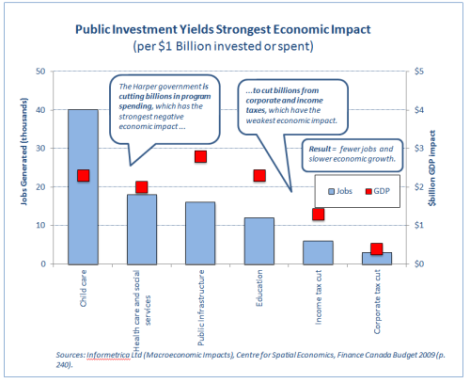
- Meanwhile, Toby Sanger highlights how austerity has undermined Canada's economy over the past few years by replacing efficient public investment with useless tax baubles:


- Which isn't to say that we're lacking for areas where public money can still be put to better use, as Don Pittis writes about the billions being funneled by governments into making climate change worse.

- Alison observes that while deep integration with the U.S. has taken multiple forms, neither its goals nor its proponents have changed one bit over the past decade.

- Finally, both Frances Russell and Lawrence Martin partially explain the Cons' destructive policies by looking at Stephen Harper's insularity and refusal to allow either any real outside input into his plans, or any debate over his unilateral decisions.

Tuesday, November 11, 2014

Tuesday Afternoon Links

This and that for your Tuesday reading.

- Shannon Gormley points out that human rights are meaningless in the face of a government which claims the entitlement to strip people of their humanity - which is exactly what the Cons are setting out to do:
(W)hen Canada’s Citizenship and Immigration Minister Chris Alexander announced this year that, “Citizenship is not a right, it is a privilege,” most human rights advocates couldn’t take him seriously. He may as well have declared that the curvature of the earth is merely an optical illusion and the world is indeed flat, or that the second law of thermodynamics doesn’t apply to his government, which can perpetually stay in power whether or not its ministers fuel it with statements deserving serious consideration.

But while remarks such as the minister’s may not be worth taking seriously as statements of fact, they’re worth remembering as philosophical beliefs that determine policy directions. 
...
(T)o make simple policy changes, the government must make serious philosophical changes. It has to reverse its absurd and dangerous position that “the right to have rights” isn’t a right at all.
- Rick Salutin highlights the amount of work young Canadians already put into their efforts to break into a hostile job market. And Aaron Wherry points out that there's no reason for workers to have any confidence in a government which will proudly trumpet the funnelling of hundreds of millions of dollars to employers in the name of a jobs program without even considering whether they'll actually create any jobs in the process.

- Jen St. Denis discusses the negative effects income-splitting would have on women's earning power even in the few families who would enjoy some surface benefit. And Angella MacEwen exposes Andrew Coyne's blind spot in valuing the contributions of a stay-at-home spouse at zero (resulting in tax benefits based solely on the actual income of the other spouse).

- Madhavi Acharya-Tom Yew reports on the widespread food bank use among people with full-time jobs which don't provide enough income to put food on the table. And Jordon Cooper discusses how Saskatchewan governments have come to see increasing reliance on food banks as a solution rather than a problem.

- Finally, Michael Harris writes about the Cons' exploitative relationship with Canada's veterans. And Ryan Meili comments on the connection between peace and health:
War brings injury and death by definition, but the impact of war is not limited to wartime. Long after the bullets stop flying, the destructive effects on a country continue: on its economy, its infrastructure, its psychology, its soul. War leaves behind land mines literal and metaphorical. Unexploded ordinances claim the lives and limbs of civilians. The spread of illnesses like HIV increases with the transience of wartime life. Violence and disease kill the young, the healthy backbone of the nation's families and economy. Those left behind often struggle with the emotional and psychological echoes of the trauma they survived. All of this damage leads to the perpetuation of poverty on numerous levels and, all too often, to a return to conflict and a repetition of the destructive cycle.

The road from peace to health is not a one-way street; a healthy society is less likely to find itself fighting. The same conditions that lead to higher levels of illness -- economic inequality, food insecurity, labour unrest -- can also lead to dangerous political instability. Since the early 1990s a series of global initiatives known as Peace through Health have been actively looking at the ways in which humanitarian health efforts can serve as a bridge to peaceful resolution of conflict. Well-resourced universal health systems can be a stabilizing element in both preventing and responding to violence. In this context, recent cuts to health services (including the drastic cuts to refugee health, many of whom have come to Canada to flee conflict) present a real threat to our health and security.

At this time of remembrance we are moved to think of those who sacrificed their lives in times of war so that others might live in peace. But to say "never again" to the horrors of the past means to work for peace today. A successful peace movement must recognize how injustice and inequality promote and perpetuate conflict. The world is suffering from a disease, with most gruesome symptom. As we continue to learn in health care, the most effective way to combat disease is to move upstream, to prevent sickness from starting.

Wednesday, November 05, 2014

Wednesday Morning Links

Miscellaneous material for your mid-week reading.

- Robert Reich discusses the right's utter lack of - and aversion to - empathy as either a personal or political value. Bob Norman reports on a particularly galling example of that phenomenon, as Fort Lauderdale has begun arresting people for feeding the homeless. And CBC reports on one of the systemic effects of a government which couldn't care less about the people under its jurisdiction, as Saskatchewan is seeing a drastic increase in people having to rely on food banks.

- Speaking of the Saskatchewan Party's contempt for social issues, Simon Enoch highlights how its push to sell off Saskatchewan's liquor retailing system ignores the well-documented social consequences of increased alcohol consumption. And Duncan Cameron writes about the latest set of privatization schemes designed to extract public investments for corporate benefit, while Thomas Walkom laments how quick the Ontario Libs (among other governing parties) have been to follow that path even when it means both higher costs and worse services.

- Michal Rozworski argues that our tax system should not only ensure that the wealthy pay their fair share, but also limit anybody's ability to accumulate so much as to distort the distribution of power:
[It] turns out there are good reasons for taxing the rich beyond raising revenue, and these reasons have precisely to do with changing how things are done.

The Nation has an excellent explainer of a recent study on the drastic fall in top tax rates over the past few decades. The authors, including Thomas Piketty of Capital in the 21st Century fame, wanted to see why the share of pre-tax income going to the very richest rose at the same time as top tax rates fell.

In short, they found that the rapidly growing incomes of those at the top were not due to rising productivity as mainstream theory suggests, but resulted from a better bargaining position. When top tax rates are low, CEOs, financial managers and others are motivated to spend more time trying to raise their earnings — for instance, stacking corporate boards that set salaries or giving out bigger bonuses — because they’ll get to keep more of them. Across countries in recent years, growth rates were very similar regardless of whether the top tax rate was high or low; the pie grew more or less as fast everywhere. In the countries where top taxes were low, however, top earners were able to capture a much, much bigger piece of the pie for themselves.
...
...We can raise top tax rates not only, maybe not even mostly, to fill public coffers but also to help restore bargaining power to the rank and file in workplaces, making top managers less willing to make out with all that they can for themselves — a top-down aid to those fighting inequality from the bottom up.

The lesson here is that taxes do much more than just redistribute income. They can also change institutions such as the family and the firm, redistributing power and changing how we relate to one another. The more pernicious tax cuts for the rich do more than leave money in well-heeled pockets. By the same token, the opposing call to “tax the rich!” can be a way to achieve more than padding the public purse.
- But Dennis Howlett points out that the Cons are instead looking to hand billions of dollars to the people who need the gift least, while Carol Goar notes that the calculated effect of income splitting is to redistribute income (and power) upward.

- Finally, Naomi Klein writes that big polluters are starting to receive some of the public opprobrium they deserve.

Tuesday, November 04, 2014

Tuesday Morning Links

This and that for your Tuesday reading.

- Paul Krugman points out the chasm between the policies demanded by businesses to suit their corporate biases, and those which actually best serve the cause of a strong and fair economy. And Michael Konczal highlights the damage done to our broader economy by a narrow focus on financial interests.

- Lisa Pasolli discusses the history of child care in Canada to offer some context to the policy choice that figures to dominate the next federal election. Margot Young makes the case that a new facade can't fix the serious structural problems with income splitting. And the CP reports that Canada's food banks have weighed in on the child care vs. tax bauble debate with strong support for a real child care system along with other improvements to our social safety net:
Canadian food banks are wading into the hot political debate over how best the federal government can help families with kids: give them tax breaks, as the Conservatives are doing, or invest in regulated child care, as the NDP proposes.

In its annual HungerCount report, Food Banks Canada comes down squarely on the side of the NDP.

It says the use of food banks remains 25 per cent higher than it was before the devastating global recession in 2008 and that 37 per cent of those helped are children.

According to the report, almost half of the households helped are families with kids and nearly half of those are two-parent families.

Among other recommendations, the report says the federal government should replace "the current alphabet soup" of child tax benefits with a new child well-being benefit that targets the most vulnerable families.

And it calls on federal and provincial governments to invest in predictable, stable funding for affordable, regulated child care, enabling parents to enter or remain in the workforce.
...
The report says "existing welfare bureaucracies" should be dismantled and replaced with a guaranteed basic income system.

And it recommends expanding eligibility for education and training programs offered through the Employment Insurance program.

It also calls on the federal government to invest in affordable housing.
- Meanwhile, Jen St. Denis talks to Gary Bloch about the effects of poverty and other social determinants of health. Annalise Klingbeil offers some good news in the form of Medicine Hat's progress in eradicating chronic homelessness. And Yvonne Roberts discusses the UK's living wage movement, while Christine Berry reports on its all-party agreement on four crucial elements of an economic policy oriented toward well-being.

- Finally, Christian Smith and Hilary Davidson write that the benefits of generosity include both personal and social gains.

Monday, November 03, 2014

Monday Morning Links

Miscellaneous material to start your week.

- Jim Stanford points out that the choice to leave drug development to the market resulted in a promising ebola vaccine going unused - and indeed untested - for years until the disease threatened a wealthy enough target population:
Canada’s outstanding work to invent one of the world’s most promising vaccines against Ebola perfectly epitomizes both the promise of public research, and the perverse incentives of the for-profit industry. Early this century Health Canada recognized the need for an Ebola vaccine, and assigned scientists with the Public Health Agency of Canada to find one. Almost a decade ago they patented a vaccine that prevents Ebola in monkeys. Canadian researchers should have been hailed as heroes.

Unfortunately, the government snatched defeat from the jaws of victory by handing over this important invention to the private sector – for a pittance. In 2010 Ottawa licensed the Ebola vaccine to a small U.S. firm called NewLink Genetics. I’ve been asking Health Canada to explain how the licensing was negotiated, and how much Canada was paid; I have yet to receive an answer. NewLink’s financial filings report it paid Canada an initial patent and signing fee, and a “milestone” payment of up to $205,000; “low single-digit” royalty fees will be payable on future commercial sales.

Most distressingly, guided by the profit-maximizing calculations of NewLink’s executives, the promising vaccine languished for years with no human testing – until this year’s outbreak. NewLink has suddenly rediscovered a sense of urgency, and is now accelerating human tests: but too late for thousands whose lives could have been saved if a vaccine was ready now. Even with the licence, Ottawa could have forced NewLink to move more quickly (or else revoke the licence altogether), but chose not to interfere. In the words of the University of Ottawa’s Amir Attaran, an expert on drug policy and public health, “This could have been a heroic Banting and Best moment for Canadian science, but instead it is a black comedy.”

Motivated by their government salaries and a desire to do good, smart Canadians can develop incredible medicines that significantly enhance human life. It’s only when the whole business becomes guided by profit, instead of human need, that this noble mission is lost.
- And Carol Goar exposes the use of Canada's public health care system for medical tourism, rather than to provide needed care to citizens.

- The Star weighs in on the Cons' latest income-splitting scheme and rightly concludes that a few tweaks around the edges can't justify a deliberate transfer of billions of dollars to disproportionately benefit wealthy families.

- Alan Tovey reports on KPMG's study showing that millions of workers in the UK are scraping by on less than a living wage. And Trish Hennessy looks at the numbers on our insufficient minimum wage levels in Canada.

- Mike De Souza reports on ExxonMobil's efforts to get him not to report on ALEC's shady dealings - including an ominous warning that other media have been entirely happy to fall in line with orders from their corporate overlords not to examine how big money is affecting policy debates. Andrew Prokop points out how the need for constant fund-raising makes it a challenge for U.S. political candidates to keep the public good in mind, while Democracy Now and Emily Atkin each document examples of the oil lobby flat-out buying municipal elections. And David Ball confirms that the Koch brothers have been funnelling money to the Fraser Institute's corporatist projects for decades, while Mark Eliesen explains his conclusion that the National Energy Board has joined the list of institutions which have been completely co-opted by corporate owners.

- Finally, Murray Dobbin has a few questions for Stephen Harper arising out of the tragic shootings in Ottawa. And Joan Bryden reports on Harper's refusal to discourage any anti-Muslim backlash.

Saturday, November 01, 2014

Saturday Morning Links

Assorted content for your weekend reading.

- Chris Matthews takes note of the gross growth of inequality in the U.S. Dean Baker notes that much of the wealth built on what's branded as "innovation" reflects little more than successful attempts to evade health, safety and consumer protection laws. And Mike De Souza explores how the notorious ALEC pushes climate denial and other anti-social policies with an alarming amount of support from businesses who (once challenged) claim not to know who they're funding.

- Meanwhile, Digby points out that the corporatist right is downright eager to work people to the point where they have to focus on bare survival rather than improving their lot in life. And Lana Payne warns us that the Cons are turning retirement into a luxury good rather than a reasonable expectation for most workers:
More and more Canadians believe they will never be able to retire, giving whole new meaning to the phrase “work till you drop.”
...
(A) full 60 per cent (of Canadians) do not believe they have saved enough to retire in comfort. Not surprisingly, women and lower-income earners were even less likely to have saved enough.

Shockingly, one in five Canadians reported that they will never retire. In addition, nearly one-third of those surveyed said they didn’t know when they’d be able to retire. Stagnant wages are coming home to roost.

The survey also found that over 40 per cent of employers surveyed said their employees are overly optimistic with respect to their assessment of when they will be able to retire.

That is rather astonishing, considering the dreary outlook so many Canadians seem to hold about their ability to retire in comfort. Yet even Canadians’ low expectations about retirement are considered optimistic.
...
CARP, the Canadian Association of Retired Persons, also supports enhancing CPP and notes the majority of Canadians agree. Indeed, the vast majority of CARP members see it as a ballot box question.

“We need federal and provincial governments willing to work together on a national solution to the national retirement savings problem,” CARP said in a statement.

It is clear that this won’t happen as long as the Harper Conservatives are in power.

We may as well add retirement income crisis to their legacy of neglect. Harper has been quoted as saying we won’t recognize Canada when he is done.

But damage can be undone, just as a new federal government can address the looming retirement crisis.
- But of course, the Cons are instead more interested in handing free money to families wealthy enough that they can already afford to have a parent stay home voluntarily. And even the Cons aren't pretending that income splitting could possibly offer meaningful help to households without a high-income worker - using that fact as an excuse to avoid offering any similar advantage for single-parent families.

- Mitch Jones points out that privatized water markets figure to do nothing but damage as we try to ensure the continued availability of a vital (and increasingly scarce) resource.

- Andrew Jackson reminds us that commodity markets are inevitably boom-and-bust - while recognizing that the Cons' obsession with pushing an oil-only economy has exposed Canada to dangerous risks as prices drop. And Mychaylo Prystupa reports that Kinder Morgan is SLAPPing Burnaby residents concerned about the effect of a pipeline expansion on their community.

- Finally, the Telegram slams the Cons for their continued contempt for election law - as well as their refusal to take responsibility for what's now a consistent, multiple-election pattern of illegality in their party. And Gerald Caplan writes that we should distinguish between mere members of Parliament and those who earn the title of "parliamentarian".

Friday, October 31, 2014

Friday Morning Links

Assorted content to end your week.

- Natasha Luckhardt examines what we can expect from Burger King's takeover of Tim Hortons - and the news isn't good for Canadian workers and citizens alike. But Jim Stanford reminds us that we're not without some public policy options by following up on the employment effects of an increased minimum wage.

- Of course, that would require a government committed to ensuring that the benefits of public policy go where they're needed. And we plainly can't count on that as long as the Cons are in power - as Kathleen Lahey, Jennifer Robson, and Scott Clark and Peter DeVries all note in discussing the distortions created by income splitting. Per Clark and DeVries:
According to the Harper government, income-splitting will cost Ottawa $2.4 billion 2014-15 and $1.9 billion in 2015-16. That’s an awful lot of revenue to give up just to make a small group of well-heeled taxpayers happy. Why do these households deserve a deep tax break more than the vast majority of Canadian taxpayer? How can the government justify a re-distribution of income that benefits the wealthy?
...
There is no justification whatsoever for introducing income-splitting on social or economic grounds — certainly not in the current economic environment. The argument that the government makes — that it did it for seniors and therefore it should be applied to other families — doesn’t make a particle of sense. The fact is that the Harper government gave income-splitting to seniors to make amends for its decision to tax income trusts.

Income-splitting is being done to placate a small part of the Conservative base at the expense of virtually everyone else.
- Meanwhile, Canada Without Poverty highlights the Cons' targeted attacks at those who most need help, this time through a budget which attacks benefits to refugees.

- But in case anybody thought that meant the general public is safe from the Cons' action, Scott Anderson and Vanmala Subramaniam report on the latest example of gross regulatory neglect - as Transport Canada let GM vehicles with a deadly flaw stay on the road after failing to follow up on an investigation. (And as an added bonus, Lisa Raitt lied to the public about her department's knowledge - though that seems to be the trend among Harper and his provincial puppet governments.)

- Finally, the CP reports on the NDP's work to pass an environmental bill of rights.