Saturday, June 04, 2022

Saturday Afternoon Links

Assorted content for your weekend reading.

- Matt Gurney examines the competing interpretations of what it means to say COVID is over, reaching the grim conclusion that we're never going to reach a better outcome than one with people dying needlessly and governments refusing to take preventative action. And the Canadian Press discusses the warning from experts that choosing not to collect or release data about continued infection will exacerbate the already-worrisome spectre of untreated long COVID.

- David MacDonald discusses how inflation is largely the result of corporate profiteering rather than any inevitability, while Amy Peng offers her own take on its causes and effects. Angella MacEwen highlights the unfairness of punishing workers while their bosses scoop even more profits off the top. And Andrew Nikiforuk argues in a two-part series that the inflation we're facing now is an inevitable result of overreliance on unsustainable fossil fuels which need to be phased out. 

- Lawrence Berkeley writes about research showing how the U.S. can meet a commitment to halve its greenhouse gas emissions by 2030 - but only if it gets to work immediately. And Gregor Semieniuk and Philip Holden note that while plenty of oil barons will keep their individual riches, it's institutional wealth that mostly stands to be affected as fossil fuel assets become uneconomic.

- Finally, Paula Tran reports that the UCP's attempt to claim that Alberta's drug overdose crisis is improving at all lacks any basis in reality. And David Moscrop writes that while British Columbia's move to decriminalize possession of small amounts of drugs represents a first step, there's a long way to go in eliminating the causes of the drug poisoning epidemic.

Friday, June 03, 2022

Musical interlude

The War On Drugs - Living Proof


Friday Morning Links

Assorted content to end your week.

- Fiona Small writes about the hope that one of the responses to COVID-19 will be a shift toward inhaled vaccines. But for those expecting that efforts will be made to address an ongoing pandemic, Melody Schrieber reports on new research showing the U.S.'s case count is off by a multiple of 30 or more. And Bill Kaufman reports on the documents showing how the UCP was fully aware of the effectiveness of mask mandates in preventing school outbreaks when it decreed that nobody in Alberta's public schools would be protected by them. 

- John Loeppky discusses the problem with a system of supports for people with disabilities which fails to take into account the inevitable transition from childhood to adulthood. And John Clarke highlights how our governments currently regulate people living in poverty more than they make any effort to ensure an acceptable standard of living. 

- Amy Goodman and Denis Moynihan offer a reminder that the corporate sector is no help whatsoever, as oligopolists have managed to endanger the supply of food for babies by pushing short-term profits over the supply of needed nutrition. And Leilani Farha writes that the right to a home is similarly being unmet due to the financialization of housing. 

- But as Zak Vescera reports, the Saskatchewan Party is looking to push a for-profit health care model which will ensure that public money flows to their cronies (not that people receive the services they need). And Hasan Sheikh and Brandon Doucet discuss the need for dental care to be publicly delivered to ensure access. 

- In case there was any doubt as to the need to build up progressive organizing infrastructure, Alexander Sammon reports on the Republicans' secretive efforts at sophisticated outreach in only the few minority communities which fall within swing districts, while Jonathan Chait exposes Donald Trump's institutionalized efforts to disrupt and overturn elections which don't suit his purposes. 

- Finally, Joan Walsh is right to be concerned about the future of democracy in the U.S. And Cassie Miller discusses how the problem is as much one of public opinion as partisan action, with large number of Americans buying into racist "great replacement" messages. 

Thursday, June 02, 2022

#SKNDPLDR Roundup

The Saskatchewan NDP's leadership campaign has followed a highly unusual path, with very little official activity (and only a few unofficial events and announcements) preceding last month's membership deadline. And it's only in the last week or so that the pace has begun to pick up - even as members have already received their ballots and voting instructions, with social media now showing plenty of ballots already being cast. 

That combination of factors again looks to strongly favour the front-runner, and there's still little indication that Carla Beck will face any suspense in her campaign. But for those interested in what's still developing...
- While there have been a few candidate meetings conducted by other organizers, the first official leadership forum is scheduled to take place in Moose Jaw tonight, with three more to follow in the weeks ahead. As Phil Tank notes, this will be the first chance to see whether there will be much contrast between the candidates within the campaign - and there are some seemingly important difference in the candidates' policies and point of emphasis if they look to discuss them.  
- It took until last week for Kaitlin Harvey to unveil her first caucus endorsement (from Jennifer Bowes), clearing at least one of the obvious hurdles in establishing support within the party. She  followed that up this week by declaring her intention to run to succeed Ryan Meili in Saskatoon Meewasin, signaling that there may be no issue as to concerns about a leader outside of caucus. 
- Harvey is also making a direct appeal for policy input on her leadership site, which offers at least a nod toward a more participatory model for her campaign. But it also raises the concern of her platform being a moving target even as votes are being cast.
- Meanwhile, Beck has continued to announce significant endorsements, including prominent elected officials like Doyle Vermette and Eric Cline, along with a bevy of activists and substantial labour support. But aside from that, Beck's activity has mostly been in her capacity as an MLA rather than aimed at the leadership campaign. 
- And finally, it's possible to get some information about the standing of the campaigns from their financial disclosures - which unsurprisingly feature Beck well ahead by the end of the last reporting period in April, with over $57,000 in donations compared to just under $11,000 for Harvey. 

For now, we'll look to see how the candidates compare in the leadership forums - as well as who has both joined the voter pool, and waited to decide as the campaign continues. 

Thursday Morning Links

This and that for your Thursday reading.

- Richard Sima examines how the steps needed to limit the spread of COVID-19 in indoor workplaces would also help address longstanding air quality issues. But Robert Pearl notes that rather than taking systemic steps to protect health from COVID as well as other issues, political leaders are pushing an ethic of immoral disregard for the well-being of others in order to facilitate the continuation of business as usual. 

- Fiona Harvey reports on Katharine Hayhoe's warning that we can't adapt out way out of the climate crisis, while John Fialka discusses how methane spikes are producing particularly rapid warming at the exact point when we need to be pushing in the opposite direction. The Energy Mix points out Deloitte's research estimating a $178 trillion cost of climate inaction over the next 50 years (compared to a positive return on investing in an energy transition). And Natasha Bulowski reports on the problems with the Libs' idea of consultations on a just transition where the witness list is slanted toward fossil fuel interests. 

- Meanwhile, in case there weren't enough reasons to rule out technology which doesn't yet exist and won't even reach the pilot stage for a decade as a substitute for a transition to renewables now, Mark Shwartz reports on new research showing that small modular reactors would create an even worse nuclear waste issue than existing power plants (whose waste of course still hasn't been dealt with after decades of use). 

- Bruce Campbell offers a reminder that Lac-Megantic and other preventable disasters signal the dangers of letting businesses decide how they're going to be regulated. And Anand Giridharadas talks to David Gelles about the need for business media to be far more skeptical about the assumption that the corporate lobby has anybody's best interests at heart. 

- Finally, David Moscrop is frustrated with the apparent malaise reflected in Ontario's election today, while Kaneera Uthayakumaran offers the hope of a young voter excited to exercise a voice in the direction of the province. Lucas Powers and John Rieti highlight how housing looks to be the key issue for may voters - though that should surely militate against support for a government determined to generate profit for developers rather than meeting the right to a home. And Stephen Magusiak and Luke LeBrun's late-campaign bombshell about PC insiders looking to use Doug Ford's government to get around sanctions against Russian oligarchs would seem to confirm that the already-obvious corruption within the current government is just the tip of the iceberg. 

Wednesday, June 01, 2022

Wednesday Morning Links

Miscellaneous material for your mid-week reading.

- Benjamin Mueller and Eleanor Lutz discuss the increased number of deaths among the elderly caused the Omicron COVID-19 variant as compared to previous ones, while WorkSafeBC's updated chart shows how 2022 has seen the largest claim counts for workplace COVID. And Gavin Leech et al. confirm the reality that masking can play a major role in reducing transmission in community settings.  

- But sadly, Kate Grenville writes that the pandemic has revealed how eager governments are to claim - and many people are to accept - that "every man for himself" is the only possible response to a social crisis. And Lauren Pelley reports on the warnings that went unheeded which have led to spread of a new monkeypox virus.  

- Armine Yalnizyan warns that the suppression of wages and workers' rights being imposed in response to inflation is far worse than the supposed problem it's intended to solve. And Grace Blakeley points out that privatized shipping and infrastructure is one of the major contributors to inflation (while also representing an obvious example of profiteering at the expense of both workers and consumers). 

- Sigal Samuel writes about the drastic impact of a modest basic income amount in reducing crime among men at risk of criminal behaviour. Rhonda Castello discusses how Ontario's basic income pilot project - which in again at issue in tomorrow's provincial election - relieved some of the most important stressors for people living in precarious circumstances. And Andrew Russell, Carolyn Jarvis, Michael Wrobel and Kenneth Jackson discuss the distinction between the NDP and Greens who are committed to ensuring that child welfare funding actually supports the people who need it, and the PC/Lib determination to prop up operators of for-profit care. 

- Finally, Lex Harvey reports on Doug Ford's feat in breaking the Star's fact-checking system by building his campaign rhetoric around claims which couldn't be tested for accuracy.  

Tuesday, May 31, 2022

Tuesday Night Cat Blogging

Outsider cats.


Tuesday Morning Links

This and that for your Tuesday reading.

- Kimberlyn McGrail examines the excess deaths caused by COVID-19 in Canada. Eric Berger discusses the continued lack of progress in diagnosing and treating a growing number of long COVID cases. Joshua Chong reports on the CCPA's study showing that women continue to bear the brunt of an unmanaged pandemic. 

- Meanwhile, Andre Picard writes that our response to a small number of cases of monkeypox may indicate whether we've learned anything at all from COVID. And Kristina Fiore notes that one of the enduring effects of the pandemic is the development of wingnut welfare for a new set of anti-science cranks. 

- Gillian Steward discusses how Alberta's health care system is suffering as a result of Jason Kenney's war on doctors (among other workers). And Zak Vescera reports on the growing recognition among health agencies that Saskatchewan needs to take action to limit the spread of HIV. 

- Marc Fawcett-Atkinson writes about the plea from Ontario's food banks for the province's next government to put them out of business, rather than continuing to make food deprivation into a growth industry. But Jessica McDiarmid warns that Doug Ford is on the verge of taking another majority by pretending to be everything to everyone (while governing only to funnel wealth toward his personal cronies). 

- Finally, Omar Mawji finds (PDF) that even in the midst of soaring prices, oil companies aren't bothering to set aside anywhere near enough money to clean up their existing messes. Geoff Dembicki discusses the reality that Suncor is one of the U.S.' worst climate villains, as it tries to undermine any effort to reduce pollution from refining and burning its products while posturing in Canada based solely on its extraction processes. And John Woodside reports on how Canada's major banks are propping up the TMX pipeline. 

Monday, May 30, 2022

Monday Afternoon Links

Miscellaneous material to start your week.

- Bruce Arthur is rightly frustrated by an attitude of utter denial and amnesia toward a pandemic still in progress. And Fenit Nirappil, Craig Pittman and Maureen O'Hagan report on the deterioration of the U.S.' response, including a dramatic increase over the case load this time last year. 

- Julia Levin asks why we're allowing the fossil fuel sector to determine Canada's climate policy. Adam Morton looks to Australia's example of how both the environment and the economy suffer when dirty energy producers are allowed to define their own responsibilities. Anna Cooban reports that even the UK Cons are applying a windfall profit tax to oil and gas companies - though their loophole for expanded production isn't one that we should be looking to emulate. And Emma McIntosh and Fatima Syed break down what Ontario's political parties have on offer for climate and environmental policy in this week's provincial election. 

- Jessica Spieker points out the dangers of unnecessarily large vehicles - and the glaring lack of action to make roads safer for everybody trying to use them. And Judith Enck and Jan Dell discuss the futility of relying on plastic recycling, rather than shifting away from substances increasingly known to be toxic and permanent. 

- Colleen MacPherson writes about the Saskatchewan Party's chronic underfunding of the province's education system. 

- Finally, Jessica McDiarmid reports on the continued deception of right-wing data miners posing as local "conversation" pages. 

Sunday, May 29, 2022

Sunday Afternoon Links

This and that for your Sunday reading.

- Selena Simmons-Duffin writes about the large number of COVID cases going unreported - and thus unaccounted for in risk mitigation - due to the shift toward private, at-home testing.  

- Jessie Anton reports on Saskatchewan's place as the worst jurisdiction in Canada for HIV transmission (among other preventable social maladies). 

- Laura McQullan reports on warnings from scientists that many parts of the Earth are headed toward temperatures that are uninhabitable for humans. 

- The David Suzuki Foundation studies how a shift to 100% renewable power in Canada by 2035 is both feasible and affordable. Matthew Gray charts the relative carbon prices needed to facilitate switches from coal to either gas or renewables - with the most recent data showing a strong advantage to renewables as the more affordable (as well as cleaner) option to phase out the dirtiest past energy sources. And Jake Johnson reports on the reason for cautious optimism from a G7 promise to cut off new public financing for fossil fuels. 

- Bob Murphy and Chiara Padovani discuss the cruelty involve in Ontario's meagre social assistance rates which have decayed for decades under PCs and Libs alike. 

- Finally, Arwa Mahdawi is duly appalled by the Republicans' attempt to blame doors for yet another preventable gun massacre. And Scientific American sets out some of the data showing how gun control measures are the policies which would reduce the number of mass shootings. 

Saturday, May 28, 2022

Saturday Afternoon Links

Assorted content for your weekend reading.

- Katherine Wu warns about the consequences of the powers that be deciding that people will be subjected to repeated COVID-19 infections. And Saba Qasmieh et al. examine the difference between reported case numbers and actual COVID prevalence, and find that the data now being provided may underestimate case counts by 30 times due to the choice not to conduct systematic testing. 

- The Globe and Mail's editorial board discusses how density - not further publicly-subsidized sprawl - represents a key part of the solution to ensuring people's right to housing is met. 

- Marco Chown Oved, Kenyon Wallace and Ed Tubb call out the Ford PCs' plan to shovel billions more public dollars toward the well-connected private long-term care home operators which saw some of the worst death rates in the course of the COVID pandemic. And Stephen Magusiak and Luke LeBrun report that Doug Ford's shady activities include having inner-circle operatives put one of his own cabinet ministers under surveillance. 

- Duncan Kinney exposes how the Edmonton Chamber of Commerce is exploiting a loophole intended for community groups to avoid property tax on most of a $11 million commercial property - and how the provincial government is allowing the business lobby tax advantages which aren't available for labour organizations. 

- Finally, Umair Haque laments the ongoing - and indeed worsening - carnage in the U.S. most recently exemplified through the mass murders in Buffalo and Uvalde. Elizabeth Bruenig writes about the U.S.' final descent into utter nihilism as yet another preventable  massacre of children produces public outcry but absolutely no policy response. And Sigal Samuel writes about the debate over grossly insufficient estimates of the social cost of carbon in the U.S. - and the reality that any reasonable valuation of human rights and a viable existence for future generations would make any avoidable carbon pollution untenable. 

Friday, May 27, 2022

Musical interlude

Jarryd James - Do You Remember


Friday Morning Links

Assorted content to end your week.

- Jennifer Hulme discusses how long COVID is causing devastating long-term effects on women in particular, with little apparent prospect of treatment to improve matters. And Linda Gaudino's report on the prevalence of long COVID offers an important reminder that the damage is both economic and physical. 

- Emily Leedham surveys the response of Ontario's major unions to Doug Ford's attempt to claim to have workers' interests in mind. And Adam King argues that Canadian labour law should be changed to enhance the right to strike - particularly by ensuring that non-union workers are able to strike in order to effect change in the workplace. 

- The CCPA examines how Saskatchewan's minimum wage continues to lag far below the cost of living even for a two-income family. And Don Pittis discusses how Canadians generally are seeing a need to cut back on consumer spending.

- Mitchell Beer reports on Caroline Dennett's revelations about Shell's complete disregard for the need for climate action despite a glossy greenwashing campaign. Innovative Research Group examines Canadian public opinion on the need for a just transition - with the phrasing of a particular question having an outsized effect on many respondents' support for change. 

- Sharon Udasin reports on Massachusetts' move to sue manufacturers over the "forever chemicals" used in a fire suppressant. 

- Finally, David Moscrop writes that the planned Rogers-Shaw merger is just the latest indication that private telecoms can't be expected to serve as anything but profit extractors - strengthening the case for public providers to ensure people have access to information. 

Thursday, May 26, 2022

Thursday Morning Links

This and that for your Thursday reading.

- Sara Reardon discusses new research showing that vaccination has only a limited effect on the prevalance of long COVID among people who wind up getting infected, while Cindy Harnett offers a reminder that the best way to limit the likelihood of long-term symptoms is to avoid catching COVID at all. Jaela Berntsen looks for answers to some of the questions people still have about masking, including by identifying the need to keep masking after an infection. And Kay Lazar reports on research showing that people who receive Paxlovid may have a propensity to become highly contagious again after their treatment is done.  

- Bridget Kuehn examines the causes of the U.S. mental health crisis, with both the added stresses of the pandemic and a lack of clinicians adding to the burden on patients. 

- David Milstead and Susan Krashinsky Robertson report on Dollarama's doubling of CEO pay even as it slashes even the minimal benefits provided to workers during the pandemic. 

- Doug Henwood points out the increasing proportion of Americans identifying themselves as working-class or lower-class - though it's jarring to see that increase predominantly among supporters of the Republican party doing everything in its power to make conditions even worse for all but the ultra-rich. And Robert Reich discusses the similarities between the Republicans and Russia's oligarchy in using violent nationalism to distract from the systematic looting of the general public. 

- Finally, Jerome Foster, Julia Jackson and Alexandria Villaseñor write that continued dependence on fossil fuels is a threat to national security among other vital interests. And Paul Sutter discusses new research suggesting that we're much further than anticipated down the road toward chaotic behaviour in our climate system (rather than pattern-based damage which can be predicted and mitigated). 

Wednesday, May 25, 2022

Wednesday Afternoon Links

Miscellaneous material for your mid-week reading.

- Aekkachai Tuekprakhon et al. study how the Omicron COVID-19 subvariants are evading both previous immunity and existing treatments. And Zak Vescera reports on Dr. Saqib Shahab's recognition that misinformation and apathy are key factors keeping Saskatchewan's vaccination rates low - though both government policy and messaging have played a substantial role in their development. 

- Meanwhile, Dr. Kevin Wasko discusses the five key areas where Saskatchewan's health care system is in the most need of improvement.

- Isaac Callan reports on the Ford PCs' refusal to make any effort to even discuss accessibility improvements for people with disabilities. And as Vanmala Subramaniam reports, that contrasts thoroughly against their choice to grant virtually every item on the wish list of Uber and other exploiters of precarious workers seeking to avoid normal employment responsibilities. Luke Lebrun exposes the PC's approval of a candidate whose background involves scamming students through an unaccredited career college. And Randy Robinson discusses the state of the Ontario election campaign - including the strong demand for change among women.  

- Alex Hemingway highlights how an investment in public housing can be self-financing while meeting people's essential needs. 

- Barry Saxifrage examines how Canada (like other countries) fell far short of its Copenhagen climate change commitments, while AFP reports on InfluenceMap's research showing how the fossil fuel sector is trying to use Russia's attack on Ukraine as an excuse to keep ignoring any climate responsibilities. And Damian Carrington reports on Antonio Gutteres' call for young people to refuse to pursue work with climate wreckers. 

- Finally, Clint Smith rightly opines that nobody should have to live through the losses caused by the U.S.' refusal to avoid readily-preventable mass shootings. 

Tuesday, May 24, 2022

Tuesday Night Cat Blogging

Focused cats.


Tuesday Morning Links

This and that for your Tuesday reading.

- Nicola Davis reports on new research showing that the effects of long COVID include sustained damage to organs including the heart, lungs and kidneys. 

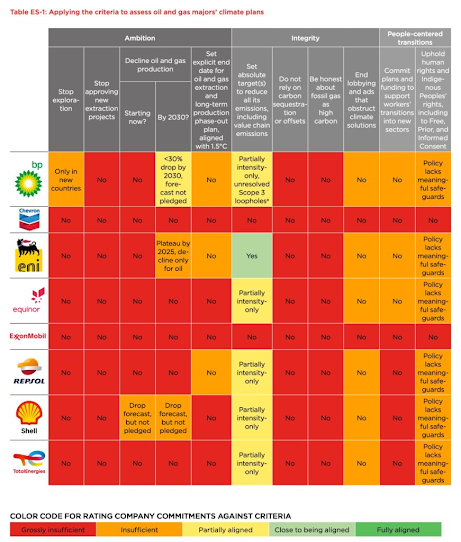
- Neal Wilcott and Sean Cleary discuss why businesses would be smart to plan for a net-zero emission world rather than delaying climate action and facing the risk of ecological system breakdowns as a result. But Oil Change International assesses the much-ballyhooed climate claims of the major oil companies, and finds that none of them are remotely close to operating within the imperative of meeting the world's Paris targets:


- Meanwhile, Fiona Harvey reports on the need for sharp methane cuts in order to avoid unacceptable near-term harm to our global environment. 

- Jen St. Denis writes about the potential for collective action by renters to shift a balance of power that now entirely favours commercial landlords. 

- Finally, Gaby Hinsliff notes that the resounding defeat of Australia's right-wing coalition offers hope that similar results are in store for the UK Cons and other right-wing, know-nothing populists. But Catharine Tunney reports on warnings from security experts that Canada needs a plan to decouple from the U.S. if it succumbs to the Republicans' anti-democratic bent.

Monday, May 23, 2022

Monday Afternoon Links

Assorted content to start your week.

- The Associated Press reports on Tedros Adhanom Ghebreyesus's warning that the COVID-19 pandemic is far from over. Mary Papenfuss discusses how people living in Trump-supporting counties (with lower vaccination rates driven by COVID denialism) have thus far been twice as likely to die of the coronavirus. And Ja'Han Jones writes about the latest research showing how widespread the ill effects of long COVID have been even among people fortunate enough to avoid severe initial symptoms.

- Meanwhile, Zak Vescera reports that the list of public health crises being allowed to run rampant by the Moe government includes Saskatchewan worst-ever level of HIV infection.

- Nisha Patel writes about the "shrinkflation" which is allowing corporations to pad profits while providing less of what people need. And Scott Horlsey discusses the corporate concentration that resulted in the U.S. having no baby formula available for families which desperately need it. 

- Jon Quealley writes about Oxfam's call for taxes on concentrated wealth and windfall profits to reduce poverty and inequality. And Will Bunch notes that even the oligarchs of the world are ultimately better off not competing for total domination.

- Dave Robbins interviews George Monbiot about his new book on how to sustainably feed the planet. And Mia Rabson points out the need for more resilient infrastructure and more effective disaster response to address the harm already wrought by climate change.

- Finally, Brian Topp offers a post-mortem on Jason Kenney's tenure in charge of Alberta. But Scott Schmidt warns that nobody should assume the UCP can't find someone even worse.

Sunday, May 22, 2022

Sunday Afternoon Links

Assorted content for your Sunday reading.

- Irelyne Lavery reports on the increasing number of Canadians needing medical attention for the flu as COVID-related protections have been scrapped. And Wallace Immen reports on some of the possibilities to try to improve a health care system which has been put under intolerable strain by the pandemic - though it's worth noting the distinction between the people working on improving the system, and those looking to enable the extraction of wealth from it.

- Meanwhile, Ian Tucker interviews Peter Kalmus about the dangers of trying to stay on auto-pilot in a system which is obviously breaking down absent major repair. And Fiona Harvey reports on the first steps being taken toward managing geoengineering as a risky substitute for reducing avoidable carbon pollution.

- Matt Krupnick reports on research showing that thousands of dangerous chemicals can be found in food packaging.

- Kriston Capps and Sarah Holder report on the workplace organizing happening among architects in an occupation where long hours and heavy debt are the norm.

- Finally, Jordan Bollag discusses the need for the left to build capacity as a movement willing to fight for social outcomes, rather than merely as an electoral machine hoping to harvest votes on election day. And Melanie Paradis points out how the anger-driven strategy which has become the norm on the right is ultimately untenable for any party or leader.

Saturday, May 21, 2022

Saturday Afternoon Links

Assorted content for your weekend reading.

- William J. Barber and Tope Folarin write that the U.S.' grim milestone of one million COVID-19 deaths already serves as a searing indictment of its policy choices and disregard for people living in poverty - and this before a combination of Republican cruelty and Democratic fecklessness results in there being no resources at all to meet a new wave of the coronavirus. And Alicia Wittmeyer looks at some of the human toll through the last messages between victims and their loved ones.

- John Smith discusses how rising costs and declining standards of living are pushing people living in poverty into perpetual fear and desperation. And Listen Chen examines how supportive housing may do as much harm as good in attempting to address homelessness - particularly by creating excuses for commercial landlords to evict the people in need of a home. 

- Bill McKibben points out how major corporations are feeding into the climate breakdown through their financial holdings while pretending to be green in their direct operations. And Emily Chung highlights how Canada's oil sector is trying to claim credit for carbon emission reductions when all it's done is to disclaim responsibility for the dirty energy it exports - or as Paul Dechene puts it:

- Meanwhile, Kevin Philipupillai reports on the Libs' latest move to avoid answering for continuing to pour public money into the Trans Mountain pipeline (among other fossil fuel subsidies), this time by reclassifying Trans Mountain Corporation to evade a need for Parliamentary approval for financing.

- Finally, Adam Serwer discusses how the "great replacement" bigotry underlying the Buffalo mass shooting (among other massacres) has become mainstream Republican messaging.