Showing posts with label australia. Show all posts

Saturday, May 02, 2026

Saturday Afternoon Links

Assorted content for your weekend reading.

- Alec Luhn warns that the potential consequences of the breakdown of the AMOC current include the release of far more of the carbon pollution that's already causing it to collapse. And Claudia Vorbeck points out that our current reliance on fossil fuels to produce fertilizer is unnecessary, with localized alternatives offering both a more secure supply and a reduced environmental impact. 

- Sabrina Tavernise notes that opposition to data centres has become one of the most universal areas of bipartisan agreement in the U.S. And Brian Merchant examines what the organizing against data centres may presage in the wider political system. 

- Alissa Quart discusses how fear and uncertainty have been propagated and weaponized by the corporations who are able to profit from them. And Johnnie Kallas et al. examine the reduction in strike activity which has seen American workers do less to assert their power over exploitative employers. 

- Finally, Althia Raj discusses how Mark Carney has forgotten - or at least chosen to ignore - the progressive voters who lent their support to elect him. The Star's editorial board highlights how Carney's plans for privatization serve nobody's purposes but those of corporate wealth extractors. And Lucy Hamilton offers similar observations from Australia, where a nominally progressive governing party is mostly using its power to cater to the wealthy few. 

Monday, December 22, 2025

Monday Afternoon Links

Miscellaneous material to start your week.

- Amanda Marcotte discusses how Donald Trump is taking know-nothingism to new depths in response to even the most glaring of realities. Mike Konczal notes that whatever theory there was behind Trump's economic policy (other than naked corruption) has utterly failed to materialize. And Casey Michel points out that white-collar criminals are among the few groups seeing any advantage to Trump's regime, while Adam Serwer adds Confederacy enthusiasts and anti-equality conservatives to the list. 

- Conor Curtis writes that Trump's most important current attack on Canada is being launched through corporate lobbyists. And Antonia Scatton discusses the failure of empty messaging which fails to recognize or challenge the control exerted by the wealthy few. 

- David Roberts interviews Samuel Bagg about the importance of social identity in guarding against misinformation, while David Climenhaga points out the massive pile of propaganda being served up by the UCP as it seeks to push anti-Canadian sentiment with no regard for facts or outcomes. And David Gilbert notes that some of the most influential voices in politics are ones who use large platforms to only rarely address political issues.  

- Finally, Patrick Marlborough calls out the Australian right for seeking to exploit a tragedy to push immigrant-bashing. But Amy Remeikis notes that nobody should be surprised to see the shock doctrine applied by conservative parties or their media sycophants. 

Friday, July 08, 2022

Friday Morning Links

Assorted content to end your week.

- Benjamin Mazer writes that of all the other public health analogies, COVID-19 may prove most similar to smoking in the systematic failure of governments to take readily-available steps to prevent widespread harm. Beth Mole reports on research showing that COVID was the leading cause of death of Americans aged 45 to 54 in the first three quarters of 2021. And Benjamin Shingler reports on the new wave cresting due to the BA.5 subvariant, while Katie Anthony and Andrea Michelson discuss the danger of repeated infections at short intervals. 

- Meanwhile, Zak Vescera reports on the glaring gap between the messaging conveyed to the public about Saskatchewan's public health measures in 2021, and the recognition by Dr. Shahab and others that it was grossly insufficient. And Patrick Collison writes that the prospect of universal COVID vaccines is running into a lack of interest in developing new versions which could be more easily administered and more effective against variants.  

- Carolyn Ferns discusses how Ontario's private child care operators have proven they can't be trusted with the task of building an effective system for families. Tom Conway highlights how unions are having to take the lead in pushing for safety in all kinds of workplaces. And Christine Saulnier points out the continued need for paid sick days for the sake of everybody's health. 

- Damian Carrington reports on new research showing that investment in plant-based proteins is the most effective use of carbon mitigation funding. And Geoff Dembicki discusses how the oil industry's history of deception includes pushing carbon capture and storage which it has known for decades to be ineffective. 

- Finally, Shane Wright discusses how Australia's Labour government is ensuring that its budget is assessed based on public well-being, not merely on GDP or profits. 

Tuesday, May 24, 2022

Tuesday Morning Links

This and that for your Tuesday reading.

- Nicola Davis reports on new research showing that the effects of long COVID include sustained damage to organs including the heart, lungs and kidneys. 

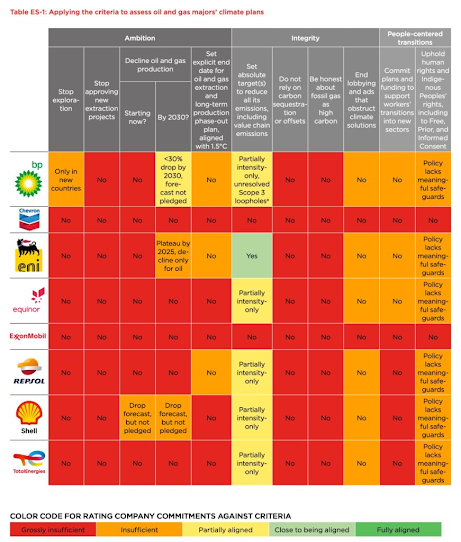
- Neal Wilcott and Sean Cleary discuss why businesses would be smart to plan for a net-zero emission world rather than delaying climate action and facing the risk of ecological system breakdowns as a result. But Oil Change International assesses the much-ballyhooed climate claims of the major oil companies, and finds that none of them are remotely close to operating within the imperative of meeting the world's Paris targets:


- Meanwhile, Fiona Harvey reports on the need for sharp methane cuts in order to avoid unacceptable near-term harm to our global environment. 

- Jen St. Denis writes about the potential for collective action by renters to shift a balance of power that now entirely favours commercial landlords. 

- Finally, Gaby Hinsliff notes that the resounding defeat of Australia's right-wing coalition offers hope that similar results are in store for the UK Cons and other right-wing, know-nothing populists. But Catharine Tunney reports on warnings from security experts that Canada needs a plan to decouple from the U.S. if it succumbs to the Republicans' anti-democratic bent.

Sunday, February 16, 2020

Sunday Morning Links

This and that for your Sunday reading.

- Heesu Lee reports on Greenpeace's estimate that air pollution costs the world nearly $3 trillion every year. And Damien Cave writes that this year's wildfires have permanently changed Australia as people knew it.

- Meanwhile, Alice Bell warns against trusting oil barons when it comes to developing policy to combat climate breakdown. Ian Austen talks to Christopher Flavelle about divestment - including the fear people have of speaking out due to the petronationalism emanating from Alberta and elsewhere. And Paul Dechene traces how Regina managed to invite a climate denialist to keynote a sustainability conference.

- Alex Boyd recognizes the historical significance in Indigenous protests in support of Wet’suwet’en sovereignty over its land targeting railways across the country. And Doug Cuthand weighs in on the importance of First Nations standing up for their land.

- Owen Jones writes about the dangers of treating a university education as a commodity to be delivered by the most precarious workforce possible.

- Rod Myer discusses how the rise of the gig economy is endangering the very concept of retirement, while Euan Black notes that older workers are facing consistent age discrimination even as they're told retirement isn't an option. And Omar Mosleh wonders whether the job action at Co-op's Regina refinery will represent a watershed moment for Canada's labour movement.

- Finally, Joel Lexchin writes that among the other compelling reasons to develop a national pharmacare program, it may be necessary merely to counterbalance the increases in drug costs arising out of the Libs' trade concessions.

Wednesday, January 22, 2020

Wednesday Morning Links

Miscellaneous material for your mid-week reading.

- Joseph Stiglitz, Todd Tucker and Gabriel Zucman write about the need for governments to bring in sufficient revenue to act in the public interest. And Sophie Alexander points out some of the millionaires who want their class to contribute their fair share.

- Robinson Meyer offers some historical perspective on both the climate breakdown we're already facing, and the continued carbon pollution which only figures to make matters worse. Mitchell Anderson comments on the futility of the Australian government's helicoptering of temporary food supplies to wallabies while it remains determined to destroy their habitat. And Emma McIntosh writes that both global economic forces and public opinion are on the side of a transition away from fossil fuels.

- Meanwhile, John Vidal writes that the solution to our excess of plastic waste involves planning to avoid creating it in the first place, not relying on recycling after the fact.

- Josh Rubin reports on the wage stagnation facing men living in Toronto over the past two decades. And the Economist weighs in on the connection between minimum wage levels and suicide rates.

- Finally, David Climenhaga takes note of the general strikes in France to save pensions under attack by Emmanuel Macron - as well as the media blackout against that type of collective action in Canada.

Saturday, January 18, 2020

Saturday Morning Links

Assorted content for your weekend reading.

- Dion Rabouin offers a reminder that corporate tax giveaways don't do anything to help the economy beyond the interests of wealthy shareholders. And Nicole Aschoff discusses the importance of building a model for progressive globalism to counter the reach of international capital.

- Meanwhile, PressProgress notes that the Libs' Infrastructure Bank is siding squarely with the latter by looking to turn municipal water supplies into fodder for corporate operators.

- Nicholas Kristoff and Sheryn WuDunn write about the deaths of despair which are lowering American life expectancies.

- Andrew Nikiforuk observes that B.C. fracking is causing the earthquakes which have long been anticipated, creating massive and avoidable risks to the province's dam infrastructure.

- Finally, Greg Jericho calls out the attempt of Scott Morrison's government to claim credit for climate negligence and "reductions" which involve the continued accumulation of carbon pollution - a position which is of course all too familiar in the Canadian context.

Monday, January 13, 2020

Monday Morning Links

Miscellaneous material to start your week.

- James Bradley writes about the range of responses to an increasingly threatening climate. And Emma Morris offers some suggestions as to how to become part of the solution to the climate crisis.

- Adrienne Buller discusses why the popular and necessary prospect of a Green New Deal didn't get anything approaching a fair hearing in the UK's general election. And Malcolm Turnbull writes that Australia's catastrophic bushfires should have provided the impetus for a transition - though part of the lesson to be taken from Scott Morrison's response is that we can't afford to have fossil fuel lackeys in power to obstruct vital progress.

- PressProgress rounds up a few of the Jason Kenney UCP's holiday disasters, while Scott Schmidt rightly criticizes the UCP's pattern of trying to point fingers at newly-declared enemies rather than answering even simple questions about its actions in government.

- Sara Birrell highlights just a few of the examples of how Saskatchewan has suffered as a result of P3 schemes.

- Finally, Birrell also discusses the clash of values underlying the Co-op refinery lockout. And Jim Keohane and David Colletto note that Canadians generally would prefer a far more secure pension system than is currently available to most.

Saturday, January 11, 2020

Saturday Morning Links

Assorted content for your weekend reading.

- Ben Jenkins rightly calls out Australia's right-wing government and media for caring not a whit for the people seeing their country go up in flames:
If you were holding out hope that the cynical and partisan way we currently talk about climate change can’t possibly hold in the face of actual climate disasters — when it’s undeniably manifested itself in unbreathable air and burning homes and smoldering coastline — let go of that hope now. These fires have shown the status quo to be a stubborn thing, possibly an immovable one. It’s rooted fast in place by money and politics and ideology.
...
Even from a cynical standpoint, there seems to be very little to gain in playing down a national crisis of this sort. A strong response rallies the nation. It shows you’re a leader who acts. Best of all, there’s no partisan division to navigate. It is a political truism that everyone, regardless of how they vote, does not want the country to be on fire.

But this isn’t about people, it’s about ideology, and to accept the unprecedented scale of the fires and act accordingly is to accept that the climate is changing and something needs to be done. That’s it. To me, this is the most striking aspect of the crisis — the debate about how best to douse a burning country has been seamlessly press-ganged into service in the ongoing culture war, all of which is amplified and buttressed by an increasingly demented right-wing media and an absurdly powerful fossil fuels lobby.
...
In this crisis, the conservative media have defended Morrison against the most benign attacks even as the death toll climbed and the fury mounted; they have dismissed experts with decades of in-field experience as “activists”; they’ve spread thoroughly debunked theories about these fires being caused by environmentalists’ opposition to preventative land clearing; even bushfire victims themselves were branded as “feral” when they had the temerity to heckle the PM during a photo opportunity in their fire-ravaged town of Cobargo. Possibly most telling of all, Craig Kelly, a member of Morrison’s government, went on UK television to deny any link between the fires and climate change, where even a wet gollum like Piers Morgan couldn’t let it pass. Back home, pundits on Sky News defended him, saying that they “didn’t know anymore more across the science than [Kelly].”

And so warnings weren’t heeded, rescue efforts weren’t funded, Hawaiian jaunts weren’t called off, not through incompetence, but through sheer bloodymindedness. If you take one thing away from all of this, know that there are people in both the government and the media who would sooner see the country burn than confront the enormity of this problem.

All of this should terrify you, because the appalling response to this crisis in Australia isn’t an aberration. Like the fires themselves, it’s the product of years of adverse conditions — a dominant conservative press, a powerful fossil fuel lobby, a class of politicians in the thrall of both — that would look very familiar the world over.
- Damien Cave likewise calls out Rupert Murdoch's role in spreading disinformation and anti-climate propaganda in the face of a public emergency. Emily Holden discusses the oil industry's investment in controlling any conversation about the climate crisis. And Vikram Dodd and Jamie Grierson report that the UK is choosing to label people fighting for our survival as extremists to be subject to extra surveillance and control.

- Spencer Jakab writes about the readily-avoidable damage being inflicted by natural gas flaring. And Chris Varcoe's reporting on the UCP's closed-door development of policy for orphan wells only looks to highlight another area in which the public will be expected to bear the cost of environmental destruction wrought by the oil sector.

- A new Pew Research poll shows that fully 70% of Americans view their economic system as unfairly favoring those who already have the most. And Reuters/Ipsos finds majority support for a wealth tax as one means of addressing the unfairness.

- Finally, James Hurley reports on a wave of foreclosure forgery in the UK comparable to what took hold in the U.S. after the 2008 economic crisis.

Tuesday, January 07, 2020

Tuesday Morning Links

This and that for your Tuesday reading.

- Martin Lukacs writes that the Trudeau Libs' attempts to put a glossier face on politics as usual may be running into a less than compliant public:
Not just in Canada, but around the world we have seen the emergence of an airbrushed, focus-grouped avatar liberalism—“yuppie simulacrum of populist breakthrough,” in Perry Anderson’s words—to face the challenge from a democratic-socialist left and an ugly resurgent right. This model of politics was ground-tested by the Obama administration and is today exemplified in the “extreme centrism” of Trudeau, French President Emanuel Macron, and U.S. Democratic politicians like Pete Buttegieg and Beto O’Rourke. What these men all share in common is an effort to forge a new consensus that can salvage the failed yet still pervasive neoliberal governing logic that counts extreme inequality and climate breakdown as its most obvious consequences.

Alongside a continued support for privatization, deregulation, corporate tax cuts, and a slow withdrawal of the welfare state, these political figures have tinkered around the edges to give their conservative economic policies a patina of emancipatory progressivism. Trudeau offered reforms, like a means-tested Canada Child Benefit, more representation of women and racialized people in cabinet and the civil service, and incremental measures on climate change. But none of Trudeau’s actions have so far threatened the authority of corporate interests to set the political agenda.

In rare moments, Trudeau has been candid about his role as a diligent manager of the status quo. Describing his government’s early achievements in a late-2016 interview with the Guardian (U.K.), the prime minister said: “We’re actually able to approve pipelines at a time when everyone wants protection of the environment. We’re being able to show that we get people’s fears and there are constructive ways of allaying them—and not just ways to lash out and give a big kick to the system.”

While the brand of the messenger of this formula has evidently been damaged since then, the formula itself lives on.
...
If “radical centrism” of the kind offered by Trudeau is not helping this situation, the question is whether it will be the right-wing who seizes on popular insecurity and directs it toward scapegoats, or whether a resurgent left can channel it in a movement against vested interests.

There are some hopeful signs. Class politics have made a return to western countries, however haltingly in Canada. Polls show enormous popularity for wealth taxation and programs like a Green New Deal. While the NDP under Jagmeet Singh has stopped its slow slide to the centre, its ability to advocate in opposition for the vastly ambitious policies that Canadians are evidently hungry for has yet to be seen.

The moral clarity and passion shown by a new crop of young left-wing parliamentarians suggests one way forward. But ultimately what we need is a voice for a radically different vision for the country—a vision rooted in redistribution, solidarity, and equality. Nothing less will test the Liberal government’s continued success in capturing voters by saying progressive things they may not ever mean.
- And Canadians for Tax Fairness points out that we've already reached Corporate Tax Freedom Day, with Canadian businesses having made enough money in the first work week of the year to pay all they'll be asked to contribute to a functioning country.

- Geoff Davies writes about the failure of neoliberal economics in Australia. And Royson James highlights how the Eglinton Crosstown LRT serves as a prime example of the dangers of public-private partnerships.

- Nicola Davis reports on the connection between severe childhood deprivation and permanent harm to brain development.

- Finally, John Vidal laments the loss of a decade in taking meaningful action against a global climate breakdown. And while Amanda Cahill raises the possibility that the fossil fuel sector should foot the bill for this year's calamitous bushfires, Reuters reports that Australia's Liberal government is instead responding with continued denialism.

Sunday, January 05, 2020

Sunday Morning Links

This and that for your Sunday reading.

- Scott Gilmore writes about the glaring need for Canada's politicians to show more capacity for shame - through it's worth noting both a global pattern to the same effect, and the dangers of trying to draw "both-sides" equivalency (as Gilmore does) in circumstances where the problem is asymmetrical.

- Carrie Tait reports on Jason Kenney's foisting of additional policing costs on municipalities which are already suffering from the UCP's cutbacks elsewhere. And Jennifer Hamilton writes about the UCP's gross neglect of Alberta's social and infrastructure needs as it tries to wring out every possible cent for its corporate benefactors.

- Samantha Beattie points out how little progress Canada has made on the climate change front over the past decade. Cynthia Banham rightly argues that we can't accept politics as usual in response to environmental threats to our ability even to sleep or breathe. Joelle Gergis writes that we're seeing the most dire scientific predictions come true as our climate breaks down, while Linden Ashcroft notes that the panic in Mallacoota is merely what we can expect in the future. And Mike Foley discusses how Australia's wildfires are only amplifying the damage by releasing far more carbon pollution.

- Meanwhile, Jay Greene reports on Amazon's threats against employees who dare to question its contribution to the climate crisis.

- Finally, the Globe and Mail's editorial board highlights the reality that Canada can't expect added population in its already-congested urban centres to rely on car culture for transportation. And Mario Canseco discusses new polling showing strong support in B.C. for the province's speculation tax which turns secondary and/or investment properties into funding for improved housing.

Saturday, January 04, 2020

Saturday Morning Links

Assorted content for your weekend reading.

- Michael Mann writes about Australia's deadly lesson in the dangers of a climate breakdown. Ian Gill offers a reminder that we may soon be next - and that we have every reason for rage at the oil barons and politicians responsible. And Duane Bratt highlights the meritless partisanship behind the Canadian right's attacks on carbon pricing.

- Meanwhile, George Monbiot offers some optimism that the new year can help us to recharge the planet and ourselves.

- Margaret McCartney criticizes the efforts of cynical corporate operators to monetize wellness. And Marcy Cuttler points out how infants and toddlers are taking in far too much sugar due to the food industry's choices.

- Finally, Katie Nopolous laments the transformation of the Internet from a state of decentralization to one of monopolization.

Saturday, December 28, 2019

Saturday Afternoon Links

Assorted content for your weekend reading.

- Andray Domise highlights the importance of fighting back against the excesses and harms of capitalism, rather than accepting it as being necessary or inescapable:

There’s no way around a simple reality for people who consider themselves to be on the left side of the political spectrum, the people who strive for widespread and radical, if not revolutionary, change—we’re getting our tails kicked. There’s no putting an end to that if people who hold left-leaning ideals cannot quit kidding themselves by believing that capitalism exists as a benevolent or even neutral social arrangement. If the left intends to win these fights, it must also stand in principled opposition to capitalism. 2020 is the year to do it.

“It is easier to imagine the end of the world than to imagine the end of capitalism,” goes an observation by, depending on your sources, either Fredric Jameson or Slavoj Žižek. And the frightening thing is, not only does the world’s end become easier to imagine with each passing day, there is also a politically active bloc that intends to keep squeezing profits until the music stops.
...
Environmental policy is not the only one where norms have become warped to the point of immorality. In Toronto, where nearly half of renters are paying costs categorized by the Canada Mortgage and Housing Corporation as “unaffordable,” it can take between two and 14 years to be placed into social housing. The situation is equally dire in Vancouver, where rising rents force tenants into recreational vehicles, and then the eventual possibility of being kicked out of RV camps en masse.

How does the federal government address any of this? By offering financial assistance and incentives to bolster people with tens (if not hundreds) of thousands of dollars stashed away to buy a home. Which of course helps the real estate industry, helps mortgage lenders, and does nothing for people pressed ever further into the reaches of poverty. Condo towers sprout up all along Toronto’s Gardiner Expressway and tent cities underneath it are bulldozed, while the earth continues to pirouette carelessly on its axis.
...

Our political, business and media class would like nothing more than to pretend that these are natural outcomes, that none of it is avoidable, and that the world is and always has been shaped according to the capricious whims of that unknowable free market.

But the truth of the matter is this: 58 per cent of Canadians have a favourable view of socialism, and 77 per cent of us believe the world is facing a climate emergency. Most Canadians find income inequality to be fundamentally un-Canadian, and there are, numerically, more of us than there are bankers, landlords, brokers and executives put together. The only way for the left to win this fight is for its political vision to expand beyond capitalism, and to capture the widespread desire to move on from its exploitative limits.

We’ve lived in that world for long enough. Time for it to end.
- Meanwhile, David Dayen discusses how the U.S.' media is allowing the financial sector to avoid any discussion of the policies desperately needed to restrain its wealth and influence. And Ian Welsh writes about the reasons for UK Labour's election defeat - with the role of a hostile media in an anti-social propaganda campaign ranking as a crucial factor.
 
- Cathy Crowe discusses a brutal decade for homeless people in Canada. 

- Mike Addelman comments on the lack of mental health care to meet the needs of people facing terminal illnesses.

- Tony Doucette interviews Susan Caxaj about the coercive environment facing migrant agricultural workers in Ontario. And Grace-Edward Galabuzi and Sheila Block examine the costs of racism in Canada's labour market. 

- Finally, Gundi Rhoades writes about the devastating impact of climate change on animals in Australia. And Ebony Bennett points out that Scott Morrison's government is continuing to subsidize fossil fuels and neglect any emission reduction or mitigation plans even while his country is ablaze.

Tuesday, December 17, 2019

Tuesday Afternoon Links

This and that for your Tuesday reading.

- David Ritter writes that a gross failure to act against a climate breakdown causing out-of-control wildfires and unprecedented temperatures is creating a crisis of legitimacy for Australia's government. Chris Hatch and Barry Saxifrage discuss the failure of the world's governments to turn dozens of climate meetings into meaningful progress. And Samantha Beattie examines Imperial Oil's deliberate climate denial after its own research confirmed the damage carbon pollution is doing to our planet.

-  Meanwhile, Hiroko Tabuchi reports on a single Ohio methane leak spewing more carbon pollution into the air than some entire countries. Which is of course an ideal time for a reminder that Jason Kenney doesn't want leaking methane to be regulated.

- OneZero examines the environmental injustice in Detroit, where deadly pollution is concentrated in clusters of poor and minority residents.

- Finally, Heather Scoffield discusses how the Trudeau Libs have abandoned their progressive promises and rhetoric now that they're again ensconced in power. And Amanda Terfloth offers a devastating account of how people are suffering from the Libs' stalling on universal national pharmacare.

Wednesday, March 28, 2018

Wednesday Morning Links

Miscellaneous material for your mid-week reading.

- Nathaniel Lewis laments the state of the U.S.' woefully insufficient social supports, while emphasizing the importance of public social spending in particular:
(P)rivate “social spending” is, for the most part, regressive and narrowly distributed. Households are bearing the cost directly for the goods and services that they themselves consume (like health care).

Public social spending is different. Often (though not always), it is a transfer of funds from the better-off to the worse-off. Think of a progressively funded, single-payer system. You get health insurance whether you have a job or not, and if you have a low-paying job, it will cost proportionally less than if you had a high-paying job.
...
There is a strong, direct relationship between public social spending and poverty reduction. This is even more impressive when you consider that “public social spending” does not automatically mean “progressive.”
...
...(P)ublic social spending does not just reduce poverty. It also creates a more equitable environment for society as a whole.
...
(I)t follows fairly obviously from the above that the US should be making large outlays on social welfare that it currently is not making. While other wealthy countries apparently view their inhabitants as part of a society with universal needs, the US largely leaves its people to fend for themselves.
- Elizabeth McIsaac writes that social assistance should be a key point of comparison for Ontario voters in this year's election. And David Pfrimmer points out that the federal Libs are again kicking the can down the road rather than putting any meaningful resources into fighting poverty.

- Meanwhile, Peter Martin reports on new research estimating the cost of Australia's tax giveaways to the rich at $68 billion per year. And Andrew Leigh notes that the current government's plan is only to make matters worse - even in the face of opposition from four out of five citizens.

- Marshall Steinbaum, Eric Harris Bernstein and John Sturm study (PDF) the economic and social harms resulting from corporate monopolies.

- Jia Tolentino highlights the perversity of a gig economy which treats the eradication of "life" from any attempt at work-life balance as a plus. 

- Finally, Ian Capstick offers a worthwhile read on the dangers of looking at politics solely through a partisan lens - particularly to the extent the result is to limit empathy toward political competitors.

Wednesday, August 02, 2017

Wednesday Morning Links

Miscellaneous material for your mid-week reading.

- Angella MacEwen offers her suggestions as to what a fair and progressive trade agenda should look like:
Investor-State Dispute Settlement (ISDS) mechanisms are especially unpopular, as they prioritize investor rights over investor responsibilities. Canada and Mexico have had similar dismal experiences under NAFTA — while the US has never lost a NAFTA investor-state case. ISDS chapters should be eliminated from progressive trade agreements, and any new investor protections should be subsidiary to national judicial processes and privilege state-to-state settlements.

The most effective way to compensate and transition people who lose out from economic shocks — whether from trade, automation or a variety of other sources — is to have a well-financed social safety net and universal public services. Employment Insurance and associated active labour market policies are important, but so are universal health care, child care, affordable housing and other elements of the welfare state. This is why public services must be fully carved out.

Transparency and accountability are missing from the current trade model. We need more than token stakeholder meetings or vague gender chapters to correct this gap. Environmental, human rights and gender audits can reduce exploitation and guide policy-makers toward better policy. Initial audits would be enhanced by a public system for regular monitoring and assessment of specific outcomes over time.

Finally, economic development strategies, such as strategic government procurement and community benefit agreements, must be available to domestic governments at all levels.

All of these areas represent untapped opportunities for significant improvements based on an alternative vision of a real “progressive trade agenda” — one that truly puts workers and the environment first.
- And Jim Stanford discusses how Canada is better off for Petronas having pulled away from its plans for a giant, unsustainable LNG project.

- Christine Saulnier takes a look at the lessons which should be learned from Nova Scotia's disastrous experiment with P3 schools. But Kelly Grant reports that the Trudeau Libs aren't much interested in being informed of the dangers of privatization run amok, as they pushed ahead with approvals for private plasma donations in the face of warnings from Canadian Blood Services.

- Which is to say that the Globe and Mail's understandable push for the Libs to put human rights ahead of profits when it comes to arms exports is likely to meet with something less than a receptive audience.

- Finally, Phil McDuff points out how a shift from first-past-the-post politics to a proportional electoral system would actually offer the public control whose absence resulted in the UK's Brexit vote (among other signs of citizen discontent).

Thursday, February 02, 2017

Thursday Morning Links

This and that for your Thursday reading.

- Andrew Coyne and Rob Mason each discuss Justin Trudeau's broken promise of a fairer electoral system. Chantal Hebert observes that the commitment itself - however frequently and fervently repeated - looks to have been little more than a cheap campaign prop. And Karl Nerenberg highlights how the Libs sucked in "strategic" voters with a promise they've done nothing but try to avoid keeping, while Ethan Cox places the false hope of electoral reform within a pattern of Lib lies.

- Andre Picard comments on the key issues which need to be addressed in Canadian health care - and particularly the importance of properly defining and funding medically necessary services, rather than letting user fees serve as a barrier to access.

- Carmen Lawrence asks who's really running Australia at a time when government choices seem to be oriented solely toward enriching corporate supporters:
It’s clear Australians are increasingly wary of the power of big business; in the latest post-election survey by researchers at the Australian National University, 74% responded “yes” to the proposition that “big business has too much power”, with 56% (up from the last survey) agreeing that “government is run for a few big interests”.
...
In the face of frequent revelations about corporate wrongdoing and corruption – including participation in foreign bribery, accelerating levels of tax avoidance and evasion, fraudulent misrepresentation of financial products, systematic underpayment of wages, and environmental vandalism – governments, state and federal, have not responded with robust measures to deter such practices. Nor have they made good use of the powers they already have to take effective action, despite evidence of clear abuses of corporate power.  
- And Sarah Cox raises similar concerns in British Columbia, where the Clark Libs are engaged in a scorched-earth campaign to stifle critics while pushing the controversial (but business-friendly) Site C project to the point where the public can't vote to stop it.

- Finally, Elise Stolte reports on a positive development out of Edmonton's City Council, which has voted to apply a subset clause to private reports to make sure they can be publicly reviewed once information is no longer sensitive.

Tuesday, March 29, 2016

Tuesday Morning Links

This and that for your Tuesday reading.

- Martin Regg Cohn exposes the Ontario Libs' pay-to-play governing strategy, as cabinet ministers have been instructed to use their roles and access to meet fund-raising targets of up to half a million dollars per year. And Gary Mason reports that privileged access to Christy Clark is likewise a cash cow for the B.C. Liberals.

- Meanwhile, Sean McElwee points out the income divide among young voters both in being pursued by political parties, and in participating in the U.S. political system.

- Corporate Knights takes a look at the massive amounts of corporate money currently stashed offshore. And David Climenhaga offers the modest suggestion that we should at least stop shovelling public subsidies toward tycoons like Murray Edwards who are going far out of their way to avoid contributing to the public good.

- Mark Penny writes that Australia's experience with corporate tax slashing is much the same as Canada's, with massive amounts of foregone revenue producing none of the promised economic benefits.

- Nadja Sayej highlights the latest exercise in lowering expectations and standards of living for precarious workers, in the form of pod-like home-offices. But Sara Mojtehezadeh reports on the Urban Worker Project which is looking to give precarious workers a voice that's currently lacking.

- Finally, Karen Turner examines new research showing that mass surveillance serves to stifle minority opinions.

Wednesday, December 17, 2014

Wednesday Morning Links

Miscellaneous material for your mid-week reading.

- Mariana Mazzucato comments on the role of the innovative state - and the unfortunate reality that we currently lack anything of the sort due to corporatist thinking:
(T)hanks in part to the conventional wisdom about its dynamism and the state’s sluggishness, the private sector has been able to successfully lobby governments to weaken regulations and cut capital gains taxes. From 1976 to 1981 alone, after heavy lobbying from the National Venture Capital Association, the capital gains tax rate in the United States fell from 40 percent to 20 percent. And in the name of bringing Silicon Valley’s dynamism to the United Kingdom, in 2002, the government of British Prime Minister Tony Blair reduced the time that private equity funds have to be invested to be eligible for tax reductions from ten years to two years. These policies increase inequality, not investment, and by rewarding short-term investments at the expense of long-term ones, they hurt innovation.


Getting governments to think big about innovation is not just about throwing more taxpayer money at more activities. It requires fundamentally reconsidering the traditional role of the state in the economy. Specifically, that means empowering governments to envision a direction for technological change and invest in that direction. It means abandoning the shortsighted way public spending is usually evaluated. It means ending the practice of insulating the private sector from the public sector. And it means figuring out ways for governments and taxpayers to reap some of the rewards of public investment, instead of just the risks. Only once policymakers move past the myths about the state’s role in innovation will they stop being, as John Maynard Keynes put it in another era, “the slaves of some defunct economist.”

- And Ross Gittins describes how an obsession with balanced budgets and tax tinkering is preventing Australia from even discussing meaningful social and economic goals.

- Of course, that will sound all too familiar based on the Harper Cons' treatment of Canada. And Carol Goar surveys some of the crazy policy choices which have led us to be grossly overreliant on unstable resource prices, while Trish Garner notes that poverty remained endemic even a supposedly strong economy prior to the resource bust.

- Murray Mandryk recognizes that the Wall government's determination to favour private consultants rather than building a strong public sector workforce is thoroughly counterproductive. And Paul Hanley laments the waste of $1.4 billion of public money on a carbon-capture scheme which is both dirtier and more expensive than renewable alternatives.

- And finally, the CLC rightly blasts the Senate for refusing to apply either second thought or any apparent sobriety in rubber-stamping an anti-labour bill which all parties agree contained serious errors.

Saturday, July 19, 2014

Saturday Morning Links

Assorted content for your weekend reading.

- Joseph Stiglitz writes that while we should expect natural resources to result in broad-based prosperity, Australia (much like Canada) is now turning toward the U.S. model of instead directing as much shared wealth as possible toward the privileged few:
There is something deeply ironic about Abbott’s reverence for the American model in defending many of his government’s proposed “reforms.” After all, America’s economic model has not been working for most Americans. Median income in the US is lower today than it was a quarter-century ago – not because productivity has been stagnating, but because wages have.

The Australian model has performed far better. Indeed, Australia is one of the few commodity-based economies that has not suffered from the natural-resource curse. Prosperity has been relatively widely shared. Median household income has grown at an average annual rate above 3% in the last decades – almost twice the OECD average.

To be sure, given its abundance of natural resources, Australia should have far greater equality than it does. After all, a country’s natural resources should belong to all of its people, and the “rents” that they generate provide a source of revenue that could be used to reduce inequality. And taxing natural-resource rents at high rates does not cause the adverse consequences that follow from taxing savings or work (reserves of iron ore and natural gas cannot move to another country to avoid taxation). But Australia’s Gini coefficient, a standard measure of inequality, is one-third higher than that of Norway, a resource-rich country that has done a particularly good job of managing its wealth for the benefit of all citizens.
...
Australia should be proud of its successes, from which the rest of the world can learn a great deal. It would be a shame if a misunderstanding of what has happened in the US, combined with a strong dose of ideology, caused its leaders to fix what is not broken.   
- Meanwhile, Julian Beltrame reports that Canada's combination of corporate tax giveaways and gutting regulations has done nothing to change stagnant business investment. (Though as Armine Yalnizyan notes, that's sadly accompanied by the C.D. Howe Institute insisting on more of the same failed corporatist policies.) Don Pittis writes that stagnant wages are leaving Canadian workers with nothing to show for economic growth. And Dennis Howlett's mild optimism about Ontario's single-year budget is more than outweighed by his recognition that Ontarians are far worse off for decades of austerity and tax slashing:
For years now, Ontario governments (both Liberal and Progressive Conservative) have been inflicting austerity policies while failing to comprehensively collect revenue from large corporations and the wealthy. This sloppy fiscal management persisted - long after it was obvious that it just doesn't work.

Cuts to public services have caused a lot of pain and not much gain in terms of reducing deficits. Those cuts also boosted unemployment, slowed economic recovery and reduced tax revenue.

We can no longer afford the steep price tag that comes with avoiding revenue side solutions. Governments need to be clear about the real costs of tax cuts and loopholes.
...
After so much tax cutting, Ontario kick starting a $1 billion reversal is a pretty small step. But it is a step in the right direction. But further steps in this direction are needed in the next budget, including possibly some modest but broader income tax increases.

There's a caveat though.

Boosting taxes on the rich and on corporations will not result in more revenue if governments don't close tax loopholes and take stronger measures to go after tax cheats. On this front too, though there were some encouraging words in the Ontario budget:

"Reducing corporate tax avoidance and closing tax loopholes is a priority for the Ontario government. The government supports the principle that everyone should pay their fair share of taxes, including corporations."

Word is that Ontario government will be pushing the federal government and the Canada Revenue Agency to step up their efforts. This is welcome news. Each and every Canadian province loses revenue from corporate tax avoidance schemes that take advantage of tax loopholes and offshore tax havens. It is time for a strong stand by all provinces at the premiers meeting scheduled for August. They can no longer avoid tackling what has become a chronic problem.
- Stephan Lefebvre points out how yet another set of free-trade spin is based on flat-out lies about the effect of NAFTA.

- Ethel Tungohan highlights the absurdity of the Cons' temporary foreign worker tinkering which does nothing at all to help actual workers of any kind:
If Kenney and Alexander truly want to protect temporary foreign workers from abuse, they would include robust measures that take into account the reality of these workers’ lives.

Workplace audits should be accompanied by a guarantee that abused temporary foreign workers will not be deported and will be given jobs in other companies for the duration of their stay in Canada.

Temporary foreign workers should be given open work permits that tie them to a specific industry, but not to a specific employer to mitigate abuse.

And, most importantly, the Canadian government should recognize that temporary foreign workers provide important economic contributions to Canada. Like other immigrants, they come to provide for themselves and their families. They should be provided pathways to Canadian citizenship.

If they are good enough to work, they are good enough to stay.
- Finally, today is another NDP Day of Action - this time focusing on climate change to celebrate Jack Layton's birthday. You can search for an event here - and I'll point out my home riding's canvass and barbecue in particular for anybody in Regina interested in getting involved.