Friday, June 05, 2020

Friday Morning Links

Assorted content to end your week.

- Linda McQuaig writes about the policies which were needed to sustain us through the COVID-19 crisis so far - but whose success can lay the groundwork for a fair and inclusive economy for the future:
For years, we’ve submitted to the economic orthodoxy dictated by Bay Street: that governments must deliver balanced budgets and low spending or economic disaster will follow — as surely as gravity will bring a heavy object plunging to the ground.

Then along came the pandemic. Suddenly the Bank of Canada is creating vast amounts of money, which the federal government is distributing to Canadians across the country. 

Nobody told us we could do that!
...
...Now that we see how it can be done, one is tempted to ask: could this be a way to pay for increased government spending on future things we truly need — like building hospitals and public transit and investing in renewable energy?

This is the sort of dangerous thinking that a phalanx of powerful interests — from the Fraser Institute to the financial press — are keen to crush, realizing it could spread more easily than coronavirus at a crowded, maskless beach party.

But, as economist Jim Stanford suggests, “the genie is out of the bottle.”
- Meanwhile, as part of Policy Response's comparison between the 2008 and 2020 crises, Angella MacEwen highlights the importance of investing in the care economy, David Macdonald emphasizes the work done to put money into people's pockets quickly, and Alex Himelfarb notes that we can deal with any fiscal impact by ensuring an increasingly wealthy elite pays its fair share.

- Joy Thomas writes that the pandemic offers a golden opportunity to ensure corporate transparency and crack down on money laundering.

- Sam Gindin points out the need to move beyond merely praising care workers to ensuring fair wages and working conditions, while CBC News reports on Scott Moe's continued failure to do anything of the sort. And Adam Carter reports on the mocking attitude of one private long-term care executive who carelessly let her contempt for residents and their families get heard by the people affected.

- Finally, Jim Storrie discusses how both the U.S. and Canada have been built on foundations of racial injustice. Peter Donolo calls out the Canadian leaders - including Justin Trudeau - who are unwilling to speak out against the U.S. deliberate violent repression of civil rights activists. And Rinaldo Walcott writes about the importance of fighting to abolish racial inequality once and for all.

Thursday, June 04, 2020

Thursday Afternoon Links

This and that for your Thursday reading.

- David A. Green, J. Rhys Kesselman, Lindsay Tedds discuss some of the complications involved in designing a basic income system. And David Roberts makes the case for a universal basic services model to ensure people have access to the necessities of life and social participation regardless of their income level.

- Meanwhile, Lauren Pelly discusses how shared and cramped housing can turn one's home from the best means of avoiding COVID-19 into a concentrated transmission zone.

- Penney Kome writes that there's an achievable path to convert to a sustainable, equitable economy. But Martin Hirst highlights how neoliberals are looking to put an end to the hope that we can build a stronger society in the wake of the COVID-19 pandemic.

- Sharon Lerner discusses how big pharma is trying to exploit a massive social problem by price-gouging when it comes to any possible prevention or treatment. And Emma McIntosh documents the painfully long list of environmental protections which have been opportunistically set aside to allow corporations to maximize their damage to our planet in the midst of a public health crisis.

- Finally, Amir Attaran writes about Canada's failure to manage that crisis. And Kendall Latimer and Alicia Bridges report on the expert consensus that Saskatchewan's choice not to be transparent about the spread of the coronavirus can't be justified as a matter of privacy.

Wednesday, June 03, 2020

Wednesday Morning Links

Miscellaneous material for your mid-week reading.

- George Monbiot opines that the UK has ceased to be a functioning democracy as unelected people exercise unchecked power. And Bruce Livesey wonders whether the U.S. is tearing itself apart as the racial divisions used to undermine class cohesion become untenable, while Rebecca Solnit recognizes that the violence being inflicted on a peaceful protest movement is entirely top-down at the direction of Donald Trump and police forces following his lead. 

- Vanmala Subramium calls out Rex Murphy and anybody else seeking to perpetuate denial of Canada's ongoing racial injustice, while Andre Picard takes note of the public health effects of racism. Roshini Nair discusses the need for people in positions of privilege to put in the effort to identify systemic racism.

- Alicia Elliott rightly questions why there's been so little action three years after the release of the report of the National Inquiry into Missing and Murdered Indigenous Women and Girls, while Chris Selley points out how the Trudeau Libs have fallen far short of their promises to fight racism. And Max FineDay writes about the need for Canada's rebuilding plan from COVID-19 to be rooted in reconciliation.

- Finally, Marieke Walsh reports on the NDP's push for race-based data collection to ensure Canada can identify and address racial inequality. And Tom Parkin discusses the successes of the NDP in pushing the Libs to help people otherwise left behind, particularly compared to the do-nothing anger of the Cons:
(O)ur Prime Minister announced his economic support plan—waiving the one week “waiting period” for Employment Insurance sickness benefits for workers quarantined or required to self-isolate. That plan collapsed to immediate criticism. “The vast majority of Canadians will not have access to his plan,” Jagmeet Singh warned from the Commons that day. “Sixty per cent of workers have no access to Employment Insurance.”

One week later the Liberals announced a new program—CERB, the $2,000 per month Canadian Emergency Response Benefit. But it continued to be a complicated program that cut people out. Singh and his caucus again pointed to gaps. And on April 15, the Trudeau government took what it called “decisive action,” expanding CERB eligibility to include seasonal workers and some others not eligible for EI.

On March 11, the Trudeau government also introduced a 10 per cent wage subsidy program for hard-hit businesses. Singh brought together a coalition of union leaders and small business owners to press for wage support of 75 per cent. And on March 27, the Trudeau government did that, too.

For weeks Singh and his caucus advocated for students, excluded from CERB, who face bleak summer job prospects. Finally on April 22, the Trudeau created the Canada Emergency Student Benefit.

Singh has ramped up his call for a national paid sick leave plan. And after a week of Trudeau saying that wasn’t his jurisdictional concern, on May 25, Singh got the PM on-side.

Conservatives pundits—for reasons perhaps as much psychological as ideological—seem miffed and perplexed at Singh’s string of wins for Canadians. Wrong, but self-convinced as ever, Conservatives’ big push was to cut CERB, which hit a wall of backlash. Can anyone recall any tangible win for Canadians engineered by Conservative leader Andrew Scheer?

Tuesday, June 02, 2020

Tuesday Night Cat Blogging

Flattened cat.


Tuesday Morning Links

This and that for your Tuesday reading.

- Robert Reich writes about the end of any pretense that Donald Trump was acting as a president rather than a self-serving social media influencer.

- Branko Milanovic discusses why it's useless to make modeled economic predictions in a time of complete uncertainty about the effect of reverberating shocks.

- Gary Mason points out that a national report on violence against women has been awaiting followup for three decades. And Chris Hall writes about the disproportionate burden being borne by women during the course of the COVID-19 pandemic, while Laurie Penny examines the data as to the share of vital domestic work being taken on.

- CBC News reports that Scott Moe is lagging behind even his western conservative counterparts in taking note of the desperate need for activities for children. And Cally Stephanow reports on the lack of addiction services and supports when they're needed even more than usual.

- Finally, Kaitlyn Matulewicz and David Fairey chart a path to establish a system of paid sick leave through provincial employment standards. But Andrew Hills notes that Doug Ford is joining Moe and others in using the pandemic to hack away at employment standards.

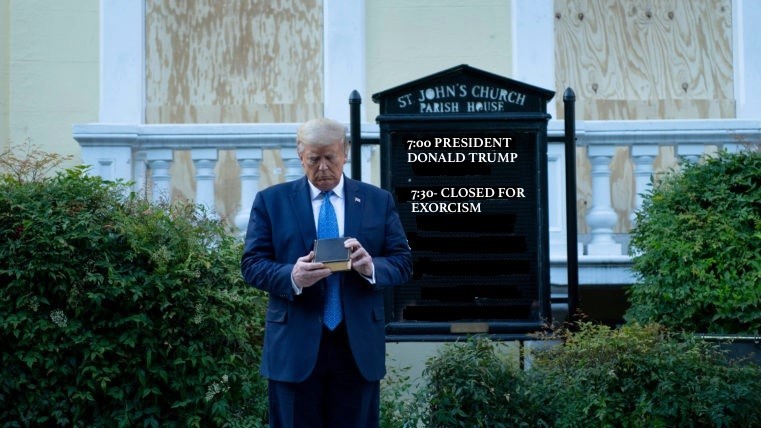
Signs of the times

It's been awhile since I've done much with Photoshop, and I can't take credit for the concept of working with this background. But for those interested, a couple of takes on Donald Trump's most prominent recent sacrilege:


Monday, June 01, 2020

Monday Morning Links

Miscellaneous material to start your week.

- Eric Cadesky writes about the psychology behind adherence to - and deviation from - the social distancing rules needed to keep us all safe.

- Nora Loreto discusses how COVID-19 has exposed the lethal problems with Canada's long-term care system. Karl Belanger points out that among the other warnings, Howard Hampton tried to highlight the neglect of residents in 2007 - only to see austerian governments continue to hold power. And Susan Delacourt discusses the role the federal government can play in ensuring that seniors are treated with care, while Scott Schmidt calls out Jason Kenney's UCP for declaring it's willing to sacrifice residents' lives if it means profits keep flowing.

- Kelly Grant and Carly Weeks examine Ontario's hot spots for community transmission of the coronavirus - as well as the social inequalities they reflect. And Jennifer Yang discusses the prospect that workplaces will be the new danger zones.

- Fair Vote Canada makes the case to restore democratically-determined per-vote funding to our federal political parties.

- Finally, Sandy Garossino discusses how Stephen Harper has cemented his place as an embarrassment since being voted out of office.

Sunday, May 31, 2020

Sunday Morning Links

This and that for your Sunday reading.

- Andrew Nikiforuk writes about the need to emerge from the COVID-19 crisis into a new normal, rather than trying to return to the distorted society that existed before.

- Sophie Ikura and Joshua Tapper discuss the other curves of ill health beyond the spread of the coronavirus which also need to be flattened as we respond to COVID-19. And Ian Hilton explores some of the options to organize a more fair and inclusive economy.

- Rasha Mourtada points out that we can't operate under the assumption that women will assume the full burden of caring for children. And Lana Stermac, Jenna Cripps, Touraj Amiri and Veronica Badali study how sexual violence damages women's academic performance and persistence.

- Louis Blouin and Peter Zimonjic report that the Libs are leaving their economic consultations to the wealthy few most responsible for the inequality we're already facing. And David Sirota offers a reminder that the real looting going on in the U.S. involves the gluttonous raising of public coffers by big business.

- Finally, Eric Holthaus discusses how the climate crisis is an example of racism which can only be confronted with an explicit anti-racist response. Shree Paradkar writes about the absurdity of white people taking offense at their privilege being pointed out, particularly in contrast to the life-and-death dangers created by racist social structures. And Paul Butler calls out the U.S.' criminal law system as serving to enforce different rights and obligations by race. 

Musical interlude

Metric - Youth Without Youth

Friday, May 29, 2020

Friday Afternoon Links

Assorted content to end your week.

- Fiona Harvey writes that as we rebuild after the coronavirus pandemic, there's no reason to pretend that prosperity requires continued reliance on greenhouse gas emissions. David Roberts examines how a coherent climate plan is finally emerging in the U.S. And Max Fawcett writes that the pipeline posturing that has represented one of the primary talking points of Canadian petropoliticians will soon be obsolete no matter how desperately they try to cling to fossil fuels.

- Emily Holden reports on the dirty fossil fuel money behind the U.S. protests against public health orders. And Jeff Gray exposes how Doug Ford is using the pandemic as a pretext to offer giveaways to his developer donors without public consultation or review.

- George Monbiot highlights how the privatization of health and long-term care is at the root of the UK's coronavirus catastrophe. And Aaron Wherry writes that it's about time to include long-term care in our public health care system where it should have been all along, while John Michael McGrath opines that Ontario can no longer hide from the consequences of decades of austerity and deregulation.

- Patty Winsa examines the types of workers hit hardest by COVID-19, while Alex Ballingall focuses on the particular challenges facing care workers with insecure immigration status. Matthew Boesler and Reade Pickert note that even people who have retained their jobs have often been confronted with pay cuts and deteriorating working conditions. And Iglika Ivanova and Kendra Strauss examine who stands to benefit from the availability of sick leave (and by implication, who's being forced to work even while sick in its absence).

- Finally, Sharon Lindores reports on the favourable Canadian response to international discussion of a four-day work week.

Thursday, May 28, 2020

Thursday Morning Links

This and that for your Thursday reading.

- Ian Hilton talks to several progressive economists about the opportunities for change as we manage and emerge from the coronavirus crisis. And Andre Roncaglia de Carvalho writes about the importance of state planning in charting our future course.

- Nav Persaud and Steve Morgan discuss how the COVID-19 pandemic has confirmed and strengthened the need for a national pharmacare system. And Carl Meyer reports on Canada Post's pilot projects testing the benefits of postal banking.

- Lynn Giesbrecht reports on the Moe Sask Party's failure to address children's programs and community opportunities as they've instead focused their plan for "reopening" around the business class, while Krista Broda calls for children's recreation to at least be included in the next phase. Matthew Yglesias highlights why it's far more important to focus on reopening schools than non-essential businesses. And the Canadian Centre for Policy Alternatives, the Canadian Women’s Foundation, Ontario Nonprofit Network (ONN), and Dr. Kathleen Lahey highlight the need to provide funding and resources to the women's sector. 

- PressProgress reports on Statistics Canada's warning that the urban Indigenous population may be particularly hard hit by COVID-19. And Kelly Provost reports that Saskatchewan has the highest rate of Indigenous cases of any province. 

- Finally, Hassan Yussuff calls for collective action to replace me-first thinking. And Nick French makes the case for radical workplace organizing as the foundation for renewed labour and social movements.

Wednesday, May 27, 2020

Wednesday Evening Links

Assorted content for your mid-week reading.

- Christine Boyle, Penny Gurstein, Matthew Norris and Jim Stanford make the case for a public option in housing. And PressProgress documents how for-profit seniors' homes are dominated by board members with no knowledge or experience in caring for people's health.

- Toby Sanger discusses how the pandemic has exposed how Canada's tax system excludes people with low incomes.

- I.F. Mason contrasts Doug Ford's rhetoric about supporting workers against his government's action in unfailingly forcing people to stay on the job in the face of unsafe work.

- Chad D. Cotti, Bryan Engelhardt, Joshua Foster, Erik T. Nesson and Paul S. Niekamp study how forced in-person voting caused an increase in the spread of COVID-19 in Wisconsin. 

- Andrew Nikiforuk points out that Jason Kenney is trying to turn the trashing of environmental protections into the new normal.

- Finally, Gary Mason writes about the need to address the additional pandemic of domestic violence.

Tuesday, May 26, 2020

Tuesday Night Cat Blogging

Elevated cat.


Tuesday Morning Links

This and that for your Tuesday reading.

- Ethan Cox highlights how Canada's wealthiest few are raking in billions in additional wealth through the COVID-19 pandemic, and returning a pitiful amount in the form of charitable donations.

- Karl Nerenberg discusses how people already on the wrong end of social and economic inequality face disproportionate risks from plans to force people back to work while a lethal virus is still in circulation. And James Doubek reports on the "inequality on top of inequality" found in the U.S.' coronavirus death toll.

- Mahli Brindamour and Ayisha Kurji highlight the need to minimize the damage the continuing pandemic does to child development - which is particularly worth contrasting their against the provincial government's emphasis on restoring the normalcy of golf and recreational fishing before taking children's interests into account. Derek Thompson writes about the need to move beyond social distancing alone in minimizing the risk of transmission, while Jaason Geerts writes about some of the changes we'll need to make as a second wave of COVID-19 approaches.

- Don Pittis discusses the potential for economic transformation as we rebuild from COVID-19. And Mike Moffatt and John McNally warn that we need to prepare for a difficult if worthwhile trek toward a new normal, rather than pretending we can merely restart the old economy.

- Finally, Eleanor Ainge Roy reports on Jacinda Ardern's proposal for a four-day work week as one way of rebuilding for the better. And Ryan Stuart points out that a move toward smaller and more diverse agriculture can make us more resilient, in contrast to the potential shortage we're facing from centralized corporate processing.

Monday, May 25, 2020

Monday Afternoon Links

Miscellaneous material to start your week.

- Ethan Cox writes that a large majority of Canadians favours massive public investments funded by more fair taxes on the wealthy as our road to recovery from the COVID-19 pandemic. And Aaron Wherry points out the folly of fixating on deficits and public-sector debts when there are far more important and urgent problems demanding our attention.

- Dakshana Bascaramurty, Carly Weeks and Eric Andrew-Gee discuss how vulnerable populations are facing a disproportionate share of the harm caused by COVID-19, while Elizabeth Leier highlights that reality in Montreal in particular. And Meenakshi Mannoe notes that selective policing is only making matters worse.

- Bill McKibben examines what it will take to avert catastrophic climate change - noting in particular the importance of not building additional fossil fuel infrastructure which results in continued carbon pollution.

- Emma McIntosh reports on Doug Ford's use of COVID-19 to undermine environmental regulation, as well as Ecojustice's push for him to reverse course. Archie Waquan writes about the effects of Jason Kenney's similar blanket destruction of regulation and consultation in Alberta, including its threat to a World Heritage Site. And Andrew Nikiforuk discusses Alberta's longstanding shell game when it comes to responsibility for oil site cleanup, while highlighting the Alberta Energy Regulator's rare order that Shell can't dump its existing obligations onto a smaller company.

- Finally, Hilistis Pauline Waterfall points out that many of the aspects of the coronavirus pandemic which are resulting in new traumas within settler populations are all too familiar for Indigenous people.

Sunday, May 24, 2020

Sunday Morning Links

This and that for your Sunday reading.

- Laird Cronk and Sussanne Skidmore offer their take as to how to ensure everybody benefits from British Columbia's recovery plan. And Trish Hennessy discusses the need to build a more empathetic and inclusive society:
COVID-19 has exposed what many of us already knew: public health is the key driver of everything, from community wellbeing to a thriving economy. If ever there was a time to embrace a Health-in-All-Policies approach to government decision-making, it is now.

COVID-19 has exposed the short-sightedness of austerity budgeting, where governments prioritized tax cuts over needed investments in public services—in health and mental health, education, child care, social supports, affordable housing, public transit, long-term care, and more. Decades of government cuts removed the layers of protection that should have already been there for us to weather the COVID-19 storm. Governments that respond to re-emergence with more belt-tightening are doing more harm than good.

COVID-19 has exposed how profit should not be a motive for basic services, such as long-term care. It has also exposed weak links in the supply chain and the need to ensure domestic supply chains that are resilient and promote local inclusive economic initiatives. It is showing us that some services should be in public hands, not for profit.

The pandemic  has also exposed underlying structural inequities that have long existed but went ignored: inequities based on income, race, ethnicity, gender, disability, and postal code (where you live). Those inequities interconnect to create health inequities, to limit life chances for those who are marginalized, disadvantaged, and low-income. A crisis like COVID-19 only serves to magnify and deepend [sic] those inequalities.
...
There can be no going back to the old system, which failed to meet the needs of the modern labour market even before the arrival of the pandemic. Nor can we continue to ignore the need for a basic income standard, better support for people who work in the service, retail, accommodation, arts and culture, and caring sectors, and the regulation of “sharing economy” work.

Wellbeing. Equality. Inclusion. Resilience. Sustainability. People and planet before profits.

These are key principles that should guide us as we recover, reset, and rebuild.
- Better Dwelling points out how people have long been taking on increasing debt loads as the public sector has refused to invest in people's needs. And Jesse Snyder reports on the additional debt load COVID-19 is imposing on households (which, unlike governments, can't sustain them in the longer term).

- Polly Toynbee highlights the capital gains which are further distorting the distribution of wealth in favour of the ultra-rich. Luke Savage points out how tech giants have become the new robber barons, including by taking advantage of the crisis which has harmed the productive economy. Mark Harris discusses the cruel absurdity of pandemic disaster capitalism. And David Hillman makes the case for a Robin Hood tax to ensure the financial sector contributes its fair share toward the public good.

- The Canadian Press reports on the conditions attached to federal bailouts for large businesses, which properly include an equity stake for the public. But Canadians for Tax Fairness notes the need to do more to prevent tax dodging by corporate recipients of public aid.

- Finally, Jordan Leichnitz discusses the vital role the federal NDP is playing in ensuring that people aren't left behind by a federal government focused primarily on maintaining the capital-focused status quo.

Saturday, May 23, 2020

Saturday Afternoon Links

Assorted content for your weekend reading.

- Ryan Hayes and Edward Hon-Sing Wong discuss both the importance of collective action to protect workers' rights, and the strategies which are proving most effective. Hamilton Nolan writes about the increasingly strong case for sectoral bargaining. And Chelsea Nash examines the gig-worker unionization campaign at Foodora which led it to flee Canada rather than being required to deal fairly with its workers.

- Meanwhile, Samantha Melamed points out how people are being pushed into gig work by a lack of other alternatives. And Kait Bolongaro and Shelly Hagan discuss why Canadian farms are having difficulty recruiting the seasonal migrant workers who are normally relied on to harvest crops - though it's worth noting the problems with a sector being structured to rely on insecure labour.

- Rob Shaw reports that John Horgan is both pushing the federal government to implement paid sick leave so that workers aren't pressured to endanger themselves and others, and planning to ensure B.C. workers have that level of income security if Justin Trudeau can't be bothered. 

- David Bernstein reports on the false promise that massive tax breaks for a new Sears headquarters would lead to any sustainable jobs or economic development. And Christopher Reynolds reports on WestJet's demand to be handed the right to lay off thousands of employees without liability even as it's already receiving a 75% wage subsidy to keep people employed.

- Jack Hicks writes about the travesty that is Saskatchewan's current excuse for a suicide prevention plan.

- Finally, Kai Kupferschmidt writes about the factors which result in the "superspreading" of COVID-19 while many infected people don't pass it along at all. Andre Picard notes that while we should turn mask-wearing into a social norm, it's far from the only action we need to take in order to minimize the harm from the coronavirus. And David Fisman points out that the success we've had in limiting the spread of COVID-19 so far means that there's all the more to lose if we abandon the effort prematurely.

Friday, May 22, 2020

Musical interlude

Royal Canoe - Living a Lie (Glacial)

Friday Morning Links

Assorted content to end your week.

- Through the newly-developed Progressive International, Grace Blakely writes that we don't have any choice as to whether our future will be planned - only as to whose interest are taken into account in the process:
Our choice is not ‘to plan or not to plan?’ but ‘in whose interests should we plan?’

The case for democratic public planning is clear. The inefficiencies, inequities and corruption generated by state-monopoly capitalism do not result from centralisation in itself, but from centralisation absent the centrifugal force of democratic accountability. There is a strong case to be made that, in the wake of this crisis, the resources by then under the command of the state should be allocated by the public, for the public. Absent this plan to democratize the economy, this crisis — and the suffering of so many millions of people it has caused — will have been for nothing but capital itself.
- The Economist highlights the opportunity to flatten the climate curve along the way. And Marc Lee points out some of the options for a low-carbon reboot of Canada's economy, while Adam Radwanski discusses the push to demand that the Libs make use of them.

- Abacus Data offers a detailed look at the progressive plan Canadians support - including both increased taxes on the rich, and investments in social priorities - as we rebuild from the coronavirus pause. Matthew Yglesias notes that even in the U.S., there's plenty of public support for public spending to finance a recovery - particularly if it's paid for by fair taxes on the wealthy. And Brian Jones also notes the importance of finally ensuring the lucky few contribute to the common good.

- But then, Norman Solomon discusses the class war being waged by the privileged in order to exploit the pandemic to further consolidate their control while denying any meaning to what everybody else is losing. Paul Krugman writes about Donald Trump's plan to sacrifice tens of thousands of Americans in the hope of securing temporary gains in the stock market. Owen Jones points out how the well-connected are able to extract preferential treatment from the business sector with reference to Boris Johnson's circle of close associates. And Eduardo Porter and David Yaffe-Bellany highlight how another generation is facing diminished long-term prospects as it emerges into an economy which is both crumbling generally, and top-heavy in its allocation of any gains.

- Finally, the Globe and Mail's editorial board rightly asks why testing and tracing which has long been promised - and which is known to be the only feasible option to increase activity without enabling the spread of COVID-19 - is still lacking in far too much of Canada. And Bruce Arthur writes about the need to make sure our lockdown actually results in the development of an effective public health strategy, rather than merely hitting the snooze button on an even more catastrophic wave of infection.

Thursday, May 21, 2020

Thursday Afternoon Links

This and that for your Thursday reading.

- Robert Reich argues that U.S. corporations need to prioritize the health of their workers over immediate profits. But James Galbraith writes about the wider need to move past disaster capitalism, including through government action to take core economic decisions out of the hands of self-interested executives and capital owners.

- Meanwhile, Heather Vogell reports on the financial sector's latest inflation of asset values in order to justify making loans which could be securitized - this time in the commercial property sector rather than residential real estate.

- Melissa Perri and Naheed Dosani discuss how the coronavirus pandemic has exposed the plight of homeless people. But Juliana Nnoko-Memanu writes that the temporary relief offered initially may soon give way to a wave of people being pushed out of their homes by lenders.

- Anna North observes that employers are rushing to withdraw "hero pay" even while continuing to demand that their workers put themselves at risk.

- Finally, Devi Sridhar writes that a push to reopen businesses without a plan for testing and tracing will mean our efforts to contain COVID-19 to date will do nothing but delay mass infection. And Elizabeth Renzetti argues that masks will need to become the norm as part of any attempt to increase social activity.

Wednesday, May 20, 2020

Wednesday Morning Links

Miscellaneous material for your mid-week reading.

- Linda McQuaig warns us not to tolerate yet another around of austerian demagoguery when investment in people's well-being is a positive step toward every end other than the goal of pushing people into additional precarity. And Marilyn Watkins examines how Washington state was left far less resilient by needless austerity following the last corporate crash.

- Jeanne Morefield reviews Jessica Whyte's The Morals of the Market, including by noting that neoliberalism has hijacked the language of human rights to serve the purposes of wealth accumulation. And Rutger Bregman discusses what may come next if the neoliberal era is finally at an end. But Nesmine Malik warns that the wealthy and powerful won't give up their privileged positions without a fight.

- On that front, Matthew Chapman notes that the Trump administration is using the COVID-19 pandemic to enable predatory financial institutions to extract even more from consumers. And John Bennett reports on Trump's more recent plan to use the crisis to utterly demolish regulation in the public interest, while Mark Winfield catches Doug Ford doing the same.

- Kim Kelly discusses how meatpackers' lives have been put at risk by exploitative employers and uncaring governments. And Colin Gordon writes about the role of decades of union-busting in trashing wages and worker protections.

- Finally, John Christensen writes that climate justice and economic justice are both inseparable, and essential to a sustainable future.

[Edit: fixed typo.]

Tuesday, May 19, 2020

On crossed lines

Shorter Scott Moe:
Would-be bombers shouldn't be threatening locked-out workers. That's my job.

Tuesday Night Cat Blogging

Fluffy cat.


Tuesday Afternoon Links

This and that for your Tuesday reading.

- Ian Welsh highlights the false choice between lives and the economy which is being used an excuse to concentrate the power of the wealthy at the expense of both. And Paul Krugman makes the obvious point - yet one seemingly controversial among Republicans and Cons alike - that it's a success to help workers rather than condemning them to death.

- Alessandro Marazzi Sassoon reports on the latest move by the right to suppress facts about the coronavirus to that end, as the architect of Florida' lauded dashboard has been pushed out for insisting that it be used to provide accurate data. Caitlyn McGlade reports on Arizona's refusal to name nursing homes with known COVID-19 outbreaks because it might be bad for business. And Peter Geoghegan and Mary Fitzgerald discuss the UK culture war aimed at attacking the concepts of science and expertise.

- Shannon Osaka discusses the sleight of hand used by fossil fuel giants to claim to be pushing toward carbon neutrality while omitting the carbon pollution generated by their products.

- Shawn McCarthy notes that the pandemic only highlights the desperate need to act to rein in climate change. Michael Enright interviews Charles Taylor about his hope that we'll win the battle against a climate breakdown. And Akshat Rathi discusses the growing consensus as to the value of recovering from the COVID recession through a Green New Deal.

- But Mia Rabson reports that the Libs have decided to put even their already-meager environmental plans on hold while catering to the corporate class. And Beatrice Britneff reports that a modest increase to Old Age Security is likewise being delayed in favour of one-time relief, turning what would have been a predictable source of income into a single payment.

- Finally, Noah Berlatsky comments on "vice-signaling" as a prominent and growing facet of conservatism.

Monday, May 18, 2020

On breaches of trust

Among other lessons to be learned from the coronavirus pandemic, we should be taking the opportunity to ask ourselves what we expect from our leaders - and whether they're living up to the standards we need to set for the public good.

That represents more than a matter of choosing ideal leaders. It's been well documented that social trust is one of the crucial factors in allowing a society to survive a collective action problem. And while a single government alone may not be able to establish or eradicate trust altogether, its choices figure to heavily influence how people react to a crisis.

Which brings us to the multiple breakdowns of trust under Scott Moe and the Saskatchewan Party government - all of them directly affecting the decisions Saskatchewan people make, and all posing grave threats both in their first-order effects, and in their resulting damage to social trust.

Let's start with the simple matter of the facts about COVID-19, and the Saskatchewan Party's seeming conclusion that we're better off not knowing where we're at the most risk.

It was dubious enough when a previous outbreak at Lloydminster's hospital was suppressed from the public for a period of days. (And it's hardly any consolation that part of that time was the result of a lack of communication within the government which is supposed to be looking out for everybody.)

But this past week's news from Regina's Pasqua Hospital establishes a pattern of COVID-19 cases in hospitals being suppressed. And this time, that secrecy came with the added bonus of Moe cutting off the normal flow of COVID-19 reporting for the long weekend to avoid answering questions about it.

That deliberate non-disclosure creates immediate risks for anybody who decides to attend to an hospital without being told that there's a known issue on site. But even more perniciously, it also creates reason for suspicion everywhere else: if we can't count on cases being reported when they arise in medical facilities, then people may avoid necessary care when it could safely be provided. (And we should fully expect addressing a backlog in needed-but-not-urgent care to be a far higher priority than the recreational businesses at the top of Moe's priority list for reopening.)

Beyond what Moe's government deigns to tell us, our trust is also necessarily affected by its competence (or lack thereof) in responding to a pandemic.

There, Moe has blindly followed Alberta in ritual Ottawa-bashing aimed at Health Canada, only to wind up ordering tests that don't work because he wouldn't allow a federal regulator to do its job. The Saskatchewan Party failed utterly to provide needed resources for mental health generally and suicide prevention in particular, even while using those systemic problems as an excuse to reopen businesses and increase the risk of community transmission of COVID-19. And it's provided pitiful excuses for relief out of provincial coffers, even as Moe has postured about allowing the federal government to help at all without his say-so.

Finally, we come to a government's willingness to listen and accept both suggestions and criticism. And there too, all evidence is that both the interests of deeply affected people and vital lines of communication have been cut off by choice - paired with deception and denial as to who's been kept in the loop.

Just ask the essential workers who are being told at best that they have to use paid sick leave in order to follow public health orders, and at worst that they're not allowed to try to protect their health at all.

Or the leaders from Northern Saskatchewan who were forced to set up their own response team after urging the province take some action to stop an outbreak which they could see coming - only to have Moe ignore them entirely at the beginning, then falsely assert they'd been included once the public health damage was too obvious for him to say nothing.

And of course, the people's mechanism for holding the government to account remains shut down due to the personal whims of the Premier, even as he tries to point the finger at a party which doesn't have authority to reopen the Legislature. Once again, the pattern is both to reject the basic structures of social cohesion and response, and to be dishonest about how he's chosen to undermine them. 

Fortunately, Saskatchewan voters have the option of a leader whose reaction to a crisis is to do everything he can to help, rather than to try to keep the public strictly isolated from the truth. But it's tragic that we're having to see the consequences of the avoidable erosion of trust first.

Monday Morning Links

Miscellaneous material to start your week.

- Martin Birt writes that we can never again ignore the importance and value of the people performing essential work. And Jennifer Keesmat argues that the patterns of life made necessary by the coronavirus point the way toward a far greater focus on building liveable neighbourhoods.

- John Stapleton highlights how many provinces are using the CERB and other COVID-19 benefits to reduce their own contribution to public health and welfare.

- Jonathan Freedland points out how authoritarians around the globe are using the coronavirus as an excuse to tighten their stranglehold on power.

- Christian Favreau discusses how the NDP has served as the effective opposition (in multiple sense of the word) to ensure people haven't been left behind in coronavirus relief measures. And Premila D'Sa reports on Charlie Angus' justified criticism of the Libs handing control over the distribution of vital public health supplies to Amazon.

- Scott Larson reports on how COVID-19 is exposing and exacerbating racism in Saskatchewan.

- Finally, Max Fawcett writes that Norway's disinvestment from the oil sands is just the latest indication that it's long past time for Alberta to stop denying both the climate crisis and its impact on investment decisions.

Sunday, May 17, 2020

Sunday Afternoon Links

This and that for your Sunday reading.

- Yves Engler discusses how Canadian corporations have shown a consistent pattern of pursuing profit with no consideration of the public good.

- Marco Chown Oved, Kenyon Wallace and Brendan Kennedy analyze how corporate care homes have paid out massive executive compensation and brought in billions in profits while leaving their residents vulnerable to COVID-19. And Kevin Donovan reports that Ontario isn't bothering to track the spread of COVID-19 among personal care workers who are among the most likely to be exposed to it.

- Brittany Scott writes about the need to develop workers' power as part of the effort to make workplaces - and by implication, the public - more safe in the midst of a pandemic. And Steven Greenhouse notes that even in the U.S.' distorted media environment, the public is well aware that the deck is stacked against workers.

- Moira Wyton reports on the lack of any meaningful response to First Nations who have sought help in responding to the coronavirus.

- Karl Nerenberg highlights how the federal NDP has ensured that seniors, students and many others weren't left to fend without any coronavirus relief.

- Finally, Ashley Martin reports on the Regina activists finding new ways to reach people when physical protest is either impossible or less likely to be seen.

Saturday, May 16, 2020

Saturday Afternoon Links

Assorted content for your weekend reading.

- Bryan Borzykowski recognizes that many Canadian families are weathering the COVID-19 crisis only by taking on more debt - though it's worth questioning whether the burden should fall on individuals to dig their way out from under it, rather than receiving systemic relief.

- A distinguished group of academics writes about the importance of democratizing work in rebuilding from the pandemic. Cailynn Klingbeil discusses the importance of not replicating existing inequalities as we map out the path forward. And Larry Savage theorizes that we may see a surge in workers standing up for their rights through strike action.

- But Alex Doherty warns that while governments are doing something approximating the bare minimum to keep people afloat through the pandemic, far too many interests are pushing to return to the old neoliberal normal as soon (and with as little care for people's well-being) as possible. Reuters News Agency reports on the Modi government's push to gut workers' rights in India in the name of a coronavirus response. And David Climenhaga points out that demands to turn the crisis into even greater corporate control are coming from the likes of Stephen Harper and Jason Kenney.

- Homi Kharas and Kristofer Hamel discuss how the coronavirus is setting back progress in fighting poverty around the globe. And Shakti Jaising notes that cultural depictions of pandemics all too often leave out the class effects.

- Finally, Nicola Jones writes that while there's reason to point out where the public health response to the coronavirus could be improved, we should also pay attention to the millions of lives already saved by the steps taken so far.

Friday, May 15, 2020

Musical interlude

Esthero - Black Mermaid

Friday Morning Links

Assorted content to end your week.

- Annie Lowrey discusses how essential workers have been consistently undervalued due to political choices. And Patty Coates, Jan Simpson and Pablo Godoy discuss the need to ensure legal protections for workers' rights in the wake of Foodora fleeing the country after its attempt to find a loophole in employment law failed.

- Meanwhile, Vanessa Brcic argues that we have a much-needed opportunity to better apply principles of equity and public health to the design of our social supports. Rutger Bregman implores us to take advantage of the opening to change the world for the better. And Laura Spinney interviews Thomas Piketty about the prospect that the response to COVID-19 will result in fairer societies.

- Gregory Beatty notes that social programs and safety regulations have been under neoliberal attack for decades. And Nam Kiwanuka highlights the dishonesty and inhumanity underlying the right-wing assumption that people receiving needed income support must be gaming the system.

- Susan Delacourt offers a reminder that Stephen Harper's last call for austerity and corporatism in the wake of a global crisis produced little benefit for anybody but the wealthy and well-connected. And Bruce Arthur notes that while Harper tries to deliver right-wing messages to an American audience, Canada faces the need to protect itself from the U.S.' reckless choice to let the coronavirus run wild in the name of Trump and profits.

- Finally, Matt Taibbi writes that the COVID-19 corporate bailout has once again offered the wealthiest Americans the opportunity to avoid any losses from their financial gambling. And Sharon Riley reports on Alberta's use of the pandemic to let oil companies off the hook for the environmental damage done by abandoned wells, while Lawrie McFarlane notes that Alberta is facing the consequences of its own disdain for the rest of Canada.

Thursday, May 14, 2020

Thursday Afternoon Links

This and that for your Thursday reading.

- The Globe and Mail's editorial board argues that Canada has put far too few resources toward actually stopping the spread of the coronavirus, focusing instead on immediate financial concerns rather than the underlying health issue. Justin Kong and Tsui Yee Wu make the case for ensuring that everybody has access to high-quality masks. Andre Picard highlights the importance of dramatically expanding our testing capacity before we let our guard down and resume business resembling the previous normal. And the Star's editorial board discusses how child care is an absolute must for our economy to recover.

- Andrea Horwath writes that Ontarians have had enough of long-term care oriented toward profit rather than residents' well-being. And Jen St. Denis writes about the human cost of treating housing primarily as a source of wealth and profits, rather than a human right to be provided to people who lack it.

- Isaac Chotiner interviews Arif Husain about the potential for COVID-19 to cause catastrophic hunger around the globe.

- Charlie Smith and David Climenhaga each offer reminders that Canada's oil sands are primarily owned by outside capital, meaning that even the benefits of any future price increases would mostly flow out of the country. And Geoff Dembicki reports on Deborah Lawrence's analysis suggesting that oil sands extraction is past its shelf life as a viable business model.

- Finally, Shannon Gormley discusses the warped interpretation of "liberty" being pushed by the fringe movement determined to endanger everybody in order to avoid even the least intrusive of public health measures.

Wednesday, May 13, 2020

Wednesday Afternoon Links

Miscellaneous material for your mid-week reading.

- PressProgress discusses now polling showing that a strong majority of Canadians favour a broad transformation of our society in the wake of the coronavirus crisis, with a focus on health and well-being. Tamara Lorincz suggests that we take the opportunity to withdraw from the purchase of fighter jets in order to put tens of billions of dollars toward more important ends. George Monbiot writes about the opportunity to make education more focused on the ecology which sustains us. And Naheed Dosani notes that the immediate response to COVID-19 demonstrates that there's no excuse for allowing homelessness to exist in Canada.

- Meanwhile, Andrew Jackson makes the case for any funding to large corporations being tied to equity stakes and consideration of larger social goals. Aaron Wherry discusses the minimal requirement that recipients of federal bailout money give at least a modicum of thought to climate change. And Tom Sanzillo notes that loans to the fossil fuel sector are virtually certain to turn out to be an utter waste of money.

- But in case anybody was under the impression that there would be anything less than a furious push to use COVID-19 to exacerbate the problems which led to its devastating impact, Jesse Snyder reports on corporate lobbying to eliminate any consideration of social and financial requirements in evaluating infrastructure projects. And Stephen Harper never passes up an opportunity to demand austerity and corporate obeisance, rather than making any effort to build a stronger society - while Grace Blakeley recognizes that the effort is based on little more than attempting to convince people not to believe their own eyes in seeing how public investment can make them better off. 

- Finally, Jason Warick reports on the push from Saskatchewan's Information and Privacy Commissioner - among many others - to ensure that the public has accurate information about the spread of COVID-19 in the face of the Moe government's inclination toward secrecy. And Adam Hunter reports on Moe's concurrent refusal to allow for any legislative accountability, while Murray Mandryk points out the absolute lack of justification for that stance.

Tuesday, May 12, 2020

Tuesday Night Cat Blogging

Floored cat.


Tuesday Morning Links

This and that for your Tuesday reading.

- Jim Stanford highlights the drastic difference between Canada's already-high official unemployment rate, and the much higher level of loss of work. And Aaron Wherry discusses how the workers with the least are bearing the greatest risks arising out of the COVID-19 pandemic.

- Jean Twenge examines the damage the coronavirus crisis has caused to mental health - particularly for parents. And Gilbert Ngabo reports on the extreme precarity facing one lower-income family.

- Michael Rachlis argues that long-term care facilities should be built as communities rather than warehouses for their residents. And Gary Mason makes the case to bring seniors' care under the Canada Health Act.

- Gary Stevenson points out how the rich were able to consolidate their wealth and control in the wake of the 2008 crash - and warns us not to it that happen again.

- Alex Hemingway summarizes why we shouldn't let deficit or debt scolds get in the way of investing in relief and recovery from COVID-19. And Nesrine Malik notes that a combination of austerity and corporatism explains why the coronavirus has been particularly destructive in the U.S. and the UK.

- Finally, PressProgress examines the destructive protests aimed at Vancouver health care workers and facilities. And Andrea Huncar reports that Edmonton's police are being warned about far-right extremists emboldened by the lack of any response to their threats of violence.

Monday, May 11, 2020

Monday Morning Links

Assorted content to start your week.

- John Nichols writes about Pramila Jayapal's recognition that mass unemployment is a policy choice - and her plan for wage supports to make sure workers aren't left without needed income. Nicole Aschoff discusses how profiteers have been taking advantage of programs set up to favour the businesses least in need of support. And Regan Boychuk rightly slams Jason Kenney for insisting that recovery funding be few into zombie oil companies.

- Meanwhile, Duncan Kinney talks to one of the Cargill workers put at risk by the joint neglect of their employer and the UCP. PressProgress exposes Amazon's rush to take even unpaid leaves of absence away from its employees. Jan Malek points out that we can't protect against the disproportionate risks to residents of long-term care homes without addressing the working conditions of the people who care for them. And Paul Daley examines how work may change once the coronavirus lockdown is over.

- Catherine Wedge interviews Alex Neve about the human rights implications of the pandemic. And Ritika Goel discusses how the coronavirus poses extra dangers for people who already lack secure housing or social supports, while Megan Pietrus points out that the response to date has largely left homeless people behind.

- Finally, Philippe Lagassé and Srdjan Vucetic make the case that Canada's response to COVID-19 needs to include distancing ourselves from the U.S. - both due to its negligence in allowing the disease to spread, and its unreliability as a primary trading partner. Linda McQuaig writes that there's no excuse for appeasing the U.S. by continuing sanctions on vulnerable nations, particularly at a time when deprivation anywhere endangers people around the globe. And Gavin Charles and Shannon Kindornay argue that we should be boosting our international aid to ensure a full and fair recovery.

Sunday, May 10, 2020

Sunday Afternoon Links

This and that for your Sunday reading.

- Ronan Burtenshaw discusses the British public's strong support for a New Deal featuring higher wages and more fair tax contributions by the rich as the UK plans for a recovery from the coronavirus. But Naomi Klein calls out how COVID-19 is instead being used to give all the more power to tech billionaires who only want to remake society to enhance their power and goose their profits.

- The Economist points out the increasingly-glaring gap between the real economy and the stock market. And Chuck Collins discusses how the wealthiest few in the U.S. are only getting richer through the pandemic which has left nearly everybody else in a precarious financial position, while J.C. Pan likewise recognizes that billionaires are swallowing the rest of the economy whole.

- Meanwhile, Paul Krugman highlights the reasons why Republicans are determined not to help Americans facing hunger and hardship.

- Victoria Gill reports on Mark Carney's recognition that self-isolation won't save us from the effects of a climate breakdown. And Nina Lakhani discusses new researching showing that dangerous heart and humidity are on the rise.

- Finally, Tom-Pierre Frappé-Sénéclauze observes that a full building retrofit program would work wonders both in ensuring sustainable development and reducing the damage we do to our planet. And Sean McElwee, Julian NoiseCat and John Ray note that U.S. voters are all the more supportive of a Green New Deal in light of the need for massive public investments to sustain and rebuild economic activity in any event.