Monday, August 15, 2016

Monday Morning Links

Miscellaneous material to start your week.

- Branko Milanovic points out how the commodification of our interactions may create an incentive for short-term exploitation:
Commodification of what was hitherto a non-commercial resource makes each of us do many jobs and even, as in the renting of apartments, capitalists. But saying that I work many jobs is the same thing as saying that workers do not hold durably individual jobs and that the labor market is fully “flexible” with people getting in and out of jobs at a very high rate. Thus workers indeed become, from the point of view of the employer, fully interchangeable “agents”. Each of then stays in a job a few weeks or months: everyone is equally good or bad as everyone else. We are indeed coming close to the dream world of neoclassical economics where individuals, with their true characteristics, no longer exists because they have been replaced by “agents”.

The problem with this kind of commodification and flexibilization is that it undermines human relations and trust that are needed for the smooth functioning of an economy. When there are repeated games we try to establish relationships of trust with people with whom we interact. But if we move from one place to another with high frequency, change jobs every couple of weeks, and everybody else does the same, then there are no repeated games because we do not interact with the same people. If there are no repeated games, our behavior adjusts to expecting to play just a single game, a single interaction. And this new behavior is very different.
...
Increasing commodification of many activities, the gig economy and flexibilization of labor market are just a part of the same change; they should be seen as a movement toward a more rational, but ultimately more depersonalized, economy where most of interactions will be one-shot contacts. Holding of many jobs and the shortness of interactions make investing in cooperative behavior prohibitively expensive. This Is the key reason why I am less optimistic than others that we are moving toward a society with a more collective, or “nicer” ethos. Actually, I think we are moving in the opposite direction.
- Sandro Contenta and Jim Rankin report on new research showing how poverty, race and other factors influence the removal of children from their families by Ontario's Child Services. And Jake Johnson discusses the place of race in the U.S.' ongoing class war.

- Tom Parkin examines how Justin Trudeau is falling far short of his promises of reconciliation with First Nations. And Jason Warick highlights the racist assumptions behind much of the institutional response to Colten Boushie's shooting, while John Baglow exposes the virtual lynch mob that has formed to try to justify the killing. 

- Finally, Ian Millhiser examines how fines and fees imposed by the criminal justice system can trap an already-poor family in a further cycle of debt. And Michael Powell writes about the Rio Olympics as a painful example of billions being spent on an elite vanity project while people living in poverty are forced to do without necessities.

Sunday, August 14, 2016

Juxtaposition

Shorter Tim Naumetz on the NDP's consistent stance opposing Bill C-51, a position supported by 17% of respondents in a recent poll (with plenty more undecided):
Boy, it's weird that a political party would take stand on a policy issue despite the public being less than fully on board at the moment.
Shorter Tim Naumetz on the Cons' position refusing to countenance any criticism of or change to Bill C-51, a view supported by 19% of the public in the exact same poll:
[crickets]

Sunday Morning Links

This and that for your Sunday reading.

- James Stewart examines how Donald Trump could be paying zero taxes using shelters designed specifically to enrich real estate developers while serving no social purpose. And Alexandra Thornton and Brendan Duke point out the "pass-through" loophole being exploited more and more by U.S. corporations.

- Daniel Tencer reports that the Libs' plan to make it easier for employers to exploit foreign workers comes at a time when any labour shortage is coming to an end. Scott Vrooman discusses how the media is being distracted by Justin Trudeau's PR stunts when it should be calling attention to issues like the Libs' willingness to arm human rights abusers.

- Jhumka Gupta and Reginald Tucker-Seeley discuss the connection between prejudice and social health. And Paul Wells points out that the Libs' interest in social policy seems to be limited to its ability to attract and benefit big money from abroad.

- Rob Ferguson examines how the Ontario Libs' election financing legislation is set up to benefit nobody but themselves. And it still amazes me that a review process started as a response to a government pay-for-access scandal is clamping down on other parties' activities while doing nothing about that issue.

- Finally, Katharine Hayhoe lists just a few of the ways in which climate change stands to affect our health.

Saturday, August 13, 2016

Saturday Afternoon Links

Assorted content for your weekend reading.

- Paul Krugman rightly points out that it's to be expected that Republican establishment figures would line up behind Donald Trump since he shares their top priority of handing still more money to the richest few. And Emine Saner highlights how strong inheritance taxes would help connect children of privilege to the society around them.

- Meanwhile, Neil Gross comments on the decline of the U.S. union movement as a contributing factor to the rise of the xenophobic right.

- Kendall Worth makes his case for a basic income. And Ursula Huws discusses the need for our social safety to adapt to an economic where people are expected to get by without secure, full-time employment:
For workers hovering precariously on the edge of survival trying to patch together a livelihood from multiple jobs, never sure when the next piece of work or income will show up, a benefits system in which the only categories are “employed” or “seeking work” is of little help. At the same time, daytime television programmes such as Saints and Scroungers, Benefits Britain: Life on the Dole, and Benefits Street drive home the message that there is no middle ground: you are either a hardworking taxpayer, or a lazy scrounger. In times of austerity, when governments aim to save money wherever they can, this is a convenient message. But the reality is not so simple.
...
We should go back to the drawing board and develop a system that provides basic security and dignity for all while still allowing for work to be organised flexibly. One possible solution is to give everybody a basic income – a guaranteed minimum income for everyone, available as a right. This would raise the standard of living and reduce poverty among the most vulnerable, but would also allow workers to move flexibly in and out of paid work, education and care work without being subjected to the expensive, demeaning and dysfunctional inquisitorial procedures of the current benefits system that sees only the largely exclusionary categories of “work” and “claiming benefits”.
- Shaurya Taran points out a stark example of the costs of homelessness - and asks why we're absorbing both the health and human costs rather than providing needed housing.

- Finally, the Globe and Mail reminds us not to overreact to the barely-existent risk of harm from terrorism in Canada. And Murtaza Hussain points out that the example of Aaron Driver looks to have been based on a lack of psychiatric care and other social supports for a single individual, rather than any meaningful type of organization.

Friday, August 12, 2016

Musical interlude

Yuri Kane & Ana Criado - Running Wild

Friday Morning Links

Assorted content to end your week.

- Owen Jones interviews Ha-Joon Chang about the foreseeable harm caused by the UK's austerity, as well as the false claims used to push it.

- The Stoney Creek News rightly argues that Canada Post should move toward posting banking in large part due to the potential to improve the level of service available for vulnerable groups. But Dean Beeby notes that Employment Insurance administration is just one of the many areas where the idea of actually assisting the public has been lost in favour of automation and corporatization.

- The Canadian Labour Congress points out a few of the policies which could offer much-needed opportunities and security for younger workers. And Jared Bernstein writes that an improved minimum wage (one of the CLC's recommendations) has worked exactly as hoped in Seattle, increasing workers' pay and length of employment without any of the threatened side effects.

- Mound of Sound highlights how Justin Trudeau has chosen to make Stephen Harper's industry-dominated National Energy Board his own, while Kai Nagata points out Trudeau's broken promises to put a credible review system in place before ramming through more project approvals. And Christopher Adams examines CAUT's investigation into the dubiously cozy relationship between the University of Calgary and oil-sector funders. 

- Finally, Murray Brewster exposes a Canadian-owned firm's sale of troop carriers for use in the ongoing war in South Sudan. And Don Pittis rightly notes that we should be less concerned with the nationality of a corporation's official ownership than with its actual behaviour.

Thursday, August 11, 2016

New column day

Here, on the Saskatchewan Party's decision to try to make up for its gross mismanagement by squeezing benefits out of people with disabilities.

For further reading...
- This year's provincial budget spin from the Ministry of Social Services is here, featuring the following:
Government’s next steps on the Saskatchewan Disability Strategy will focus on the Where to Start actions identified in the strategy, as well as six priority areas identified by community members:
  • accessible and safe transportation so people can participate in their communities;
  • respite to help families and caregivers get a break from their caregiving role;
  • accessibility legislation to create more inclusive communities;
  • residential services to help people live in their homes and communities;
  • service co-ordination and navigation so people can find disability services when they need them; and
  • awareness and understanding of the rights of people experiencing disabilities so all citizens have a greater understanding of and respect for their rights.
These initiatives have begun, and efforts are under way to establish measures, targets and public reporting on progress.
- Jonathan Charlton and Peter Mills are among those who have reported on the cuts to disability benefit recipients, including individual stories as to how little people already have to survive on. (Speaking of which, a summary of the existing SAID benefits is here (PDF).)
- Finally, I'll once again point to the Advisory Group on Poverty Reduction's report (PDF) as an example of the type of compassionate and thoughtful policy which are utterly lacking from the Wall government.

Thursday Morning Links

This and that for your Thursday reading.

- William G. Gale, Hilary Gelfond and Aaron Krupkin examine the evidence as to the effects of upper-class tax cuts, and find that they serve no purpose but to concentrate wealth and power in the hands of those who already have the most:
[Donald Trump's economic] plan won’t generate economic growth. We’ve been down this road before. For example, Reagan’s tax cuts did not boost the long-term growth rate, according to authorities like conservative economist Martin Feldstein, who was a Reagan appointee, and Douglas Elmendorf, former head of the Congressional Budget Office.

No one even proffers the suggestion that George Bush’s tax cuts – featuring lower income and estate taxes, like Trump’s plan– helped the growth rate, and for good reason. There is simply no evidence that it did.

Other countries have tried cutting top tax rates, too. The evidence shows that tax cuts for the rich help the rich accumulate more wealth, but don’t do anything much for economic growth.

Or, ask the people of Kansas how their income tax cuts have worked out. Listen to the stories about having to cut education and other spending and raise regressive taxes to make up for the absence of the promised growth miracle. Indeed, because of the massive rise in debt, Trump’s tax plan may actually hurt growth.
- Chris Dillow argues that grossly excessive executive compensation should be seen as just as much of problem from the right as from the left. And Christopher Shell and Frank Stilwell highlight the spread of income inequality in Australia.

- Joanna Smith and Jordan Press report on the federal government's analysis of the need for proactive pay equity legislation rather than a system limited to addressing complaints.

- Crystal Warner comments on the federal government's own failure to pay our public servants due to the Phoenix pay system debacle. And Bob Barnetson tells the stories of workers fired due to a supposed lack of work after informing a major employer of serious health and safety concerns - only to see their jobs taken over by more pliable replacements.

- Finally, Franklin Warsh offers a useful example as to how the social determinants of health can manifest themselves in drastically different outcomes for people who seem on the surface to be in similar positions.

Wednesday, August 10, 2016

Wednesday Afternoon Links

Miscellaneous material for your mid-week reading.

- Norman Farrell highlights how following the reversal of the HST transition, B.C. businesses haven't given up on their goal of making sure that only individuals pay consumption taxes.

- Jordan Press and Lee Berthiaume report on the lack of any recent effort to ensure that federal government buildings don't jeopardize health and safety - which fits all too well with areas such as federal and provincial pipeline regulation as examples of short-term cost savings virtually certain to produce long-term disasters.

- David Suzuki argues that it's time to press the Trudeau Libs toward action on climate change (based in no small part on the recognition that they'll never bother of their own volition).

- Sheldon Whitehouse and Elizabeth Warren comment on how big oil has rigged the U.S.' political system to prevent anybody from even asking questions about its longtime climate fraud, while Greg Russell points out that oil operators seem set to abandon their offshore wells and cleanup responsibilities. And David Climenhaga examines how Enron suckered the Alberta PCs into the laughably unfair power deal which the NDP is now trying to reverse.

- Finally, John Conway discusses the many dark clouds looming over Brad Wall's tenure as premier. And Murray Mandryk notes that the summer's events have called most of the Saskatchewan Party's core identity into question. 

Tuesday, August 09, 2016

Faith no more

Shorter Catherine McKenna on the Libs' response to the National Energy Board misleading the public about its insider dealings with lobbyists on Energy East:
Clap sunnier! Clap sunnier!

Tuesday Night Cat Blogging

Covered cats.


Tuesday Morning Links

This and that for your Tuesday reading.

- Thomas Walkom discusses Mel Hurtig's philosophy of economic nationalism, while noting that Canada stands out as an exception in lacking a strong movement toward greater internal planning and economic control. And Maude Barlow looks back at Hurtig's work, while Melissa Fundira reports that the Libs are trying to bar the door to would-be participants in the World Social Forum who would figure to follow in his footsteps.

- Frances Ryan highlights the absurdity of the U.K. Conservatives (like other right-wing governments) pointing to exclusionary private schools as a solution to, rather than a generator of, increased inequality.

- James Wood reports on the significant increase in the availability of workers' compensation benefits for Alberta farm workers.

- Joe Fiorito offers some solutions to homelessness from the people actually faced with it. And Diana Aviv highlights the U.S.' widespread lack of food security, while noting that there are some answers at hand.

- The Star's editorial board points out that we need to ensure that governments are funded to take care of people who need it most as well as meeting our other social priorities. And Jonathan Charlton reports on the Wall government's choice to instead attack the already-minimal benefits which helped Saskatchewan citizens with disabilities to stay afloat.

- Finally, Tom Parkin comments on the Libs' continuation of the Cons' tradition of news dumps - and notes that consultation-free permits for Site C represent one of the worst attempts to bury rubbish to date.

Monday, August 08, 2016

Monday Morning Links

Miscellaneous material to start your week.

- Joseph Stiglitz writes about the continuing need to rein in the excesses of corporate-dominated globalization:
The failure of globalization to deliver on the promises of mainstream politicians has surely undermined trust and confidence in the “establishment.” And governments’ offers of generous bailouts for the banks that had brought on the 2008 financial crisis, while leaving ordinary citizens largely to fend for themselves, reinforced the view that this failure was not merely a matter of economic misjudgments.

In the United States, Congressional Republicans even opposed assistance to those who were directly hurt by globalization. More generally, neoliberals, apparently worried about adverse incentive effects, have opposed welfare measures that would have protected the losers.

But they can’t have it both ways: If globalization is to benefit most members of society, strong social protection measures must be in place. The Scandinavians figured this out long ago; it was part of the social contract that maintained an open society – open to globalization and changes in technology. Neoliberals elsewhere have not – and now, in elections in the United States and Europe, they are facing their comeuppance.

Globalization is, of course, only one part of what is going on; technological innovation is another part. But all of this openness and disruption were supposed to make us richer, and advanced countries could have introduced policies to ensure that the gains were widely shared.

Instead, they pushed for policies that restructured markets in ways that increased inequality and undermined overall economic performance; growth actually slowed as the rules of the game were rewritten to advance the interests of banks and corporations at the expense of everyone else. Workers’ bargaining power was weakened, competition laws didn’t keep up, and existing laws were inadequately enforced. Financialization continued apace, and corporate governance worsened.

Now, as I point out in my recent book Rewriting the Rules of the American Economy, the rules of the game need to be changed again – and this must include measures to tame globalization.
- And Erik Sherman writes that increasing economic inequality may be driving the U.S.' political polarization.

- Will Evans points out how temp agencies are able to engage in systemic discrimination with little prospect of having to compensate victims. And Sara Mojtehedzadeh discusses how they also serve as a shield against the enforcement of employment standards, while also reporting on a class action based on the sub-minimum wages paid to workers classified as independent contractors.

- Alec Luhn examines the environmental calamity flowing from Russia's dependence on poorly-maintained pipelines. Richard Fuller and Jack Caravanos remind us that lead poisoning remains a widespread problem which isn't the subject of any meaningful remediation. And Andrew Freedman notes that today's irresponsible experimentation with our shared planet may cause yesterday's to resurface, as climate change allows Cold War-era experiments to emerge from where they'd been buried.

- Meanwhile, Erin Auel discusses how the U.S.' worst carbon polluters are spending large amounts of money trying to fight any regulation at all rather than cleaning up their act. And Eric Lipton and Brooke Williams highlight the connection between think tanks and their corporate puppetmasters.

- Finally, Jim Stanford makes the case to revisit the Bank of Canada's mandate to deal with real concerns about stagnation and systemic unemployment, rather than focusing solely on far-fetched fearmongering about future inflation.

Sunday, August 07, 2016

Sunday Morning Links

This and that for your Sunday reading.

- Michael Wasser comments on the importance of unions - and the need to ensure that corporate-dominated politics don't stand in the way of worker organization. And Ben Sichel rightly argues that Ontario's widespread violations of employment standards demonstrate the need for unions to protect workers' rights even when there's some theoretical legal protection in place.

- Neil Irwin discusses how decades of neoliberal economics have left most of the developed world with stagnant development:
This slow growth is not some new phenomenon, but rather the way it has been for 15 years and counting. In the United States, per-person gross domestic product rose by an average of 2.2 percent a year from 1947 through 2000 — but starting in 2001 has averaged only 0.9 percent. The economies of Western Europe and Japan have done worse than that.

Over long periods, that shift implies a radically slower improvement in living standards. In the year 2000, per-person G.D.P. — which generally tracks with the average American’s income — was about $45,000. But if growth in the second half of the 20th century had been as weak as it has been since then, that number would have been only about $20,000.

To make matters worse, fewer and fewer people are seeing the spoils of what growth there is. According to a new analysis by the McKinsey Global Institute, 81 percent of the United States population is in an income bracket with flat or declining income over the last decade. That number was 97 percent in Italy, 70 percent in Britain, and 63 percent in France.

Like most things in economics, the slowdown boils down to supply and demand: the ability of the global economy to produce goods and services, and the desire of consumers and businesses to buy them. What’s worrisome is that weakness in global supply and demand seems to be pushing each other in a vicious circle.

It increasingly looks as if something fundamental is broken in the global growth machine — and that the usual menu of policies, like interest rate cuts and modest fiscal stimulus, aren’t up to the task of fixing it (though some well-devised policies could help).
- Meanwhile, Josh Bivens and Hunter Blair examine how a financial transactions tax would both redirect economic activity toward actual productivity, and provide significantly more funding for social benefits.

- Alison Brownlee discusses a thoughtful proposal to fix the twin problems of retiree isolation and unemployment by funding personal support for seniors by low-income individuals.

- Finally, Robin McKie reports on new climate data showing that we're already on the verge of exceeding the 1.5 degree Celsius target set at the Paris climate change talks.

Saturday, August 06, 2016

Saturday Afternoon Links

Assorted content for your weekend reading.

- Rachel West charts how higher wages and improved social supports can reduce crime rates and their resulting costs.

- Lana Payne comments on the glass ceiling still limiting the wages and opportunities available to women in the workplace. And Stephanie Langton highlights how a combination of student loan rules and income support clawbacks can stand in the way of students seeking to improve their education and career prospects. 

- Pam Palmater discusses some of the more important areas where the Libs' planned inquiry into murdered and missing indigenous women looks to fall short of what's needed. And Jonathan Sas recognizes that there's far more to be done to respond to the recommendations of the Truth and Reconciliation Commission on residential schools and repair the damage from a legacy of discrimination against First Nations.

- Carol Linnitt writes that two years after the Mount Polley tailings pond spill, British Columbia is far behind where it should be both in making up for the damage, and in preventing similar disasters from happening again. And Tara Scurr wonders why the province doesn't have any interest in protecting people's rights against corporate contamination. 

- Meanwhile, D.C. Fraser reports that Saskatchewan's pattern of regular oil spills has continued this week - and that once again, a major operator's leak detection system did nothing to identify the problem. And Mike De Souza exposes the National Energy Board's undisclosed meetings with multiple corporate leaders to grease the skids for Energy East, while Jesse Feith notes that Montreal has no plans to deal with the aftermath of a major oil spill.

- Finally, Fran Quigley discusses the unconscionable prices being charged for prescription drugs which drive massive rents to big pharma for the product of research funded by the public.

Friday, August 05, 2016

Musical interlude

Tycoos - The Road Less Traveled (Derek Palmer Remix)

Friday Morning Links

Assorted content to end your week.

- Melisa Foster points out why millennials should be strongly interested in a national pharmacare program:
Today, young Canadians are searching for jobs in an economy with high levels of precarious employment, unemployment or underemployment. According to a recent Statistics Canada labour force survey, approximately 39% of workers 15 to 29 are precariously employed. That means that almost half of millennials between 15 and 29 are part-time, temporary or self-employed workers, and likely don’t have access to employer-run private health insurance plans. An estimated one out of every four Canadians who are uninsured cannot afford their prescriptions.

Canada’s patchwork pharmacare system compounds these obstacles further. Provinces, territories and the federal government each fund drug therapies for a distinct portion of the population. Your postal code and socioeconomic status continue to dictate your ability to access the medication you need, making drug coverage highly inequitable. Too many are forced to pay out of pocket for prescription drugs they can’t afford to go without.
...
Understandably, prescription drug coverage only becomes a concern for many individuals when high costs limit their access. But if you haven’t personally experienced problems with drug coverage or the consequent poor health outcomes that far too many Canadians have, there is a high probability that your friend or loved one has.

Millennials must begin to understand who is involved in the decision making process and how we can work together to close the gaps in access. Parents and children have a responsibility to voice their concerns and demonstrate the struggles that arise as a result of the patchwork system.
- Bruce Sherman examines the role the health care system can play in addressing the social determininants of health. Owen Davis highlights the importance of addressing inequality in order to improve mental health. And Araz Rawshani, Ann-Marie Svensson, Björn Zethelius, Björn Eliasson, Annika Rosengren, and Soffia Gudbjörnsdottir study the connection between low incomes and mortality from diseases including diabetes and cancer.

- Linda McQuaig argues that the Ontario Libs' privatization of Hydro One is indefensible - particularly based on the excuse of "broadening" ownership in a utility shared in by every citizen of the province. David Bush points out that Canada Post's bargaining strategy seems to be intended to allow it to sell itself off for parts before a government review of its future is complete. And Duncan Kinney discusses how Alberta is trying to remedy the damage from a power purchasing scheme which allowed corporations to take easy profits then leave the province holding the bag during lean times.

- Finally, Paul Dechene examines the state of pipeline regulation in Saskatchewan, featuring Emily Eaton's observation that "almost no oil and gas infrastructure in the province undergoes an environmental impact assessment". Julie Dermansky points out that Saskatchewan is far from the only jurisdiction with an epidemic of spills arising out of lax regulation, as a single Louisiana parish has been hit by three in ten days. Robyn Allan notes that British Columbia is picking up much of the tab for the cleanup from the Mount Polley mine disaster. And Mike De Souza reports on the National Energy Board's deception about its meeting with Jean Charest while he was under contract with TransCanada.

Thursday, August 04, 2016

New column day

Here, on the continuing obstacles to pay equity and other gender equality in the workplace.

For further reading...
- For background on the current state of the gender pay gap in Canada, see the Canada Women's Foundation's fact sheet, as well as Mary Cornish's study (PDF) showing a continuing gap in every industry examined. And the OECD's data allows for comparisons both between countries and over time.
- The Education Policy Research Initiative's study by Ross Finnie, Kaveh Afshar, Eda Bozkurt, Masashi Miyairi and Dejan Pavlic cited in the column is here (PDF). And Sarah Kliff's must-read take on the ongoing pay gap is here, with particular reference to previous research (PDF) by Marianne Bertrand, Claudia Goldin and Lawrence Katz.
- Janice Dickson reports on the NDP's efforts to improve pay equity legislation at the federal level.
- Miles Corak points out the connection between inequality in general and the gender gap in particular.
- Claire Cain Miller discusses the disparate impact of a child on a male employee as opposed to a female. 
- Finally, Laura Beeston writes about a newly-released internal analysis by the federal Finance Department showing that Canadian mothers are less likely than their counterparts abroad to participate in the job market.

Thursday Morning Links

This and that for your Thursday reading.

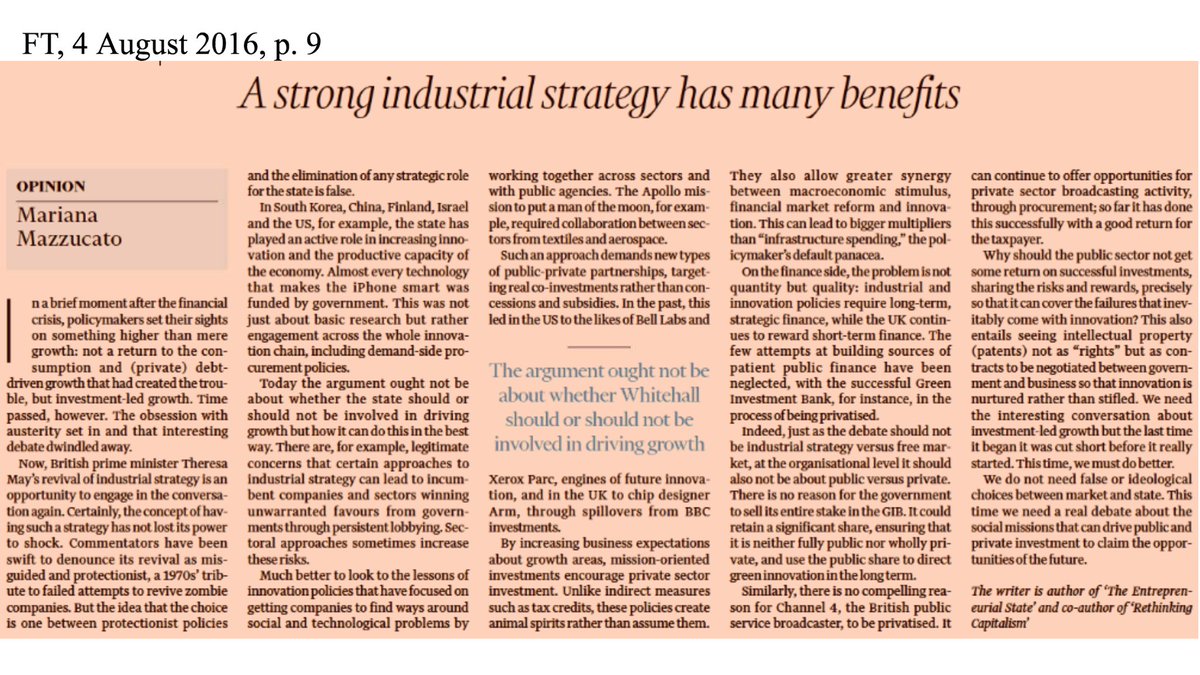
- Mariana Mazzucato discusses (JPG) the importance of an intelligent industrial strategy. And David Kotz argues that neoliberal capitalism has reached the point where there's no plausible path toward sustainable growth without a new economic model:
For several decades, neoliberal capitalism was able to bring a series of long economic expansions punctuated by relatively brief and mild recessions as well as a low rate of inflation. However, the programme of freeing markets and cutting taxes did not lead to a prosperity that trickled down to those in the middle and bottom. Rather than a rising tide that lifted all boats, neoliberal institutions brought stagnating or falling incomes for the majority and a remarkable upward income redistribution to the very rich.

Neoliberal transformation did not unleash the promised wave of investment, which has been sluggish compared to the era of post-war regulated capitalism, but the increasing inequality and rising profits it produced did stimulate initial economic expansion. However, a long economic expansion requires growing demand for output as well as profit incentives for expansion, and stagnating wages and state spending created a problem on the demand side. The demand problem was solved by two other features of neoliberal capitalism, large asset bubbles and a risk-seeking financial sector. Together those two features led to rising debt-fuelled consumer spending, which underpinned the long expansion of the 1990s and that of 2001-07 in the U.S.

However, under the surface the very same features that together promoted long expansions and low inflation — growing inequality, an increasingly risk-seeking financial sector, and a series of large asset bubbles – gave rise to trends that were unsustainable over the long run. In 2007-08 the unsustainable trends — growing household and financial sector debt, the spread of toxic financial assets, and increasing excess capacity in industry – interacted with the deflation of the U.S. real estate bubble to bring a financial panic and Great Recession, which quickly spread in various forms to the other developed countries.

Austerity policies in Europe and the U.S. can be interpreted as an effort to preserve the neoliberal form of capitalism. That form of capitalism has been very favourable for corporate profit and the income of the rich, and it is difficult for its beneficiaries to give it up. Austerity policies also follow logically from the dominant economic ideas of this era, which are difficult to dislodge despite the evidence that austerity only deepens the stagnation.

I argue that both theoretical considerations and historical precedents indicate that the neoliberal form of capitalism can no longer give rise to sustained economic growth.
- Kimberly Phillips-Fein discusses how a culture of fear created by U.S. employers led to a particular lack of solidarity and social strength at Ground Zero of the global economic meltdown, while Teuila Fuatai weighs in on Ontario's widespread violations of employment standards. And the New York Times editorial board points out that governments and their contractors should be expected to lead the way in ensuring fair treatment of workers.

- Rafe Mair writes that Justin Trudeau is following the Libs' traditional pattern of combining posturing about climate change with a lack of meaningful action. And Andreas Sieber and Pavlos Georgiadis point out how a new wave of trade agreements may prevent governments from giving effect to their climate change commitments.

- On that front, Brent Patterson asks why Justin Trudeau seems determined to push for the "provisional" application of CETA even when actual ratification seems unlikely.

- Finally, Elizabeth McSheffrey reports that Husky's North Saskatchewan River oil spill has predictably led to water quality failures. Jennifer Graham notes that the Provincial Auditor has long been calling for actual enforcement of pipeline regulations, only to be ignored by the Saskatchewan Party. And Brad Wall still refuses to talk about pipeline safety (and his government's associated neglect).

Wednesday, August 03, 2016

Wednesday Morning Links

Miscellaneous material for your mid-week reading.

- Atrios offers a reminder as to how means-testing tends to make social programs more vulnerable to attack without making our overall tax system more progressive:
We already means test through the tax code. It's called progressive taxation. There's no reason to add an entire additional layer of complexity and bureaucracy and verification to every new and existing government program out there. If we built the highway system today we'd probably toll it for everyone earning above, say, $100,000, but everyone earning less than that would have to get their income verified and a separate form and a special toll free card and would have to pay back the free tolls if they made too much money the next year blah blah blah. We'd have to contract out to private companies to hire "navigators" in order to guide people through the free toll application process. "Make the rich pay more" actually just means "make it harder and more costly for everybody else."

Usually this doesn't even "save" much money, even ignoring the individual cost of compliance and associated bureaucracy. Think rich people get too many nice things from the government? Raise their damn taxes. Don't use it as an excuse to make giving nice things to everyone else so complicated that it practically isn't worth bothering. The net cost of stopping a few Richie Riches from getting free state university tuition or pre-K is yuge. The cost of increasing taxes a tiny bit on rich people generally is essentially zero, except to the rich people in question of course.
- Ben Steverman highlights how the U.S.' Social Security disability benefit - like far too many other social supports - traps people in perpetual precarity by threatening to take away benefit from anybody seeking to earn income. But then, as Laura Ip notes, the norm for working Canadians is to be within two missed paycheques away from disaster - meaning that there's an urgent need to strengthen multiple strands of our social safety net.

- Sara Mojtehedzadeh reports on the pathetic level of enforcement of employment standards in Ontario which has given rise to an epidemic of wage theft.

- Elizabeth McSheffrey reports on the Saskatchewan government's admission that it likely won't be able to fully clean up the mess from Husky's North Saskatchewan River oil spill, while Allison Martell and Rob Nickel note that two previous spills from pipelines in the area went unreported in the previous year. Jordon Cooper highlights the importance of effectively regulating pipelines while contrasting that goal against the Sask Party's desire to be seen as serving the oil industry. And Tristin Hopper's story on the onetime (and future?) plan to exploit the tar sands through a nuclear explosion should remind us of the damage the oil sector is happy to inflict for a perceived cheap buck.

- Meanwhile, the Associated Press points out the myriad of unprecedented environmental measures recorded around the globe in 2015. And George Monbiot observes that it's all too rare to see the scope of our climate crisis accurately portrayed in the media.

- Finally, Nick Falvo discusses the importance of improved data to address homelessness and other social problems. And Kathleen O'Grady and Noralou Roos make the case to make academic research more accessible to the people who can use it in practice.

Tuesday, August 02, 2016

Tuesday Night Cat Blogging

Clutched cats.


Tuesday Morning Links

This and that for your Tuesday reading.

- Yanis Varoufakis makes the case for an international progressive political system to ensure that social progress doesn't stop at national borders:
(T)raditional political parties are fading into irrelevance, supplanted by the emergence of two new political blocs.

One bloc represents the old troika of liberalization, globalization, and financialization. It may still be in power, but its stock is falling fast, as David Cameron, Europe’s social democrats, Hillary Clinton, the European Commission, and even Greece’s post-capitulation Syriza government can attest. 

Trump, Le Pen, Britain’s right-wing Brexiteers, Poland’s and Hungary’s illiberal governments, and Russian President Vladimir Putin are forming the second bloc. Theirs is a nationalist international – a classic creature of a deflationary period – united by contempt for liberal democracy and the ability to mobilize those who would crush it. 

The clash between these two blocs is both real and misleading. Clinton vs. Trump constitutes a genuine battle, for example, as does the European Union vs. the Brexiteers; but the two combatants are accomplices, not foes, in perpetuating an endless loop of mutual reinforcement, with each side defined by – and mobilizing its supporters on the basis of – what it opposes. 

The only way out of this political trap is progressive internationalism, based on solidarity among large majorities around the world who are prepared to rekindle democratic politics on a planetary scale. If this sounds Utopian, it is worth emphasizing that the raw materials are already available. 

Bernie Sanders’s “political revolution” in the US, Jeremy Corbyn’s leadership of the UK’s Labour Party, DiEM25 (the Democracy in Europe Movement) on the continent: these are the harbingers of an international progressive movement that can define the intellectual terrain upon which democratic politics must build.
- Katie Allen reports on a new study estimating the cost of public services arising out of poverty in the UK at $78 billion every year.

- Ross Finnie, Kaveh Afshar, Eda Bozkurt, Masashi Miyairi and Dejan Pavlic examine (PDF) the earnings of Canadian post-secondary education graduates, and find a gender gap in every single field studied. And Sarah Kliff discusses how the gap can be traced in substantial part to the existence of inflexible or uncertain hours of work.

- Lawrence Martin comments on the Libs' broken promise to do anything at all to ameliorate the attack on civil rights found in Bill C-51, while noting that the inaction may arise out of pure political cowardice. And the Toronto Star's editorial board makes a strong case for immediate action to rein in the excesses of the surveillance and disruption state.

- Finally, Tom Parkin points out that the Greens' cynical spreading of misleading poll information represents just one more example of the warped incentives created by a first-past-the-post electoral system.

Monday, August 01, 2016

Monday Morning Links

Miscellaneous material to start your week.

- Thomas Walkom writes that with both major U.S. presidential candidates taking an understandably skeptical view of free-trade agreements in their current form, Canada shouldn't be planning on the past trade model continuing to spread.

- Ben Guarino discusses how climate change is leading to the spread of toxic algae in bodies of water around the globe. And Alison Moodie highlights the need for Canada's corporate sector to start contributing to reining in climate change (whether or not by choice), rather than exacerbating the problem.

- Marco Chown Oved reports that for all the tax avoidance acquiesced in by far too many countries, Canada is lagging far beyond even its international peers in prosecuting offshoring:
As worldwide pressure grows to fight offshore tax evasion, new statistics obtained by the Star show the Canadian government has convicted only 49 people and levied just $13.4 million in fines for what it calls offshore activity since 2010.

These numbers are far lower than in comparable countries and show the Canada Revenue Agency recovers only a tiny fraction of the estimated $6 to $7.8 billion in taxes Canada loses to offshore tax havens each year.
...
The Panama Papers leak has detailed how the use of shell companies in tax havens deprives public tax coffers of billions of dollars each year. While other governments have devoted significant resources to cracking down on bank secrecy and offshore tax schemes, Canada’s efforts appear to have paled in comparison.

Australia’s Project Wickenby has collected more than $600 million from cheats using tax havens since 2006. The U.K. has recouped more than £2 billion ($3.5 billion) from offshore tax evasion since 2010. 

In contrast, Canada has only handed out fines totalling $13.4 million since 2010 — less than half the $35.7 million in taxes the cheats were caught evading. 

“This doesn’t make any sense,” said tax lawyer Jonathan Garbutt. “The law states that the minimum fine for tax evasion must be 50 per cent of the amount of tax owing. And judges often fine 75 or 100 per cent.”
- Steven Chase reports that the Libs are actually loosening Canada's rules on selling arms to human rights abusers.

- Finally, Dan DiMaggio points out how workers at Detroit Chassis were able to organize in order to turn temporary employment into permanent jobs. And Valerie Strauss discusses how unionized work environments lead to better results in educating children.

Sunday, July 31, 2016

Sunday Morning Links

This and that for your Sunday reading.

- Larry Elliott discusses how the rise of Donald Trump and other exclusionary populists can be traced to the failed promises of neoliberal economics:
The fact is that the US middle class, which in Britain we would call the working class, really did enjoy more rapid increases in living standards and a much higher degree of job security three or four decades ago. It is also true that the offshoring of production has brought benefits through cheaper imports, but these gains tend to seem more nebulous than lost jobs and year after year of flat or falling pay.

A quick look at what has been happening to the US economy in recent years sheds light on the problem. As in Britain, jobs have been created but productivity has been exceptionally weak. One reason is that companies have not been investing. Rather executives have been borrowing money cheaply for share buyback schemes that boost the value of the equity they hold in their own companies. They have gorged themselves at the expense of the wider US economy and been able to do so because organised labour is so weak. There is no chance Trump will be championing new rights for unions, but he is the beneficiary of a raw form of populist politics.
- Alison points out how Christy Clark's B.C. Libs have funneled massive amounts of public money - and ceded control over crucial policy areas - to natural gas operators for no public gain. And James Wilt examines Saskatchewan's woeful lack of protection from environmental destruction due to the desire of the oil sector to avoid answering for its failures. 

- Canadians for Tax Fairness highlights just a few of the corporate behemoths which are able to structure their operations to avoid paying taxes to the countries where they derive their profits. And Josh Gordon argues that B.C.'s new tax on foreign-owned real estate represents only a minor first step in translating obscene individual wealth into social revenue.

- The Winnipeg Free Press discusses how the federal government's abdication of any responsibility for rail transportation and grain marketing is destroying the port of Churchill (among other communities).

- Finally, Max Ehrenfreund weighs in on the connection between an improved minimum wage and healthier babies - particularly for the children of mothers at the low end of the income spectrum.

Saturday, July 30, 2016

Saturday Afternoon Links

Assorted content for your weekend reading.

- Stephen Hawking discusses the crucial distinction between seeing money as a means of pursuing worthy ends versus treating it a goal in and of itself - and notes that we should be wary of political choices based on the latter view:
Money is also important because it is liberating for individuals. I have spoken in the past about my concern that government spending cuts in the UK will diminish support for disabled students, support that helped me during my career. In my case, of course, money has helped not only make my career possible but has also literally kept me alive.
...
So I would be the last person to decry the significance of money. However, although wealth has played an important practical role in my life, I have of course had a different relationship with it to most people. Paying for my care as a severely disabled man, and my work, is crucial; the acquisition of possessions is not. I don’t know what I would do with a racehorse, or indeed a Ferrari, even if I could afford one. So I have come to see money as a facilitator, as a means to an end – whether it is for ideas, or health, or security – but never as an end in itself.
...
I hope and believe that people will embrace more of this cathedral thinking for the future, as they have done in the past, because we are in perilous times. Our planet and the human race face multiple challenges. These challenges are global and serious – climate change, food production, overpopulation, the decimation of other species, epidemic disease, acidification of the oceans. Such pressing issues will require us to collaborate, all of us, with a shared vision and cooperative endeavour to ensure that humanity can survive. We will need to adapt, rethink, refocus and change some of our fundamental assumptions about what we mean by wealth, by possessions, by mine and yours. Just like children, we will have to learn to share.

If we fail then the forces that contributed to Brexit, the envy and isolationism not just in the UK but around the world that spring from not sharing, of cultures driven by a narrow definition of wealth and a failure to divide it more fairly, both within nations and across national borders, will strengthen. If that were to happen, I would not be optimistic about the long-term outlook for our species.

But we can and will succeed. Humans are endlessly resourceful, optimistic and adaptable. We must broaden our definition of wealth to include knowledge, natural resources, and human capacity, and at the same time learn to share each of those more fairly. If we do this, then there is no limit to what humans can achieve together.
- Linda McQuaig sees Bernie Sanders' progressive populist movement as a crucial force in pushing back against rule by the .01%. And Branko Milanovic offers some theories as to how our economic system should change to better account for public well-being, rather than merely focusing on corporate demands.

- Lola Okolosie notes the connection between the decline of social mobility and school systems designed to preserve and exacerbate inequality.

- Nancy Macdonald examines the woeful exclusion of indigenous people from Saskatchewan's governing institutions (among other indicators of the desperate need to close the opportunity gap).

- Finally, Charlie Smith reports on the Trudeau Libs' choice to ram through Christy Clark's Site C dam with no regard for affected First Nations. And Matthew Behrens discusses how the Libs are continuing the Cons' attacks on human rights.

Friday, July 29, 2016

Musical interlude

Broken Bells - Holding On For Life

Friday Morning Links

Assorted content to end your week.

- Bjarke Skærlund Risager interviews David Harvey about the history and effect of neoliberalism:
I’ve always treated neoliberalism as a political project carried out by the corporate capitalist class as they felt intensely threatened both politically and economically towards the end of the 1960s into the 1970s. They desperately wanted to launch a political project that would curb the power of labor.

In many respects the project was a counterrevolutionary project...
...
(F)or globalization to work you had to reduce tariffs and empower finance capital, because finance capital is the most mobile form of capital. So finance capital and things like floating currencies became critical to curbing labor.

At the same time, ideological projects to privatize and deregulate created unemployment. So, unemployment at home and offshoring taking the jobs abroad, and a third component: technological change, deindustrialization through automation and robotization. That was the strategy to squash labor.

It was an ideological assault but also an economic assault. To me this is what neoliberalism was about: it was that political project, and I think the bourgeoisie or the corporate capitalist class put it into motion bit by bit.
- Ian Johnston discusses how the privatization of health care in the UK is leading to far worse health outcomes, including decreased overall access to public services and worsening inequality as serious health problems are ignored in favour of delivering less important services to cherry-picked patients. 

- Larry Buhl highlights the disproportionate effect of environmental damage among minority populations - and the policy choices being made to facilitate that harm. (And needless to say, the Wall government's choice to wave through new pipelines without even considering their environmental impacts looks to fall under that category.) But that discriminatory effect also opens the door to dealing with environmental destruction through existing human rights mechanisms - and John Vidal reports on the Commission on Human Rights of the Philippines' move to address the effects of climate change.

- Finally, Nathan Robinson comments on the futility of trying to pitch a "stay the course" message to the public which has been sacrificed in the name of the corporate class. And Erika Shaker discusses the need to offer solutions to citizens' underlying complains, lest voters otherwise settle for punishing scapegoats instead.

Thursday, July 28, 2016

Thursday Morning Links

This and that for your Thursday reading.

- Branko Milanovic argues that there's plenty of reason to be concerned about inequality even if one puts aside a utilitarian comparison of individual needs and benefits:
(I)nequality of opportunity affects negatively economic growth (so we now have a negative effect going from my third ground back to the first) which makes inequality of opportunity abhorrent on two grounds: (1) it negates fundamental human equality, and (2) it lowers the pace of material improvements for society.

My argument, if I need to reiterate it, is: you can reject welfarism, hold that inter-personal comparison of utility is impossible, and still feel very strongly that economic outcomes should be made more equal—that inequality should be limited so that it does not strongly affect opportunities, so that it does not slow growth and so that it does not undermine democracy. Isn’t that enough?
- Brad Delong takes note of Barry Eichelgreen's timeline of the development of inequality over the past three centuries. Marvin Shaffer discusses British Columbia's inequitable growth favouring those who already have the most, while Josh Hoxie notes that the U.S.' generation of young adults is bearing the brunt of grossly unequal distributions of income and wealth. Emma Burney points out the OECD's latest report (PDF) on how tax policy can rein in inequality. And John Hood comments on the UK's seeming consensus on the need to address inequality - though it remains to be seen how (if at all) that will be translated into meaningful policy choices.

- George Hoberg rightly argues that the federal government needs to step up and develop an effective national climate change policy due to the wholly insufficient results of trying to push the issue down to the provinces. But Alex Emmons notes that the oil industry's lobbying at the Republican National Convention represents just one more example of the large amount of money being burned in an effort to stall progress wherever possible. 

- Megan Sandel and Laurel Blatchford discuss the connection between investment in adequate housing and a reduction in health care expenses. And Stephanie Dickrell comments on the massive individual and social costs of child homelessness.

- Finally, Michael Geist studies the Trans-Pacific Partnership's intellectual property rules, and find that they'd impose new and gratuitous burdens and costs on the public in the name of lining corporate pockets.

New column day

Here, on how the North Saskatchewan River oil spill may not lead directly to a needed reevaluation of the risks of pipelines - but a public expectation that we'll shift away from dirty energy may be more significant in the long run.

For further reading...
- I've previously posted about Brad Wall's response to the spill here. John Klein and David Climenhaga offer their own justified criticism of Wall's choice to hide behind oil-industry spin rather than recognizing the social and environmental damage caused by the spill.
- The Leader-Post reports that North Battleford and Prince Albert aren't interested in letting Wall hold photo ops to savd his own skin now. Betty Ann Adam notes that affected First Nations are being kept out of the loop.
- Carrie Tait examines the public impact of contaminated drinking water sources. And Jesse McLaren notes that there's been a much faster move to clamp down on individual water users than to ensure any accountability for Husky as the source of the spill.
- CBC follows up on Emily Eaton's observation that spills from Saskatchewan pipelines are a regular occurrence.
- Jordon Cooper highlights the Sask Party's tendencies toward corporate self-regulation, while Justin Fisher discusses the urgent need for far more effective monitoring of hazardous industries. And Elizabeth McSheffrey reports that the province's neglect has resulted in the federal government having to step in and investigate the spill.
- Finally, Abacus Data's poll on how Canadians see our own future is here - with people expecting that in the next two decades we'll see storage of solar and wind energy (86%), a majority of vehicles being electric (66%), and sharp declines in carbon emissions from Canada (59%) and the world (51%).

[Edit: updated link.]

Wednesday, July 27, 2016

Wednesday Morning Links

Miscellaneous material for your mid-week reading.

- Andrew Jackson discusses the challenge of ensuring that stable jobs are available in Canada:
Good jobs are a central mechanism in the creation of shared prosperity.

What matters for workers is not just being able to find any job but also security of employment, level of pay, working conditions, and the opportunity to develop talents and capacities.

Unfortunately, as has been documented in many studies, the long-term trend in Canada has been towards a much more polarized jobs market in which there has been a disproportionate increase in low pay, precarious jobs, and a concentration of income growth among higher-paid professionals and managers, especially the top 1%.
...
Many lower wage workers live in families with decent overall incomes, and income from wages is boosted by government programs such as child benefits and unemployment insurance. Still, the numbers show that a  significant minority of Canadians work in jobs which are insecure, and a surprisingly high proportion work in jobs which are low paid or very modestly paid. Indeed, the proportion of low paid workers in Canada, defined as earning less than two-thirds of the median wage, is, at 21.8%, the third highest in the industrialized world, according to the OECD.

Raising wages for lower-paid workers will require boosting minimum wages to at least $15 per hour and widening access to union representation, especially for workers in private sector sales and service jobs. These measures are critical to any realistic strategy to “grow the middle-class.”
- Anna Louie Sussman points out that stagnant wages even in the face of U.S. job growth can largely be traced to a lack of demand for additional labour. Richard Dobbs and Anu Madgavkar write about the UK's backsliding standard of living between generations. And Jim Stanford outlines a possible progressive response to the combination of stagnation and upward redistribution that's come to be treated as our economic norm.

- Andrew Mitrovica argues that a breakdown in trust arising out of the Iraq war paved the way to spread the politics of violence in the U.S. and the Middle East alike. Robert Reich emphasizes the need for Hillary Clinton to recognize the justified spread of anti-establishment sentiment while making the case against the bigoted form on offer from Donald Trump and the Republicans. And Doug Saunders reminds us that the most important problems facing the U.S. are wholly lacking from the Republicans' message.

- Steven Chase examines the connection between the arms industry and think tanks which are regularly put forward as commenters on military purchasing.

- Finally, Tom Parkin discusses how electoral reform can be expected to change the face of Canadian elections - and how a status quo which is easiest for party strategists isn't what's best for the public.

Tuesday, July 26, 2016

Tuesday Night Cat Blogging

Couched cats.


Tuesday Morning Links

This and that for your Tuesday reading.

- Lana Payne comments on the combination of low wages and nonexistent security attached to jobs for younger workers. And Catherine Baab-Muguira examines the spread of the side hustle economy as a means of bare survival.

- Roderick Benns discusses how the isolation of remote communities represents a barrier to access to needed social supports - and how that can be remedied in part through a basic income. And Emily Badger writes about new research showing that no other housing policies will put a meaningful dent in the lack of decent housing in the absence of major public investment in construction and maintenance.

- Paula Simons notes that the Husky oil spill into the North Saskatchewan River should highlight the importance of a safe water supply, while the Canadian Press reports that it will be months before North Battleford, Prince Albert and other affected communities will be able to exercise that right. David Fraser reports on the Saskatchewan Party's wanton slashing of the regulator responsible for pipelines - which led to the province having no idea when the pipe which spilled was last inspected. And Emily Eaton points out that oil spills are in fact the norm across Saskatchewan even if they don't gather as much attention as one which flows directly into a major river.

- Meanwhile, David Brumer and Jayme Poisson document the decades of poison still being inflicted on the people of Grassy Narrows First Nation due to mercury contamination by poorly-regulated industries.

- Abacus' latest survey into the future expectations of Canadians shows that the public - unlike the political class - fully expects major greenhouse gas emission reductions in the very near future. And Joe Romm points out how the plummeting cost of solar power may make that possible.

- Finally, Canadian Journalists for Free Expression comments on the desperate need for serious analysis of the rights violations embedded in Bill C-51. But Michael Harris recognizes that Justin Trudeau couldn't seem less interested in reversing the Harper Cons' steps toward a surveillance-and-disruption state.

Monday, July 25, 2016

Monday Morning Links

Miscellaneous material to start your week.

- David Blanchflower notes that there's virtually no dispute that the UK is headed into an economic downturn - meaning that there's also no excuse to hold off on fiscal relief for the public. And Brad DeLong points to a new study on the effectiveness of government spending in generating immediate economic growth well beyond the money actually spent.

- David Macdonald rightly recognizes a few important steps toward reducing poverty in Canada through broadly-available income supports.

- Jeff Guo highlights the connection between an increased workload and other job stressors, and overall health impacts on workers.

- Angella MacEwen and Laura Macdonald examine the Trans-Pacific Partnership's toxic effects on labour throughout the participating countries. And Greg Keenan reports on John Holmes and Jeffrey Carey's research showing how the TPP would harm Canada's auto sector.

- Finally, Joel French examines the massive amounts of public money being funneled into exclusionary private schools across Canada. And Morgan Modjeski reports that basic site elements including playgrounds have been left out of any design or funding for Saskatchewan schools - which both places the burden on individuals to fund-raise for community services, and effectively ensures disparity based on the wealth of a given neighbourhood.

Sunday, July 24, 2016

Polluted by crimes, but torn by no remorse

Shorter Brad Wall on what's truly important as an oil spill pollutes drinking water along the North Saskatchewan River:
I only hope this monster running amok doesn't make it harder to sell new reanimation technologies.
Or in graphic form...