The results are in from Regina's wastewater treatment referendum. And unfortunately, the combined forces of the City and the corporate sector (with an assist from far too much of the city's media) were able to carry the day.
But there's still plenty of reason to think we're better off for having had the vote.
For one thing, we can now confirm that Reginans can be motivated to participate even in a single-issue referendum - with nearly as many total voters casting a ballot on a single decision as did in electing our entire slate of city leaders just last year. And the referendum represents both an important exercise in democracy and compelling evidence that people are far more interested in having a say in municipal decisions than the current administration gives them credit for.
And the actual votes cast may be even more significant.
The gap between a city establishment lining up (and putting its thumb on the scale) in favour of one side and the 21,000+ voters who nonetheless voted for accountability and public control will hopefully result in greater recognition of the public interests at play in the wastewater procurement process to come - helping to avoid some of the real concerns the Yes side has raised about cozy, closed-door decision-making. And the possibility that other major choices will be subject to public attention should result in more thoughtful analysis of future projects.
Ideally, I'd also hope to see a few councillors whose constituents were particularly inclined to vote Yes start to develop some sustained questions and criticisms about city decision-making - rather than going along with the mayor by default and offering the "unanimous!" cover to genuinely contentious issues.
Obviously, those possibilities are on the speculative side compared to the concrete possibility of retaining public control of our water treatment system. But there looks to be plenty of room to build on the work done by Regina Water Watch - and if we end up with the public keeping a closer eye on municipal government in general, that's a result well worth the effort.
Update: Jason has more.
Thursday, September 26, 2013

Wednesday, September 25, 2013
Wednesday Morning Links
Miscellaneous material for your mid-week reading.
- Today is of course voting day in Regina's wastewater treatment plant referendum - and you can get voting information here. And Paul Dechene explains his personal Yes vote by pointing to the need for public control over our infrastructure, while Brian Webb highlights the importance of the treatment plan for water quality in Regina and elsewhere.

- Frances Russell traces the decline of democracy and equality in Canada over the past few decades to free trade agreements designed to limit both. And Miles Corak confirms that Canada has seen the same type of stagnation and stratification as the U.S.:
- And finally, Pat Atkinson comments on the mess the Wall government has made of education in Saskatchewan.
- Today is of course voting day in Regina's wastewater treatment plant referendum - and you can get voting information here. And Paul Dechene explains his personal Yes vote by pointing to the need for public control over our infrastructure, while Brian Webb highlights the importance of the treatment plan for water quality in Regina and elsewhere.
- Frances Russell traces the decline of democracy and equality in Canada over the past few decades to free trade agreements designed to limit both. And Miles Corak confirms that Canada has seen the same type of stagnation and stratification as the U.S.:
- Meanwhile, Robyn Benson notes that government and corporate attacks on the few institutions speaking up for workers aren't about to stop anytime soon.At the same time the slice of the pie going to those in the bottom has not changed, while those in the middle have, indeed, experienced a decline in their share.These patterns are remarkably similar to those in the United States. In fact, I have shamelessly borrowed the entire structure of this post from an article in The New York Times by Eduardo Porter summarizing a report released by the US Census Bureau.Thirty years of economic growth; thirty years of incremental but steady increases in productivity; after major public policy initiatives, like free trade with the United States and other countries beginning in 1980s, like the relentless and unforgiving pursuit of zero inflation that unleashed a major recession in the early 1990s, like slashing government deficits “come what may” in the years that followed, like a major run up in commodity prices and expansion of the resource sector, partly subsidized through the public purse, policies conducted in the name of increased prosperity and a better future for all; and yet after all of this, the typical family now feels less secure and has no higher a standard of living than a generation ago.
- And finally, Pat Atkinson comments on the mess the Wall government has made of education in Saskatchewan.
Tuesday, September 24, 2013
On sucker's bets
As the old saying goes, if you sit down at a poker table and can't spot the sucker, you're it.
And there shouldn't be much doubt that when the City of Regina sits down with an interconnected group of consultants and privatization advocates to decide who stands to be handed hundreds of millions of public dollars, the patsy won't be found in the group of corporate participants.
Of course, the original plan for a privatized wastewater treatment plant allowed for a slightly cleaner process. Instead allowing the public a seat at the table, the City originally planned to ante up to a high-stakes game with our money.
But fortunately, enough citizens insisted on having some say in the decision to force Council to allow us a referendum vote - a single chance to leave the table.
Which isn't to say the City has actually done anything to make the game any more fair.
The No side has insisted that we go all in without being allowed to see our own cards. It's tried to bribe us with a few complimentary chips which are dwarfed by what's actually at stake. It's tried to distract us by changing the rules without warning; it's hired outside goons to intimidate us into staying at the table.
And all the while the corporate sector has encouraged the City's diversions and deceptions - while gleefully awaiting its opportunity to divide up the spoils.
But the No side hasn't been able to avoid the most important reality about the wastewater treatment referendum.
Reginans remain the suckers in the game being played by the City and its corporate benefactors. And if we don't walk away while we have the chance, we'll be paying off the debts for decades to come.
[Edit: fixed wording.]
And there shouldn't be much doubt that when the City of Regina sits down with an interconnected group of consultants and privatization advocates to decide who stands to be handed hundreds of millions of public dollars, the patsy won't be found in the group of corporate participants.
Of course, the original plan for a privatized wastewater treatment plant allowed for a slightly cleaner process. Instead allowing the public a seat at the table, the City originally planned to ante up to a high-stakes game with our money.
But fortunately, enough citizens insisted on having some say in the decision to force Council to allow us a referendum vote - a single chance to leave the table.
Which isn't to say the City has actually done anything to make the game any more fair.
The No side has insisted that we go all in without being allowed to see our own cards. It's tried to bribe us with a few complimentary chips which are dwarfed by what's actually at stake. It's tried to distract us by changing the rules without warning; it's hired outside goons to intimidate us into staying at the table.
And all the while the corporate sector has encouraged the City's diversions and deceptions - while gleefully awaiting its opportunity to divide up the spoils.
But the No side hasn't been able to avoid the most important reality about the wastewater treatment referendum.
Reginans remain the suckers in the game being played by the City and its corporate benefactors. And if we don't walk away while we have the chance, we'll be paying off the debts for decades to come.
[Edit: fixed wording.]


#wwtp Referendum Roundup
A few links and notes as Regina's wastewater referendum approaches tomorrow.
- Jason Hammond explains that his Yes vote will be based largely on concerns about the City's dishonesty and sense of entitlement in trying to push through a P3 model. And Paul Dechene provides the full list of City shenanigans throughout the referendum process.
- That is, until today - when Vanessa Brown revealed that the City is using a U.S. PR firm with a "passion (for) helping Republican candidates, elected officials, and conservative causes" - presumably to help it offer the level of accuracy and principle we've come to expect from that party. (h/t to Leftdog)
-But interestingly enough, at least some people on the No side also seem perfectly happy to have voters make their decision based on the question of whether they have complete and utter faith in the current City Council and administration.
- Finally, Erin Weir nicely exposes and shreds the City talking points being recycled by far too many local columnists.
- Jason Hammond explains that his Yes vote will be based largely on concerns about the City's dishonesty and sense of entitlement in trying to push through a P3 model. And Paul Dechene provides the full list of City shenanigans throughout the referendum process.
- That is, until today - when Vanessa Brown revealed that the City is using a U.S. PR firm with a "passion (for) helping Republican candidates, elected officials, and conservative causes" - presumably to help it offer the level of accuracy and principle we've come to expect from that party. (h/t to Leftdog)
-But interestingly enough, at least some people on the No side also seem perfectly happy to have voters make their decision based on the question of whether they have complete and utter faith in the current City Council and administration.
- Finally, Erin Weir nicely exposes and shreds the City talking points being recycled by far too many local columnists.
Tuesday Morning Links
This and that for your Tuesday reading.
- Charles Campbell discusses Robert Reich's work to highlight the importance of a fair and progressive tax system. And while Lawrence Martin is right to lament the systematic destruction of Canada's public revenue streams under the Libs and Cons alike, his fatalistic view that nobody can stem the tide doesn't seem to match the evidence that the public - in Canada and the U.S. alike - sees inequality as a problem to be solved rather than a fair result of corporate-friendly policies.
- Mark Taliano writes about the Harper Cons' distaste for evidence-based policy. And even the New York Times takes note of Stephen Harper's desperate attempts to suppress science when it comes to the tar sands:
- And Paul Wells responds to selective leaks about the Cons' supposed reset by looking back at past throne speeches:
- Charles Campbell discusses Robert Reich's work to highlight the importance of a fair and progressive tax system. And while Lawrence Martin is right to lament the systematic destruction of Canada's public revenue streams under the Libs and Cons alike, his fatalistic view that nobody can stem the tide doesn't seem to match the evidence that the public - in Canada and the U.S. alike - sees inequality as a problem to be solved rather than a fair result of corporate-friendly policies.
- Mark Taliano writes about the Harper Cons' distaste for evidence-based policy. And even the New York Times takes note of Stephen Harper's desperate attempts to suppress science when it comes to the tar sands:
- Meanwhile, Tim Naumetz reports on Con rail safety spin which bears a striking resemblance to that on climate change: point to long-broken promises and not-yet-drafted regulations as "action", and hope nobody notices the difference between that and actual progress.Science is the gathering of hypotheses and the endless testing of them. It involves checking and double-checking, self-criticism and a willingness to overturn even fundamental assumptions if they prove to be wrong. But none of this can happen without open communication among scientists. This is more than an attack on academic freedom. It is an attempt to guarantee public ignorance.It is also designed to make sure that nothing gets in the way of the northern resource rush — the feverish effort to mine the earth and the ocean with little regard for environmental consequences. The Harper policy seems designed to make sure that the tar sands project proceeds quietly, with no surprises, no bad news, no alarms from government scientists. To all the other kinds of pollution the tar sands will yield, we must now add another: the degradation of vital streams of research and information.
- And Paul Wells responds to selective leaks about the Cons' supposed reset by looking back at past throne speeches:
(G)etting righteous on behalf of consumers would have the virtue of novelty. If this government stands up for consumers, it has until now been bashful about saying so. The most recent Throne Speech, only 25 months ago, contained no mention of the word “consumer.” Previous Throne Speeches—there have been six in total from various Harper governments up to now—contained hardly any more language on consumers’ rights. But those old speeches make fun reading today anyway, for their mix of forced rhetoric, policy dead ends and, here and there, a few real portents of what Harper had in store.- Finally, Duncan Cameron takes a look at the goals of each Canadian political party for this fall and beyond.
On Oct. 16, 2007, Michaëlle Jean delivered the Harper government’s second Throne Speech. It contained one reference to consumers. “Our government shares the concern of parents about the safety of consumer products and food.” It also promised “binding national regulations on greenhouse-gas emissions across all major industrial sectors—with requirements for emissions reductions starting this year.” Six years later, there are still no regulations for the oil sands.
On Nov. 19, 2008, after Harper’s first re-election, everyone was back in the Senate for another big speech. “Our government will follow through with legislation providing better oversight of food, drug and consumer products,” Jean said. The government also promised to “respect the jurisdiction of the provinces and territories and . . . enshrine its principles of federalism in a charter of open federalism.” That didn’t happen.
The 2008 Speech’s odes to Parliament’s greatness read a little funny in retrospect. “Parliament is Canada’s most important national institution . . . Parliament should be an expression of our highest ideals and deepest values, our greatest hopes and grandest dreams for the future of our children.” Two weeks later, the three opposition parties tried to give Harper’s job to Stéphane Dion. Harper promptly petitioned the GG to prorogue the session, thereby saving his bacon. Rarely since has Parliament expressed anyone’s values or hopes. Even Harper prefers to express his values and hopes as far from the Commons as he can get.
Monday, September 23, 2013
On independent thought
It's for the best that the idle speculation and gossip about a single point of policy difference between Thomas Mulcair and Linda McQuaig have been put to rest. But let's make clear just how pernicious the "ZOMG!!! Candidate X occasionally thinks for herself!!! Clearly she must be muzzled!!!" line of political analysis actually is.
Simply put, there's absolutely no contradiction between:
- a party leader promising that a given policy that will form part of the party's platform; and
- a candidate holding the personal opinion that a particular different policy would produce superior outcomes, while nonetheless supporting the party in general.
In fact, I'd see far more reason for concern with a party so beaten down by its leader that it thought anybody who disagreed with any of its policies should be forcibly evicted from the tent. And as ugly as it is when leaders squelch dissent in the name of consolidating their own power, it's even more disturbing to see the media spreading that theme for no reason but to generate a story where none exists.
Now, the above isn't to say that McQuaig's advocacy for a more fair tax system isn't important. And I'll definitely hope to see her to use the political platforms held by a candidate and an MP to advocate for change both within the NDP and in the wider political system.
But that should serve as reason for journalists to seriously discuss the important policy questions she raises - not to write stories which implicitly or explicitly demand that intelligent political thinkers like McQuaig be silenced.
[Edit: Fixed wording, added link.]
Simply put, there's absolutely no contradiction between:
- a party leader promising that a given policy that will form part of the party's platform; and
- a candidate holding the personal opinion that a particular different policy would produce superior outcomes, while nonetheless supporting the party in general.
In fact, I'd see far more reason for concern with a party so beaten down by its leader that it thought anybody who disagreed with any of its policies should be forcibly evicted from the tent. And as ugly as it is when leaders squelch dissent in the name of consolidating their own power, it's even more disturbing to see the media spreading that theme for no reason but to generate a story where none exists.
Now, the above isn't to say that McQuaig's advocacy for a more fair tax system isn't important. And I'll definitely hope to see her to use the political platforms held by a candidate and an MP to advocate for change both within the NDP and in the wider political system.
But that should serve as reason for journalists to seriously discuss the important policy questions she raises - not to write stories which implicitly or explicitly demand that intelligent political thinkers like McQuaig be silenced.
[Edit: Fixed wording, added link.]
Monday Morning Links
Miscellaneous material for your Monday reading.
- Paul Krugman writes about the right-wing belief that "freedom's just another word for not enough to eat":
- Which leads nicely to Robert Reich's discussion of the myth of the free market, and the reality that markets as we know them are designed for the specific benefit of the wealthy few:
- Paul Krugman writes about the right-wing belief that "freedom's just another word for not enough to eat":
(Y)ou might think that ensuring adequate nutrition for children, which is a large part of what SNAP does, actually makes it less, not more likely that those children will be poor and need public assistance when they grow up. And that’s what the evidence shows. The economists Hilary Hoynes and Diane Whitmore Schanzenbach have studied the impact of the food stamp program in the 1960s and 1970s, when it was gradually rolled out across the country. They found that children who received early assistance grew up, on average, to be healthier and more productive adults than those who didn’t — and they were also, it turns out, less likely to turn to the safety net for help.- Greg Hluska explains his decision-making process in jointing the Yes side of Regina's wastewater treatment referendum:
SNAP, in short, is public policy at its best. It not only helps those in need; it helps them help themselves. And it has done yeoman work in the economic crisis, mitigating suffering and protecting jobs at a time when all too many policy makers seem determined to do the opposite. So it tells you something that conservatives have singled out this of all programs for special ire.Even some conservative pundits worry that the war on food stamps, especially combined with the vote to increase farm subsidies, is bad for the G.O.P., because it makes Republicans look like meanspirited class warriors. Indeed it does. And that’s because they are.
I’m left thinking about fairness. You have the Federal government promising to help us with our infrastructure…but only if we choose a P3. When I look at the kinds of companies with experience in these kinds of projects, I notice that the vast majority are from Ontario. So, if we go P3, there will be fewer union jobs (thus lower wages for Regina residents) while we ship the profits off to Ontario.- Meanwhile, Regina Water Watch highlights some more shady practices from the City to try to stack the deck in favour of the No side.
And then, I look at the subject of risk, complete with its highly secretive equation. If you remove risk entirely from the equation, the P3 and traditional models are very close in terms of net present cost. That flies in the face of peer reviewed research that shows that P3s usually cost significantly more. If the Deloitte report numbers don’t jive with numbers from other similar projects, should we trust this highly secretive number attached to risk? According to peer reviewed research, audited P3s cost 16% more than traditionally tendered contracts. Yet, the Deloitte report indicates that a P3 would only cost 1.6% more than the traditional model would. In case you’re keeping track, that is an actual difference of over $60,000,000 in base construction costs.
...
(W)hen I weigh all of this, I have decided that I am going to vote yes, in opposition to the P3. I have lost trust in city council and simply cannot approve of a project that will affect our city for thirty years in light of such damning evidence.
- Which leads nicely to Robert Reich's discussion of the myth of the free market, and the reality that markets as we know them are designed for the specific benefit of the wealthy few:
Governments don't "intrude" on free markets; governments organize and maintain them. Markets aren't "free" of rules; the rules define them.- Finally, Kady O'Malley points out the glaring gap between the Cons' spin about the Robocon costs ruling, and the actual decision which will result in the party's MPs paying costs to the electors who rightfully questioned the impact of Con-based fraud on the 2011 election. But I do have to question whether the Cons are particularly concerned about losing credibility now - especially if anybody was willing to accept that they had an ounce of it left to lose given their previous attempts to paint a finding that their database was used to commit election fraud as a win.
The interesting question is what the rules should seek to achieve. They can be designed to maximize efficiency (given the current distribution of resources), or growth (depending on what we're willing to sacrifice to obtain that growth), or fairness (depending on our ideas about a decent society). Or some combination of all three -- which aren't necessarily in competition with one another. Evidence suggests, for example, that if prosperity were more widely shared, we'd have faster growth.
The rules can even be designed to entrench and enhance the wealth of a few at the top, and keep almost everyone else comparatively poor and economically insecure.
...
If we want to reduce the savage inequalities and insecurities that are now undermining our economy and democracy, we shouldn't be deterred by the myth of the "free market." We can make the economy work for us, rather than the other way around. But in order to change the rules, we must exert the power that is supposed to be ours.
Saturday, September 21, 2013
Saturday Morning Links
Assorted content for your weekend reading.
- Paul Dechene interviews Maude Barlow about the downside of privatizing public infrastructure:
- Caroline Fairchild reports on the obvious link between unionization and reasonable middle-class wages.
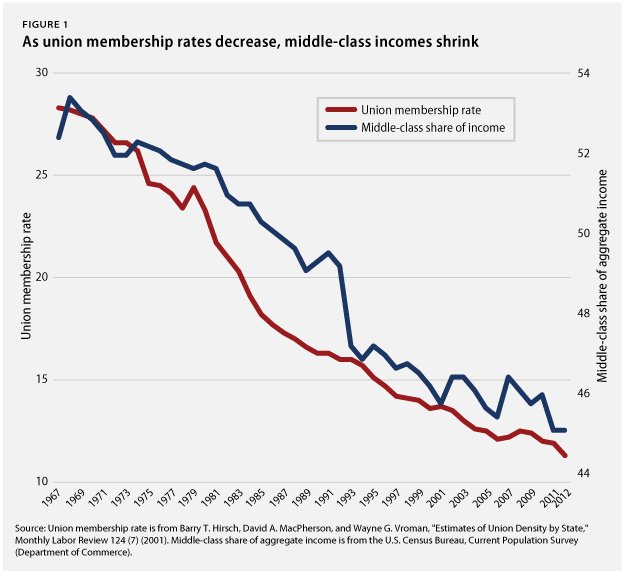 - Finally, Lana Payne discusses the dangers of allowing any level of government to silence both dissenting opinions and the people who hold them.
- Paul Dechene interviews Maude Barlow about the downside of privatizing public infrastructure:
Somebody asked me to point blank explain the difference between private and public and I said, profit. That’s the difference. In a public system, it’s the same amount of money; you’re raising it from taxes or you’re raising it from water rates, water services. And so the same amount of money has to cover for a private company not only the supposed delivery of whatever services they’re delivering but profit for their investors. Something has to give. And that’s the fundamental difference. It doesn’t take long for most municipalities to figure that out. Often, the company comes back — this is just standard — the company comes back to the local municipality and says, Gee it’s more expensive than we thought and we’re in cost overruns and we have to charge more, we can’t keep going. So, they either back out of it, or the city backs out of it or renegotiates and gives them more money. This is just classic.- And Toby Sanger looks at the risks and rewards involved in Regina's wastewater treatment plant:
...
There’s obviously no reason to think that a private company is any more efficient than the public company. If in fact they were to set rates and the municipality were not to budge, then you’d start to see declining services because the company simply has to make money, they have to make profit and something would go.
On average what goes is 30 to 50 per cent of the workforce. When you have a broken sewer line down the way it doesn’t get fixed that day. The water coming out of your tap, you’re not very happy with. It may be a week before someone comes to fix it. This is the story around the world of privatized systems. The only way they can keep up with the public system is to keep raising water rates. So they either cut their workforce in half or 25 to 35 per cent. Or they cut services. You simply cannot as a for-profit entity do the same job and find a 15-20 per cent overhead profit to send to your investors and not have something giving. It’s just a fallacy that the private sector can do it better than the public sector. If the job is done properly, it’s done properly.
I’m not saying the private sector can’t do it properly. But even if they do it properly they have to find that overhead for the profit and that’s the essential difference here.
The only real risk private operators assume in a P3 is limited by the net amount of unsecured money or equity they have in the project: usually no more than 10-15% of their total capital, as I pointed out in a previous post. Since P3s are set up as “special purpose vehicles”, the big companies behind them can simply walk away if they aren’t making enough profit or if problems develop, or use the threat of doing so to get more money out of the government. The maximum they lose is their unsecured equity and cash. And a number of P3 companies have abandoned their projects—from small P3 arenas in Ottawa to the multi-billion dollar Metronet failure in London—leaving government with the responsibility for delivering the service and paying off the creditors.- Jim Stanford notes that public-sector austerity figures to undermine the lone force that's allowed Canada to recover from the 2008 recession. And Gayle MacDonald discusses how the Toronto Centre by-election will offer a choice between a candidate who understands both the origins of inequality and the possible solutions, and one who plans to brand herself as a voice on inequality while leaving any detailed thought about where it comes from and what to do about it some unspecified point in the future.
Any calculations of risk transfer exceeding the private equity in a project should have no credibility. The amount of private equity involved in the Regina wastewater plant has not been revealed, but with total private financing at just over $118 million, it is highly unlikely the private equity share (usually a maximum of 15%, so $18 million) exceeds the estimated value of risk they claim will be transferred, which amounts to $40 million according to some of their calculations.
So even if the city administration continues to hide the financial details, it appears these claims of risk transfer are simply not credible.
- Caroline Fairchild reports on the obvious link between unionization and reasonable middle-class wages.
Friday, September 20, 2013
On questions of trust
I'll give Deputy City Manager Brent Sjoberg credit for at least partially answering one of my long-standing questions about a privatized water treatment plant: namely, who's going to be left with the job of making sure a private operator lives up to its promises?
Because anybody who might caution that the interests of our financial overlords might involve cutting to the front of the line in the event of crisis or misreading risks out of self-interest is plainly unfit to be heard by the Very Serious People who have decided that a P3 is necessary.
So never mind ensuring that the City itself is knowledgeable enough to monitor how a water treatment plan is being run. Instead, we're supposed to trust our friendly neighbourhood banksters to put the public interest first in deciding how to handle loans to a private operator.Q8. What are the contractual terms that are going to ensure that risk transfer on paper is risk transfer in practice?SJOBERG: "There's quite a number of things in place in terms of that. It's where the private sector financing portion is really important as part of this project because they will be borrowing from banks and so on, and the banks will provide oversight that the contractor is delivering on their requirements in the contract, because they want to be repaid the borrowing, so they have oversight mechanisms.
Because anybody who might caution that the interests of our financial overlords might involve cutting to the front of the line in the event of crisis or misreading risks out of self-interest is plainly unfit to be heard by the Very Serious People who have decided that a P3 is necessary.
Friday Morning Links
Assorted content to end your week.
- Armine Yalnizyan points out that Canada has followed the global pattern in which income growth has disproportionately been directed toward the few people with the most to begin with:
- Justin Brake discusses the minimum wage in Newfoundland and Labrador, concluding that at least workers should be able to expect annual adjustments to match the cost of living. And the Star concludes that it's long past time for an immediate increase in Ontario:
- Armine Yalnizyan points out that Canada has followed the global pattern in which income growth has disproportionately been directed toward the few people with the most to begin with:
Canada’s story pales in comparison – and so does our access to comprehensive and timely public data about the top 1 per cent. But the data we do have reveal the same troubling trends. In each phase of economic expansion since the 1980s, the top 1 per cent of Canadian tax-filers took a bigger share of income growth, and less of the hit in bad times. (The top 1 per cent always sees a big decline in incomes during a recession, but in the 2008-2009 recession more of the pain was shared with the rest of the top 10 per cent.)- And Edward McClelland mourns the demise of the U.S. middle class - while recognizing that corporatist zealotry will only ensure that no such thing develops again.
The bottom 50 per cent has seen a dwindling share of income growth over time, accounting for only 3 per cent of all income gains since 2009, after having lost much more during the recession. Most Canadians have seen almost no improvement in their real incomes since the crisis began.
But incomes have indeed grown since 2009, and thus far the top 10 per cent enjoyed more than half of all that growth – and the top 1 per cent alone accounts for more than half of that. Welcome to the recovery. The higher up the income ladder you are, the more you benefit from economic growth.
As one wag put it: Trickle-down would work if it weren’t for the sponges at the top.
- Justin Brake discusses the minimum wage in Newfoundland and Labrador, concluding that at least workers should be able to expect annual adjustments to match the cost of living. And the Star concludes that it's long past time for an immediate increase in Ontario:
It may sound counterintuitive but in today’s increasingly marginalized workforce, many people who work full time still live below the poverty line. That’s both socially unacceptable and just plain bad for an economy that needs consumer spending to thrive.- Finally, the Canadian Press reports on the Cons' continued refusal to take any action to combat - or even track - violence against aboriginal women:
Some 534,000 Ontarians work 35 hours or more each week in fast-growing retail and service industries, earning the provincial minimum wage of $10.25 an hour. Indeed, with annual earnings under $20,000, these workers will never even crack the paltry official low-income measurement of $23,000 a year. That means a lot of people are working very hard just to remain in poverty.
The emergence of such a huge underclass does not bode well for Ontario. There are many complex reasons for it – including long-term challenges facing the province’s old industrial economy and the lingering effects of the Great Recession. But the Liberal government didn’t helped matters by freezing the minimum wage for the past three years.
It needs to stop stalling. To both alleviate poverty and increase consumer spending, the government should move as quickly as possible on minimum wage reform. It should speed up the work of the advisory panel it set up on the issue this summer and get ready to make a substantial increase in Ontario’s minimum wage.
“There have been a number of inquiries and resulting proposals for improvements over the years,” says the reply.
“In addition, race-based statistics are not recorded in a systematic manner across Canada’s criminal justice system due to operational, methodological, legal and privacy concerns.”
Thursday, September 19, 2013
Thursday Afternoon 'Rider Blogging
It would be nice to be able to blame the 'Riders' latest loss on injuries hitting a few more of the team's key players. But that excuse would ring rather hollow against an opponent missing the CFL's defending Most Outstanding Player and its top starting quarterback - particularly at the point in the season where every team needs to be prepared to deal with a few missing starters.
Unfortunately, as I'd worried at the start of 2013, the 'Riders seem rather unprepared to deal with the foreseeable. The offensive line has indeed proven fairly thin, resulting in Darian Durant facing unmanageable pressure for the most of the past five games; the dropoff from Weston Dressler and Rey Williams to their replacements had an obvious impact on the 'Riders' performance on Saturday; and a decision to operate with only one true running back proved deadly when Kory Sheets got hurt in the first quarter against Toronto.
Yet even that spate of injuries might not have been enough to lose an otherwise close game if not for some other avoidable problems. After starting off the season as the CFL's most disciplined team in avoiding both penalties and turnovers, the 'Riders have racked up both at an alarming rate in recent weeks - with the most painful sequence Saturday coming early in the first, when an interception, a pass interference penalty, an unnecessary roughness call and a botched snap helped turn zero offensive production by the Argos into ten free points.
From that point on the 'Riders had little choice but to go to the air - initially to try to catch up, and then to account for Sheets' loss. And the results were about what we should expect when a CFL team has to show its hand too soon: Durant and company managed to make a few opportunistic plays (especially in the second quarter), but couldn't keep up consistent production against a defence which could load up a blitz with no risk of punishment. And the 'Riders' defence which started off strong gave up just one more score than the team could afford.
What's worse, the Toronto game likely ended the easiest five-game stretch the 'Riders can expect all season. Now, the schedule features plenty of tough divisional games which will only raise the degree of difficulty - and it's an open question whether Saskatchewan will be back to health in time to fix what's been ailing it over the past month.
Unfortunately, as I'd worried at the start of 2013, the 'Riders seem rather unprepared to deal with the foreseeable. The offensive line has indeed proven fairly thin, resulting in Darian Durant facing unmanageable pressure for the most of the past five games; the dropoff from Weston Dressler and Rey Williams to their replacements had an obvious impact on the 'Riders' performance on Saturday; and a decision to operate with only one true running back proved deadly when Kory Sheets got hurt in the first quarter against Toronto.
Yet even that spate of injuries might not have been enough to lose an otherwise close game if not for some other avoidable problems. After starting off the season as the CFL's most disciplined team in avoiding both penalties and turnovers, the 'Riders have racked up both at an alarming rate in recent weeks - with the most painful sequence Saturday coming early in the first, when an interception, a pass interference penalty, an unnecessary roughness call and a botched snap helped turn zero offensive production by the Argos into ten free points.
From that point on the 'Riders had little choice but to go to the air - initially to try to catch up, and then to account for Sheets' loss. And the results were about what we should expect when a CFL team has to show its hand too soon: Durant and company managed to make a few opportunistic plays (especially in the second quarter), but couldn't keep up consistent production against a defence which could load up a blitz with no risk of punishment. And the 'Riders' defence which started off strong gave up just one more score than the team could afford.
What's worse, the Toronto game likely ended the easiest five-game stretch the 'Riders can expect all season. Now, the schedule features plenty of tough divisional games which will only raise the degree of difficulty - and it's an open question whether Saskatchewan will be back to health in time to fix what's been ailing it over the past month.
Thursday Morning Links
This and that for your Thursday reading.
- Carol Goar points out why Canada's EI system is running surpluses (contrary to all parties' intentions) - and notes that the result has nothing to do with the best interests of the workers who pay into the system:
- CBC reports that an apparent tax dodge by Cameco is finally being challenged by the CRA.
- The Huffington Post reports on the damage the Cons have done to our knowledge of poverty in Canada. pogge reminds us that eliminating evidence to support evidence-based policy was the Cons' goal all along. And Mary Agnes Welch examines exactly how the destruction of the long-form census makes it more difficult to answer even basic questions about a community.
- Finally, Adam Chapnick's proposal for an annual federal leaders' debate would figure to go a long way toward encouraging greater citizen engagement and critical thought about political messages. But that's exactly why we shouldn't expect the Cons to sign on anytime soon.
- Carol Goar points out why Canada's EI system is running surpluses (contrary to all parties' intentions) - and notes that the result has nothing to do with the best interests of the workers who pay into the system:
Flaherty’s explanation was true as far as it went. Employment has edged up this year. EI claims have declined. But the real story lies in what he left out.- Paul Krugman discusses the gap between a recovery for the rich following the 2008 financial meltdown and a continued slump for everybody else.
A large proportion of jobs that have come on-stream in 2013 have been part-time, temporary, short-term, casual or intermittent. Last month, for instance, 41,800 of the 59,200 new jobs Statistics Canada reported were part-time. People who don’t work full-time seldom qualify for EI. (They can’t accumulate enough hours of paid employment to meet the eligibility criteria). But they have to pay into the fund.
More contributors and fewer beneficiaries add up to a rising EI surplus.
But that’s only half the story. The federal government has systematically restricted access to jobless benefits this year. It imposed a requirement that repeat EI claimants accept any job within 100 kilometres of their residence that pays as little as 70 per cent of their previous wage. It launched a crackdown on “false and inappropriate claims,” visiting EI recipients at their homes, unannounced, to check whether they were out looking for work — and grill those who were not. And it raised the threshold to get full EI benefits in all but a handful of regions.
These measures had exactly the effect the government intended: Payouts declined.
- CBC reports that an apparent tax dodge by Cameco is finally being challenged by the CRA.
- The Huffington Post reports on the damage the Cons have done to our knowledge of poverty in Canada. pogge reminds us that eliminating evidence to support evidence-based policy was the Cons' goal all along. And Mary Agnes Welch examines exactly how the destruction of the long-form census makes it more difficult to answer even basic questions about a community.
- Finally, Adam Chapnick's proposal for an annual federal leaders' debate would figure to go a long way toward encouraging greater citizen engagement and critical thought about political messages. But that's exactly why we shouldn't expect the Cons to sign on anytime soon.
New column day
Here, on how the real question in Regina's P3 referendum vote is that of how to operate the City's vital infrastructure - and why we should vote "yes" to maintain some control.
For further reading...
- CBC reports on last night debate between Jim Holmes and Michael Fougere.
- Brent Sjoberg's interview with Paul Dechene referenced in the column is here.
- Ryan Deschamps' commentary on rent-seeking in the context of the wastewater referendum is well worth a read (particularly given that the entire operational phase of the P3 model has been set up as a giant, 30-year pool of rent money to be paid to a contractor) - even if I don't agree with his disapproval of direct democracy.
- And finally, Deron Staffen has compiled a list of referendum resources here.
For further reading...
- CBC reports on last night debate between Jim Holmes and Michael Fougere.
- Brent Sjoberg's interview with Paul Dechene referenced in the column is here.
- Ryan Deschamps' commentary on rent-seeking in the context of the wastewater referendum is well worth a read (particularly given that the entire operational phase of the P3 model has been set up as a giant, 30-year pool of rent money to be paid to a contractor) - even if I don't agree with his disapproval of direct democracy.
- And finally, Deron Staffen has compiled a list of referendum resources here.
Wednesday, September 18, 2013
Wednesday Morning Links
Miscellaneous material for your mid-week reading.
- It shouldn't be a surprise that more people are pointing out the importance of effective regulation in preventing disasters like the Lac-Mégantic explosion. But it may be somewhat unexpected to see that message from a CEO in the industry which stands to be regulated:
- Bill Tieleman writes about the Canadian Taxpayers Federation's selective interest in transparency - which of course doesn't apply to its own shadowy funding and administration.
- Bradley Brooks and Frank Bajak report that Brazil may be leading the way in developing alternatives to the Internet in its current form as a response to the revelation that the current infrastructure has been set up to facilitate surveillance by the U.S. and other governments.
- And finally, Kapil Khatter debunks a few myths about the (negligible) difference between brand-name and generic drugs.
- It shouldn't be a surprise that more people are pointing out the importance of effective regulation in preventing disasters like the Lac-Mégantic explosion. But it may be somewhat unexpected to see that message from a CEO in the industry which stands to be regulated:
Canadian Pacific Railway Ltd. CEO Hunter Harrison warned that a catastrophic derailment like the one that levelled the centre of Lac-Mégantic could happen again if regulators don’t impose tougher safety rules for transporting hazardous materials.
Mr. Harrison, an outspoken industry executive who has been running railroads in Canada and the United States for more than five decades, said he is frustrated with the “turmoil” and “bureaucracy” of multiple cross-border investigations, legal volleys and political finger-pointing after a fiery crash of crude tankers that killed 47 residents in the small Quebec town.
The chief executive officer said the large teams and agencies investigating the accident are taking so long that regulators are not adopting precautions needed to avoid further accidents with hazardous crude, gases and chemicals. “God forbid that something else should happen again while they investigate,” he said in in an interview with The Globe and Mail on Tuesday.
The deadly accident has given new urgency to a long-standing debate about the need for safer tanker cars, a reform that Mr. Hunter said has been stonewalled for decades by petroleum and chemical producers and other commodity shippers who own the vast majority of North America’s tankers.
“The root of all this is the dollar sign,” he said. “We can fix all this stuff, it is fixable.”- Meanwhile, Mike Hudema points out that Alberta has seen another oil-spill-filled summer. And Damian Carrington notes that the only forms of energy with any realistic chance of reaching the "too cheap to meter" standard promised of non-renewable power developments are in fact...wind and solar, thanks to their zero-cost inputs.
- Bill Tieleman writes about the Canadian Taxpayers Federation's selective interest in transparency - which of course doesn't apply to its own shadowy funding and administration.
- Bradley Brooks and Frank Bajak report that Brazil may be leading the way in developing alternatives to the Internet in its current form as a response to the revelation that the current infrastructure has been set up to facilitate surveillance by the U.S. and other governments.
- And finally, Kapil Khatter debunks a few myths about the (negligible) difference between brand-name and generic drugs.
Tuesday, September 17, 2013


Tuesday Morning Links
This and that for your Tuesday reading.
- Christopher Ragan writes about the lessons we should be drawing from the 2008 financial meltdown - as well as so many similar bubbles before it:
- Stephen Maher and Glen McGregor's report on the participation of the Cons' primary counsel in interviews with Michael Sona and other Robocon figures has received plenty of attention. But I'll highlight the fact that Arthur Hamilton's intervention was purely in his capacity as the Cons' counsel - meaning that to the extent he managed to interfere with an investigation into election fraud, he did so in the name of (and the legal interests of) Stephen Harper and company.
- Finally, Nick Taylor-Vaisey and Aaron Wherry both discuss the NDP's use of Twitter to ask the questions the Cons are avoiding by shutting down Parliament. And it may be worth noting the effect that plan will have in getting responses - not from the Cons (who don't figure to be any more responsive than in the real Question Period), but from the public in determining which #QPQ questions receive the widest distribution.
[Edit: fixed typo as per comments.]
- Christopher Ragan writes about the lessons we should be drawing from the 2008 financial meltdown - as well as so many similar bubbles before it:
Contrary to what many people seem to believe, financial crises like the one that began five years ago are neither rare nor inexplicable. They have been occurring for centuries, and while each one has its own fascinating details, they also have much in common.- Anne Kingston writes about the developing Toronto Centre by-election campaign. And while some observers have raised questions about her fawning portrayal of the Libs as a party, the developing themes look to be ones which operate in Linda McQuaig's favour: a candidate with the "home-turf advantage" and a focus on income security versus a "habitué of the Davos think-tank circuit" whose message lacks much appeal beyond a business-school crowd.
...
First, there always appears to be some new kind of investment or financial instrument to get investors excited. In Amsterdam in the 1630s, it was the arrival of tulip bulbs from foreign lands. A century later, publicly traded “joint stock” companies were the new thing, and the promise of far-away profits added an exotic twist. In the 2000s, the process of “securitization” and the creation of mortgage-backed securities seemed to offer both high returns and the safety of diversification.
The complexity of many financial instruments gets us to the second common element: The belief that money and intelligence travel together. It is probably natural to think that only really smart people can make it in the complex world of financial markets. When we see these people doing so well, we naturally conclude that they know a lot more than we do and, since they’re so smart, maybe we should do whatever they’re doing. And so the bandwagon starts rolling.
The third element is something very old: By borrowing a lot to purchase investments, investors become highly “leveraged.” The wonderful thing about leverage is that for good investments, the return on equity gets highly magnified because the investor starts with so little equity in the first place. The terrible thing is that for bad investments, the same magnification happens in reverse – and many investors then find themselves with few assets but mountains of debt. In 1630s Amsterdam, individuals borrowed massively to finance their tulip investments. A century later, investors did the same to purchase shares in the Mississippi and South Sea Companies. In the 2000s, individuals purchased houses with enormous mortgages and investors then borrowed money to purchase the associated mortgage-backed securities. The tulips and company shares and houses were all purchased with the expectation of ever-rising prices. But prices didn’t keep rising – they never do.
The fourth element is the assignment of blame after the fact. Maybe it falls on the founder of the company whose share prices collapsed, or the land developer whose real estate values evaporated, or the “predatory” mortgage lenders or the agencies that rated the riskiness of the mortgage-backed securities. There’s rarely a shortage of people to blame. But Mr. Galbraith noted that we never blame “the system,” because to do so would be to question the basis of a market economy – and who wants to do that?
Yet market systems have been prone to financial crises for hundreds of years. We can regulate the extent of leverage, the nature of bank lending, mortgage conditions, corporate governance, and much else. And we are right to do so, because financial markets do not work efficiently in the absence of such regulations. But let’s not delude ourselves into thinking that we can prevent the intrinsic behaviour that fuels financial euphoria and leads to financial booms, collapses and occasional crises. These are an unfortunate but unavoidable part of a market economy.
Mr. Galbraith’s final common element is our painfully short memory preventing us from learning from previous errors. So, maybe the most important lesson to be drawn from the past five years is that we should be less ignorant of our history. Our tendency to neglect the past, and to repeat crucial mistakes, will hasten the arrival of the next financial crisis.
- Stephen Maher and Glen McGregor's report on the participation of the Cons' primary counsel in interviews with Michael Sona and other Robocon figures has received plenty of attention. But I'll highlight the fact that Arthur Hamilton's intervention was purely in his capacity as the Cons' counsel - meaning that to the extent he managed to interfere with an investigation into election fraud, he did so in the name of (and the legal interests of) Stephen Harper and company.
- Finally, Nick Taylor-Vaisey and Aaron Wherry both discuss the NDP's use of Twitter to ask the questions the Cons are avoiding by shutting down Parliament. And it may be worth noting the effect that plan will have in getting responses - not from the Cons (who don't figure to be any more responsive than in the real Question Period), but from the public in determining which #QPQ questions receive the widest distribution.
[Edit: fixed typo as per comments.]
Monday, September 16, 2013
Monday Morning Links
Miscellaneous material to start your week.
- Dean Baker discusses the strong relationship between union organization and the elimination of poverty:
- CBC reports that Newfoundland's PCs seem to have thoroughly absorbed the exclusionary strategy of their federal cousins - having threatened to slash funding from schools and other local projects if people identified with other parties weren't prevented from participating in public events.
- Finally, Paul Adams reminds us that most of what's being (rightly) criticized about the PQ's Charter of Values would have fit comfortably into major parties' platforms over the past few years. And in recognizing that the path toward social inclusion has been far less smooth than it seems in retrospect, it's well worth remembering who's led the way - and who's had to be dragged kicking and screaming.
- Dean Baker discusses the strong relationship between union organization and the elimination of poverty:
A simple regression shows that a 10 percentage point increase in the percentage of workers covered by a union contract is associated with a 0.7 percentage point drop in the poverty rate. (This result is significant at a 1.0 percent level.) This means that countries like Sweden, Belgium, and France, where the coverage rate is close to 90 percent, can be expected to have poverty rates that are more than 5.0 percentages points lower than in the United States, where the coverage rate is less than 15 percent. In the case of the United States this would imply a reduction in the poverty rate of almost a third from current levels.- Ann Cavoukian, Ron Diebert, Andrew Clement and Nathalie Des Rosiers point out that Canadians need to be able to count on genuine oversight of the federal government security apparatus in order to have any confidence that our privacy isn't being violated.
...
There are many other important differences that could be important in reducing poverty in these countries. However in almost every case, unions were a major force in advancing the various policies that are associated with lower poverty. It would have been difficult to envision a scenario in which these policies would have been enacted (without) pressure from unions.
The same holds true with measures that have reduced poverty in the United States. The creation and expansion of Social Security, which has lowered the poverty rate among seniors to the same level as the adult population as a whole, would have been impossible without pressure from unions. Similarly programs that help young children, such as Head Start or promote education such as Pell Grants and subsidized student loans, passed with strong support from organized labor. Medicare, Medicaid, and SCHIP have always been strongly supported by unions and the Affordable Care Act would not have passed without a big push from the labor movement.
- CBC reports that Newfoundland's PCs seem to have thoroughly absorbed the exclusionary strategy of their federal cousins - having threatened to slash funding from schools and other local projects if people identified with other parties weren't prevented from participating in public events.
- Finally, Paul Adams reminds us that most of what's being (rightly) criticized about the PQ's Charter of Values would have fit comfortably into major parties' platforms over the past few years. And in recognizing that the path toward social inclusion has been far less smooth than it seems in retrospect, it's well worth remembering who's led the way - and who's had to be dragged kicking and screaming.
Sunday, September 15, 2013
Sunday Afternoon Links
Assorted content for your Sunday reading.
- Alex Pareene muses that Lawrence Summers would be an entirely worthy nominee to oversee U.S. monetary policy - for a very specific set of criteria:
- Speaking of unabashed progressive heroes, Peter O'Neil excerpts Graeme Truelove's take on Svend Robinson's legacy. And the would-be MPs currently pursuing nominations in the upcoming set of by-elections would do well to follow his example.
- Finally, Armine Yalnizyan offers her take on how the Cons have permanently damaged our ability to assess the state of Canada's housing market - and how the limited data available through the National Household Survey offers plenty of reason for concern.
- Alex Pareene muses that Lawrence Summers would be an entirely worthy nominee to oversee U.S. monetary policy - for a very specific set of criteria:
Laws and policies he championed directly led to the financial crisis, and the same laws and policies caused that crisis to kick off a global recession that we still have not crawled out of. He is more responsible than almost anyone else alive — it’s him, Robert Rubin, Phil Gramm and Alan Greenspan, basically — for the severity of the crisis. I can’t think of a better time to inexplicably reward Summers for his disastrous record than today, as news outlets everywhere revisit those miserable days of five years ago and sort through the aftermath. The ascension should happen as soon as possible. Think of it as a sort of birthday president for the crisis.- And Peter Beinart sees Bill de Blasio's primary victory as evidence that voters are very much willing to throw their support behind genuinely progressive options, rather than looking for somebody who caters primarily to the Very Serious People.
...
The timing has never been better to reaffirm that in America, a lucky few are able to be wrong — disastrously wrong, in ways that cause a great deal of harm and suffering — about everything and be forever rewarded for it. Larry Summers is basically the mascot of the last few terrible decades, and today is the day that should be officially recognized.
- Speaking of unabashed progressive heroes, Peter O'Neil excerpts Graeme Truelove's take on Svend Robinson's legacy. And the would-be MPs currently pursuing nominations in the upcoming set of by-elections would do well to follow his example.
- Finally, Armine Yalnizyan offers her take on how the Cons have permanently damaged our ability to assess the state of Canada's housing market - and how the limited data available through the National Household Survey offers plenty of reason for concern.
Subscribe to:
Posts (Atom)