Showing posts with label chrystia freeland. Show all posts

Sunday, January 31, 2021

Sunday Afternoon Links

This and that for your Sunday reading.

- Linda Geddes discusses the problem with people approaching COVID-19 restrictions based on the question of what's permitted (or worse yet what they can get away with), rather than what choices are most likely to limit the spread of the virus.

- Richard Horton writes about the growing expert push for a no-COVID strategy, while Michael Baker and Martin McKee offer 16 reasons for any country to pursue that goal. Lynsey Chutel and Marc Santora point out the need to fight the pandemic everywhere for anybody to be safe from future spread and newer, more dangerous variants. May Warren wonders what ever happened to contact tracing as part of the plan to control community spread in far too much of Canada, while the Globe and Mail's editorial board laments the failure to use rapid testing as one means of identifying potential sources of transmission before symptoms have appeared. And Winnie Byanyima argues that it's unconscionable for vaccines developed largely at public expense to be turned into corporate profit centres at the expense of universal availability as a public good, while Reshma Ramachandran and Zoey Thill take note of the rhetorical sleight of hand involved in associating vaccines with pharmaceutical companies rather than public sources of research and support.

- Meanwhile, Scott Gilmore discusses how Canada's national response to the coronavirus ranks among the world's worst. Andre Picard notes that the latest federal announcements involving limitations on some type of travel figure to offer far more in terms of symbolism than substantial outcomes. Mike Blanchfield reports on the growing recognition that we need domestic vaccine production capacity. And Charles Shaver highlights the importance of paid sick leave, particularly for people working to keep the public healthy.

- AFP reports on Argentina's implementation of a wealth tax to help fund coronavirus relief. And Christian Paas-Laing interviews Miles Corak about the need to do more to rein in wealth inequality - including the fact that Chrystia Freeland earned much of her public reputation documenting and (at least implicitly) recognizing the need for greater equity which her government is choosing not to pursue.

- Finally, Zarah Sultana discusses how big money distorts the U.S.' political system beyond any reasonable definition of the term "democracy". And Umair Haque writes about the dangers of being satisfied with a return to the same normal which produced the rise of Trumpian fascism to begin with.

Saturday, August 29, 2020

Saturday Morning Links

Assorted content for your weekend reading.

- Richard Wilkinson writes that the key to building back better in the wake of the coronavirus pandemic is to close the gap in income and wealth between the rich and everybody else, with the goal of meeting both material and social needs:
(T)he most potent generators of chronic stress are embedded in the social fabric, in our lives and relationships with one another. Three aspects stand out above others: the damaging effects of low social status, whether that is due to poverty, racism or any other cause; the quality of care in early childhood; and the strongly protective effects of friendship and social integration.

Relationships matter so much because other people can be our best sources of security, comfort and cooperation or our worst rivals. Just as bad relationships are highly stressful, friendship is relaxing and restorative. We have evolved an extraordinary sensitivity to relationships, because getting them right has always been crucial to our survival.

Experiments have shown that it is threats to self-esteem or social status, where other people can judge us negatively, that most reliably raise our stress hormones. These feelings are so potent, causing anything from fury to stomach-clenching shame. Even simple experiments have shown they have serious consequences, including slower wound healing and weaker resistance to infection.
...
So what can be done to ensure our health and resilience? The key is that class and status, prejudice and discrimination are strengthened by larger income differences. As George Bernard Shaw said: “Inequality of income takes the broad, safe, and fertile plane of human society and stands it on its edge,” with the result that some people are valued very much more than others. The rich are made to seem more superior and the poor more inferior, inequalities in health and in young people’s life chances increase, while social mobility slows.

The picture could hardly be simpler: almost all the problems that we know are related to social status within our society get worse when status differences are increased. If we want a less dysfunctional society and a healthier population, building back better means addressing the scourge of income inequality.
- And Andrew Jackson challenges Chrystia Freeland to pursue the possibility of transformational change, rather than merely trying to move back toward a lost (and unsustainable) status quo ante.

- On that front, Tom Philpott discusses how the U.S.' food supply is needlessly precarious. And Dana Granofsky, Kira Heineck, Steve Lurie and Kwame McKenzie highlight the danger that we could see a new wave of homelessness connected to a resurgence of COVID-19 this fall - even as Jen St. Denis points out the lack of uptake on tiny homes in Vancouver (or elsewhere in Canada) despite the success of the same idea in U.S. cities which have pursued it.

- Finally, Christopher Cheung and Rochelle Baker each report on a push for action against a drug overdose crisis which is killing far more people than COVID-19 in British Columbia.

Saturday, August 22, 2020

Saturday Morning Links

Assorted content for your weekend reading.

- Sheila Block writes that Chrystia Freeland and the Libs have a golden opportunity to build a more equitable society in the wake of the coronavirus pandemic - though the onus is on them to demonstrate (and on the rest of us to ensure) that they're prepared to make the best of it. And Heather Scoffield discusses what it means to "build back better" in recovering from COVID-19 - while noting that it's essential to ensure that parents are able to fully participate in our social and economic redevelopment.

- Crawford Kilian reviews Mark Lynas' Our Final Warning as a powerful warning of what will happen if we can't reverse our impending climate breakdown. And Rolly Montpelier notes that oil and gas companies are recognizing that their assets will have to stay in the ground.

- But Martin Olzynski offers a reminder that neither Canada nor its provinces have anything to be proud of in regulating the climate and environmental damage done by the fossil fuel sector. And Charlie Smith points out that Bill Morneau's main legacy as the Libs' finance minister will be throwing tens of billions of public dollars at a pipeline.

- Morten Buttler reports on Denmark's move to increase taxes on corporations and the wealthiest few to allow for earlier retirement for workers in particularly arduous jobs.

- Finally, the Globe and Mail's editorial board calls out Justin Trudeau's disdain for Parliament and for Canadian voters in the face of his own politically-motivated prorogation in the midst of a public health emergency. And Jordan Press reports on the Libs' plans to govern by fiat rather than allowing other parties any say in the next set of support programs - locking in their plans to make them means-tested and convoluted.

Wednesday, June 07, 2017

Wednesday Morning Links

Miscellaneous material for your mid-week reading.

- Dennis Howlett comments on the distortions in Canada's tax system which redistribute money upward to those who need it least:
It’s time for Mr. Morneau to deliver a comprehensive and comprehensible tax strategy that will work in 2017 and beyond because, currently, tax breaks for the richest 10 per cent amount to almost $58 billion.

That includes the nearly $1 billion a year lost to the stock option loophole that Liberals promised — and failed — to ditch after pressure from CEOs and their lobbyists. Corporate tax loopholes cost another $23 billion.

That’s $80 billion not working the way it is supposed to. That’s over $80 billion the government is giving to the very richest, making them richer.

That $80 billion could provide affordable child care, free university tuition, clean water to First Nations reserves. It could kickstart a pharmacare program, address child and seniors’ poverty, boost international development funding and allow us to invest in affordable housing and clean energy.
Imagine how much more robust our communities and democracy would be if we spent that money wisely.

Imagine how much more competitive we could be if emerging Canadian companies were on the same playing field as those that currently use tax haven subsidiaries to avoid paying their fair share.

Money talks. Many Canadians might not appreciate the message they’re getting from this preferential tax treatment.
- Meanwhile, Richard Shillington and Robin Shaban offer the strongest critique yet of the Fraser Institute's torqued "tax freedom day" spin, while also noting that our tax rates are already on the low end within the OECD. And PressProgress wonders whether Canada's media will finally apply at least some scrutiny to anti-tax spin rather than reproducing it uncritically.

- Norman Farrell comments on the scandal that is the B.C. Libs' use of power contracts to systematically enrich donors at public expense. And Chrystia Freeland's announcement that the federal Libs will be delivering billions to the military-industrial complex after breaking promises of social investment signals that Justin Trudeau too is focused mostly on further entrenching existing wealth.

- Peter Prontzos reviews Keith Payne's The Broken Ladder as a useful discussion of the relationship between economic inequality and social problems. And Andre Picard comments on Canada's continued failure to provide anything approaching a reasonable standard of living and health to Indigenous children. 

- Finally, Stephen Tweedale sets out the case as to why Christy Clark shouldn't be able to force British Columbia into another election after the one which elected a majority of MLAs for change. And David Climenhaga reveals how the Wildrose Party is telling its members they can ignore political financing laws based on a plan to change them retroactively for partisan benefit.

Wednesday, February 01, 2017

Wednesday Morning Links

Miscellaneous material for your mid-week reading.

- Peter Martin reports on the Australia Institute's recent study showing that corporate tax levels have little to do with foreign investment:
New research ridicules the Prime Minister's claim that cutting the company tax rate will boost foreign investment, pointing out that almost all of Australia's foreign investment applications already come from countries with much lower tax rates.

The analysis by the Australia Institute finds that 97 per cent of the applications to Australia's foreign investment review board come from countries with lower company tax rates. By value, 71 per cent of applications come from countries with lower rates.

"All of this raises the question – if Australia is already successful at attracting foreign investment why would we give tax cuts to foreigners?" said the report's author David Richardson, a senior research fellow at the self-described progressive think tank.

"History shows that when Australia's company tax rates were adjusted in the past, foreign investment did not go the way expected. When the rate climbed to 49 per cent in the 1980s there was a rise, not a drop in investment."
- Dennis Gruending challenges Chrystia Freeland's unquestioning devotion to free trade agreements which haven't benefited anybody other than the wealthy few in practice. Patrick McDonnell writes about the effects of NAFTA and its possible repeal on Mexico - featuring the observation that the pattern of workers seeing little benefit from a corporate-driven trade deal applies just as much to the country which started with the lowest wages. And the ITF highlights how a trade deal with China may lock in ongoing abuses against workers.

- Rank and File provides a handy mythbusting guide to the effects of a more fair minimum wage.

- Finally, Jordon Cooper offers a reminder that more strict rules against panhandling don't do anything to change the social factors which drive it.

Wednesday, January 18, 2017

Wednesday Morning Links

Miscellaneous material for your mid-week reading.

- The Star argues that a crackdown on tax evasion and avoidance is a crucial first step in reining in inequality. Susan Delacourt wonders when, if ever, Chrystia Freeland's apparent interest in inequality will show up in her role in government. And Vanmala Subramaniam reminds us why the cause of developing a more equal society is such a vital one:
So what?

If you’re upper middle-class or rich in Canada, that’s a question you might find yourself asking. Being rich-ish means that you will, for the most part, live a materially comfortable existence, relatively shielded from the day-to-day struggles of the bottom 40 percent of Canadian society. You’ll be able to save and invest a substantial chunk of money, live in a safe, quiet, green neighbourhood with good schools, travel, and put your kids through university so that they don’t graduate saddled with tens of thousands in debt. Inequality, in the short or even medium run, will probably not affect you. 

But if you’re at the two lowest rungs of the income ladder, the impact of inequality is what you see and feel and breathe every single day. Despite those 60 hour work weeks, you continue living paycheque to paycheque. You wonder why your hard work is deemed significantly less valuable than those in the upper echelons of the professional world. Your consumption patterns are, almost always, short-term. When it comes to spending, you cannot see beyond a month, or a week even. Forget saving or investing — those are goals as unattainable as being a unicyclist for Cirque Du Soleil. 

One of the biggest problems with living in a society with a massive income gap is that on an economic level, at least, growth will become unsustainable. “The rich cannot eat away all the money they’ve got because they have too much, but you can be sure that the poor will spend every penny they have because they have so little to begin with,” Armine Yalnizyan, Senior Economist at the Canadian Centre for Policy Alternatives told VICE Money.

Indeed, increasing inequality reduces demand for basic goods since consumption levels depend more on the wages of those at the lower end of the income scale than the profits of the rich. When households struggle to consume on steady but low wages, they will increasingly rely on debt to maintain their lifestyles, worsening their long-term ability to consume, and save
- Mark Bulgutch warns against the dangers of running government (or public institutions) based on business principles. And Simone Chiose reports on a prime example, as Ontario universities are being required to justify higher education in terms of immediate economic outcomes.

- PressProgress examines how Christy Clark's government has pushed the cost of living ever higher in British Columbia, while Tara Carman discusses the advantages of making child care affordable and accessible. And Sean Boynton examines the public embarrassment arising out of the New York Times' report on the Libs' cash-for-access party operations.

- Reuters reports on China's massive shift away from dirty coal power - including by stopping construction which had already begun in order to move toward cleaner and more affordable alternatives. And James Wilt offers a quick look at the effects of coal power in Alberta, along with the health benefits of shifting away from it.

- Finally, Geoff Leo reports on the Saskatchewan Party's continued stonewalling of any attempt to investigate the Global Transportation Hub scandal.

Wednesday, September 02, 2015

On reasonable responses

Let's offer a quick reminder to the Libs' spin machine, and particularly to the people who should know better who are choosing to echo it.

No party is under an obligation to reflexively attack or belittle everything another party proposes in its election platform.

If a platform plank or general principle raised during the campaign can't reasonably be opposed, the appropriate response is to at least recognize that fact before trying to start spinning. And one Lib spokesperson roughly followed that course in addressing the NDP's push to fund women's shelters to ensure nobody in need of a safe place gets turned away.

Another did not. And it's no excuse to say that Ralph Goodale chose to respond to a specific idea by ignoring the subject at hand, and instead reverting to his party's most tired, off-topic talking points.

It's absolutely true that the goal of combating violence against women should be so obvious that no reasonable public representative could pretend it doesn't matter. That leaves plenty of room for response to any proposal - including general agreement in the context of the wider campaign, an offer of alternative solutions, or pointing out a valid reason why the proposal fails to meet the purpose.

But if Goodale or any other politician is so caught up in negativity as to pretend both a policy and the undisputed issue it addresses don't matter, surely the fault lies with him - not with the party pointing out his unreasonableness.

Saturday, September 21, 2013

Saturday Morning Links

Assorted content for your weekend reading.

- Paul Dechene interviews Maude Barlow about the downside of privatizing public infrastructure:
Somebody asked me to point blank explain the difference between private and public and I said, profit. That’s the difference. In a public system, it’s the same amount of money; you’re raising it from taxes or you’re raising it from water rates, water services. And so the same amount of money has to cover for a private company not only the supposed delivery of whatever services they’re delivering but profit for their investors. Something has to give. And that’s the fundamental difference. It doesn’t take long for most municipalities to figure that out. Often, the company comes back — this is just standard — the company comes back to the local municipality and says, Gee it’s more expensive than we thought and we’re in cost overruns and we have to charge more, we can’t keep going. So, they either back out of it, or the city backs out of it or renegotiates and gives them more money. This is just classic.
...
There’s obviously no reason to think that a private company is any more efficient than the public company. If in fact they were to set rates and the municipality were not to budge, then you’d start to see declining services because the company simply has to make money, they have to make profit and something would go.

On average what goes is 30 to 50 per cent of the workforce. When you have a broken sewer line down the way it doesn’t get fixed that day. The water coming out of your tap, you’re not very happy with. It may be a week before someone comes to fix it. This is the story around the world of privatized systems. The only way they can keep up with the public system is to keep raising water rates. So they either cut their workforce in half or 25 to 35 per cent. Or they cut services. You simply cannot as a for-profit entity do the same job and find a 15-20 per cent overhead profit to send to your investors and not have something giving. It’s just a fallacy that the private sector can do it better than the public sector. If the job is done properly, it’s done properly.

I’m not saying the private sector can’t do it properly. But even if they do it properly they have to find that overhead for the profit and that’s the essential difference here.
- And Toby Sanger looks at the risks and rewards involved in Regina's wastewater treatment plant:
The only real risk private operators assume in a P3 is limited by the net amount of unsecured money or equity they have in the project: usually no more than 10-15% of their total capital, as I pointed out in a previous post.   Since P3s are set up as “special purpose vehicles”, the big companies behind them can simply walk away if they aren’t making enough profit or if problems develop, or use the threat of doing so to get more money out of the government.   The maximum they lose is their unsecured equity and cash.  And a number of P3 companies have abandoned their projects—from small P3 arenas in Ottawa to the multi-billion dollar Metronet failure in London—leaving government with the responsibility for delivering the service and paying off the creditors.

Any calculations of risk transfer exceeding the private equity in a project should have no credibility.   The amount of private equity involved in the Regina wastewater plant has not been revealed, but with total private financing at just over $118 million, it is highly unlikely the private equity share (usually a maximum of 15%, so $18 million) exceeds the estimated value of risk they claim will be transferred, which amounts to $40 million according to some of their calculations.

So even if the city administration continues to hide the financial details, it appears these claims of risk transfer are simply not credible.
 - Jim Stanford notes that public-sector austerity figures to undermine the lone force that's allowed Canada to recover from the 2008 recession. And Gayle MacDonald discusses how the Toronto Centre by-election will offer a choice between a candidate who understands both the origins of inequality and the possible solutions, and one who plans to brand herself as a voice on inequality while leaving any detailed thought about where it comes from and what to do about it some unspecified point in the future.

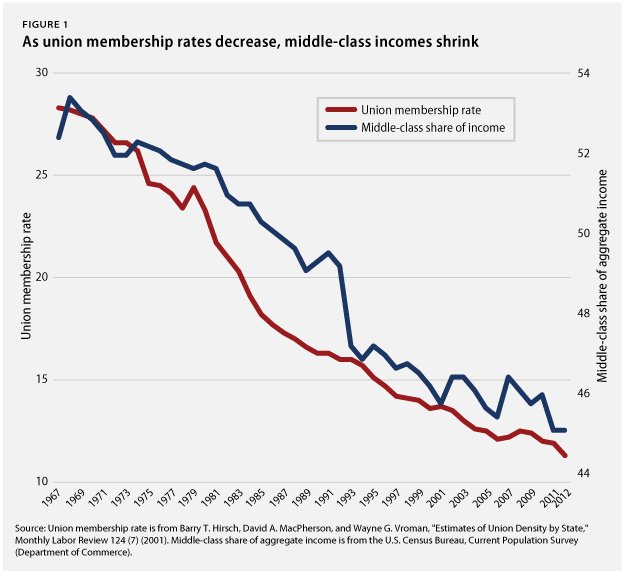
- Caroline Fairchild reports on the obvious link between unionization and reasonable middle-class wages.

- Finally, Lana Payne discusses the dangers of allowing any level of government to silence both dissenting opinions and the people who hold them.

Tuesday, September 17, 2013

Tuesday Morning Links

This and that for your Tuesday reading.

- Christopher Ragan writes about the lessons we should be drawing from the 2008 financial meltdown - as well as so many similar bubbles before it:
Contrary to what many people seem to believe, financial crises like the one that began five years ago are neither rare nor inexplicable. They have been occurring for centuries, and while each one has its own fascinating details, they also have much in common.
...
First, there always appears to be some new kind of investment or financial instrument to get investors excited. In Amsterdam in the 1630s, it was the arrival of tulip bulbs from foreign lands. A century later, publicly traded “joint stock” companies were the new thing, and the promise of far-away profits added an exotic twist. In the 2000s, the process of “securitization” and the creation of mortgage-backed securities seemed to offer both high returns and the safety of diversification.

The complexity of many financial instruments gets us to the second common element: The belief that money and intelligence travel together. It is probably natural to think that only really smart people can make it in the complex world of financial markets. When we see these people doing so well, we naturally conclude that they know a lot more than we do and, since they’re so smart, maybe we should do whatever they’re doing. And so the bandwagon starts rolling.

The third element is something very old: By borrowing a lot to purchase investments, investors become highly “leveraged.” The wonderful thing about leverage is that for good investments, the return on equity gets highly magnified because the investor starts with so little equity in the first place. The terrible thing is that for bad investments, the same magnification happens in reverse – and many investors then find themselves with few assets but mountains of debt. In 1630s Amsterdam, individuals borrowed massively to finance their tulip investments. A century later, investors did the same to purchase shares in the Mississippi and South Sea Companies. In the 2000s, individuals purchased houses with enormous mortgages and investors then borrowed money to purchase the associated mortgage-backed securities. The tulips and company shares and houses were all purchased with the expectation of ever-rising prices. But prices didn’t keep rising – they never do.

The fourth element is the assignment of blame after the fact. Maybe it falls on the founder of the company whose share prices collapsed, or the land developer whose real estate values evaporated, or the “predatory” mortgage lenders or the agencies that rated the riskiness of the mortgage-backed securities. There’s rarely a shortage of people to blame. But Mr. Galbraith noted that we never blame “the system,” because to do so would be to question the basis of a market economy – and who wants to do that?

Yet market systems have been prone to financial crises for hundreds of years. We can regulate the extent of leverage, the nature of bank lending, mortgage conditions, corporate governance, and much else. And we are right to do so, because financial markets do not work efficiently in the absence of such regulations. But let’s not delude ourselves into thinking that we can prevent the intrinsic behaviour that fuels financial euphoria and leads to financial booms, collapses and occasional crises. These are an unfortunate but unavoidable part of a market economy.

Mr. Galbraith’s final common element is our painfully short memory preventing us from learning from previous errors. So, maybe the most important lesson to be drawn from the past five years is that we should be less ignorant of our history. Our tendency to neglect the past, and to repeat crucial mistakes, will hasten the arrival of the next financial crisis.
- Anne Kingston writes about the developing Toronto Centre by-election campaign. And while some observers have raised questions about her fawning portrayal of the Libs as a party, the developing themes look to be ones which operate in Linda McQuaig's favour: a candidate with the "home-turf advantage" and a focus on income security versus a "habitué of the Davos think-tank circuit" whose message lacks much appeal beyond a business-school crowd.

- Stephen Maher and Glen McGregor's report on the participation of the Cons' primary counsel in interviews with Michael Sona and other Robocon figures has received plenty of attention. But I'll highlight the fact that Arthur Hamilton's intervention was purely in his capacity as the Cons' counsel - meaning that to the extent he managed to interfere with an investigation into election fraud, he did so in the name of (and the legal interests of) Stephen Harper and company.

- Finally, Nick Taylor-Vaisey and Aaron Wherry both discuss the NDP's use of Twitter to ask the questions the Cons are avoiding by shutting down Parliament. And it may be worth noting the effect that plan will have in getting responses - not from the Cons (who don't figure to be any more responsive than in the real Question Period), but from the public in determining which #QPQ questions receive the widest distribution.

[Edit: fixed typo as per comments.]

Sunday, August 18, 2013

Sunday Morning Links

This and that for your Sunday reading.

- Not surprisingly, this week's revelations about Pamela Wallin have set off plenty more discussion about what's wrong with the Senate and its current beneficiaries. Andrew Coyne recognizes that the problem lies in the design of an institution based on patronage and unaccountability rather than being merely an issue of who's getting appointed, while Andrea Hill discusses how the Senate breeds a sense of entitlement. Rosie DiManno sees Wallin as a prime example of that phenomenon in action, while Tim Harper writes about Stephen Harper's role in establishing his appointees' expectation that they'd be above any rules so long as they served his partisan interests. And Michael Bliss joins the chorus calling for abolition as the best way to end the abuse.

- Jenny Uechl points out Robyn Allan's observation that just as the public is likely to pay most of the bill for MMA's destruction of Lac-Mégantic, we're all likely to be on the hook for the costs of pipeline failures based on how the corporate sector prefers to do business:
"Lac Mégantic  shows that companies are making money doing things that cause huge risks, and when they cause an accident, they don't have the money to pay for the damages, so the public is left on the hook," said Allan, commenting on liability regimes. 
"That's a reprehensible situation, and it's the standard --  it certainly has been with pipeline companies." 
Allan drew public attention to Enbridge's "limited liability partnership" structure during the Northern Gateway joint review panel hearings earlier this year. Among the many points covered in her study, she noted that Enbridge set up Northern Gateway so that revenues from the pipeline would go to Enbridge shareholders, but the liability responsibility stopped with Northern Gateway, leaving the parent company protected.
 - Which makes it all the more important that we have fair assessment processes which reflect the public interest rather than mere rubber-stamps - as the Star's editorial board notes

- The Washington Post reports on how the NSA's surveillance has led to thousands of breaches of U.S. law over the past few years, while Amy Minsky writes that the RCMP has simply taken to ignoring its legal obligations to provide access to information. And the trend of outlaw law enforcement regimes offers all the more reason to doubt that spending billions of dollars on dangerous drones represents an even faintly defensible use of public money.

- Finally, Erin Weir points out Chrystia Freeland's platitude-laden economic message. And Matt Fodor and Michael Laxer suggest that it's long past time to instead have an adult conversation about taxes and public services:
As Hugh Mackenzie notes: "Nations that have the most highly developed systems of public services pay for them with all kinds of taxes, including sales taxes and payroll taxes that everyone contributes to because everyone knows there is no such thing as a free lunch."

The Nordic countries of Sweden, Denmark and Norway all have a Value Added Tax (VAT) of around 25%, far higher than the GST/HST, which finances the welfare state.  The Nordic model is notable for its reliance on transfers, which do the heavy lifting in terms of countering inequality.  While personal income taxes are higher than in Canada, they also pay much higher levels of consumption and payroll taxes.  Yet the net impact of the tax-and-transfer system is progressive. Rather massively so. In part, this is for the obvious reason that because the affluent spend more, the net impact of consumption taxes are progressive if they are spent on human need.

Indeed, the redistributive power of public spending – on healthcare, education, pensions and an array of other public services – should not be ignored.  A CCPA report, Canada’s Quiet Bargain, found that more than two thirds of Canadian households receive more than 50 percent of their income in public services, a far better deal than the market and far more than they pay in taxes. This was even more true before the tax-cutting mania of the past two decades.

The taxation of private consumption can fund the provision of public goods (such as parks, public transit, public housing, etc.) that are more ecological than private goods. Furthermore, public goods provision has the effect of decommodification which is as important as progressive taxation in terms of moving toward socialist relations in capitalist societies.

Tuesday, July 30, 2013

On coopting

Paul Wells offers a note of warning for the Libs in recruiting Chrystia Freeland as a candidate. But I see a greater problem for Freeland herself in pursuing the role.

It's not hard to see how Freeland might seem appealing as a means of papering over the Libs' disconnection from the general public:
Chrystia Freeland, winner of the 2013 National Business Book Award for her book Plutocrats: The Rise of the New Global Super-Rich and the Fall of Everyone Else (Doubleday Canada), has confirmed her foray into federal politics.

The race to replace MP Bob Rae in the Toronto Centre riding is gaining momentum as the Thomson Reuters editor and managing director has confirmed she will be seeking the Liberal party nomination. 
But it wasn't long ago that an opposition party similarly looked to press its advantage in a perceived area of weakness for the incumbent government - with little regard for whether it intended to follow through on its assurances. And that didn't exactly work out well for the star candidate involved...
Years after a nondescript public servant wouldn’t play ball with institutional sleaze (and became a national hero in the process), Allan Cutler still has Canada on his mind. He is as troubled now as ever he was when Jean Chretien had his name embossed on golf balls to keep Quebec in Canada.

“I had hoped after Gomery that things would change. If anything, it has gotten worse. We have an epidemic of corruption at the federal level. Whistleblowers are even more unwelcome now than they were then.”
...nor for the writer whose criticism was seen to define the problem:
Savoie's passionate condemnation of centralization didn't slow it down. In an odd way, it may even have contributed to it.

"An adviser to a prime minister asked me if I'd sign a copy of Governing from the Centre," Savoie says. "I leafed through it and I noticed that he had read it, he had underlined a few things. And I said, 'Now you're going to do things differently?' He said, 'No, no, no. We use it as a manual.' "
Now, I have no doubt that there are plenty of Libs hastily grabbing copies of Plutocrats for their summer reading. But given that the actual direction of the party under Justin Trudeau has involved backing the Cons and corporate interests at every turn, there's little reason to think Freeland's call to serve "everyone else" is being treated as anything other than a cookbook - nor that the Libs see an expose about the global elite as much besides a manual to gain entrance to the club.

We'll see whether Freeland herself manages to gain any traction on the Canadian political scene. But all indications now are that she's mostly being used to brand continued plutocratic rule with a large red "L" - and the rest of us shouldn't see that as an improvement.

Saturday, June 22, 2013

Saturday Morning Links

Assorted content for your weekend reading.

- Chrystia Freeland writes about the dangers of increased concentration of wealth - particularly when it bears at best a passing relationship to any worthwhile contribution to society at large. And CBC's report on Peter Sabourin's investment fraud highlights the fact that the tax havens which have allowed for extreme accumulation of wealth have also facilitated crime against anybody aspiring to join the elite.

- Toby Sanger provides a handy list of 12 problems with the Cons' anti-union legislation.

- Pat Atkinson questions the Cons' complete failure to ensure that Canadians can trust that their food is safe. Murray Mandryk sees no justification for the Sask Party's creation of a corporate right to privacy. Readers of my column won't be surprised that I concur on both counts.

- Finally, Julie Lalonde recognizes that the only change involved in the Cons' new prohibition against anonymous protesting is one for the worse:
It is important to remember that the mass arrests made in Toronto highlighted several incidents of police officers removing their identification and concealing their identity. When complaints were filed, officers argued that they violated Chief Bill Blair’s rules because they feared retaliation from the public and wanted to protect their privacy.

What about the rights of public servants who want to attend demonstrations while concealing their identity to protect their jobs? What about pro-choice advocates who fear being the targets of anti-abortion violence if their identities are revealed? Are they not entitled to the same protections as police officers?
...
Bill C-309 was not about hockey riots. There are existing measures to address those. It was about a government afraid of the power of collectivity. It is about the efficiency of the Quebec student protests and the frightening law and order agenda exposed during the G8/G20 arrests.

Conservative MP Blake Richards said his bill would make communities safer, but he couldn’t be further from the truth. This new law will make us vulnerable to the biggest threat of all: fear. If every activist is guilty until proven innocent, we will see fewer willing to take the risk of arrest and detainment. As a result, our collective rights suffer.

Bill C-309 is a canary in the mine. As an activist, I may have nothing to hide but I have everything to lose.

Saturday, June 15, 2013

Saturday Afternoon Links

Assorted content for your weekend reading.

- Paul Krugman points out that workers are receiving less and less benefit from technological advancements - and offers a simple policy prescription to ensure workers of all skill levels don't suffer unduly based on forces far beyond their control:
I’ve noted before that the nature of rising inequality in America changed around 2000. Until then, it was all about worker versus worker; the distribution of income between labor and capital — between wages and profits, if you like — had been stable for decades. Since then, however, labor’s share of the pie has fallen sharply. As it turns out, this is not a uniquely American phenomenon. A new report from the International Labor Organization points out that the same thing has been happening in many other countries, which is what you’d expect to see if global technological trends were turning against workers. 

And some of those turns may well be sudden. The McKinsey Global Institute recently released a report on a dozen major new technologies that it considers likely to be “disruptive,” upsetting existing market and social arrangements. Even a quick scan of the report’s list suggests that some of the victims of disruption will be workers who are currently considered highly skilled, and who invested a lot of time and money in acquiring those skills. For example, the report suggests that we’re going to be seeing a lot of “automation of knowledge work,” with software doing things that used to require college graduates. Advanced robotics could further diminish employment in manufacturing, but it could also replace some medical professionals.
...
So what is the answer? If the picture I’ve drawn is at all right, the only way we could have anything resembling a middle-class society — a society in which ordinary citizens have a reasonable assurance of maintaining a decent life as long as they work hard and play by the rules — would be by having a strong social safety net, one that guarantees not just health care but a minimum income, too. And with an ever-rising share of income going to capital rather than labor, that safety net would have to be paid for to an important extent via taxes on profits and/or investment income.
- And Sarah Cooper and Lynne Fernandez concur in the conclusion that a more fair distribution of income is the best treatment for poverty (among other problems). 

- Meanwhile, Chrystia Freeland highlights the reality that even the 1% can't avoid the detrimental effects of inequality - with a TED event in Edinburgh serving to bring the issue to the forefront:
I was a speaker, too. I talked about my chief obsession, soaring global income inequality, particularly at the very top of the pyramid, and the uncomfortable fact that the same forces that are enriching the global super-elite are hollowing out the middle class in the West’s developed economies. Making capitalism work for everyone, and not just the plutocrats, I argued, is our most pressing political and economic problem.

Taken together, and given the gilded venue, all of these comments amount to a significant shift in tone. Charlie Robertson, the global chief economist for Renaissance Capital, the Russian-based investment bank, was moved to post on Twitter, in reaction to the TED lineup, that the “intellectual ascendancy of neo-liberalism since ’70s may be in retreat.”

That is probably going too far. But we do seem to be at a turning point, or the beginning of one. Judging by this week in Edinburgh, even the winners in the global economy are beginning to realize that there are a lot of losers, too, and that it’s a problem. You might see that as too little too late; you might also see it as, at long last, a start.
- Colin Horgan writes that Stephen Harper's speech to the UK Parliament this week was more partisan than prime ministerial. Bruce Johnstone notes that it was predictably laden with falsehoods as well. And contrary to Harper's efforts to claim immunity from international economic conditions, Krugman points to Canada's rising household debt load and housing prices as offering a test case for the dangers of future deleveraging shocks.

- Finally, Lana Payne proposes that we get serious in addressing tax avoidance and evasion, while recognizing that the Cons' anti-tax ideology is standing in the way of global action:
Given Mr. Harper’s opinion on taxes, it should come as no surprise that he is said to be the problem at the G8 table. Tax havens, of course, are a practice by which the very rich get to hide their money so they can avoid paying taxes.

After all, if, as the prime minister believes, all taxes are bad, why then the need to seriously crack down on those who avoid them?

According to Canadians for Tax Fairness, Canada has been withholding support for two key aspects of the G8 tax havens action plan. They include that financial institutions in tax havens be required to have a public registry of the ultimate beneficial owner of all accounts, trusts or corporations and that there be multilateral tax information sharing between governments.

The tax fairness folks say these measures are important to “lifting the veil of secrecy that allows wealthy individuals and corporate tax evaders and criminal organizations to hide their wealth offshore.”

But Stephen Harper, it appears, would rather protect the cheats. Yes, well, don’t be surprised; there was that Mike Duffy affair.

So let’s get this straight.

The government — bent on forcing unions to publish nearly every transaction on a public website, taking up the time and resources of Revenue Canada officials, creating a pile of red tape for labour organizations, violating privacy laws and in all likelihood the Constitution — is opposed to a public registry to catch tax evaders.

Sunday, March 03, 2013

Sunday Afternoon Links

Assorted content for your Sunday reading.

- Chrystia Freeland comments on the disproportionate influence of the super-rich in a democratic system which is supposed to value citizens equally:
“I think most Americans believe in the idea of political equality,” Callahan told me. “That idea is obviously corrupted when in 2012, one guy, Sheldon Adelson, can make more political donations than the residents of 12 states put together.”

The Demos study draws in part on the quantitative research of Martin Gilens, a professor of politics at Princeton University and author of “Affluence and Influence: Economic Inequality and Political Power in America.” Gilens, who focused on the divide between the top 10 percent and everyone else, found a high degree of what he calls political inequality.

“I looked at lots of survey data that indicated what people at different income levels wanted the government to do, and then I looked at what the government did,” Gilens explained.

“For people at the top 10 percent, you could predict what the government would do based on their preferences,” he said. “But when the preferences of people at lower income levels diverged from the affluent, that had no impact at all on the policies that were adopted. That was true not only for the poor but for the middle class as well.”

Gilens is a social scientist who is careful to stick to his data. But he told me he was “definitely surprised by the extent of the inequality.”

“If you value democracy, if you value the ability of people at all levels of income to shape government, which is what it means to be a democracy, then, yes, you should be very worried,” he said.
- Michael Smyth discusses the chaos surrounding the B.C. Libs, who aren't having any particular success running damage control after using public resources for a partisan ethnic voter strategy. And even one of Gordon Campbell's former chiefs of staff is pointing out that a combination of untrustworthy government and transparent corporate interference is only making the NDP look all the better by comparison.

- I'm not sure there's ever going to be much basis for confidence in the Northern Gateway pipeline. But an Enbridge witness trying to make the case that oil spills would be good for northern B.C. doesn't exactly inspire confidence that the project's backers are taking the dangers of a spill seriously.

- Finally, Noah Evanchuk wonders whether the Cons' stranglehold on much of western Canada is as safe as most pundits seem to presume - and notes that a track record of patronage and waste like the one amassed by the Harper Cons tends to give rise to a backlash on the prairies:
For two decades, Conservatives have been able to campaign in Alberta and Saskatchewan as Hill outsiders, vowing to go to Ottawa to “stand up” for the region. This “nail ‘em up” ethos has a long history in Western Canada and, going back to Louis Riel and the Red River Rebellion, no area of Canada has as consistently sent non-traditional parties to the House of Commons as Manitoba, Saskatchewan and Alberta.

Hot-button issues like the Liberal long gun registry and the Firearm Act allowed the Conservatives to tap into deep regional dissatisfaction with Ottawa. Their consistent dominance on the Prairies has fooled some Ottawa-based commentators into thinking the area is a lost cause for the NDP.

But the winds are changing direction for Tom Mulcair and the NDP in the West, where — along with the changing demographics that have given rise to the Idle No More movement — they will be taking seats directly from Conservatives, and electing a truly national NDP government in the process.

Sunday, February 24, 2013

Sunday Morning Links

That and that for your Sunday reading.

- Alex Himelfarb weighs in against gratuitous austerity by pointing out the dishonest cycle of excuses used to push destructive policy:
(T)he consequences of cuts are increasingly visible, first for the most vulnerable: aboriginal communities struggling to meet basic needs, higher tuitions and student debt, refugees who cannot get needed medicine, more unemployed Canadians thrown onto inadequate welfare because they cannot access insurance. Some consequences will play out more slowly: weaker environmental regulations, cuts to education and science, neglect of crumbling infrastructure, eroding public services will all make our economy less competitive, less fair, less sustainable. The deeper the cuts, the more public services erode, the more inequality and poverty grow, the greater the risks of social disruption and the higher the political costs. Then what?

The final refuge is to argue that all the right things have been done and now it’s up to the market. These arguments are already on the business pages of our media: when the governor of the Bank of Canada urged business to put some of the cash they were sitting on back into the economy, the austerians reacted with force. Don’t worry about “dead money,” they said. Don’t worry about the failure of the corporate sector to turn its profits — and tax cuts — into job-creating investments. Sounding eerily like old Communists clinging to the notion of inevitable revolution, their argument was pure ideology — “it’s only a matter of time,” surely market forces, as the laws of economics require, will kick in. If there are inexorable laws of economics that yield jobs and growth from cuts to taxes and government, it seems somebody forgot to tell business.
- Chrystia Freeland notes that the promise of prosperity out of free trade looks to be similarly empty within one of the largest trade relationships in the world, as the primary effect of increased U.S. trade with China has been domestic job losses:
“U.S.-China trade is almost a one-way street. This trade relationship doesn’t clearly give you the benefit that you can sell a lot of stuff to your trade partner,” Dorn said. “If you talk to someone who is somehow involved in the promotion of free trade, they may say that maybe the headquarters of Apple (AAPL.O) benefits. That may be true. But the first-order effect is of job loss.”
...
What is challenging about both of these trends, and what makes the hollowing out of the middle class a political problem as well as an economic one, is how different they look depending on whether you own a company or work for one.

Shipping middle-class jobs to China, or hollowing them out with machines, is a win for smart managers and their shareholders. We call the result higher productivity. But, looked at through the lens of middle-class jobs, it is a loss. That profound difference is why politics in the rich democracies are so polarized right now. Capitalism and democracy are at cross-purposes, and no one yet has a clear plan for reconciling them.
- Meanwhile, Laurie Monsebraaten discusses the plight of the precariat, as roughly half of workers in the Toronto area lack secure employment. And pogge rightly notes that the trend toward instability is part of a conscious set of policy choices aimed at redistributing wealth in the direction of the few at the top:
Governments over the past thirty years or so have increasingly catered to the corporate agenda while organized labour has been steadily undermined. Politicians have practically hurt themselves in the rush to sign on to so-called trade agreements that curtail their own ability to affect the economy in favour of giving more control to the private sector. They've either looked on benignly or actively smoothed the way for employers who want to rely less on full time employees and turn as many jobs as possible into temporary, contract positions with no benefits.

Wasn't the state of affairs described in this article the point? People who feel their economic position is precarious will settle for lower wages, fewer benefits and more abuse. Their employers can look forward to bigger profits on which, thanks to those same co-operative governments, they'll pay lower taxes.
- Finally, the public editor of a Bell-owned paper has concluded that there's no need for any critical look at Bell's motives or choices so long as it proclaims a story to be purely a matter of good news. I for one see no way this philosophy could possibly go wrong.

Saturday, February 23, 2013

Saturday Morning Links

Assorted content for your weekend reading.

- Chrystia Freeland points out why productivity doesn't provide an accurate picture of economic development if it merely results in increased inequality rather than shared benefits:
Productivity and innovation, the focus of policy makers and business leaders, no longer guarantee widely shared prosperity. “Digital technologies are different in that they allow people with skills to replicate their talents to serve billions,” Mr. Brynjolfsson said. “There is really a drastic winner-take-all effect because every industry is becoming like the software industry.”

Classical economic theory isn’t entirely wrong. The danger isn’t — as it was easy to fear during the depths of the financial crisis — structural unemployment. The problem is what kind of jobs, at what kind of salaries, the shiny new technologically powered economy of the future will generate.

Lawrence H. Summers, the Harvard professor and former U.S. secretary of the Treasury, has a vivid way of describing the dystopian possibility. “As economists like to explain, the system will equilibrate at full employment,” Mr. Summers said in a public interview at the World Economic Forum in Davos, Switzerland, last month. “But maybe the way it will equilibrate at full employment is there’ll be specialists at cleaning the shallow end and the deep end of rich people’s swimming pools. And that’s a problematic way for society to function.” 
- And Michael Harris comments on another obvious set of problems in developing a functional society, as the manipulation of interest rates by a financial sector left to nothing but an irrational honour system served to siphon massive amounts of wealth toward a privileged few:
The snakes in suits who think about sleazy ways of making money day and night couldn’t have dreamed up a better scam than manipulating the Libor. Anyone who pays a mortgage or struggles with a student loan feels their power. So do the people who get less of a dividend on their corporate bonds.

But for bankers and brokers with cash-register hearts, the possibilities of profit and benefit from fiddling the Libor were endless.

That’s because the rate was whatever they said it was. Setting it became a vast exercise in Scout’s Honour run amok. Floor traders who assisted in the scam increased their bonuses. The colluding banks made money by lending at a higher interest rate, knowing that they had the ability to artificially lower their costs when borrowing the same currency by driving down the Libor. Governments had the appearance of wisdom.
...
The thievery and deception went on for years. Finally, heads rolled and charges were laid. As usual, public and private regulators proved to be direct relatives of Rip Van Winkle. They bleated, lamb-like, claiming to be shocked that the world’s biggest banks had turned international banking into a private casino. In that gaming house, the cards were marked, the dice loaded, and everyone got fleeced but the guys who drove Ferraris.
...
The Libor scandal, you see, was actually aided and abetted by the government of the day and the Bank of England. No one was regulating the Wild West banking practices because they had opted for the so-called “light touch” approach to supervising banking.

People with the lightest touch usually turn out to be pickpockets. De-regulation of the banking industry unleashed 10,000 hyenas on an unsuspecting public.
Which is particularly worth noting as other areas of interest - such as, say, Saskatchewan's environment - are also shifted toward models where the specialized expertise of regulators gives way to a similar "light touch" to encourage innovative evasion tactics.
 
- Better Way Alberta emphatically refutes Alison Redford's claim that the province's budget problems are a matter of spending rather than revenue, pointing out that Alberta could raise tens of billions of dollars each year simply by applying a more reasonable royalty structure and a tax system consistent more with other Canadian provinces.

- Glen McGregor and Stephen Maher offer an overview of where Robocon stands, as well as the news that Elections Canada's review of the Cons' vote suppression is still in progress but running into limitations in its own investigative authority.

- Finally, Jeffrey Simpson recognizes that the Cons' much-ballyhooed Office of Religious Freedom is intended purely for domestic political consumption rather than any plausible hope of influence around the world.

Friday, January 25, 2013

Friday Morning Links

Assorted content for your Friday reading.

- In addition to providing my latest tagline, Alex Himelfarb takes aim at the austerians who seem happy to attack social well-being and economic development alike in the name of government-slashing:
(A)usterity had never been driven by fiscal policy or economics or evidence.  It was driven by ideology.  Market fundamentalism.  A desire to make government much smaller, eliminate or reduce, as much as politics allowed, so-called entitlements, create a “pro-business” climate of less regulation, less government, and, above all, lower taxes.

Think about the irony of this: that the huge recession-induced deficits that were largely the result of tax cuts and deregulation were now the justification to renew the commitment to that same failed ideology. Deficits were a gift – cover to do what many had wanted to do all along.  Cut government down to size.  Cut services. Cut. It seems that every failure of this neoconservative approach is used by its advocates to justify doing more of the same. That’s kind of nuts.

How about Canada? I left the Privy Council and Canada for a few years in 2006. At that time Canada had a $16 billion surplus. That’s a real problem for those who might share Cameron’s ideology because without big deficits it’s harder to argue for the urgency to cut programs, reduce government. Instead, the decision was made to cut taxes, for example, taking two cents out of GST. Today those two cents cost the federal government about $14 billion annually. That’s on top of continuing the corporate tax cuts the Liberals had already launched and on top of numerous “boutique tax cuts” and on top of Liberal tax cuts in 2000 that were the biggest in Canadian history.

Imagine none of that had happened.  Imagine that the federal government had at least a good portion of the revenue that they gave up over the last dozen years. They would have had enough money to be far more resilient in the face of recession, to help provinces that were in trouble, to invest in science, education, in a greener, cleaner economy and to begin to transform our health and social programs so they would be there for future generations.

Instead, we’re now talking about austerity as though it’s inevitable, as though we have no choice. (When our leaders tell us that there is no alternative, it is a safe bet to assume that there is indeed an alternative and one that we would prefer were it on offer.)
- Meanwhile, Chrystia Freeland points out that many of the world's wealthiest tycoons gathered in Davos are trying to perpetuate an obsession with deficits rather than well-being. But Paul Krugman has some hope that deficit hawks are rightly being marginalized in Washington.

- At home, Kevin Page's latest report features two obvious indications that deficit talk is just as empty here as elsewhere: the CP points out that the Cons' attacks on the civil service have resulted in a shift away from providing useful services without actually saving any money.

- And finally, Hugh MacKenzie reminds us that we should be concerned about a $145 billion backlog of infrastructure neglect rather than limiting our focus to cuts and tax baubles.

Saturday, January 05, 2013

Saturday Morning Links

Assorted content for your weekend reading.

- Crawford Kilian comments on Chrystia Freeland's Plutocrats as a useful expression of trends many of us have seen in action for some time:
(T)he plutonomy is not just booming, but skewing the still-depressed economy the rest of us live in. Many of the plutocrats reflect soberly on Andrew Carnegie's comment that the man who dies rich dies disgraced. Many, including George Soros, Bill Gates, and Warren Buffett, are giving away their billions to various causes and charities.

Individually, those causes may be admirable (Soros has worked hard to promote democracy in eastern Europe). Collectively, those causes may be compromised and diverted from their original purposes by the sheer quantity of plutocratic money available. And of course many billionaires like the Koch brothers are pumping money into political causes that promise to keep their taxes low while suffocating government programs for the rest of us.

This is just one form of plutocratic "rent-seeking" -- getting one's businesses into a monopoly position, or lowering their operational costs, through favourable legislation. Every business, after all, wants to improve its own working conditions, just as every worker does.

But what is good for one's business is not always good for the country. Rent-seeking simply runs up the plutocrats' revenues while doing nothing for their customers. And it never occurs to such plutocrats that their success ultimately stems from the system created and maintained by the rest of society. As Barack Obama observed, "You didn't build that."

Freeland makes a useful contrast between plutocrats who are pro-market and those who are pro-business: In the market, companies compete, innovate, or die if they can't. This is the "creative destruction" that brings genuine improvements in living standards, and it's still at work. As one plutocrat told Freeland, the big companies used to eat the little ones. Now the swift eat the slow.
But in business, one tries to protect one's own company by eliminating the competition (and the innovation). Historically, innovators become consolidators and rent-seekers, creating a new privileged class of their children and hangers-on.
- And on a related note, Frances Russell writes that we're now in the age of corporate shakedowns of government:
A Canadian government official puts it this way: “I’ve seen the letters from the New York and D.C. law firms coming up to the Canadian government on virtually every new environmental regulation … Virtually all of the new initiatives were targeted and most of them never saw the light of day.”

These so-called “pre-emptive strikes” are on the rise, with investment arbitration no longer a last resort but a political weapon in a wider war of attrition against states.

Even already-adopted laws on public health and environmental protection have been abandoned or watered down because of the threat of huge damage claims. Canada backed away from anti-smoking policies after Big Tobacco threatened to seek compensation.

NAFTA and its growing ranks of copycats like the Canada-Europe Trade Agreement and the Trans-Pacific Partnership are about nothing less than entrenching de facto government by transnational corporations. So far, the corporations are winning. In the process, they’re not just enriching themselves but also a global network of fabulously wealthy lawyers and accountants busy impoverishing governments and their citizens to achieve maximum profits for the multinationals they represent.
- Frank Graves discusses how arguably rational political calculations on the part of the Cons may be producing decisions which directly attack Canada's future:
The political calculus couldn’t be clearer: it makes great sense for a conservative politician to concentrate on emotionally resonant policies and communications which will appeal to a group that votes en masse. It also makes sense to discourage the participation of younger voters (who wouldn’t vote for you anyway) through negative advertising and policy positions that are of little interest, or antagonistic, to those younger voters.

The net result, however, is a gerontocracy which reflects the exaggerated and imagined fears of older Canada precisely at a time when we urgently need the more optimistic and innovative outlook of the relatively scarcer youth portion of our society. So good politics becomes highly suspect as a tool for meeting the severe challenges of the 21st century.

This growing disconnect between the public interest and what works in the political marketplace is a serious challenge. The mounting generational tensions in our society are just one particularly unwelcome expression of this.
- Trish Hennessy runs the numbers on how First Nations have been frozen out of social gains in Canada.

- Finally, Andrew Potter expands on Glen McGregor's ideas for more productive political journalism:
If there is a big takeaway from "McDogme95" (as Stephen Maher calls it) it is this: It is an opportunity for political journalists to retrench and concentrate their energies on what they are best positioned and best qualified to do: work sources, file ATIP requests, comb through public databases, and break stories that are in the public interest. That in turn creates a space for academics to insert themselves directly into the conversation through their own devices (Twitter, blogs, etc), or through more traditional means such as op-eds or essays. (I can't think of a better example of this than Peter Loewen's recent essay for the Citizen looking at what Stephen Harper is up to.)

Canadian politics is in need of both better reporting and better contributions by academics. Glen McGregor's manifesto is an excellent first step at articulating the proper division of labour that will take us in that direction.

Saturday, December 01, 2012

Saturday Morning Links

Assorted content for your weekend reading.

- Chrystia Freeland discusses the developing view that inequality can serve to stifle growth and development, while more equitable tax systems and social supports can encourage them:
Set aside any moral or political concerns you may have about rising income inequality – worries about poverty, justice, undue political influence or even social mobility. According to Mr. Dervis, a growing number of economists suspect that once inequality passes a certain point, it may jeopardize economic stability and economic growth.

As his book argues, “rebalancing of the distribution of income may play a role in unlocking the U.S. economy’s growth potential in a sustainable way.”

Now that is a truly radical thought, and it brings us back to Mr. Milanovic’s earlier view that income inequality was a forbidden subject in the United States.

Worrying about the poor is one thing. To contend that equality is necessary for growth is an altogether different and more radical idea. Three decades later, trickle-down economics has met its antithesis. We are set for one of the great battles of ideas of our time.
- And Paul Krugman rightly paints the U.S.' recent election as a well-defined class clash - and one where the public interest won out:
(T)he disappointed plutocrats weren’t wrong about who was on their side. This was very much an election pitting the interests of the very rich against those of the middle class and the poor.

 And the Obama campaign won largely by disregarding the warnings of squeamish “centrists” and embracing that reality, stressing the class-war aspect of the confrontation. This ensured not only that President Obama won by huge margins among lower-income voters, but that those voters turned out in large numbers, sealing his victory.

The important thing to understand now is that while the election is over, the class war isn’t. The same people who bet big on Mr. Romney, and lost, are now trying to win by stealth — in the name of fiscal responsibility — the ground they failed to gain in an open election.
- Stephen Maher and Glen McGregor dig into the details of Elections Canada's continued investigation into Robocon - including complaints in 56 separate ridings. And Sixth Estate puts the latest news into context, wondering why it's taken this long to start seeking even basic contact information for the parties responsible.

- Finally, the Star nicely sums up how the Cons' latest round of international belligerence (this time trying to bully the Palestinian Authority into withdrawing its since-approved application for observer state status at the UN) is only marginalizing Canada on the world stage.