Saturday, December 13, 2014

Saturday Morning Links

Assorted content for your weekend reading.

- George Monbiot opines that curbing corporate power is the most fundamental political issue we need to address in order to make progress possible on any other front:
Does this sometimes feel like a country under enemy occupation? Do you wonder why the demands of so much of the electorate seldom translate into policy? Why parties of the left seem incapable of offering effective opposition to market fundamentalism, let alone proposing coherent alternatives? Do you wonder why those who want a kind and decent and just world, in which both human beings and other living creatures are protected, so often appear to be opposed by the entire political establishment?

If so, you have encountered corporate power – the corrupting influence that prevents parties from connecting with the public, distorts spending and tax decisions, and limits the scope of democracy. It helps explain the otherwise inexplicable: the creeping privatisation of health and education, hated by the vast majority of voters; the private finance initiative, which has left public services with unpayable debts; the replacement of the civil service with companies distinguished only by incompetence; the failure to re-regulate the banks and collect tax; the war on the natural world; the scrapping of the safeguards that protect us from exploitation; above all, the severe limitation of political choice in a nation crying out for alternatives.
...
This is not only about politicians, it is also about us. Corporate power has shut down our imagination, persuading us that there is no alternative to market fundamentalism, and that “market” is a reasonable description of a state-endorsed corporate oligarchy.

We have been persuaded that we have power only as consumers, that citizenship is an anachronism, that changing the world is either impossible or best effected by buying a different brand of biscuits. Corporate power now lives within us. Confronting it means shaking off the manacles it has imposed on our minds.
- Toby Sanger takes a closer look at the disastrous results of Ontario's attempt to use P3 schemes to direct public money into private hands. And Cheryl Stadnichuk discusses how the Wall government's "savings" on public-sector staffing are based on diverting tens of millions of dollars to consultants without any explanation.

- Meanwhile, Jeremy Heimans and Henry Timms examine the difference between "old power" based on hoarding exclusive forms of authority, and "new power" based on the coordinated application of broadly-held values. But it's worth acknowledging how far there is to go in sustaining the latter.

- Chris Hall reports that after turning the federal government's operations into little more than a cheerleading team for the tar sands, the Cons are accepting zero responsibility for the utter failure of that plan. Which would be laughable enough on its own - but looks doubly so in light of Mike De Souza's revelation that Stephen Harper's Privy Council Office had its fingerprints all over the ad campaigns which have failed miserably in their attempt to greenwash the tar sands.

- Finally, Lana Payne highlights the Cons' need for a bogeyman to deflect attention from their destructive government.

Friday, December 12, 2014

Musical interlude

Hooverphonic - Expedition Impossible

Friday Morning Links

Assorted content to end your week.

- Aditya Chakrabortty contrasts the myth of the free market against the reality that massive amounts of public money and other privileges are shoveled toward the corporate sector:
Few conceits are more cherished by our political classes than the notion that this is a free-market economy. To the right it is what makes Britain great. For the left it is what they are up against. And for the rich it is what justifies their huge pay packets: after all, they have earned it.

When asked for his view of western civilisation, Gandhi said he thought it would be a very good idea. I feel much the same way about the free market: I’m genuinely curious to see what such a mythical beast looks like. But that term, however widely accepted and advertised, has little to do with today’s Britain. The economy most of us experience – everything from who collects our bins, to how we commute to work, to that new school attended by the kids – is often not a free market at all. Instead, it’s a bog of privately run monopolies; of public projects and services outsourced to businesses for years, even decades, at a time; and massive taxpayer subsidies handed to the corporate sector with fewer questions asked than of disabled people wondering where their living allowance has gone.

Grasp that, and the question of how to tame corporate power becomes easier to answer. If corporations rely on the public for a sizeable chunk of their revenues and power, then we should start asking what they are doing for us in return. Do businesses deserve the privileges given them by society?
...
In Britain businesses take £85bn a year from the public in grants, subsidies, insurance schemes, preferential credit and government services. That’s the corporate welfare bill as totted up by Kevin Farnsworth, senior lecturer in social policy at the University of York, and he admits it’s on the conservative side. Add on the various subsidies for too-big-to-fail banks and you’re well in excess of a hundred billion. Nor does he include the most fundamental privilege society affords the investors in a business such as Tesco: that of limited liability, which means they only stand to lose the value of their shares, and no more. We could argue for limited liability, but let’s not pretend it’s anything less than a substantial underwriting of shareholder enterprises.
...
The fashionable thing to say is that in a globalised economy states can’t keep up with businesses. That is to get the relationship the wrong way round. The reality is that states often give businesses their revenues and so their power. More than that: markets are created by states, who provide the infrastructure, the transports and the rule of law.

So let’s start asking businesses what they’ve done for us recently.
- And Andre Picard discusses why our support for science shouldn't be limited to research with immediate commercial applications:
Government’s role should be to invest tax dollars for the collective good. In science, that means investing where businesses won’t, namely in basic research. A secondary purpose is to direct tax dollars where there are shortcomings and great public need, such as aboriginal health, mental health and repairing environmental damage (as opposed to just extracting more oil out of the ground). The strategy starves already neglected areas.

Whether it ultimately creates jobs or not, innovation is a complex process. It emerges in an environment where there is healthy pursuit of knowledge, an exchange of ideas and no small measure of serendipity.

The scientific environment the federal government has created is precisely the opposite: Scientists are muzzled, more time is spent on bureaucracy required to get funding than on research itself, and the only measure of success is return on investment.
...
The problem with this approach is that it won’t result in better science or more innovation. On the contrary, it will make scientists shy away from taking risks or from pursuing “paradigm-shifting” ideas (speaking of buzzwords). Instead, they will opt for projects with sure-fire return on investment in the short term, and good political optics that ensure continued funding.

In short, the new science and technology strategy will result in the rich getting richer, and all of us being the poorer for it.
- But the pattern of freebies for the corporate sector is still playing out, as Erika Eichelberger notes in reporting on a giveaway to the financial sector snuck into the U.S.' budget legislation at the behest of Citigroup.

- Carrie Tait and Jeff Lewis report on Alberta's plans to allow tar sands operators to put off cleaning up the environmental devastation they've wrought, while Justin Ling catches the Cons pairing their tendency to criminalize dissent with new and draconian sentencing. And Seth Klein observes that contrary to the Cons' spin, a time of dropping prices is exactly the best time to reevaluate our reliance on resource extraction.

- Finally, Michael Harris reminds us of the Cons' focus on marketing rather than reality. And Mia Rabson offers an update on their continued efforts to keep accurate information from reaching the public.

Thursday, December 11, 2014

New column day

Here, on how the Cons' secretive giveaway of what's left of the Canadian Wheat Board can only be explained by their desire to eliminate collective marketing in favour of total corporate control.

For further reading...
- Janyce McGregor reported on the Cons' refusal to consider allowing the Farmers of North America to bid on the Wheat Board's remaining assets. And Karl Nerenberg followed up on the Cons' excuses in Parliament.
- Dougald Lamont rightly sees the Cons as forcing producers toward the "bozo zone" of racing to the bottom in quality and price.
- And even the Globe and Mail recognizes the dangers of giving away public assets through a secretive process when there are bidders willing to ensure both some return in the short term, and a viable business structure in the long term.

Thursday Morning Links

This and that for your Thursday reading.

- Wray Herbert examines Lukasz Walasek and Gordon Brown's work on the psychological links between inequality, status-seeking and reduced well-being. And Linda McQuaig writes about the harm increasing inequality has done to Canada both economically and socially:
(The OECD's recent) report puts actual numbers on how much growth has been reduced as a result of trickle-down. In the case of Canada, the reduced economic growth amounts to about $62 billion a year — which economist Toby Sanger notes is almost three times more than the estimated annual loss to the Canadian economy of lower oil prices.

But while dropping oil prices are grabbing headlines, the serious negative economic consequences of Canada’s pro-rich economic policies are largely ignored. Certainly the Harper government promises to entrench these policies more deeply if re-elected.
...
The OECD’s powerful message is clearly of little interest to the Harper government, which is planning to exacerbate Canada’s rich-poor gap by introducing an income-splitting scheme that will benefit rich families almost exclusively. Harper’s plan to provide an additional $60 a month per child to all families won’t be nearly enough to allow the bottom 40 per cent of Canadians to invest meaningfully in their children’s education.

The OECD stresses the need “not only for cash transfers, but also increasing access to public services, such as high-quality education, training and healthcare” — areas where Harper’s planned cutbacks to the provinces will hit hard.

What’s striking about the entrenchment of policies favouring inequality is how out of sync they appear to be with popular will.
...
While the world’s elite may still be slapping their knees and marveling at what they’ve managed to pull off, the fact that the most prestigious international economic bodies have lined up against trickle-down orthodoxy may mean there are now prospects for real change.

At the least, it suggests that, in a showdown with the world’s billionaires and multi-millionaires, the world’s people may actually stand an outside chance.
- Of course, if free money for the rich is a demonstrably foolish policy, the Cons remain all too happy to destroy the evidence. But Tavia Grant reports that we can still see an alarming number of Canadians living with low incomes - signalling that the promise of trickle-down economics remains as empty as ever.

- Stephen Gordon takes a look at the fiscal squeeze Stephen Harper has placed on the federal government. But it's well worth pointing out one more piece to the puzzle, as the eroding resources nominally allocated for public services are increasingly being applied to spin rather than anything which could help anybody besides the Cons themselves.

- Thomas Walkom weighs in on the fallout from the Ontario Libs' failed P3 schemes - including needless debts which the province will be paying off for decades to come.

- Finally, Pablo Iglesias discusses how social justice principles reach far beyond partisan lines - even as they've been applied to turn Podemos into an emerging political force (as both a party and a movement) in Spain:
When you study successful transformational movements, you see that the key to success is to establish a certain identity between your analysis and what the majority feels. And that is very hard. It implies riding out contradictions.
...
Politics is not what you or I would like it to be. It is what it is, and it is terrible. Terrible. And that’s why we must talk about popular unity, and be humble. Sometimes you have to talk to people who don’t like your language, with whom the concepts you use to explain don’t resonate. What does that tell us? That we have been defeated for many years. Losing all the time implies just that: that people’s “common sense” is different [from what we think is right]. But that is not news. Revolutionaries have always known that. The key is to succeed in making “common sense” go in a direction of change.

César Rendueles, a very smart guy, says most people are against capitalism, and they don’t know it. Most people defend feminism and they haven’t read Judith Butler or Simone de Beauvoir. Whenever you see a father doing the dishes or playing with his daughter, or a grandfather teaching his grandkid to share his toys, there is more social transformation in that than in all the red flags you can bring to a demonstration. And if we fail to understand that those things can serve as unifiers, they will keep laughing at us.

Wednesday, December 10, 2014

Wednesday Morning Links

Miscellaneous material for your mid-week reading.

- Scott Clark and Peter DeVries remind us that any fiscal problems Canada has faced under the Cons have been entirely of Stephen Harper's making:
Harper needed a deficit problem; the fact that the previous government neglected to leave him one was just a short-term inconvenience. From the very beginning his fiscal strategy has been driven by a commitment to his Conservative base and ideology — which demand smaller government by any means — and by a desire to show that he had ‘what it takes’. He desperately wanted to be seen by history as a better fiscal manager than his predecessors.

Harper and Flaherty both believed — as do most modern Conservatives — that smaller government inevitably leads to stronger economic growth. Unfortunately, stubborn reality has once again refused to cooperate with an impractical theory.

The evidence is clear: Cutting deficits does not by itself generate economic growth. The Conservative “growth friendly austerity” strategy has failed consistently, whenever and wherever it has been applied — in the U.S. under Republican administrations, in the eurozone in recent years, by the G20 after 2010 … and in Canada since 2010.

Cutting the GST by two points will go down in Canadian fiscal history as one of the worst public finance decisions ever. It served no useful purpose — apart from giving the prime minister the cover he needed to impose a neo-liberal fiscal orthodoxy that diminished the federal government while failing to generate growth and jobs.

All Canadians paid the price for securing Mr. Harper’s legacy. We’ll go on paying it for while.
- Meanwhile, Brent Patterson points out how another of the Cons' "economic management" themes - that of constantly pushing trade agreements which entrench corporate power at the expense of the public - seems designed to prevent the development of an effective national pharmacare plan.

- Andrew Jackson notes that it's silly to think that markets can address climate change without some strong public policy leadership. But of course, for the Cons (and other petro-politicians), the only acceptable time to consider the well-being of the planet is never. And indeed, Mychaylo Prystupa reports that the Cons' kangaroo-court National Energy Board is positively bragging about its elimination of any public voices from regulatory decisions about pipelines.

- Adrian Morrow reports on the Ontario Auditor-General's findings that public-private partnerships have cost that province upwards of $8 billion in public money compared to simple public management.

- Finally, Frances Russell points out how the Cons go out of their way to eliminate precisely the voices which would ensure that public policy benefits everybody, rather than only the privileged few:
Harper now faces a wide swath of civil society groups opposed to his government on everything from shockingly mean-spirited assistance to wounded veterans to wanton disregard for the environment to authoritarian disdain – and deep antagonism -towards the forms and traditions of parliamentary democracy.

Never content with just opposing his adversaries, Harper enjoys pre-empting them, beating them up with a totally unexpected attack.

As prime minister, he frequently uses private members bills to begin the softening up process.

Take, for example, the Conservatives’ visceral – and obviously intensely personal – antagonism to organized labour. Harper is moving swiftly to destabilize and disempower Canada’s trade unions. Using the ruse of a backbench Conservative MP’s private member’s bill as the cover, the legislation will force unions to publicly disclose the names and salaries of all employees earning more than $100,000 a year and reveal how much of their time each spends on political activities, lobbying and other non-labour relations work.

Noticeably missing from this purported concern for union members is any actual changes to ensure workplace rights and protection for Canadian workers. And, of course, there is not the remotest indication of similar disclosures being required from the corporate side of the economy.

What better way to try to weaken, divide and destabilize Canada’s House of Labour than perpetrating a Hobbesian war of all against all by stirring up internal strife between leaders and members and between unions with strong and progressive collective agreements and those struggling with weaker and less robust ones forced to exist on the fringes?

With the Harper Conservatives, it’s always win-win for corporations and the well-to-do and lose-lose for everyone else.

Tuesday, December 09, 2014

Tuesday Night Cat Blogging


Tuesday Morning Links

This and that for your Tuesday reading.

- The OECD reports on the relationship between equality and growth, and concludes that rising inequality is as toxic for economic development as it is for our social fabric. And David Rider discusses how increasing inequality is manifesting itself in several Toronto neighbourhoods.

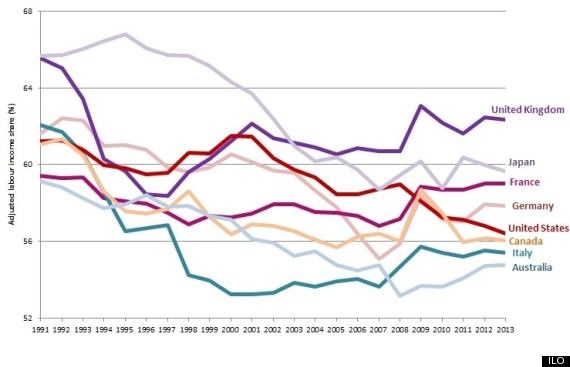
- Meanwhile, Daniel Tancer finds finds that Canada' workers receive a significantly lower share of income than in other developed countries:
Our modern economy is anything but egalitarian, and labour’s share of income has been shrinking for decades as business profits soar while wages stagnate.

On this measure, Canada is actually more unequal than the U.S.

According to the ILO's global wage report, released last week, Americans — by a small margin — take home more of the country’s national income than Canadians do.

Labour’s share of income in the U.S. was 56.4 per cent in 2013, compared to 56 per cent for Canada.

A small difference, but unexpected, given that most other measures (such as income distribution) show Canada is considerably more equal than the U.S. when it comes to wealth.

In fact Canadian labour's share of income is among the lowest of the developed G20 countries, with only Italian and Australian workers taking home a smaller share of the income pie.
labor share of income
Most developed countries have been seeing that number slide for years. The ILO’s chart going back to 1991 shows all of the developed G20 economies seeing labour’s share of the income pie shrinking over the years.
- But unfortunately, the trend is instead toward workers' efforts instead being siphoned off to further enrich our corporate overlords - as in the case of pension funds which are being handed over to the financial sector with no accountability whatsoever.

- Mike De Souza exposes the Cons' failure to bother hiring staff to ensure rail safety.

- Finally, Shawn McCarthy reports on Environment Canada's conclusion that Canada will miss by far even the new and modest targets set by the Cons after they took power. And Isaac Tamblyn proposes that it's time to start ignoring climate change deniers in making policy - though removing them from far too many seats of government would seem to be a necessary first step.

Monday, December 08, 2014

Monday Morning Links

Miscellaneous material to start your week.

- Will Hutton compares the alternative goals of either shrinking government to the point where it does nothing or harnessing it to meet everybody's basic needs, and explains why we should demand the latter:
A financial crisis has been allowed to morph into a crisis of public provision because the government of the day will not lift a finger to compensate for the haemorrhaging of the UK tax base. What the state does is not the subject of a collective decision with concerned weighing of options. Instead, it’s an afterthought, with the greater priorities a reduction in public borrowing and freezing or lowering tax rates.

All the state can spend is what is left after those two greater priorities are met, and if it has to shrink to pre-modern levels then so be it. The market will provide: charity will alleviate suffering; people will get by; the roof will not fall in. Lifting taxation can never be considered to close the gap. It is, it is alleged, both economically self-defeating and immoral.
...
(T)here is never a weighing up of the benefits of raising taxes against a particular use for public spending, nor any strategic long-term programme of investment.

This is bad enough in ordinary times, but when a chancellor refuses to consider raising taxes as the tax base collapses it is a recipe for disaster. It results in a minimal state, with implications for prisons, schools, courts, policing, legal aid, care, security and defence that are profound. Some of this could be avoided if, as both Labour and the LibDems propose, capital investment was not lumped in with current spending so that virtuous borrowing could be separated out. The country may also get lucky: wages stop stagnating and income tax receipts rise.

But the bigger truth is that if Britain wants the scale of public activity congruent with a civilised society, it has to be paid for.
...
There is a different future, and our politicians of the centre and left have to argue for it, but they must accept it has to be paid for. This has become an existential divide. Politics and political argument have never mattered more.
- Meanwhile, Bill Curry notes that the Harper Cons are matching their UK cousins by "balancing" a budget only based on unexplained and implausible assumptions which make it all too likely that we'll end up losing important public assets at fire-sale prices.

- Linda Tirado offers her observations on the high cost of being poor. And Adam Walsh discusses the difficulties faced by the people left behind in boom times.

- Tony Burke writes about the need for both more fair taxation and stronger collective bargaining to ensure that workers benefit from economic gains.

- Finally, Michael Harris highlights the Cons' cynical attempt to cling to power by replacing any expectation of effective government with a non-stop spin cycle.

Sunday, December 07, 2014

Excuses, excuses

Shorter Leona Aglukkaq:
It's absolutely essential that we align our greenhouse gas emissions policies with the U.S. if that means delaying regulations which could limit pollution from the tar sands. Also, it's absolutely essential that we refuse to align our greenhouse gas emission policies with the U.S. if they're committing to targets which could limit pollution from the tar sands.

Sunday Afternoon Links

Assorted content for your Sunday reading.

- Walden Bello discusses the need for our political system to include constant citizen engagement, not merely periodic elections to determine who will be responsible to implement the wishes of the elite:
Even more than dictatorships, Western-style democracies are, we are forced to conclude, the natural system of governance of neoliberal capitalism, for they promote rather than restrain the savage forces of capital accumulation that lead to ever greater levels of inequality and poverty. In fact, liberal democratic systems are ideal for the economic elites, for they are programmed with periodic electoral exercises that promote the illusion of equality, thus granting the system an aura of legitimacy.
...
To reverse the process requires not just an alternative economic program based on justice, equity, and ecological stability, but a new democratic system to replace the liberal democratic regime that has become so vulnerable to elite and foreign capture.

First of all, representative institutions must be balanced by the formation of institutions of direct democracy.

Second, civil society must organize itself politically to act as a counterpoint and check to the dominant state institutions.

Third, citizens must keep in readiness a parliament of the streets, or “people power,” that can be brought at critical points to bear on the decision-making process: a system, if you will, of parallel power. People power must be institutionalized for periodic intervention, not abandoned once the insurrection has banished the old regime.
- As a prime example of the problems with the status quo, Eric Lipton exposes how U.S. Republican elected officials see their main job as repeating and amplifying the message of their oil-sector backers. Bronwen Tucker points out that the Harper Cons are likewise taking the side of the tar sands over people and the planet. And Dean Baker notes that the most recent set of international trade agreements goes far beyond even earlier versions in limiting health and environmental regulations.

- Meanwhile, Tyler Cowen offers some suggestions as to how technology could blunt the impacts of income inequality. But it's hard to see how those theoretical possibilities would accomplish much if not accompanied by a concerted effort to spread the benefit around - rather than merely being allowed to evolve in ways that favour the people in control of current capital and technology.

- Indeed, David Kynaston observes that a shift toward private education has only exacerbated inequality in the UK. And every bit of attention and funding directed toward corporatized education represents resources not put toward something more important - such as food for hungry children.

- And finally, the ILO reminds us that it's corporate decision-making rather than anything beyond employers' control that's led to the growing gap between the executive and shareholder classes and people working for a living.

Saturday, December 06, 2014

Saturday Morning Links

This and that for your weekend reading.

- Reviewing Darrell West's Billionaires, Michael Lewis discusses how extreme wealth doesn't make anybody better off - including the people fighting for position at the top of the wealth spectrum:
A team of researchers at the New York State Psychiatric Institute surveyed 43,000 Americans and found that, by some wide margin, the rich were more likely to shoplift than the poor. Another study, by a coalition of nonprofits called the Independent Sector, revealed that people with incomes below twenty-five grand give away, on average, 4.2 percent of their income, while those earning more than 150 grand a year give away only 2.7 percent. A UCLA neuroscientist named Keely Muscatell has published an interesting paper showing that wealth quiets the nerves in the brain associated with empathy: if you show rich people and poor people pictures of kids with cancer, the poor people’s brains exhibit a great deal more activity than the rich people’s. (An inability to empathize with others has just got to be a disadvantage for any rich person seeking political office, at least outside of New York City.) “As you move up the class ladder,” says Keltner, “you are more likely to violate the rules of the road, to lie, to cheat, to take candy from kids, to shoplift, and to be tightfisted in giving to others. Straightforward economic analyses have trouble making sense of this pattern of results.”

There is an obvious chicken-and-egg question to ask here. But it is beginning to seem that the problem isn’t that the kind of people who wind up on the pleasant side of inequality suffer from some moral disability that gives them a market edge. The problem is caused by the inequality itself: it triggers a chemical reaction in the privileged few. It tilts their brains. It causes them to be less likely to care about anyone but themselves or to experience the moral sentiments needed to be a decent citizen. 

Or even a happy one. Not long ago an enterprising professor at the Harvard Business School named Mike Norton persuaded a big investment bank to let him survey the bank’s rich clients. (The poor people in the survey were millionaires.) In a forthcoming paper, Norton and his colleagues track the effects of getting money on the happiness of people who already have a lot of it: a rich person getting even richer experiences zero gain in happiness. That’s not all that surprising; it’s what Norton asked next that led to an interesting insight. He asked these rich people how happy they were at any given moment. Then he asked them how much money they would need to be even happier. “All of them said they needed two to three times more than they had to feel happier,” says Norton. The evidence overwhelmingly suggests that money, above a certain modest sum, does not have the power to buy happiness, and yet even very rich people continue to believe that it does: the happiness will come from the money they don’t yet have. To the general rule that money, above a certain low level, cannot buy happiness there is one exception. “While spending money upon oneself does nothing for one’s happiness,” says Norton, “spending it on others increases happiness.”
- Lucinda Platt discusses the devastating effects of poverty on childhood development - while noting that more than half of children experience poverty at some point.

- CBC News reports on the continued growth of food bank use in Saskatchewan - a fact which seems to be entirely in keeping with Brad Wall's plans. And Will Chabun reports on a new CCPA/Parkland Institute study showing that the Sask Party's determination to privatize liquor sales will make it far more difficult to fund adequate social programs or other public priorities in the future. 

- Meanwhile, thwap highlights how we face both constant demands to borrow for the sake of meeting consumer expectations, and severe punishments for giving in to that pressure.

- Kathleen Mogelgaard examines what's needed for a climate change summit to be successful. And the Cons' familiar distraction tactics (with the obvious goal of continuing to facilitate pollution from the tar sands) have absolutely no place in accomplishing anything useful - while their international lobbying to avoid having anybody else make up for the Cons' negligence may not be working out as planned.

- Finally, Ian Welsh writes that while it might seem obvious that police violence should be discouraged and punished, the complete lack of consequences for police officers killing civilians reflects an authoritarian culture working as intended rather than a failure of the system in its present form.

Friday, December 05, 2014

Deep thought

In general, we should be appalled by the idea of letting catastrophic climate change run amok and force people to abandon their homes and communities.

But for a few self-selected people, it's tough not to see some poetic justice in the possibility.

Musical interlude

Activa - Antimatter

Friday Morning Links

Assorted content to end your week.

- Manuel Perez-Rocha writes about the corrosive effect of allowing businesses to dictate public policy through trade agreements:
(C)orporations are increasingly using investment and trade agreements — specifically, the investor-state dispute settlement provisions in them — to bring opportunistic cases in arbitral courts, circumventing decisions states deem in their best interest. And now investor-state dispute settlement provisions may be enshrined in two new treaties: the Transatlantic Trade and Investment Partnership and Trans-Pacific Partnership, currently under negotiation between, respectively, the United States and the European Union, and the United States and 11 Asia-Pacific nations. If the final agreements contain these mechanisms, we can expect a flood of cases like Pacific Rim v. El Salvador.

Investor-state dispute settlement provisions feature in many significant pacts, including the North American Free Trade Agreement, and nine U.S.-E.U. bilateral investment treaties. Foreign investors can sue over alleged violations of myriad “investor protections,” including public-interest regulations that would reduce their profits. But it doesn’t cut both ways: Governments or communities affected by foreign investors cannot bring claims. Equally troublesome, tribunal operations are often opaque.
...
The investor-state dispute settlement mechanism is like playing soccer on half the field. Corporations are free to sue, and nations must defend themselves at enormous cost — and the best a government can hope for is a scoreless game. As the T.T.I.P. and T.P.P. negotiations continue, Pacific Rim vs. El Salvador should remind us not to privilege foreign investors to the detriment of the national — or global — good.
- And that corporate privilege stands in particularly stark contrast to the limited rights of citizens - as evidenced by the Ontario Court of Appeal's recent decision that individuals can't even make out an arguable case for a Charter right to housing.

- Joseph Heath examines the reality that dirty and hard-to-extract oil reserves should be seen as stranded assets for the sake of our planet, rather than relied on as a source of future wealth.

- Keith Neuman and Ian Bruce comment on the growing consensus that we need to take strong action to fight climate change. Martin Lukacs suggests that public ownership within the energy industry would go a long way toward getting greenhouse gas emissions in check. And the Fraser Institute helpfully points out that the alternative to mitigating climate change is to abandon cities built in locations which will suffer its most extreme effects.

- Finally, Thomas Walkom discusses the Cons' habit of cultivating foreign enemies in order to paper over their lack of interest in governing in the interest of Canadians.

Thursday, December 04, 2014

Thursday Morning Links

This and that for your Thursday reading.

- Monica Pohlmann interviews Armine Yalnizyan about the undue influence of our corporate overlords in setting public policy:
What’s your sense of the state of our democracy?

We have a troubled relationship with our democratic institutions. We need to get over the idea that government is something and someone else. The government is us. The idea that governments are largely useless, that they’re more likely to make a mess than fix things, is exactly what corporations would like us to think. It gives them more freedom to use the enormous power of the state to their advantage.

We are becoming a corporatocracy, a state that serves the interests of corporations first and foremost. Business groups write legislation. lobby, use campaign finance to shape the public sphere – how big it is, what it does, who it serves. This is the biggest test democracy faces today.
- Meanwhile, Kelly Crowe reports that the Cons are dictating that Canadian health researchers won't receive any public support for their work unless they have private backing first - ensuring that the corporate sector gets to vet what research gets done.

- Robert Antonio examines Thomas Piketty's analysis of the seemingly inevitable concentration of capital and power (absent a major push to the contrary). But on the bright side, Joshua Holland notes that the U.S. has seen a rare debate over "tax extenders" which may signal some much-needed pushback against corporate giveaways and the erosion of the public sector.

- Sara Mojtehedzadeh writes about the divisive effect of precarious work, along with the role of anti-union policymaking in suppressing wages and job security for the most vulnerable workers. Luisa D'Amato points out that some of Ontario's poorest citizens are bearing the brunt of an error-ridden computer system used to manage welfare and disability payments, reflecting an appalling choice to ensure that predictable system failures lead to the greatest possible amount of human suffering.

- Finally, Linda McQuaig writes that we should fully expect Robocon to be replicated in future elections, as the Cons have gone out of their way to ensure that future vote suppression will be more difficult to investigate:
(I)n the name of clamping down on “voter fraud,” the Conservatives have brought in election reforms that will actually make it easier for voter suppression to go undetected in the future.

That’s because the government’s controversial election reform package includes a section that prevents the Commissioner of Elections from revealing any details about investigations being conducted by Elections Canada.
...
The robocalls came to light only because, after receiving complaints of electoral irregularities (primarily involving Guelph), the Commissioner of Elections began to investigate and filed a court application related to that investigation. After the details of the application were picked up by the media, there was a flood of complaints from citizens across the country reporting they received similar misleading phone calls on election day.

Had the new “muzzling” rule been in place, the application filed by the Commissioner would have been sealed, preventing the public from knowing about the initial investigation — the trigger that prompted the nationwide response, allowing the public to see a larger pattern of possible voter suppression.
...
(T)he Conservatives don’t seem the slightest bit concerned that the party’s top-secret internal database was apparently used as part of an organized campaign of voter suppression.

Rather, as they gear up for the next election, the Harper crowd is focused on ensuring that not a single vote by an undocumented homeless person, student or senior will be allowed to contaminate our democracy.

New column day

Here, taking a quick look at Canada's options for electoral reform while arguing that an MMP system would create far better incentives for our political leaders than the alternatives.

For further reading...
- Alison wrote about our options in advance of yesterday's vote on the NDP's electoral reform proposal.
- Eric Grenier discusses the possible outcomes under the three main alternatives based on current polling. And I'd argue that the current party standings offer a useful litmus test as to one's weighting of representativeness versus defaulting toward majority government - as a preferential system would put the Libs within spitting distance of a majority with the first-choice support of under 35% of voters (and with two other parties within 12% of their support level).
- Finally, while "ramming through pipelines" is hardly the issue I'd want to see pursued as a top federal priority, Andrew Coyne does recognize that an improved electoral system would confer more legitimacy on our federal government.

Wednesday, December 03, 2014

Wednesday Afternoon Links

Miscellaneous material for your mid-week reading.

- Polly Toynbee writes about the unfortunate agreement among the UK's major parties not to talk about the real effects of gratuitous cuts for fear that the public won't abide honesty in politics. And George Monbiot discusses how the UK's tax system favours rents over productive uses of capital:
The Westminster government claims to champion an entrepreneurial society of wealth creators and hardworking families, but the real rewards and incentives are for rent. The power and majesty of the state protects the patrimonial class. A looped and windowed democratic cloak barely covers the corrupt old body of the nation. Here peaceful protesters can still be arrested under the 1361 Justices of the Peace Act. Here the Royal Mines Act 1424 gives the crown the right to all the gold and silver in Scotland. Here the Remembrancer of the City of London sits behind the Speaker’s chair in the House of Commons to protect the entitlements of a corporation that pre-dates the Norman conquest. This is an essentially feudal nation.

It’s no coincidence that the two most regressive forms of taxation in the UK – council tax banding and the payment of farm subsidies – both favour major owners of property. The capping of council tax bands ensures that the owners of £100m flats in London pay less than the owners of £200,000 houses in Blackburn. Farm subsidies, which remain limitless as a result of the Westminster government’s lobbying, ensure that every household in Britain hands £245 a year to the richest people in the land. The single farm payment system, under which landowners are paid by the hectare, is a reinstatement of a medieval levy called feudal aid, a tax the vassals had to pay to their lords.

If this is the government of enterprise, not rent, ask yourself why capital gains tax (at 28%) is lower than the top rate of income tax. Ask yourself why principal residences, though their value may rise by millions, are altogether exempt. Ask yourself why rural landowners are typically excused capital gains tax, inheritance tax and the first five years of income tax. The enterprise society? It’s a con, designed to create an illusion of social mobility.
- Jen St. Denis reports on a few of our options to reduce inequality in Canada. Carol Goar follows up by observing that fair taxation needs to be a significant piece of the puzzle. And David Cay Johnston highlights how tax giveaways to the rich have proven to be an economic failure - while more fair taxes at the top have been a boon to California's economy.

- Monika Dutt makes the case for a national pharmacare program. And the Institute for Research in Public Policy concludes that in the absence of a federal government willing to take the lead, we'd be best of to have the provinces take the first step in making medication available to everybody who needs it.

- Naomi Klein points out why the tar sands are far from the source of indefinite economic growth they've been painted at by the Cons.

- Finally, Michael Geist discusses what tends to stay hidden in selective "open government" policies. And Jim Bronskill exposes the Cons' attempt to keep telecoms from offering any information at all about how the release of personal information to police and other governmental authorities.

Tuesday, December 02, 2014

Tuesday Night Cat Blogging

Chin-up cats.


Tuesday Morning Links

This and that for your Tuesday reading.

- Martin O'Neill and Rick Pearce interview Thomas Piketty about possible policy responses to growing inequality:
[Martin O'Neill]...(D)o you think that the response to the increase in inequality might be one that explores the sorts of avenues that Meade opened up, and doesn’t just rely on mechanisms of redistribution through the tax system?
 
Thomas Piketty: Yes, I think that you are right – I am glad that you have asked this question. First I would like to pay tribute to James Meade and this long tradition of British economists, including Tony Atkinson, with whom we have been working with a lot and who is largely the godfather of historical studies of income and wealth. Tony wrote a great book in 1978 on the history of the inequality of wealth in this country – and this has been a source of inspiration to me along with others...

James Meade, just like me, believed that progressive taxation and the development of other forms of property relationships and of other forms of governance are complementary institutions. In the book I probably place too much emphasis on progressive taxation, but I do talk about the development of new forms of governance and property structure, but probably not sufficiently. So I agree with that – that can be for volume two!

Let me make the point that these are complementary institutions, because progressive taxation of wealth will always be necessary even if we manage to develop these other alternative forms of property. Also progressive taxation of wealth comes with increased financial transparency – transparency of assets and company accounts – and that is very important because, if you want workers to be involved in the management of their company and if you want people more generally to be involved in the management of the economy, then you want access to information. You want to know who earns what in the company, and you want to know who owns the shares. When you have financial opacity about property and shareholder structures of the company, and you don’t have access to proper accounts, then you don’t have the information that you need.

Financial opacity is the worst enemy of economic democracy; so you need transparency if you want to have economic democracy.
- Meanwhile, Kieran Healy suggests that people take a look at the seating arrangement on an Air Gini patterned after actual income inequality. And Trish Hennessy crunches the numbers on the billionaire class in Canada and around the world.

- Travis Gettys discusses Gregory Clark's findings that social mobility in the U.S. is no better than that in medieval England, meaning that the myth of being able to succeed merely by working hard is becoming less and less believable. And the Campaign to Raise the Minimum Wage debunks the claim that it's small businesses rather than corporate behemoths that seek to pay workers the bare minimum.

- The Canadian Youth Delegation exposes the embarrassing positions the Cons are taking at the Lima climate change talks, while Emily Chung reports that they've managed to make Canada irrelevant to any international conversation.

- And finally, Richard Blackwell makes it abundantly clear that the Cons' cheerleading for the oil industry has nothing at all to do with jobs, as a new Clean Energy Canada report shows that there are already more jobs being generated in green energy than in the tar sands.