The Ambientalist - Who We Are
Friday, January 05, 2024

Friday Afternoon Links
Assorted content to end your week.
- Brent Appelman et al. study how mental and physical exertion in the midst of a COVID-19 infection can cause long-term damage. Tom Scocca discusses the devastating health and professional effects of his bout of COVID. And Nathaniel Weixel reports on the tens of thousands of deaths traceable to the use of hydroxychloroquine arising out of the determination to find an easy answer to a complex public health emergency.
- Angela Grace asks what Albertans want to see in their health care system - though it's well worth noting that it's governed by a party opposed on principle to the concepts of prevention and evidence-based decision-making which would actually leave a legacy worth praising. And Dayne Patterson reports on a closure at Saskatoon City Hospital's emergency room as the latest example of a health care system buckling under the weight of neglect.
- Jonathan Watts reports on the grim conclusion of some scientists that will mark the year when we lost any plausible prospect of reining in the climate breakdown, while Damien Gayle notes that hostility to climate action and democratic governance are once again being treated as the main qualifications for the of the next COP conference. and Geoff Dembicki exposes how the fossil gas industry is engaging in a secretive propaganda campaign against climate action.
- Meanwhile, Craig Watts reports on the reality that 2024 figures to be yet another year of previously-unheard-of wildfires.
- Finally, David Climenhaga offers a warning about the UCP's plans to demolish any pretense of public service in favour of a fully weaponized partisan state apparatus. And Jeremy Appel exposes how the fringe group which has already taken over Alberta's governing party is now plotting to take control of the province's school boards.
Wednesday, January 03, 2024
Wednesday Afternoon Links
Miscellaneous material for your mid-week reading.
- Julia Conley reports that Massachusetts' referendum-approved millionaire tax raised substantially more income than projected, contributing both to greater equality and more funding for public priorities.
- Charlotte Kukowski and Emma Garnett discuss the need to overcome multiple forms of inequality in order to ensure a just transition to clean energy. Which, needless to say, means that Scott Moe is handing gobs of public money to the biggest polluters in Saskatchewan in order to keep greenhouse gases spewing, while threatening the modest rebates available to people living in poverty.
- Gary McWilliams discusses how big oil companies accumulating even more wealth and power through consolidation, while Jack Marley notes that the fossil fuel industry got its way in hijacking global climate talks. Jillian Ambrose reports on the unconscionable dividend payouts and buybacks from the five largest oil companies. And Alex Mell-Taylor calls out Exxon-Mobil's well-funded but grossly dishonest greenwashing campaign as it continues to profit from the harm it does to our living environment.
- David Climenhaga offers a grim set of expectations for the UCP, while Gillian Steward highlights how Danielle Smith's government is fully in thrall to anti-science loons. And Paula Simons calls out how Moe and other anti-trans right-wingers are using the notwithstanding clause to strip rights away from vulnerable people - while noting that it's the electorate that has the ultimate ability to hold them to account.
- Finally, Mary Rehman explores the parallels between COVID diaries and Samuel Pepys' writings about the plague in the 17th century.
Tuesday, January 02, 2024


Tuesday Afternoon Links
This and that for your Tuesday reading.
- David Macdonald highlights yet another record-breaking year of Canadian CEO income compared to the pay of the average worker.
- Lisa Young's wish for the new year is for better public health - though the hostility to the concept from Danielle Smith (as well as Scott Moe) doesn't bode well for that hope. Andrew MacLeod examines the politics of privatized health care in British Columbia as Telus keeps taking over the role of care providers. Rachel Cohen highlights how mental health treatment looks radically different for the rich compared to the poor. And Rebecca Watson warns that that the same private equity ghouls who have put numerous major retailers out of business through leveraged buyouts are turning their attention to the medical system.
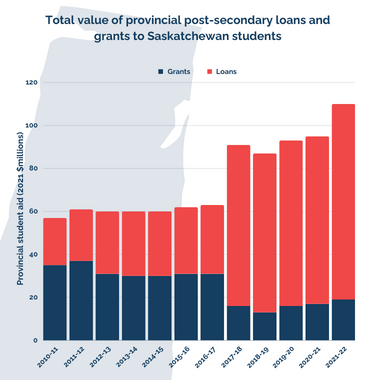
- Asia Fields and Becca Savransky examine what happens when a government chooses not to maintain its education system. And the CCPA offers up its favourite graphs of 2023 - including this depiction of how Saskatchewan students are taking on massive amounts of debt to pay higher fees in the face of slashed grant funding:
- Raymond Zheng discusses the scientific debate as to whether global warming is merely happening as projected based on the continued spewing of carbon pollution, or increasing due to unanticipated feedback effects. And Daphne Ewing-Chow points out which foods are facing the greatest risks due to the climate breakdown.
- Finally, Leigh Stickle and Luke Mari respond to a baseless attack on housing density by pointing out that more housing and increased park space are entirely compatible when they're both designed to be inclusive rather than fenced-off.
Friday, December 29, 2023
Friday Afternoon Links
Assorted content to end your 2023.
- Shannon Hall discusses new research showing that the positive effects of COVID-19 vaccination include a reduction in long COVID in children. And Erin Prater warns about the building Pirola wave which is already causing record-high infection levels in some countries.
- Meanwhile, Carly Weeks reports on the dire state of Canada's health care system even before that wave crests. And Larissa Kurz details the cascading failures within Saskatchewan's emergency care system, as the spillover effects from overwhelmed and under-resourced hospitals and emergency rooms has led to a lack of ambulances available for people in urgent need of care.
- Lucy McAllister et al. examine the coverage of climate issues in English-speaking countries, with the National Post getting called out as inflicting particularly inaccurate coverage of the climate breakdown including more outright denialism than any other outlet.
- Emily Chung reports on new data showing the industries which spew the most carbon pollution in each of Canada's provinces and territories - with fossil fuels taking the top spot in most jurisdictions due to factors including oil and gas production, coal-fired power and vehicular fuel consumption. And Shawn Fluker, Drew Yewchuk and Martin Olszynski discuss the Alberta Auditor General's conclusion that the Alberta Energy Regulator has failed to meet any outstanding recommendations to ensure that polluters pay the cost of closing down oil and gas well sites.
- Finally, Sally Younger discusses how warming Arctic waters are resulting in yet another climate feedback loop as more melting results in increased carbon dioxide releases. And Alec Luhn reports on the climate-driven releases of iron and sulfuric acid which are turning many of Alaska's rivers most pristine rivers into a rusting orange froth.
Thursday, December 28, 2023


Thursday Morning Links
This and that for your Thursday reading.
- Jessica Wildfire offers a reminder of the breadth and depth of harm continuing to be caused by COVID-19. Julia Doubleday calls out the role of the media in normalizing perpetual reinfection, while Arijit Chakravarty and T. Ryan Gregory discuss the importance of naming things in the context of the termination of any effort to identify new variants for public awareness purposes. And Paul Withers reports on new research warning of the potential for a COVID-related heart failure pandemic, while Stephanie Soucheray discusses the revelation that brain injury markers show up in the blood even of people who are lucky enough to avoid neurological symptoms during the acute phase of COVID.
- Chris Russell and Joel Tansey interview Akshat Rathi about his optimism based on the reality that it's now cheaper to fund a clean energy transition than to keep spewing the carbon pollution that's causing a climate breakdown. And Amanda Stephenson discusses the potential for geothermal energy to be a major part of Canada's transition.
- But Graham Thomson offers a reminder that Danielle Smith and other petropoliticians are determined to spend obscene amounts of money on laughable promises of carbon capture and storage in order to avoid the affordable and feasible path to clean energy. And Ainslie Cruickshank reports that Fernie, B.C. is now searching for potable drinking water due to the ongoing leaching of selenium from a Teck Resources coal mine.
- Finally, Katharina Maier, Carolyn Greene, Justin Tetrault and Marta-Marika Urbanik make the case to treat violence targeted at unhoused people as a hate crime. And Kyle Swenson reports on the right's attempts to systematically punish both people facing housing challenges and the communities who make any effort to help them.
Friday, December 22, 2023
Thursday, December 21, 2023
Thursday Afternoon Links
This and that for your Thursday reading.
- Jackie Ruryk reports on the push by public health officials to have people take precautions against COVID-19 and seasonal illnesses only after there's already been a massive degree of uncontrolled spread. And Alanna Smith exposes how Danielle Smith's UCP is so deeply in denial as to have ordered any reference to COVID-19 or seasonal influenza to be removed from a fall public awareness campaign.
- Matthew Rosza juxtaposes the increasing urgency of trying to avert a total climate breakdown with the U.S.' continued expansion of fossil fuel production and associated carbon pollution. Jessica McKenzie interviews Raymond Pierrehumbert about the dubious spin from the fossil energy sector which attempts to lock in long-term production (and associated spewing of greenhouse gases) with the promise of limited cuts to operational emissions. And Graham Redfearn reports on a new analysis confirming that in Australia (like elsewhere) renewables offer the prospect of a far quicker and more affordable transition to clean energy than a bet on future nuclear development.
- David Zipper examines how vehicle bloat has pushed U.S. pedestrian fatalities to levels not seen in over four decades (among other pernicious effects on public health and safety).
- Jim Stanford weighs in on the connection between corporate profiteering and increase food prices. And Andrew Stevens points out how unionization helps to counter corporate power and give workers a better deal in terms of both wages and working conditions.
- Finally, Cory Doctorow takes a look at the material entering the public domain in 2024, while lamenting how cultural monopolists continue to abuse intellectual property rules and in some cases destroy works before they're ever freed.
Wednesday, December 20, 2023
Wednesday Afternoon Links
Miscellaneous material for your mid-week reading.
- Katherine Wu discusses how the U.S. is facing a particularly grim set of winter illnesses as people have failed to get vaccinated against known threats, while Lauren Pelley reports on the low number of Canadians who got new COVID-19 vaccines this fall. Ewen Callaway writes that inhaled COVID vaccines may be able to shield against infection and spread. And Daniel Altmann and Christina Pagel point out that there's ample potential for controlled trials in treating long COVID - but seemingly little appetite to pursue them.
- Christopher Ketcham points out that climate breakdown is just one of the problems with an economy system based on perpetually increasing extraction and waste emission. And Robert Constanza singles out the blinkered focus on economic growth as an obstacle to the pursuit of sustainable well-being.
- Meanwhile, Shannon Osaka writes about the consistent pattern of refusal to take even the most basic steps to transition away from reliance on dirty energy. Kurt Zenz House, Josh Goldman and Charles F. Harvey highlight how direct air carbon capture schemes serve no useful purpose (except to the extent they allow denialists to pretend there's a magical solution just around the corner). And Geoffrey Diehl discusses how reliance on that type of wishcasting is one of the main problems with the work product from COP28.
- Finally, Aishwarya Dudha reports on Jim Clifford's observation that Saskatchewan would have no problem building enough electrical infrastructure to fit with the federal government's timeline for EV adoption if it weren't governed by compulsive obstructionists.
Tuesday, December 19, 2023


Tuesday Afternoon Links
This and that for your Tuesday reading.
- Ryan Meili discusses how a blinkered focus on austerian "efficiency" and exit strategies prevents the development of care systems capable of meeting long-term needs. And Dione Wearmouth reports on the fallout from the UCP's insistence on putting performative politics over even those restrictive policy goals.
- David Climenhaga points out that Danielle Smith's reflexive Trudeau-bashing has reached the point of actively criticizing her own government's actions where they're approved of by a federal department. And Arno Kopecky offers a reminder that it's the greed of the Cons' corporate backers - not a carbon tax which is more than fully rebated for most people - that's made life ever less affordable for Canadians. But Alan Westwood, Manjulika Robertson and Samantha Chu discuss how the experts who could better inform the public about the urgency of the climate crisis and the viability of the available solutions are being muzzled.
- Dan Zakreski reports that the Moe government's idea of investing in supportive housing is to take over and clear out a building with over a hundred tenants so it can be flipped (presumably for a friendly developer's profit).
- A.R. Moxom discusses how fascists use denial and both-sidesing to play the victim while avoiding answering for their eliminationism.
- Finally, Katie Baker rightly questions how a steady stream of prosecutions of previous crypto pitchmen has had little apparent effect on people's willingness to throw money at the concept. And Cory Doctorow notes that the key question in evaluating AI isn't whether it's a bubble at all, but what type of bubble it will prove to be.
Monday, December 18, 2023
Monday Afternoon Links
Miscellaneous material to start your week.
- Geoffrey Johnston examines how the latest wave of COVID-19 is swamping Ontario's health care system while its cumulative effect is reducing life expectancies. Philip Moscovitch discusses the dangers of repeat COVID infections. And Zaki Arshad, Joshua Nazareth and Manish Pareek offer a reminder that the same vaccination, masking, and testing which have been vital to limiting the spread of COVID for the past three years remain so now even if they're being treated solely as individual choices rather than ongoing public health necessities.
- Martin Lukacs interviews Eriel Deranger about what happened at COP28, with fossil fuel interests and their fully-owned politicians looking to block progress at every turn. And Binoy Kampmark points out that the end product is both non-binding, and ineffective even to the extent it were treated as having any effect (as also noted by the experts surveyed by Carolyn Gramling).
- Topher Sanders et al. expose the combination of bullying and bribery used by major rail companies to prevent the accurate reporting of worker injuries so they can avoid safety regulation and keep dangerous conditions in place.
- Finally, Kenan Malik discusses how the hesitancy to challenge the class power of the wealthy has sapped politics of any meaningful effect. And while Rachel Cohen's interview with Brent Cebul rightly challenges the neoliberal view that the sole focus of policy development should be to gesture toward a given problem as cheaply and profitably as possible, it's worth noting the problem with trying to co-opt business interests by handing them even more money and power.
Friday, December 15, 2023
Friday Morning Links
Assorted content to end your week.
- Damian Carrington confirms the consensus among climate experts that the outcome of the fossil-dominated COP28 was an utter failure, while Paige Vega interviews Bill McKibben about the reality that it's long past time to be counting on empty and vague words to reverse a breakdown in progress (and the continued carbon pollution which is exacerbating it). And Alaa Al Kourdajie, Chris Bataille and Lars Nilsson warn that weasel wording is likely to be used as an excuse to actually expand production and pollution.
- Rob Miller discusses how carbon capture and storage is far less effective and more costly than shifting to existing renewable energy technology - meaning that the fossil fuel stooges hyping the former and seeking to suppress the latter can only be treated as climate vandals. And Anna Aglietta highlights how the addiction to constantly growing extraction is at the root of both the climate crisis and the failure of efforts to combat it.
- Tammy Robert exposes how the Saskatchewan Party has destroyed the province's crop insurance system by taking insurance premiums into general revenues - even as it's also managed to blow up the provincial budget and destroy public services.
- Finally, Yan Jie, Taeyoung Choi and Ziyad Al-Aly find that the long-term outcomes from COVID-19 remain far more severe than those from seasonal influenza. And the John Snow Project points out Statistics Canada's survey results showing that nearly everybody will know somebody who has suffered from long COVID - even if that reality has rarely been acknowledged.
Thursday, December 14, 2023
Thursday Afternoon Links
This and that for your Thursday reading.
- Jessica Wildfire examines how employees are being illegally forced to put their health at risk by employers determined to impose policies which facilitate the spread of COVID-19. And Craig Ellingson and Chelan Skulski report on the Alberta Medical Association's warning that the province's health care system is on the verge of collapse, while Timm Bruch reports that the UCP is trying to spin naturopathy and other quackery-for-profit as a substitute for the availability of public health care.
- Jake Bittle calls out the large number of fossil fuel lobbyists at COP28, while Nina Lakhani reveals that hundreds of the attendees charged with working out a global response to the climate crisis have a history of actively denying its existence. So it's no surprise that the output has been grossly insufficient - according to the International Energy Agency as well as other expert participants. And Oliver Milman reports on the continued establishment focus on magical future technology as a substitute for near-term cuts to carbon pollution.
- Andrew Nikiforuk points out that Alberta bears the dubious distinction of having the world's single most harmful methane leak. And Bob Weber reports that Saskatchewan too continues to report fictitious figures while spewing far more methane than it's bothering to measure.
- Ryan Hogg reports on new research by IPPR and Common Wealth showing that large companies predictably capitalized on messaging about inflation by extracting massive windfall profits far exceeding any increase in costs. And Trevor Tombe and Jennifer Winter discuss the Canadian twist on the exploitation of inflation to further enrich the already-wealthy, as the Cons use a false narrative blaming carbon pricing rather than corporate greed to try to transfer even more wealth to the top.
- Christopher Cheung examines how the non-profit industrial complex is a poor substitute for public programs with the resources to meaningfully address social needs.
- Finally, Ian Kreitzberg reports on the UAW's ambitions to organize every automaker in the U.S. to spur broad-based gains in wages and working conditions.
Tuesday, December 12, 2023


Friday, December 08, 2023
Subscribe to:
Posts (Atom)