Wednesday, November 19, 2014

Wednesday Morning Links

Miscellaneous material for your mid-week reading.

- The 25th anniversary of Parliament's unanimous - if failed - commitment to eliminate child poverty has given rise to plenty of worthwhile commentary. Marco Chown Oved talks to Ed Broadbent about what the resolution meant at the time (as well as how it came to be ignored), while also interviewing social justice advocates about the need to effective start from scratch now. And Olivia Carville explores one life which could have been changed for the better if Canada had made good on its promise.

- Meanwhile, Dennis Raphael discusses the need to combat both poverty and inequality - with wages serving as a primary issue on both fronts. And Joseph Stiglitz highlights how inequality is undermining economic and social progress alike in the U.S.:
The extreme to which inequality has grown in the United States and the manner in which these inequities arise undermine our economy. Too much of the wealth at the top of the ladder arises from exploitation—whether from the exercise of monopoly power, from taking advantage of deficiencies in corporate governance laws to divert large amounts of corporate revenues to pay CEOs’ outsized bonuses unrelated to true performance, or from a financial sector devoted to market manipulation, predatory and discriminatory lending, and abusive credit card practices. Too much of the poverty at the bottom of the income spectrum is due to economic discrimination and the failure to provide adequate education and health care to the nearly one out of five children growing up poor. 
...
We now know that there are huge disparities even as children enter kindergarten. These grow larger over time, as the children of the rich, living in rich enclaves, get a better education than the one received by those attending schools in poorer areas. Economic segregation has become the order of the day, so much so that even those well-off and well-intentioned selective colleges that instituted programs of economic affirmative action—explicitly trying to increase the fraction of their student body from lower socioeconomic groups—have struggled to do so. The children of the poor can afford neither the advanced degrees that are increasingly required for employment nor the unpaid internships that provide the alternative route to “good” jobs.
...
(M)any of the distributional issues are related not to how much we spend but who we spend it on. If we include within our expenditures the “tax expenditures” buried in our tax system, we effectively spend a lot more on the housing of the rich than is generally recognized. Interest deductability on a mega-mansion could easily be worth $25,000 a year. And alone among advanced economies, the United States tends to invest more in schools with richer student bodies than in those with mostly poor students—an effect of U.S. school districts’ dependence on local tax bases for funding. Interestingly, according to some calculations, the entire deficit can be attributed to our inefficient and inequitable health care system: if we had a better health care system—of the kind that provided more equality at lower cost, such as those in so many European countries—we arguably wouldn’t even have a federal budget deficit today.

Or consider this: if we provided more opportunity to the poor, including better education and an economic system that ensured access to jobs with decent pay, then perhaps we would not spend so much on prisons—in some states spending on prisons has at times exceeded that on universities. The poor instead would be better able to seize new employment opportunities, in turn making our economy more productive. And if we had better public transportation systems that made it easier and more affordable for working-class people to commute to where jobs are available, then a higher percentage of our population would be working and paying taxes. If, like the Scandinavian countries, we provided better child care and had more active labor market policies that assisted workers in moving from one job to another, we would have a higher labor force participation rate—and the enhanced growth would yield more tax revenues. It pays to invest in people.
- Carol Goar remarkably sees reason for optimism about the possibility of social progress based on the rhetoric of Kathleen Wynne and John Tory. But sadly, Goar is in fact referring to that Kathleen Wynne and that John Tory. And Sheila Block notes that Wynne in particular is spending far more of her attention on shuffling pools of money around for accounting purposes than on improving the lives of Ontarians.

- Finally, Murray Mandryk writes that we should recognize Jerry Peequaquat's death as the result of multiple social failings.

Tuesday, November 18, 2014

Tuesday Night Cat Blogging

Crashing cats.


Tuesday Morning Links

This and that for your Tuesday reading.

- A Gandalf Group poll finds (PDF) that Canadians have come to perceive and expect a disturbing level of self-serving action by our political leaders. And while Dale Smith is right to note that we've largely limited the most obvious forms of corruption, there's still plenty of reason for concern that public policy is being driven by a few insiders and political cronies at the expense of the public.

- On that front, Gerald Caplan reminds us how the CRA is being used to silence only charities who promote social justice - while at the same time cutting back on collecting taxes from the people who owe the most:
The government somehow found an extra $13.4-million for the CRA to audit charities to ensure they were using tax dollars properly. As far as anyone can tell, all the new funds have been used to audit the government’s critics, none to audit its friends. The first wave of such audits mostly focused on environmental groups, but the net was later widened to include anti-poverty, international aid and human-rights groups that drive the Conservatives – and apparently the CRA – crazy.
...
Indeed the Harper government has never hidden its opposition for certain charities, like the very ones the CRA has chosen to audit. For a while, for example, outrageous attacks on “radical” environmental groups that opposed new pipelines became de rigueur for members of the Harper government.

There’s a scandal within a scandal here as well. While the CRA is disrupting the work of often tiny NGOs, the government is simultaneously laying off international tax auditors who specialized in investigating the tax avoidance strategies of 1-per-cent-ers and corporations. Tax dollars lost to the public treasury are estimated in the multi-billions, which is why the G20, including Canada, has formally made cracking down on tax evasion a priority. Except when it’s not.
- And the CRA's selective attacks on charities fit all too well with the oil companies' own strategy of bullying dissenting voices into silence.

- PressProgress points out how the Cons' climate change negligence is sinking to new depths, with spokesflacks trying to pretend that Environment Canada's own scientific data is merely an "opinion" (to be ignored since it might be inconvenient for the Cons' oil baron base). And Aaron Wherry raises plenty of worthwhile followup questions which we can count on the Cons similarly refusing to address.

- Frank Soodeen highlights how secure housing for everybody serves both social and economic purposes.

- But of course, the Cons are instead determined to destroy the federal government's capacity to help people with boutique tax baubles - which lead to Stephen Tapp's call for a more sensible tax system.

- Finally, Salvator Cusimano and Nath Gbikpi write that the Cons are following the UK's model of deliberate exclusion and marginalization for refugees.

Monday, November 17, 2014

Monday Morning Links

Miscellaneous material to start your week.

- Richard Wike notes that inequality is properly being recognized as a higher priority around the globe. But Steven Rattner observes that recognition of the issue isn't doing anything to resolve it, as income and wealth concentration are only getting worse. And Linda McQuaig discusses the need for far more political attention to the gap in Canada:
Apart from the obvious issue of fairness, this diversion of money to the top raises other issues that should be central to meaningful public debate.

For instance, there is growing evidence that a high level of inequality hurts economic growth -- presumably something voters might want to know. A staff report released earlier this year by economists at the International Monetary Fund noted: "Recent empirical work finds that high levels of inequality are harmful for the pace and sustainability of growth."

Even more worrisome is the impact on democracy, as Canada's 70 billionaires and hundreds of multi-millionaires become ever more dominant in the political sphere, with an effective veto over a range of economic policies.

It's hard to imagine a development more crucial to the future of Canadian democracy. Just don't expect to hear much about it during the coming election campaign.
- Meanwhile, Yves Smith highlights another obvious (and dangerous) trend as corporate profits continue to grow at the expense of wages.

- Chris Dillow points out that it's utter folly to expect "innovation" in the private sector to accomplish anything other than to further enrich the wealthy - and that if we want to see new financial instruments developed for the public good, we'll only get them through public control:
(W)hy do we get so much "dark" innovation and so little "bright"? Banks are guilty not just of sins of commission - mis-selling and rigging markets - but of sins of omission, not developing good products sufficiently.

The answer lies in the basic economics of innovation - that the social benefits (or costs!) of it often differ from the private benefits. (There is, of course, nothing unusual about financial innovation in this regard.) The type of innovation that occurs will depend not upon its social utility, but upon whether its proceeds can be appropriated privately. And this incentivizes dark innovation. "Crap" and "shitty" CDOs which can be sold to fools - sometimes in a different division of the same bank - will be produced, whereas products with big external social benefits need not be. It might be no accident that a big chunk of the good innovation we've had in recent decades - such as index funds or venture capital trusts - has received nice tax breaks.

Herein, I suspect, lies an under-rated argument for intelligent state control (or even ownership) of banks. Such control might be necessary to rejig incentives towards bright innovation and away from dark. Mariana Mazzucato's argument (pdf) that the state can be entrepreneurial might be especially valid for the financial sector.
- Susan Prentice and Holly McCracken follow up on this weekend's child care convention by reminding us how much good could be done for the cost of just one of the Cons' tax giveaways. And Aaron Wherry muses about the budget debate we might have seen if the Cons were willing to allow Parliament to discuss their latest fiscal update, rather than presenting it in an isolation chamber to stifle any response.

- Finally, Michael Harris writes that after a decade of relying on campaigns designed to win over just enough swing voters at election time to overcome general public unpopularity, Stephen Harper is now losing even his party's base.

Sunday, November 16, 2014

Sunday Afternoon Links

Assorted content for your Sunday reading.

- Eric Reguly opines that the best way to ensure that banks (and other businesses) operate under the law is to make sure that individual executives are held accountable for failing to do so:
(I)f fines and the odd firing are no deterrent to bad bank behaviour, what is? The obvious answer is shareholder rage. The trouble is, shareholders are not enraged. They have not grabbed pitchforks and torches and stormed CEOs’ houses when the multibillion-dollar fines are paid to secure settlements. Instead, they meekly accept the fines as if they are a cost of doing business, a sleaze tax, if you like.

In some cases, the bank shares actually rise when the fines are announced. The reason? Because in each of the settlements, the fines could have been far worse and, in no case, have the penalties threatened to put the banks out of business. The era of destroying terminally vice-ridden companies is, apparently, long gone. The last time that happened was in 2002, when Arthur Andersen, one of the Big Five accounting firms, was convicted of obstruction of justice for shredding documents in the Enron case. Some 85,000 employees eventually lost their jobs. Regulators and the governments that employ them no longer have the appetite for collateral damage in the form of massive job destruction.
...
Unless senior executives are put on criminal trial or, at a minimum, marched out the door in shame, shorn of their lavish bonuses and corporate golf-club memberships, the rotten culture of the banks will not change. Why would it? The traders in the currency scandal who worked for HSBC, Citi, UBS and other biggies decided that the chances of them getting caught were minimal and kept going. And if they were to get caught, it would be the bank – that is, the shareholders – not them, who would be on the hook for fines worth fortunes.

The bank fines are getting so big and frequent that you can be forgiven for suspecting a mutually beneficial racket is in progress. The banks pay big fines for settlements that leave their businesses and executive ranks largely intact. The regulators typically pocket some of the fines and pad out government treasuries. Shareholders are the main losers. To break this absurd cycle, and to encourage banks to operate morally, a little prison time would do the trick.
- And Bessma Momani reports on both the unfortunate reality that governments haven't made the effort to cooperate in ensuring that corporate income is taxed at all, and the tentative steps being taken by the G20 to correct that gross loophole.

- Josh Bivens highlights the fact that tax cuts and other giveaways to employers haven't done - and can't be expected to do - anything to improve wages:
Mr. Leonhardt pointed out the dismal wage trends for the vast majority of American workers in recent decades and how it would be a heavy policy lift to reverse them. This seems right to me. But then he wrote:

“Washington could definitely do more to help growth: better infrastructure, a less burdensome tax code, a less wasteful health care system, more bargaining power for workers and, above all, stronger schools and colleges, to lift the skills of the nation’s work force.”

As they might say on “Seinfeld,” you can’t “yada yada“ more bargaining power for workers. It’s the most important part of the story.

The root of the U.S. wage problem (which is, in turn, the root of America’s inequality problem) is that most workers aren’t seeing their wages keep pace with overall productivity growth. The policies on Mr. Leonhardt’s list are worthy, but most would not reliably close this gap between productivity and pay. Boosting the bargaining power of workers would.
- Meanwhile, Andrew Jackson suggests that employers need to bear the cost of building their future workforce rather than letting hundreds of billions of dollars sit idle. And Chuck Collins proposes a combination of inheritance tax revenue, and an educational opportunity fund to ensure greater equality both between and within generations.

- The Hamilton Spectator laments the woeful state of child care in Canada.

- And finally, David Miller writes that refusing to do anything about climate change is no longer an option.

Juxtaposition

The minister responsible for the plight of Saskatchewan's homeless people:
In response to a CBC iTeam question about the waiting list for social housing faced by homeless people Harpauer said, “you’re assuming that there’s these desperate homeless people.”
The plight of Saskatchewan's homeless people:
Saskatoon police have confirmed that a 42-year-old homeless man was found dead inside the cab of a an abandoned semi-trailer in an alley off Avenue K.
...
There is no confirmation on the cause (of) Peequaquat’s death, but police said it did not appear suspicious.

Severight said he did have addictions issues and he had been homeless since being cut off social assistance.
I do hope Harpauer will clarify how much more desperate someone like Jerry Peequaquat needs to become in order to receive some help.

Saturday, November 15, 2014

Saturday Morning Links

This and that for your weekend reading.

- The Economist discusses how a tiny elite group is taking a startling share of the U.S.' total wealth:
The ratio of household wealth to national income has risen back toward the level of the 1920s, but the share in the hands of middle-class families has tumbled (see chart). Tepid growth in middle-class incomes is partly to blame; real incomes for the top 1% of families grew 3.4% a year from 1986-2012 while those for the bottom 90% grew 0.7%. But Messrs Saez and Zucman reckon the main cause of falling middle-class net worth is soaring debt. Rising home values did little to raise middle-class wealth since mortgage debt also soared. The recession battered home prices but left the debt untouched, further squeezing middle-class wealth.
...
On the other side of the spectrum, the fortunes of the wealthy have grown, especially at the very top. The 16,000 families making up the richest 0.01%, with an average net worth of $371m, now control 11.2% of total wealth—back to the 1916 share, which is the highest on record. Those down the distribution have not done quite so well: the top 0.1% (consisting of 160,000 families worth $73m on average) hold 22% of America’s wealth, just shy of the 1929 peak—and exactly the same share as the bottom 90% of the population.
- Meanwhile, Lana Payne points out that the Cons are looking to set up the same level of inequality in Canada by pushing tax giveaways at the top end of the income spectrum. And Mike Konczal and Bryce Covert rightly challenge the regressive claim that pushing people toward marriage is somehow a solution to inequality.

- Thomas Walkom and Jeffrey Simpson are both duly skeptical as to whether Stephen Harper will do anything of substance in response to the new greenhouse gas emission reduction agreement between the U.S. and China. But even if we should fully expect continued stonewalling from the Cons, it's not such a bad thing for Harper to be forced to explain that choice.

- Harsha Walia calls out the Cons' "managed migration" which serves primarily to limit individual rights and freedoms:
While Canada is often cast as a liberal counterpoint to aggressive U.S. immigration enforcement tactics, the U.S. has actually pointed to Canada as the model to implement for U.S. migration policy. This is because Canada has perfected a system of managed migration to ensure the steady supply of cheap labour within neoliberalism while entrenching racialized citizenship.
...
Canada currently accepts more migrants under temporary permits than those who can immigrate permanently. Permanent residency for refugees, skilled workers and family members is restricted, citizenship is becoming harder to get and easier to lose, but the migrant worker program is exploding.

These changes are drastic. The number of family-class immigrants dropped by 10,000 in the first four years the Conservative Party of Canada formed government.

According to Avvy Yao-Yao Go, Director of the Metro Toronto Chinese and Southeast Asian Legal Clinic, "Thirty years ago, family-class immigrants made up the majority of all immigrants. Today, they account for less than 20 per cent of the total intake."
...
For the few refugees and migrants who do become permanent residents or citizens, the battle for secure legal status doesn't end there. The Immigrant Criminalization law that passed last year allows for deportations of thousands of permanent residents who have been convicted for minor offences including traffic offenses.

And the new Stealing Citizenship law makes it possible to revoke citizenship from dual nationals or even from Canadian-born children who have the possibility of accessing dual citizenship.
- Finally, David Broockman and Joshua Kalla examine the effectiveness of direct personal contact with voters - both in making an immediate impression, and actually inspiring people to vote. And it's well worth contrasting Broockman and Kalla's findings that genuine conversations represent the most important result of door-to-door canvassing against Derek Willis' claim that it's a problem for volunteers to have their own principles and values rather than merely seeking to match a voter's preexisting views.

Friday, November 14, 2014

Musical interlude

Moist - Freaky Be Beautiful

Friday Morning Links

Assorted content to end your week.

- Jonas Fossli Gherso discusses the unfortunate (and unnecessary) acceptance of burgeoning inequality even by the people who suffer most from its presence. And Ryan Meili interviews Gabor Mate about the ill health effects of an economic system designed to keep people under stress:
(T)he very nature of the system in which people live their lives is a significant source of illness. Now there are obvious factors like environmental pollution, toxins, and then of course there are the social determinants of health that you write about in A Healthy Society: the impact of poverty, the impact of inequality, the impact of history and continued racism. There’s an article in the Saskatoon Star Phoenix today about sentencing practices in the courts of Saskatchewan. People who are identified as Aboriginal are likely to get double the sentences of people who are not identified as Aboriginal. That’s going to have a health impact.

But I’m going to go beyond even that and say that even the people who are not on the wrong end of economic inequality or systemic racism are still made ill just by how we live our lives. The stress that we live under, the competition, the aggressiveness, the uncertainty, the loss of control that we experience in our lives. The gender inequalities, these are not just social phenomena, they have an actual impact on community health. The isolation people are experiencing.
- Meanwhile, Charles Smith points out how young workers are losing out as a result of policy choices designed to maximize employer leverage at their expense:
Canadian young people are among the most educated in the world. According to the Organization of Economic Co-operation and Development, in 2014 Canada had the highest percentage of university or college trained population in the world. Recognizing that, Statistics Canada reported in 2010 that most OECD countries were more successful than Canada in employing individuals with university or college education.

In other words, the problem with finding full and meaningful employment is not necessarily a problem with individual young people, but a broader problem of government and private sector employers.
...
Outside the classroom, students are demanding social change, pushing our organizations in new and exciting directions, challenging traditional pedagogy, and creating a new generation of community and ecological awareness.

At the University of Saskatchewan, young women are challenging traditional forms of power by creating new organizations and demanding justice in public and private life. Indigenous students are reclaiming space and demanding greater access to opportunities long denied to them.

All of this suggests that today's students are multi-talented, skilled and ready to lead. It is time that government and private employers recognized this by promoting an industrial policy designed to create meaningful full employment.
- Alan Kors reports on Stephen Lewis' advice in advocating for child care as a public good, not a benefit limited to those who immediately find spaces. And Jeffrey Simpson highlights how much work there is to be done in fixing a tax system built around the Cons' trinkets and baubles.

- Finally, Michael Den Tandt recognizes that the Cons' interest in Canadian troops goes no further than using them in photo ops. And Michael Harris notes that a direct clash between the Cons and the veterans they've left behind may make for an important piece of Canada's next election campaign.

Thursday, November 13, 2014

Thursday Morning Links

This and that for your Thursday reading.

- Paul Krugman discusses the U.S.' multi-decade pattern of income stagnation. David MacDonald and Kayle Hatt study the price we've paid to suit the Cons' political purposes, while Kristin Rushowy reports on two new calls for a genuine child care system. And Andrew Jackson notes that the Cons' only real end goal has been to hand free money to people who don't need it:
The government forecasts a deficit of $2.9 billion in this fiscal year, (2014-15.) Yet there would almost have been a surplus this year if the government had not decided to introduce family income splitting for the current tax year of 2014, at a cost of $2.4 billion in the fiscal year 2014-15 in terms of reduced revenues.
...
The big winners are high income, single earner families where the higher earner has an income of at least $75,000 per year. They will receive tax refund cheques of $2,000 on the eve of the 2015 election.

In the context of rapidly rising income and wealth inequality, it is outrageous that the Conservative government’s priority is to introduce a tax measure that will actually worsen inequality and do nothing to lower child poverty or to fund a badly needed child care program.
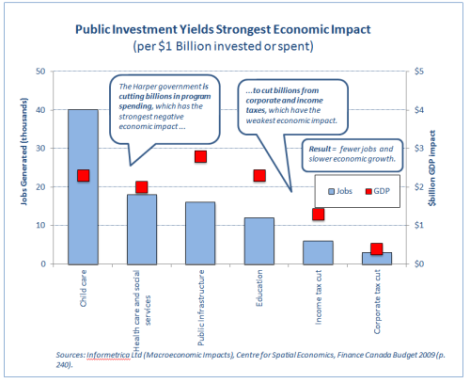
- Meanwhile, Toby Sanger highlights how austerity has undermined Canada's economy over the past few years by replacing efficient public investment with useless tax baubles:


- Which isn't to say that we're lacking for areas where public money can still be put to better use, as Don Pittis writes about the billions being funneled by governments into making climate change worse.

- Alison observes that while deep integration with the U.S. has taken multiple forms, neither its goals nor its proponents have changed one bit over the past decade.

- Finally, both Frances Russell and Lawrence Martin partially explain the Cons' destructive policies by looking at Stephen Harper's insularity and refusal to allow either any real outside input into his plans, or any debate over his unilateral decisions.

New column day

Here, on how user reviews and the wisdom of crowds don't do us much good if businesses are able to silence anything that raises concerns about them.

For further reading...
- Laura K makes a similar point here.
- CBC reports on libel chill here, including a discussion of the Ottawa property manager which managed to intimidate a tenant into pulling an unfavourable review.
- Again, Mike De Souza discusses Exxon Mobil's attempts to silence his reporting on ALEC here. Jenny Uechl and Warren Bell expose Canada's links to the Western Energy Alliance - including its dirty war against the public - here.
- And finally, CBC reports on Kinder Morgan's attempt to silence protestors and the #kmface movement which responded, while Lauren Krugel notes that there's ample reason to doubt Kinder Morgan's own spin.

Wednesday, November 12, 2014

Wednesday Morning Links

Miscellaneous material for your mid-week reading.

- Jenny Uechi and Warren Bell expose Canada's embarrassing place as the only government participating in a climate-denial group pushing for a dirty war against the planet. But despite the Harper Cons' worst efforts, there's some good news on the climate front - as the use of solar energy is booming in the U.S., while a new bilateral deal between the U.S. and China is rapidly eliminating the Cons' traditional excuses for blocking international agreement to cut greenhouse gas emissions.

- Kathryn May reports on some of the vital public services the Cons have been slashing in the name of paying for income splitting and other tax baubles - with food safety and frontline staff addressing EI and veterans' benefits ranking at the top of the list. And Tim Harper comments on how those cuts affect Canadians directly:
A simple tally of recent reports, some gleaned by this newspaper and The Canadian Press and testimony before Parliamentary committees, gives us a partial sense of what we are sacrificing to ensure this government could get to surplus and offer its tax breaks in a pre-election period.

This week alone there was a report from the government’s public accounts showing the Harper government’s spending on marine safety had plunged 27 per cent since 2009-10 while aviation and rail safety were both down 20 per cent or more.

Transport Canada says the cuts were made on overhead, administrative and support services, but opposition critics find it hard to believe safety is not being compromised while oil shipments by rail skyrocket.

Another document obtained by CP showed Aboriginal Affairs had to shift $505 million in money earmarked for infrastructure over a six-year period to social and educational spending.

The money has bled the infrastructure fund and still not covered the shortfall on education and social spending. The infrastructure shortfall means fewer schools and more boil water orders in First Nations communities.
...
While you await your cheques, you might want to remember they didn’t come free. It may have already cost you from health care to security, from access to parks to treatment of our First Nations.
- Meanwhile, Kelly Grant notes that the Cons' plans to undermine the public service now include taking any real authority out of the hands of Canada's chief public health officer.

- CBC reports that the false promise of a privatized prison in Ontario has finally been deemed a failure in terms of cost and other outcomes - to the point where the province paid millions of dollars just to take back control for itself. [Update: as noted by @YouthAndWork, the story dates from 2006.]

- Finally, Thomas Walkom discusses how the Harper Cons are seeking to profit politically from their own culture of fear.

Tuesday, November 11, 2014

Tuesday Night Cat Blogging

Fashionable cats.


Tuesday Afternoon Links

This and that for your Tuesday reading.

- Shannon Gormley points out that human rights are meaningless in the face of a government which claims the entitlement to strip people of their humanity - which is exactly what the Cons are setting out to do:
(W)hen Canada’s Citizenship and Immigration Minister Chris Alexander announced this year that, “Citizenship is not a right, it is a privilege,” most human rights advocates couldn’t take him seriously. He may as well have declared that the curvature of the earth is merely an optical illusion and the world is indeed flat, or that the second law of thermodynamics doesn’t apply to his government, which can perpetually stay in power whether or not its ministers fuel it with statements deserving serious consideration.

But while remarks such as the minister’s may not be worth taking seriously as statements of fact, they’re worth remembering as philosophical beliefs that determine policy directions. 
...
(T)o make simple policy changes, the government must make serious philosophical changes. It has to reverse its absurd and dangerous position that “the right to have rights” isn’t a right at all.
- Rick Salutin highlights the amount of work young Canadians already put into their efforts to break into a hostile job market. And Aaron Wherry points out that there's no reason for workers to have any confidence in a government which will proudly trumpet the funnelling of hundreds of millions of dollars to employers in the name of a jobs program without even considering whether they'll actually create any jobs in the process.

- Jen St. Denis discusses the negative effects income-splitting would have on women's earning power even in the few families who would enjoy some surface benefit. And Angella MacEwen exposes Andrew Coyne's blind spot in valuing the contributions of a stay-at-home spouse at zero (resulting in tax benefits based solely on the actual income of the other spouse).

- Madhavi Acharya-Tom Yew reports on the widespread food bank use among people with full-time jobs which don't provide enough income to put food on the table. And Jordon Cooper discusses how Saskatchewan governments have come to see increasing reliance on food banks as a solution rather than a problem.

- Finally, Michael Harris writes about the Cons' exploitative relationship with Canada's veterans. And Ryan Meili comments on the connection between peace and health:
War brings injury and death by definition, but the impact of war is not limited to wartime. Long after the bullets stop flying, the destructive effects on a country continue: on its economy, its infrastructure, its psychology, its soul. War leaves behind land mines literal and metaphorical. Unexploded ordinances claim the lives and limbs of civilians. The spread of illnesses like HIV increases with the transience of wartime life. Violence and disease kill the young, the healthy backbone of the nation's families and economy. Those left behind often struggle with the emotional and psychological echoes of the trauma they survived. All of this damage leads to the perpetuation of poverty on numerous levels and, all too often, to a return to conflict and a repetition of the destructive cycle.

The road from peace to health is not a one-way street; a healthy society is less likely to find itself fighting. The same conditions that lead to higher levels of illness -- economic inequality, food insecurity, labour unrest -- can also lead to dangerous political instability. Since the early 1990s a series of global initiatives known as Peace through Health have been actively looking at the ways in which humanitarian health efforts can serve as a bridge to peaceful resolution of conflict. Well-resourced universal health systems can be a stabilizing element in both preventing and responding to violence. In this context, recent cuts to health services (including the drastic cuts to refugee health, many of whom have come to Canada to flee conflict) present a real threat to our health and security.

At this time of remembrance we are moved to think of those who sacrificed their lives in times of war so that others might live in peace. But to say "never again" to the horrors of the past means to work for peace today. A successful peace movement must recognize how injustice and inequality promote and perpetuate conflict. The world is suffering from a disease, with most gruesome symptom. As we continue to learn in health care, the most effective way to combat disease is to move upstream, to prevent sickness from starting.

Monday, November 10, 2014

Monday Morning Links

Miscellaneous material to start your week.

- Barrie McKenna looks to Norway as an example of how an oil-rich country can both ensure long-term benefits from its non-renewable resources, and be far more environmentally responsible than Canada has been to date.

- Michal Rozworski discusses how the devaluing of work is a largely political phenomenon. And Paul Mason wonders what it will take for workers who now see themselves as disenfranchised to fight back again a system that's rigged against them. 

- Speaking of which, Brendan James discusses a new study suggesting that the U.S. is past the point of being a democracy in any meaningful sense of the word. Paul Buchhelt comments on the disappearance of middle-class wealth. And John Stapleton studies (PDF) how lower-income citizens are both excluded and exploited by our financial system, while Arturo Garcia highlights Matt Taibbi's continued observation that absolutely nobody has been held responsible for financial-sector criminality even when it's crashed the economy.

- Jim Bronskill reports on Suzanne Legault's efforts to save access to information from Con cutbacks. The Star slams Tony Clement's Orwellian definition of "open government", while Sean Holman writes that even in opposition the Libs' plans don't seem to be much of an improvement. And Dan Leger writes about the spread of deliberately-cultivated ignorance among citizens across the developed world:
Here are some facts to illuminate your day: violent crime is getting worse, the country is overrun with immigrants, there’s an epidemic of teenage pregnancies and we’ve become a nation of geriatrics.

And that’s not all: 20 percent of Canadians are Muslim while the Christian population shrinks. Unemployment stalks the land.

No wonder people think we need to crack down on crime, choke off border access, enforce morality on teenagers and encourage Christian family values.

The problem is, the statements aren’t facts. They are widely held but entirely incorrect perceptions and they are common across the western world.
...
(G)overning from the gut by capitalizing on fear of crime, economic disruption or terrorism is a Conservative stock in trade under Stephen Harper. He’s been in power since 2006, so it works pretty well.

Of course the alternative to perception-driven politics is reliable public information; the kind you would get, say, from the mandatory long-form census. The Conservatives cancelled that in 2010.

Perhaps Canada would have better environmental policies if people were fully informed about pollution and climate change? The current government forbids scientists from telling the public about their work.
- Finally, Michael Harris notes that even as the Cons publicly claimed to have backed off their longstanding public push to buy F-35s which are ill-suited to Canada's purposes, they're in fact barging ahead with a plan to take delivery in the next couple of years.

[Edit: added link.]

Sunday, November 09, 2014

Sunday Morning Links

This and that for your Sunday reading.

- Rob Nixon's review of Naomi Klein's This Changes Everything nicely sums up why the book - and the fundamental clash it documents between corporate profit-seeking and the health of people and our planet - should be at the centre of our political conversation:
(N)eoliberalism — promotes a high-consumption, ­carbon-hungry system. Neoliberalism has encouraged mega-mergers, trade agreements hostile to environmental and labor regulations, and global hypermobility, enabling a corporation like Exxon to make, as McKibben has noted, “more money last year than any company in the history of money.” Their outsize power mangles the democratic process. Yet the carbon giants continue to reap $600 billion in annual subsidies from public coffers, not to speak of a greater subsidy: the right, in Klein’s words, to treat the atmosphere as a “waste dump.”

So much for the invisible hand. As the science fiction writer Kim Stanley Robinson observed, when it comes to the environment, the invisible hand never picks up the check.
...
In democracies driven by lobbyists, donors and plutocrats, the giant polluters are going to win while the rest of us, in various degrees of passivity and complicity, will watch the planet die. “Any attempt to rise to the climate challenge will be fruitless unless it is understood as part of a much broader battle of worldviews,” Klein writes. “Our economic system and our planetary system are now at war.”
...
To change economic norms and ethical perceptions in tandem is even more formidable than the technological battle to adapt to the heavy weather coming down the tubes. Yet “This Changes Everything” is, improbably, Klein’s most optimistic book. She braids together the science, psychology, geopolitics, economics, ethics and activism that shape the climate question. 
- Meanwhile, Karl Nerenberg writes that we should see Stephen Harper's gross failure to do anything about climate change as his greatest scandal. And Bob Weber reports that NAFTA's Commission on Environmental Cooperation is just the latest environmental watchdog to be put down by the Cons - highlighting both the ineffectiveness of trade agreements in serving any interests other than profit maximization, and Harper's own hostility toward the world around us.

- John Nichols sees the U.S. as a prime (and painful) example of what happens when politics are governed by money rather than by people. But Mary Hansen and Kayla Schultz note that on at least a few fronts, voters nonetheless voted against corporate money and power in the recent midterm elections.

- Of course, that positive takeaway depends on voters actually having the chance to express their views. And Bruce Johnstone writes that the Sask Party is determined to prevent both public opinion and empirical evidence from interfering with their drive to privatize liquor retailing.

- Finally, Dr. Dawg exposes the barbarism behind the Cons' treatment of refugees and other vulnerable immigrants. But we shouldn't pretend the problem of dehumanizing perceived outsiders is limited to that issue alone, as Tabatha Southey notes that the Cons are similarly bent on depriving sex workers of their humanity.

Saturday, November 08, 2014

Saturday Morning Links

Assorted content for your weekend reading.

- The Globe and Mail reminds us why we should demand the restoration of an effective census, while Evidence for Democracy is making a public push toward that goal. And Tavia Grant discusses how the destruction of effective data collection is affecting Canadian workplace:
Reliable, complete and up-to-date labour market data is a crucial component of government policy, influencing everything from educational priorities to immigration.

Yet, fallout from faulty or missing labour market information has made headlines on a number of issues this year alone. It’s been hard to pinpoint the size of the temporary foreign worker program (The Globe and Mail has reported that some employers say the tally for their organizations is miscounted).

Some TFWs are working on First Nations reserves with high unemployment rates – but it is unclear just how high jobless rates are on reserves. And earlier this year, the Finance Department had to correct its estimates of job vacancies when it emerged it was relying on a software program that was skewed by including Kijiji listings.

Statscan itself has faced budget cuts and staff reductions, while a memo has shown Employment and Social Development Canada has cut spending on labour market information by more than 20 per cent over the past two years.
- PressProgress documents a week in the life of the Fraser Institute's corporate shilling. And Stephen Leahy comments on big oil's dirty war against our planet and the people who seek to protect it:
(W)e already know how to make the low-carbon transition because it is "hardly rocket science," said Bob Watson, former chair of the IPCC.

To reiterate the steps: big increases in energy efficiency, massive roll outs of renewable energy, shutting down most coal plants, a carbon price, etc. There are dozens of studies on how to do this with no new technology. All of this can be achieved with very little extra cost to the global economy, according to The Global Commission on the Economy and Climate.

These studies end up concluding that what's missing in a shift to low-carbon living is political will or political courage. Left unsaid is the incredibly powerful and influential fossil fuel industry, their bankers, investors, lawyers, public relations consultants, unions and others all fighting desperately to keep humanity addicted to their products.

That means opposing low-carbon alternatives and branding grandparents who worry about their grandchildren's future as "green radicals."

"Think of this as an endless war," public relations consultant Richard Berman told oil and gas industry executives last June in Colorado.

It's a dirty war against environmental organizations and their supporters. Industry executives must be willing to exploit emotions like fear, greed and anger of the public against green groups and individuals...
- Roberto Ferdman discusses how disparities in income are reflected in infant nutritional health - which then tends to produce habits which last a lifetime.

- Alison examines the connections between the Cons' pension board appointees and the use of offshore tax havens.

- Finally, Michael Harris notes that Stephen Harper's support for, and promotion of, convicted election fraudster Dean Del Mastro is entirely consistent with his judgment in managing his party and Canada's government. And Thomas Walkom notes that Chris Alexander is just the latest MP to be put to work trying to trash vulnerable people and their supporters.

Friday, November 07, 2014

Musical interlude

Mahmut Orhan & Boral Kibil - Fringe

Friday Morning Links

Assorted content to end your week.

- Jessica McCormick and Jerry Dias respond to Stephen Poloz' view that young workers should be happy to work for free, and note that he of all people shouldn't be pointing the finger at individuals to address problems with systemic unemployment:
The most infuriating aspect of Poloz's statement is that he himself could do more than virtually any other Canadian to help put young people into real, paying jobs. Monetary policy is one of the most potent tools to stimulate spending power and job-creation. The Bank of Canada could do much more to create real jobs for young people (using conventional and unconventional policies regarding interest rates, monetary expansion, and exchange rates). But instead, it puts more priority on orthodox financial goals (like inflation targeting and non-interference in foreign exchange) than on full employment. Poloz is left to advise young people on how to "adjust" to this grim reality, instead of doing more to solve the underlying problem.

When there are far fewer jobs than job-seekers, there is a natural tendency for individuals to do whatever they can to personally survive. Individual actions such as preparing better resumés, developing good networks, and -- yes -- doing volunteer work, might increase one person's chance of landing a rare paid job. But those individual coping strategies hardly constitute an adequate policy response to a genuine social crisis. Poloz, and his counterparts in the federal government, need to develop and implement real solutions for youth unemployment, instead of issuing insulting platitudes to job-seekers.
- Meanwhile, Mike King and Edward Woolley examine (PDF) the effect of public investment on research and development, and find that it actually tends to "crowd in" more private innovation than would have happened otherwise. And SOS Crowns discusses the Sask Party's stubbornness in pushing private ownership and profit regardless of whether it makes any sense to do so - with liquor retailing serving as just the most recent example.

- Scott Sinclair and Stuart Trew ask why we're not seeing any meaningful discussion of the CETA now that we know exactly what's included. And Aaron Cosbey looks at the risks of the CETA and other new trade deals, including wording which may require that complicated issues be regulated simplistically:
There are also some areas that give cause for concern around sustainable development objectives. The chapter on domestic regulation obliges parties to make their licensing requirements – which could include environmental permissions and approvals – “as simple as possible” in their application to all economic activity of each other’s nationals or firms. This is an unqualified requirement that could be disastrously interpreted.
- The Economist offers a handy summary of the dangers of Dutch disease.

- Finally, Frances Webber notes that the Harper Cons are far from the only right-wing government looking to undermine the idea of human rights, as the UK Conservatives are looking at declaring that rights can be removed from anybody who falls out of favour with the government.

Thursday, November 06, 2014

Thursday Morning Links

This and that for your Thursday reading.

- Heather Mallick and Linda McQuaig both weigh in on the connection between income splitting and the Cons' plans for social engineering. And Scott Clark and Peter DeVries point out that a giveaway to wealthy families is as indefensible from an economic standpoint as from a social one:
(T)his tax conversation is simply the wrong one for us to be having right now. Why the rush to cut taxes? More importantly, why these tax cuts — ones which will do nothing at all to jump-start Canada’s anemic economic growth rate?

The unemployment rate is stuck at seven per cent. The youth unemployment rate remains at around 14 per cent. The labour force participation rate is lower today than in 2008. Long-term unemployment continues at record levels. The employment rate is lower than it was in 2008, while employment growth in the last 18 months has been virtually stagnant, with very few full-time jobs created. Oil prices have dropped by 25 per cent, which will undermine economic growth and government revenues. The IMF has warned that the global economy is entering a period of “mediocre” or “stagnant” growth.

We fully understand the pressures on families to provide childcare, but unless we act now to build a stronger economy going forward, all social programs will be at risk. Tax breaks are nice. But we’ve got far bigger problems right now. Creating good jobs for the many Canadians who need them is the critical first step to an affordable and sustainable childcare program.
- Meanwhile, it's no coincidence that the party which wants to incentivize financial dependence is also the one which refuses to protect women (or anybody else) in the workplace.

- And likewise, the Cons' anti-social tendencies are obvious from the access the PMO repeatedly granted to anti-worker groups to develop legislation to attack unions.

- Anna Mehler Paperny reports on the Cons' consistent message to non-citizens - and particularly refugees and other vulnerable immigrants - that they're not welcome in Stephen Harper's Canada. And Patrick Butler highlights the experience of children living in poverty who likewise don't seem to be priorities for the Cons.

- Finally, Clay Nikiforuk discusses how Michael Zehaf-Bibeau fell through the gaps in a shredded social safety net.

New column day

Here, arguing that while Stephen Poloz is indeed thoroughly out of touch in suggesting that people entering the workforce should take on unpaid internships as matters stand now, we should in fact make sure that unpaid work (or study, or other activity) is a viable option for young workers.

For further reading...
- The CP reports on Poloz' comments here, while Tavia Grant expands on the story here. CBC follows up with a Saskatchewan perspective here. And Elizabeth Lane looks at the issue as one of the workers who's been unable to find a job despite ample training and effort. [Update: Alison's response is also well worth a read in linking Poloz' advice to Scotiabank's massive job cuts.]
- Miles Corak points out here (PDF) that a systemic lack of employment for young workers has been one of the defining labour trends over the past few years.
- Unifor and the Broadbent Institute (PDF) each make the case for a substantial jobs program as another means of ensuring there's a place for young workers to build experience without going hungry.
- But the principle behind the Globe and Mail's discussion of a guaranteed income seems particularly compelling to me in the case of unemployed or underemployed young workers. Given the choice between trusting employers (who have plenty of money to hire more workers if they wanted to) in planning for workers' long-term well-being in exchange for a tax credit or direct job funding or in the workers themselves to determine how best to plan their careers given a secure income, the latter seems far more likely to generate positive outcomes.

Wednesday, November 05, 2014

Wednesday Morning Links

Miscellaneous material for your mid-week reading.

- Robert Reich discusses the right's utter lack of - and aversion to - empathy as either a personal or political value. Bob Norman reports on a particularly galling example of that phenomenon, as Fort Lauderdale has begun arresting people for feeding the homeless. And CBC reports on one of the systemic effects of a government which couldn't care less about the people under its jurisdiction, as Saskatchewan is seeing a drastic increase in people having to rely on food banks.

- Speaking of the Saskatchewan Party's contempt for social issues, Simon Enoch highlights how its push to sell off Saskatchewan's liquor retailing system ignores the well-documented social consequences of increased alcohol consumption. And Duncan Cameron writes about the latest set of privatization schemes designed to extract public investments for corporate benefit, while Thomas Walkom laments how quick the Ontario Libs (among other governing parties) have been to follow that path even when it means both higher costs and worse services.

- Michal Rozworski argues that our tax system should not only ensure that the wealthy pay their fair share, but also limit anybody's ability to accumulate so much as to distort the distribution of power:
[It] turns out there are good reasons for taxing the rich beyond raising revenue, and these reasons have precisely to do with changing how things are done.

The Nation has an excellent explainer of a recent study on the drastic fall in top tax rates over the past few decades. The authors, including Thomas Piketty of Capital in the 21st Century fame, wanted to see why the share of pre-tax income going to the very richest rose at the same time as top tax rates fell.

In short, they found that the rapidly growing incomes of those at the top were not due to rising productivity as mainstream theory suggests, but resulted from a better bargaining position. When top tax rates are low, CEOs, financial managers and others are motivated to spend more time trying to raise their earnings — for instance, stacking corporate boards that set salaries or giving out bigger bonuses — because they’ll get to keep more of them. Across countries in recent years, growth rates were very similar regardless of whether the top tax rate was high or low; the pie grew more or less as fast everywhere. In the countries where top taxes were low, however, top earners were able to capture a much, much bigger piece of the pie for themselves.
...
...We can raise top tax rates not only, maybe not even mostly, to fill public coffers but also to help restore bargaining power to the rank and file in workplaces, making top managers less willing to make out with all that they can for themselves — a top-down aid to those fighting inequality from the bottom up.

The lesson here is that taxes do much more than just redistribute income. They can also change institutions such as the family and the firm, redistributing power and changing how we relate to one another. The more pernicious tax cuts for the rich do more than leave money in well-heeled pockets. By the same token, the opposing call to “tax the rich!” can be a way to achieve more than padding the public purse.
- But Dennis Howlett points out that the Cons are instead looking to hand billions of dollars to the people who need the gift least, while Carol Goar notes that the calculated effect of income splitting is to redistribute income (and power) upward.

- Finally, Naomi Klein writes that big polluters are starting to receive some of the public opprobrium they deserve.

Tuesday, November 04, 2014

Tuesday Night Cat Blogging

Angled cats.


Tuesday Morning Links

This and that for your Tuesday reading.

- Paul Krugman points out the chasm between the policies demanded by businesses to suit their corporate biases, and those which actually best serve the cause of a strong and fair economy. And Michael Konczal highlights the damage done to our broader economy by a narrow focus on financial interests.

- Lisa Pasolli discusses the history of child care in Canada to offer some context to the policy choice that figures to dominate the next federal election. Margot Young makes the case that a new facade can't fix the serious structural problems with income splitting. And the CP reports that Canada's food banks have weighed in on the child care vs. tax bauble debate with strong support for a real child care system along with other improvements to our social safety net:
Canadian food banks are wading into the hot political debate over how best the federal government can help families with kids: give them tax breaks, as the Conservatives are doing, or invest in regulated child care, as the NDP proposes.

In its annual HungerCount report, Food Banks Canada comes down squarely on the side of the NDP.

It says the use of food banks remains 25 per cent higher than it was before the devastating global recession in 2008 and that 37 per cent of those helped are children.

According to the report, almost half of the households helped are families with kids and nearly half of those are two-parent families.

Among other recommendations, the report says the federal government should replace "the current alphabet soup" of child tax benefits with a new child well-being benefit that targets the most vulnerable families.

And it calls on federal and provincial governments to invest in predictable, stable funding for affordable, regulated child care, enabling parents to enter or remain in the workforce.
...
The report says "existing welfare bureaucracies" should be dismantled and replaced with a guaranteed basic income system.

And it recommends expanding eligibility for education and training programs offered through the Employment Insurance program.

It also calls on the federal government to invest in affordable housing.
- Meanwhile, Jen St. Denis talks to Gary Bloch about the effects of poverty and other social determinants of health. Annalise Klingbeil offers some good news in the form of Medicine Hat's progress in eradicating chronic homelessness. And Yvonne Roberts discusses the UK's living wage movement, while Christine Berry reports on its all-party agreement on four crucial elements of an economic policy oriented toward well-being.

- Finally, Christian Smith and Hilary Davidson write that the benefits of generosity include both personal and social gains.

Monday, November 03, 2014

Monday Morning Links

Miscellaneous material to start your week.

- Jim Stanford points out that the choice to leave drug development to the market resulted in a promising ebola vaccine going unused - and indeed untested - for years until the disease threatened a wealthy enough target population:
Canada’s outstanding work to invent one of the world’s most promising vaccines against Ebola perfectly epitomizes both the promise of public research, and the perverse incentives of the for-profit industry. Early this century Health Canada recognized the need for an Ebola vaccine, and assigned scientists with the Public Health Agency of Canada to find one. Almost a decade ago they patented a vaccine that prevents Ebola in monkeys. Canadian researchers should have been hailed as heroes.

Unfortunately, the government snatched defeat from the jaws of victory by handing over this important invention to the private sector – for a pittance. In 2010 Ottawa licensed the Ebola vaccine to a small U.S. firm called NewLink Genetics. I’ve been asking Health Canada to explain how the licensing was negotiated, and how much Canada was paid; I have yet to receive an answer. NewLink’s financial filings report it paid Canada an initial patent and signing fee, and a “milestone” payment of up to $205,000; “low single-digit” royalty fees will be payable on future commercial sales.

Most distressingly, guided by the profit-maximizing calculations of NewLink’s executives, the promising vaccine languished for years with no human testing – until this year’s outbreak. NewLink has suddenly rediscovered a sense of urgency, and is now accelerating human tests: but too late for thousands whose lives could have been saved if a vaccine was ready now. Even with the licence, Ottawa could have forced NewLink to move more quickly (or else revoke the licence altogether), but chose not to interfere. In the words of the University of Ottawa’s Amir Attaran, an expert on drug policy and public health, “This could have been a heroic Banting and Best moment for Canadian science, but instead it is a black comedy.”

Motivated by their government salaries and a desire to do good, smart Canadians can develop incredible medicines that significantly enhance human life. It’s only when the whole business becomes guided by profit, instead of human need, that this noble mission is lost.
- And Carol Goar exposes the use of Canada's public health care system for medical tourism, rather than to provide needed care to citizens.

- The Star weighs in on the Cons' latest income-splitting scheme and rightly concludes that a few tweaks around the edges can't justify a deliberate transfer of billions of dollars to disproportionately benefit wealthy families.

- Alan Tovey reports on KPMG's study showing that millions of workers in the UK are scraping by on less than a living wage. And Trish Hennessy looks at the numbers on our insufficient minimum wage levels in Canada.

- Mike De Souza reports on ExxonMobil's efforts to get him not to report on ALEC's shady dealings - including an ominous warning that other media have been entirely happy to fall in line with orders from their corporate overlords not to examine how big money is affecting policy debates. Andrew Prokop points out how the need for constant fund-raising makes it a challenge for U.S. political candidates to keep the public good in mind, while Democracy Now and Emily Atkin each document examples of the oil lobby flat-out buying municipal elections. And David Ball confirms that the Koch brothers have been funnelling money to the Fraser Institute's corporatist projects for decades, while Mark Eliesen explains his conclusion that the National Energy Board has joined the list of institutions which have been completely co-opted by corporate owners.

- Finally, Murray Dobbin has a few questions for Stephen Harper arising out of the tragic shootings in Ottawa. And Joan Bryden reports on Harper's refusal to discourage any anti-Muslim backlash.

Sunday, November 02, 2014

Sunday Morning Links

This and that for your Sunday reading.

- Will Hutton rightly slams David Cameron for his antisocial view of taxes and public institutions - which should of course sound all too familiar in Canada:
Believe the prime minister and it is morality, rather than economics, which requires him to cut taxes. In an important article in the Times last week that was factually incorrect, philosophically incoherent and economically bonkers, David Cameron set out the Tory credo. He was wrong on all counts. Trying to argue why every reader should vote Conservative, he instead revealed the darkness of the blind alley into which modern Conservatism has stumbled.
...
The economy needs public agency. The long commutes that Mr Cameron so celebrated in his article are done in publicly provided railways with fat public grants for the private companies that operate them. The innovations that make offices and factory floors competitive come from publicly funded science and public grants that allow companies and entrepreneurs to lay off some of the enormous risk of being technological pioneers. No significant innovation or invention has ever happened anywhere without public initiative at some stage in the process.

Economies and societies grow out of an interdependence between public and private: they need each other and taxation is the financial connecting rod. To echo the IFS, there is no sense in which “every pound of public money is private earning”: private earning becomes as high as it is only because of public investment. Taxes are the means by which we furnish public agencies the wherewithal to provide us with the universities, research, roads, railways, networks and all the rest that allow private companies to flourish. It is why the IMF, considering the best way to get public finances back on track after a credit crunch, recommends that governments try to preserve as much of that enterprise-enhancing public spending as possible, increasing rather than lowering taxes as part of the programme. Mr Cameron’s boast is economically illiterate.

Taxes are socially indispensable as well. “Public services and safety nets” are not inconvenient social burdens that require immoral taxes. They are created as a collectively owned means of guarding against the hazards and risks that every human might confront – of a crippling illness or disability – and problems associated with ageing.

We do not deserve what will or could happen to us, but we pay our taxes to fund systems that protect not just ourselves but each other. Taxation, in this sense, is the most complete expression of our morality. Of course the Treasury should husband our resources, not because taxation is immoral but because it has a duty to make sure this social money does as much work as possible, giving us the biggest return for our moral taxes.
- And David Doorey both reminds us that more social countries tend to be far happier than those which adopt the Cameron/Harper beggar-thy-neighbour ethos, and offers an interesting explanation as to why:
Today, the United Nation’s released its second annual “World Happiness Index”. One thing that is striking about these studies is that the ‘most happy countries’ are always countries with the a long tradition of strong government social welfare programs, high overall tax levels, and of interest to a blog on work law, high levels of collective bargaining coverage. That is, in happy countries, unions and collective bargaining play a substantial role in the setting of conditions of work, which creates a strong middle class. Not surprisingly, therefore, the ‘happiest’ countries also tend to be the least unequal societies: they score well on measures of income inequality.
...
Given what we know about the effects of collective bargaining, the relationship should not be surprising. Empirically, we know that collective bargaining raises incomes, contributes to a stronger middle class, results in better health benefits and pensions, and produces safer jobs and better job security than the alternative system, in which employers usually fix working conditions unilaterally, subject to certain regulatory minimum standards. We know that countries with high collective bargaining coverage have a broader distribution of wealth throughout society than countries with low collective bargaining coverage. My colleague Professor Michael Lynk has nicely summarized these outcomes in this paper.

We might also expect that countries that respect collective bargaining rights are also more likely to provide a strong bundle of social benefits that tend to make like more enjoyable, and easier, for its citizens. These countries operate under a different type of capitalism than prevails in countries, like the USA, where a belief in ‘market forces’ and ‘individual responsibility” borders on religious doctrine. In these ‘happy’ countries, the role of ‘social partners’, like unions, has long been accepted as a necessary counterbalance to capitalist forces. Critics of strong government and unions like to deride these systems as ‘socialist’. But whatever you want to call it, these systems consistently produce the happiest citizens in the world.
...
The Happiness Index provides another insight into why collective bargaining coverage might be associated with happiness. In a very interesting segment of the report (pages 62-64), the authors explain that a significant factor affecting happiness is individual perceptions of ‘relative income’. People become less happy when they believe their income is lower relative to a comparator, such as coworkers or friends. This is something I’ve discussed before on this blog (see Why Do Workers Support Policies to Weaken Labour Rights?) A theory might be that where large segments of the population have their wage and benefits fixed by collective agreements, rather than at the whim of human resources policies, there will be fewer gaps in compensation that seem arbitrary or unfair to people. They can more easily understand differences in pay, because those differences are more likely to be transparent and explained in the collective agreements.

In contrast, in countries where union representation is lower, like the USA, unionized workers earn considerably more money and have better benefits and pensions. Nonunion workers become resentful (unhappy) of this privilege, because they are relatively worse off than their perceived comparators in the unionized workplaces. High collective agreement coverage reduces the potential for wage and benefit envy, which breeds unhappiness.
- But David Sirota notes that we're still a long way from giving effect to the principle of using collective power for the public good - and indeed the U.S. is seeing a new batch of candidates who seem nearly certain to turn hard-earned public pensions over to their financial-sector cronies at the expense of the workers who rely on them.

- Amanda Marcotte writes about the split between the progressive preference for real news and the conservative inclination to live in a fact-free echo chamber.

- And there are few issues where the divide is more stark than climate change and resource extraction. On the fact-based side, the BBC reports on the IPCC's eminently reasonable conclusion that we need to transition away from the fossil fuels which power much of the right-wing propaganda machine, while Tim McDonnell discusses the continued environmental damage done by BP's Gulf of Mexico blowout. But Eric Lipton exposes how oil barons are eager to play dirty in trying to silence anybody who questions their destruction of the planet.

- Finally, Amira Elghawaby interviews Glenn Greenwald about the Cons' plans for a more pervasive and intrusive surveillance state.