Saturday, August 09, 2014

Saturday Morning Links

Assorted content for your weekend reading.

- Monica Potts responds to the big lie that increasing inequality and perpetual poverty are necessary - or indeed remotely beneficial - as elements of economic growth:
Hanauer and Piketty inspire these broadsides because they are challenging, in a far more aggressive way than plutocrats and economists usually do, the conservative economic orthodoxy that has reigned since at least the 1980s. Under Ronald Reagan, we called it trickle-down economics, the idea that the men who can afford their own private jets—they’re usually men—deserve gobs of money because they provide some special entrepreneurial or innovative talent that drives the American economy.

That’s well known. Far less often discussed is the flipside of this belief: that helping the less well off will dampen the American money-generating engine—that it will hurt growth, because the only thing that inspires the “job creators” to work so hard is the promise of insanely vast financial rewards. Poverty is a necessary evil in this worldview, and helping the less well off creates a “culture of dependency,” which discourages work.
...
Conservatives have dominated discussions of poverty for a generation with arguments like this one. It’s completely wrong. It’s more than that—it’s just a lie, concocted as cover for policies that overwhelmingly favored the rich. But it took the worst economic crisis since the Great Depression for many economists, liberal or not, to finally say publicly what many had long argued: Inequality is bad for the economy.
...
An S&P report released August 5 says that rising inequality—gaps in both income and wealth—between the very rich and the rest of us is hurting economic growth. The agency downgraded its forecast for the economy in the coming years because of the record level of inequality and the lack of policy changes to correct for it. The report’s authors argue against the notion that caring about equality necessarily involves a trade-off with “efficiency”—that is, a well-functioning economy.
- William Wolfe-Wylie points out the massive profits being made by corporations cutting in line to use and resell drinking water. And Kamil Ahsan discusses how the business sector has co-opted the very notion of science:
(L)iberals have been remarkably uncritical of the scientific establishment’s blind spots. Left-of-center outlets generally frame scientific issues in one of two ways.

The first is to expose conservatives who fail to accept evolution and climate change, and to extol the virtues of science popularizers. The second is to blame Big Ag, Big Pharma, governmental regulatory agencies, and oil drilling companies for tragedies ranging from pesticide poisoning and farming and seed monopolies, to oil spills and nuclear waste disasters.

Yet much of the scientific establishment, the very same one liberals oppose to Republican “crazies,”  is complicit in the second set of acts liberals so loudly condemn.
...
If the history of science has one lesson, it is that much of what we know about the world today, our ability to care for it, and the our existence as a species, is a direct result of the scientific discoveries of many pioneering women and men — many of whom, like Rachel Carson, embodied social consciousness.

A robust commitment to scientific exploration and advancement is incomplete without a cognizance of the social consequences of scientific results, and the ways in which financial incentives can debase the scientific process.

The subordination of science to profits, walled off from public scrutiny, is just as damaging as any creationist dogma.
- Sadly, a preference for corporate impunity is all too often entrenched in law as well, as Maura Forrest notes that the mining industry represents just one of the corporate recipients of immunity against the consequences of its own actions. And David Sirota reports on Republicans' efforts to tear down anti-corruption rules intended to ensure that political donations don't get converted into massive contracts to manage pensions funds.

- All of which leads to Errol Sharpe's review of Richard Swift's SOS: Alternatives to Capitalism:
Swift leads us on an exploration of our pre-capitalist roots pointing to the historical reality of different ways of living without falling into the idealistic trait of simply glorifies the past. Following Polanyi he points to an earlier time when the economy was embedded in, and thus in service to, the society. This is in contrast to the present day era of advanced capitalism where society is embedded in and thus in service to, the economy. "Advocates of an alternative to wasteful capitalism," says Swift, "have their roots in past human experience."
...
It is pointed out that "since the birth of capitalism there has been a constant pressure to transfer the ownership and control of common resources into private hands." Therefore alternatives to capitalism involve defending and expanding the commons. The commons "represents a space between the private market and the political state in which humanity can control and democratically root our common wealth."

Swift also speaks of 'the democratic emergency', the rolling back of the 1960s and the embedding since then of a concept of democracy where representatives are elected only to be subject to a 'disciplined obedience' between elections when the market rules supreme. As Swift in his colourful phraseology puts it "Any sense of the common good was buried in the shopping malls and online boutiques."
...
In the end, Swift does get it right when he cautions that scenarios for the future must not been seen as blueprints but as a process, an ongoing movement toward 'living well'. It is for a better understanding of this process that we need to turn to Indigenous thought.

SOS is a book that should be read, not only read, but also seriously contemplated by all who are concerned about the present state of affairs. In this book we are both challenged to rethink where we have been and are provided much fodder to stimulate our collective imaginations as to where we need to go.
- Finally, Gregory Beatty comments on the Cons' war on charities. And Rafe Mair discusses why it's long past time for a renovation of Canada's government:
Canadians must get used to the idea that minority or coalition governments are not bad things. We are told, by those who prefer the current system, that minority governments and coalitions bring uncertainty and wobbly decision-making.

Dictatorships are always very popular with those who do the dictating. But many democracies in the world have minority or coalition governments most of the time — and they do just fine.

Minority or coalition governments do not crumble and fall regularly. There is a strong sense of self-preservation in every MP, and elections are very expensive to both members and parties.

What does happen — what must happen — is that minority or coalition governments actually consult all MPs before bringing in budgets or legislation. A revolutionary idea: The people elected to govern the citizens’ affairs actually get a voice in how those affairs will be conducted. And through them, voters actually know what the hell is really going on. Supporters of our current system somehow find this idea unattractive.

Friday, August 08, 2014

Musical interlude

Iris - Lose in Wanting (Lovett's Sonar Eclipse Edit)

Friday Morning Links

Assorted content to end your week.

- Jenna Smialiek reports on Gabriel Zucman's conclusion that the .1% has managed to prevent the rest of us from even approaching reasonable estimates as to how much wealth is being hoarded at the top. And Bryce Covert discusses how that carefully-cultivated lack of knowledge figures to distort policy debates.

- Meanwhile, Emily Schwartz Greco and William Collins note that even slight positive news for most of the population - such as modest employment growth in the U.S. - is being treated as a catastrophe by Wall Street since it could result in wealth being shared:
For the first time since 1997, the U.S. economy just added at least 200,000 jobs per month for six months running. GDP grew at a 4 percent annual clip between April and June. The percentage of Americans who describe the economy as “good” has climbed to the highest level of President Barack Obama’s presidency.

Who wouldn’t rejoice over these happy milestones on the bumpy road to a real recovery?

Wall Street. On July 31, within hours of the release of a bunch of sunny indicators, stocks sank more than they had on any day since early February. The decline wiped out all gains the S&P 500 stock index had racked up over the month.

Global instability contributed to the sharp drop, but so did investors’ fretting over indications that workers are finally getting higher wages and more benefits.
...
(W)hy exactly does Wall Street tank on news portending economic gains for most Americans? Don’t people with extra money in their pockets boost the economy when they spend more freely? Isn’t it something worth celebrating?

Not in an economy that caters to the rich.
- Peter Moskowitz offers a useful primer on tailings ponds, while Bob Weber reports on the Harper Cons' continued refusal to allow anybody to assess the dangers posed by the ones set up by tar sands operators. Barbara Yaffe chimes in on the lack of reason for confidence in environmental regulation at every level of government. And David Atkins recognizes that we're up against "Mordoresque" forces looking to keep dirty energy business booming at whatever cost necessary to the environment and the rest of humanity.

- Devon Black writes that the Cons are looking to censor opposing voices through any means available - including by imposing gratuitous audits on charities who dare to take up social causes.

- But Rick Salutin theorizes that the Con's focus on breaking systems and organizations which reflect Canadian values hints at their recognition that they'll never actually win if those values serve as the basis for public policy:
I wonder obsessively myself about Stephen Harper's efforts to reshape the Canadian character. I think he thought it was all due to media influence, but he's won that battle. He was endorsed by every paper in the country except the Star last election. Yet attitudes persist. He can still legislate massive changes, and does, but has he despaired of deeper, attitudinal change?

On reality barriers

Shorter Brian Crowley:
It turns out that finding "facts" and "evidence" about mythical trade barriers is tougher than I'd realized. In light of this adversity, can't we just agree to accept my unsupported assertions as fact, and impose the most extreme anti-government policy my corporate benefactors can imagine in response?

Thursday, August 07, 2014

Thursday Morning Links

This and that for your Thursday reading.

- Steven Hoffman and Julia Belluz write that the current ebola outbreak - like many health catastrophes in the developing world - is traceable largely to the warped incentives facing medical researchers:
(W)e've learned a lot about Ebola: that it's spread through contact with the bodily fluids of an infected person, that we can stop it by using simple precautionary measures and basic hygiene practices. But every once in a while, these nightmarish outbreaks pop up and capture the international imagination. Worries about global spread are worsened by the fact that Ebola has no vaccine and no cure.

Here's what's surprising and interesting about this state of affairs: it is not caused by a lack of human ingenuity or scientific capacity to come up with Ebola remedies. It's because this is an African disease, and our global innovation system largely ignores the health problems of the poor.
...
Ebola will continue to move through Africa — this time, and again in the future — not only because of the viral reservoirs and broken health systems specific to the continent. There are much larger issues at play here. Namely, the global institutions we designed to promote health innovation, trade, and investment perpetuate its spread and prevent its resolution.

This shouldn't be news. Most all of the money for research and development in health comes from the private sector. They naturally have a singular focus — making money — and they do that by selling patent-protected products to many people who can and are willing to pay very high monopoly prices. Not by developing medicines and vaccines for the world's poorest people, like those suffering with Ebola.

Right now, more money goes into fighting baldness and erectile dysfunction than hemorrhagic fevers like dengue or Ebola. In the graph below, you can see global pharmaceutical spending in 2013. Neglected diseases (ie., Ebola) got hardly any of the share of funding. 
- Meanwhile, Justin Ling writes that Canada's own intellectual property system stands to become even more biased in favour of big pharma if the CETA comes into effect. And Aaron Carroll writes about the dangers of pay for performance within the medical system.

- Josiah Mortimer reports on the UK Cons' latest attack on the unemployed, this time deliberately requiring newly-unemployed workers to go up to six weeks without pay before receiving any employment benefits.

- Finally, Shannon Gormley discusses how mass surveillance may make it impossible for journalists, lawyers and other professionals who need to be able to assure confidentiality in defending important public interests to live up to their promises. And Conor Friedersdorf rightly questions how anybody could trust a system which allows state actors whose actions are under investigation to choose for themselves what information to release about their own wrongdoing.

New column day

Here, on the need to take downside risks into account in discussing industrial development - especially when our water, land and lives are at stake.

For further reading...
- The CP and Jenni Sheppard report on the many warning signs which should have identified the causes of the Mount Polley spill before it turned a town's water toxic. Stephen Hume rightly concludes that the spill can be traced to a lax regulatory culture. Alison Bailey's report points out that similar ponds set up for larger mining projects could cause even more damage. And Nature Canada discusses the deliberate choice not to require tar sands operators to assess the risk of tailings pond breaches.
- Mike de Souza reports on the "investigation" into the continuing Cold Lake oil spill - which included regulators allowing Canadian Natural Resources Limited to self-report and collect its own evidence. And Laura Broadley's report reminds us about CNRL's stonewalling in even admitting that a problem existed.
- CBC reports on Toledo's water contamination, as well as the earthquakes caused by fracking in the U.S.
- Tanya Lewis discusses the methane releases which are blowing holes in the Siberian landscape. And Brian Merchant notes that similar uncontrolled methane releases from the ocean floor could make climate change far worse than even the most dire scenarios currently under discussion. So while Marc Jaccard may be right to point out the need for honest discussion about climate change, that conversation also needs to factor in the growing dangers of leaving emissions to soar.
- Finally, PressProgress highlights the policy choice to imposing all kinds of new and unassessed risks on an unknowing public - as the Cons fully intend for their lax regulation to cause a wave of applications for projects whose damage to land, water and wildlife would never have been permitted before.

Update: I wasn't previously aware the Mount Polley and Cold Lake incidents were connected by more than lax regulation. But apparently there's another common thread between the two.

Wednesday, August 06, 2014

Wednesday Morning Links

Miscellaneous material for your mid-week reading.

- Robert Reich muses about how our economy would look if we actually paid people based on their contribution to society rather than their ability to exploit others. In related news, the Broadbent Institute's next Progress Gala is looking all the more fascinating with the announcement that Reich will be the keynote speaker.

- David MacDonald studies the distribution of income from the tar sands, and predictably finds that the 1% has managed to suck up obscene amounts of income while leaving crumbs for everybody else. But let's also note that the smallish gains for Calgary's bottom 90% over the last three decades don't represent an indication of a sound development strategy: workers across the country (PDF) regularly achieved in a decade what Calgary's bottom 90% added to their income in 30 years until wage suppression became a core element of economic policy.

- And Michael Rozworski points out how the erosion of bargaining power in recent decades caused even worker-friendly pension regulations to backfire.

- Carol Goar looks at the policies we should expect in a slow growth recovery - in contrast to the Con's insistence on austerity at all times. And Kevin Drum reminds us that gratuitous austerity has thoroughly undermined the U.S.' recovery as well.

- Finally, Matteo Mameli and Lorenzo del Savio discuss two competing challenges to a system of strict representative democracy - and the inevitable need to choose one side or the other:
The representative structures of contemporary democracies are under attack on two opposite fronts. One front finds its motivation in a desire to resist the effects that increasing economic inequalities are having on the distribution of political power, effects that are taking contemporary societies further and further away from the ideal of political equality. This is a proposal to cure the diseased state of democracy by making contemporary democracies more genuinely democratic. The other front proposes to cure democracy by making contemporary democracies less democratic. The proposal is to replace elected bodies with an efficient technocracy. Because of the distribution of real power in contemporary societies, this technocracy cannot be anything but an oligarchy-controlled technocracy, which would inevitably exacerbate the concentration of political power that the anti-oligarchic attacks on electoral-representative structures are trying to oppose.

Some might take this diagnosis as indicating that the critiques of electoral-representative structures coming from these two different perspectives counterbalance each other, and that it is thereby important to hold the centre by defending and protecting electoral-representative structures. We disagree. We think that the existence and strength of the two kinds of attacks show that the electoral-representative structures have become irremediably obsolete. Even if they played a positive role in the past history of democracy, they are now chronically malfunctioning and are destined to disappear as a result of technological change and globalization. The fight between the two opposite proposals will be crucial for determining the future of democracy and ultimately the future of humanity.

Tuesday, August 05, 2014

Tuesday Night Cat Blogging

Cats with toys.


Tuesday Morning Links

This and that for your Tuesday reading.

- Mike Konczal and Bryce Covert write that an effective solution to wealth inequality shouldn't be limited to redistributing individual income or assets, but should also include the development of a commonwealth which benefits everybody:
Instead of just giving people more purchasing power, we should be taking basic needs off the market altogether.

Consider Social Security, a wildly popular program that doesn’t count toward individual wealth. If Social Security were replaced with a private savings account, individuals would have more “wealth” (because they would have their own financial account) but less actual security. The elderly would have to spin the financial-markets roulette wheel and suffer destitution if they were unlucky. This is why social-wealth programs like Social Security combat inequality more powerfully than any privatized, individualized wealth-building “solution.”

Public programs like universal healthcare and free education function the same way, providing social wealth directly instead of hoping to boost people’s savings enough to allow them to afford either. Rather than requiring people to struggle with a byzantine system of private health insurance, universal healthcare would be available to cover the costs of genuine health needs. Similarly, broadly accessible higher education would allow people to thrive without taking on massive student loans and hoping that their “human capital” investment helps them hit the jackpot.

We already know how to create social wealth using taxes on private wealth and capital. Consider inheritance taxes: in addition to creating revenue, they motivate the wealthy to donate to nonprofits and other organs of civil society. Inheritance taxes direct private wealth to public ends.

Bringing wealth under democratic accountability—rather than making everyone a tiny capitalist—has to be an essential part of any equality agenda.
- Meanwhile, Trish Hennessy documents the high (and soaring) costs of university tuition and child care after decades of planning based on user-pay principles. Canada Without Poverty offers 10 reasons to eliminate poverty in Canada. And PressProgress highlights how a living wage is better for the economy at large.

- Matthew Yglesias discusses the relationship between the pursuit of equality and open-door immigration policies:
Reagan-era conservatives could be for welfare state rollback and broadly pro-immigration because they promised a rising tide that would lift all boats. Now that we're decades into an era of wage stagnation, those kind of easy promises ring hollow. So for Cameron and the reformicons, a tilt against immigrants is the new answer. On this view, the big problem with trickle-down economics is that the bucket is too leaky. Let the rich get richer, but prevent them from hiring maids from Latin America, and soon enough wages for native-born maids will rise.

The moral math whereby this policy becomes more attractive than the win/win/win alternative of broadly freer movement of people paired with progressive taxation and more provision of public services has always escaped me somewhat. It appears to involve putting a negative value on the interests of foreign-born people. But it is a real movement. But it's a movement on the right of politics in the United States and other English-speaking countries. Progressives, rightly, see no need to chose between equality and cosmopolitanism.
- And the Star laments that the Cons are matching the Republicans' antipathy toward anybody who doesn't share our luck in being born within a wealthy country's borders:
Last week, the federal government made a small change to Canada’s immigration rules, lowering the maximum age of a “dependant child” and eliminating any recourse for immigrant or refugee parents seeking an exception to the new definition. It’s a subtle shift, to be sure, but its subtlety belies the cruelty of its future impact and the utter lack of human feeling that underlies it and so much of our recent immigration policy.

Until this month, any unmarried child of 21 or younger could qualify as a dependant under Canada’s immigration rules and be automatically accepted along with his or her parents. Accommodations could be made, too, for full-time students older than 21 who were financially dependent on their family. But as of Aug. 1, the federal government lowered the maximum age to 18 and eliminated all exceptions.
...
From a human perspective...it’s appalling. As Ashley Chapman of Citizens for Public Justice pointed out in a recent Star opinion piece, “the changes go against one of the official objectives of the Immigration and Refugee Protection Act — to reunite families.” The government estimates that roughly 7,000 young adults – some 800 children of refugees among them – will no longer be eligible to immigrate along with their families as dependants this year.

To abandon these youths, often in dangerous countries, without the financial or psychological support of their parents, is morally backwards. The children of those fleeing persecution are known to be at higher risk of violence themselves, especially without the protection of their family. As the Canadian Council for Refugees has pointed out, the dangers are particularly grave and abundant for isolated young women.
...
And so we have closed the door a little further, become yet a little less welcoming and a little less caring. And all this because of a foolish and dangerous abstraction: the fallacious idea, ever more central to our immigration policy, that people can be reduced to mere economic units.
- Finally, Colin Freeze reports on CSEC's refusal to let Canadians know how long it's storing their private data - offering a compelling signal that privacy rights are being given absolutely no weight whatsoever as massive amounts of personal information are collected without approval or effective public oversight. But lest we think complete unaccountability is an exception rather than the rule, Bob Weber finds a similar response from Alberta's government after asking for an explanation as to who's being included and excluded in energy development hearings.

Monday, August 04, 2014

On soft support

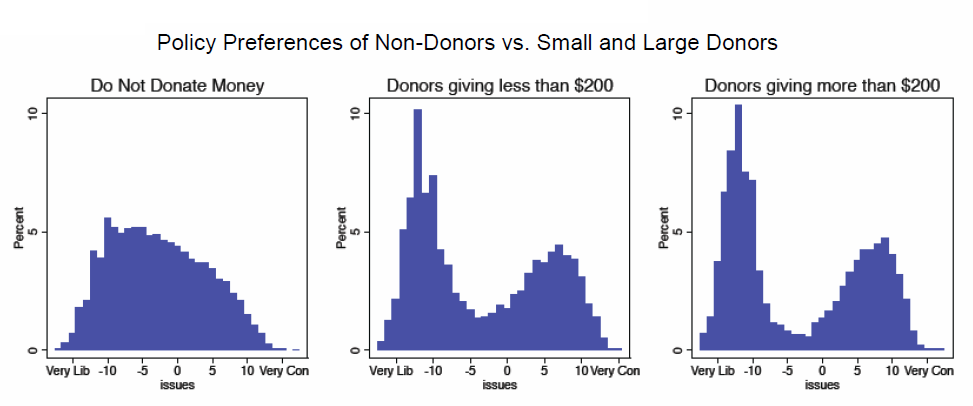
Ezra Klein discusses Ray LaRaja and Brian Schnaffer's graph of U.S. donor policy preferences against political donations:


Klein's take involves a comparison between the graph and the U.S.' discussion about political polarization. But it's worth wondering to what extent the same theory might apply in Canada - and how they might in fact conflict with current party strategies.

After all, the most obvious uncertainty on Canada's political scene involves the fight for centre-left voters - with the NDP, Libs, Greens and Bloc using much of their effort to seek to win over and retain that cohort alongside traditional supporters.

But LaRaja and Schnaffer's findings suggest that centre-left voters are disproportionately unlikely to donate money - with the tendency to donate dropping precipitously as a voter approaches the ideological centre. So if their research matches Canadian donor behaviour, that group may actually be the least likely to provide the support most sought by parties between elections: the funds needed to run a campaign to persuade and turn out voters once the writ drops.

And the importance of seeking mass fund-raising support is only heightened in Canada, since (unlike in the U.S.) a candidate or party can't rely on big-money contributors to make up for a small number of donors. 

Now, it could be that the U.S.' fund-raising patterns themselves arise out of a different enough set of political circumstances to be inapplicable in Canada. But it's worth considering that a strategy designed to pursue centre-left voters between elections may ultimately prove a hindrance not just in maintaining the support of members with stronger views, but also in fund-raising generally.

Monday Morning Links

Miscellaneous material to start your week.

- Leo Panitch questions the "responsible capitalism" theme which is being used by Ed Miliband in lieu of a more significant alternative to unfettered market dogma:
It is most unlikely that Miliband’s call for “responsible capitalism” will refresh genuine political debate let alone galvanise anew a meaningful left-right discourse at the popular level. The real problem with “responsible capitalism” is not that it sounds clunky on the doorstep but rather that ordinary people know in their gut that it is a contradiction in terms. They can sense how evasive it is in relation to their own experience.
...
What is today called irresponsible finance was in fact incubated in the postwar decades, and it had outgrown the old boys’ City networks through which postwar state regulations operated long before they were finally removed by Margaret Thatcher’s “big bang”. In fact, the sterling crises that rocked Labour governments in the 1960s took place in the context of the deepening integration between Wall Street and the City. These crises rendered incredible Anthony Crosland’s confident claim just a decade earlier that there had been an irreversible “transformation of capitalism” in terms of the “diminished power of banks and financial markets” amid the overall loss of the “commanding position” of the capitalist class.

Merely blaming Thatcher free-market rhetoric and sheer force of will for the undoing of the Keynesian welfare state ignores the deep crisis it was already in by the time she came along. As the main parties of the left responded to the growing contradictions between capitalist markets and social reforms by trying to cling to the chimera of a responsible capitalism, neoliberalism triumphed everywhere. The misguided attempt to cling to a romanticised image of a stable responsible capitalism in the face of the rise of neoliberalism was recognised as a failure by New Labour. But by embracing so completely a financialised global capitalism centred in the City of London, it further contributed to the growth of this chaotic and increasingly irrational system – as 2008 proved.

Miliband’s attempt to distance himself from this is to his credit, although the architects of New Labour will continually try to contain him by threatening to divide the party in the run up to next year’s election. But the compromise of clinging to the tired old discourse of responsible capitalism is not the way to go. Ordinary people recognise it for the doublespeak it is. And if they are not offered a positive vision and plan for a renewed democratic socialism that embodies cooperation rather than competition as the basis of social life – if they are not offered, that is, any alternative to capitalism – they will increasingly cling to whatever toehold they have within it at the expense of the “others”.
- Meanwhile, if we needed a reminder as to how irresponsible corporatism is in practice, Nick Surgey discusses the connections between ALEC and the oil industry - featuring TransCanada as one of the most prominent fossil fuel peddlers funding the development of anti-environmental legislation. And Justin Gillis reports on Naomi Klein's work finding nominally environment-friendly groups working hand in hand to exploit even land which is supposed to be set aside for conservation - which all too likely parallels what's happening in Canada as well.

- Jeff Furman makes the case for a financial transactions tax to limit some of the most dangerous incentives in the financial sector.

- Amelia Gentleman highlights the devastating human consequences of cuts to social programs in the UK - while adding "no one should die penniless and alone" to "please don't slaughter children" on the list of seemingly unobjectionable statements which are being hotly contested by far too many.

- And finally, Maria Konnikova writes that even as the absence of positive choices is a major stressor for people living in poverty, so too can an excess of choices cause needless stress even for the lucky few with relative income security.

Sunday, August 03, 2014

Sunday Morning Links

This and that for your Sunday reading.

- John Millar writes that a determined effort to eliminate poverty would be a plus as a matter of mere public accounting (even without taking into account the improved lives of people avoiding the burden of poverty and income insecurity):
According to many studies, the Canadian poverty rate remains high. A recent OECD report shows that the very rich are taking an ever greater share of income. And a new study from three leading Canadian academics shows the rich obscure the total extent of their individual wealth through private companies, which means they are even richer than we thought.

Why should we care?

Because poverty and inequities hurt all of us in the long run. They erode social cohesion and create a burden on all taxpayers to pay for poverty reduction, health care services, unemployment, crime and homelessness.
...
Economists call what we need “a judicious redistributive approach” — that is, to raise government revenues via natural resources, taxes on the wealthy (income, estates, capital), regulation of offshore tax havens, and taxes on externalities, such as pollution, tobacco, alcohol and sugar. Governments should direct these revenues toward social investments such as income support, education, health care and infrastructure.

The business community also has a role. Businesses can help reduce poverty and inequities by paying their share of corporate taxes and having a triple bottom line — people, planet and profits — with a living wage for their staff, co-ownership and profit-sharing policies. The public as consumers can vote with their wallets and support such progressive businesses.

We are paying dearly for inaction. It would cost taxpayers less to eradicate poverty than to continue to pay for poverty related policing, corrections, housing and health care. In B.C., the estimated cost to implement a poverty reduction plan is $4 billion annually, according to the Canadian Centre for Policy Alternatives. Right now, poverty costs the province up to $9.2 billion per year. Businesses and governments must take measures now to reduce poverty and inequities. It is time for concerned citizens to demand action.
- And Heather Digby Parton looks at Kansas' example as to what happens when corporate fundamentalists are able to get their way:
Unlike other Tea Party governors around the nation who have tried out a handful of their more extreme policies, Brownback went for broke. First he and his Koch brother allies (they are Kansas homeboys too, you'll recall) engineered a full-blown Tea Party takeover of the legislature with a well-funded primary strategy in 2012. It is now the most conservative legislature in the nation (and that's saying something considering how conservative Republican legislatures have become). In their minds, they are on a mission from God.
...
All of this was to be expected from Sam Brownback. But the results of his equally fundamentalist approach to economics has made a lot of people stand up and take notice. First and foremost, he slashed taxes to the bone. Well, not for everyone. The Center on Budget and policy priorities shows how that tax cut has been distributed...

Yes, the citizens of Kansas voted in this right-wing wrecking crew, but it must be remembered that there was a whole lot of help from the deep pockets of native sons Charles and David Koch, who wanted to demonstrate once and for all how well their libertarian economic ideas would work if only they were given a chance. Unlike their counterparts in DC, they didn't have to deal with a Democratic usurper in the Governor's Mansion—they had a true believer leading the way and full rein to see their ideology put to the test.

Their problem now is not because they are seen as the Party of No, or that they are using obstructionist tactics that offend the sensibilities of those who seek a nice bipartisan consensus. These Republicans got everything they wanted. Governor Brownback's approval rating is unsurprisingly in the dirt and he is in grave danger of losing re-election. Another nail in his coffin was pounded in last week when more than 100 current and former Republican officials endorsed Brownback's Democratic opponent, citing the failure of his economic program and the extreme nature of his overall agenda.

Just as other races in the country are reflecting the fight between the GOP establishment and the Tea Party wing, Kansas will be a battleground in the fall for the latest fight for the soul of the Republican Party. But this time it isn't just about race or the culture war or bad political tactics. This one is about all of that to be sure. But this time the Koch brothers' libertarian economic dream agenda has been enacted and it's on the ballot. If America wants to see what the country will look like if the Brownback wing of the GOP manages to get its way nationally, they only need to look at Sam Brownback's Kansas—a disaster on every level.
- Meanwhile, Normal Farrell catches the B.C. Libs backtracking on their previous faith-based assertions that liquid natural gas would mean permanent riches for the province, though Andrew Nikiforuk notes that they're still being entirely reality-averse in claiming that dangerous and untested extraction techniques will post no environmental risk whatsoever. And Tim Devaney exposes the pitiful tax rate paid by the U.S.' oil industry.

- Dean Beeby takes another look at the CRA's targeting of progressive charities for audits. And Hayden King writes that the Cons' new legislation imposing specific disclosure requirements on First Nations - like the similar Harper attack on unions - is aimed primarily at making collective action less effective. Meanwhile, any sense that corporate influence over (or returns from) public policy should similarly be tracked is of course nowhere to be found.

- Finally, Justin Garguilo offers a response to the theory that increased data collection and analysis is the lone secret to political success - pointing out that data itself means nothing if it doesn't serve a greater purpose.

Saturday, August 02, 2014

Saturday Morning Links

Assorted content for your weekend reading.

- Rick Perlstein observes that Ronald Reagan's most lasting contribution to American politics may be his admonition not to recognize flaws or past sins which might require serious responses - and that democratic discourse in the U.S. and elsewhere has yet to recover:
(T)he baseline is this moment in 1973 when the Vietnam War ends, and that spring, Watergate breaks wide open, after basically disappearing from the political scene for a while. You have this remarkable thing, where Sam Ervin puts these hearings on television. And day after day the public hears White House officials sounding like Mafia figures. That same spring, you get the energy crisis, and you hear officials say that we’re running out of energy when heretofore, nobody knew you could run out. That’s a blindsiding blow to the American psyche. And then there’s the oil embargo, suddenly a bunch of Arab oil sheiks decide to hold America hostage, and succeed. So the way I characterize that is that we had this idea of America as existing outside of the rules of history, as a country that can’t do any wrong. Suddenly we begin to think of ourselves as just another country, not God’s chosen nation. I have a quote in the preface to the book by Immanuel Kant, who defined the Enlightenment as “man’s emergence from his self-incurred immaturity,” basically the process of leaving childhood and becoming a grown-up. And that’s what we’re seeing in America in the 1970s.

This is a remarkable juncture, and you could see it in popular culture. Like “M*A*S*H,” and how it takes on militarism. People were insistently following the Watergate hearings, which were enormously complex. And America is really beginning to take on big problems, thinking about what it would mean to conserve energy, to create energy independence. Then everything takes a turn, Reagan is introduced, and he says don’t worry about this stuff. America is that shining city on a hill...
...
Leaders are for calling people to their better angels, for helping guide them to a kind of sterner, more mature sense of what we need to do. To me, Reagan’s brand of leadership was what I call “a liturgy of absolution.” He absolved Americans almost in a priestly role to contend with sin. Who wouldn’t want that? But the consequences of that absolution are all around us today. The inability to contend with climate change. The inability to call elites to account who wrecked the economy in 2008. The inability to reckon with the times when we fall short.
- But Lucy Mangan writes that it's becoming more and more difficult to avoid the truth about deliberate social exclusion - with "poor doors" looming as just the latest example of deliberate attempts to insulate the wealthy from any interaction with their fellow citizens. And Rick Smith wonders whether the Cons' over-the-top hostility toward the environment may finally push Canada toward far stronger policy than we've ever had before even under governments who paid lip service to the issue.

- In a similar vein, David Crane discusses the stark divide between the Cons' economic spin and the real insecurity of far too many Canadians. And Andrew Jackson points out that needless austerity is destroying jobs even as the unemployment rate increases. 

- CBC reports on the utter failure of Alberta's power deregulation to do anything other than drive up consumers' bills by tens of billions of dollars. But unfortunately, the Saskatchewan Party never saw a failed Alberta scheme it wouldn't insist on copying - which is why it's pushing ahead with P3 schools after even the Alberta PCs have learned better.

- Finally, Chris Dillow tests the question of whether poverty should be seen as resulting from individual ability or inescapable social context - and rightly concludes that it's futile to rely solely on improving the former without addressing the latter:
The "poverty is individual" brigade would say that some form of Say's law would lead to the creation of sufficient good, well-paid jobs to eliminate poverty. The "poverty is structural" band would say that this won't happen, because inequality, deskilling and unemployment are inherent structural features of capitalism, which would condemn some to (relative) poverty even if we were all smart and employable.

What's the empirical evidence here? Immediately, we run into a problem. The research on the links between human capital and aggregate growth, whilst large, is not conclusive (pdf). On the one hand, Erik Hanushek among others thinks there might be big macro-level payoffs to higher cognitive skills. But on the other, there's lots of scepticism about the link between education and growth. Bryan Caplan's reading of the evidence is that the response is "low" - and Middendorf and Krueger and Lindhal agree (pdf). This is consistent to the private payoffs to education being due to signaling - which implies that it is one's relative, not absolute, level of education which determines one's income. If so, better education for all won't raise incomes much.

All this said, two bits of evidence - on top of my priors! - makes me side with Matt in believing that mass upskilling won't eliminate relative poverty.

1. Graduate over-education is significant in most countries. This suggests that Say's law doesn't work; good jobs haven't increased fully in response to a supply of educated workers.

2. There's no correlation between inequality in human capital and in incomes, either across countries or over time. This is inconsistent with human capital-based explanations for inequality, but consistent with the view that inequality is due to inequalities of power.

Personally, I suspect that the "poverty is individual" view owes a lot to ideology: system justification and the just world fallacy cause people to blame the victim.

Friday, August 01, 2014

Musical interlude

Deftones - Digital Bath

Friday Morning Links

Assorted content to end your week.

- Colleen Flood writes that our health care system is more similar to the U.S.' than we'd like to admit - and that many of the most glaring inefficiencies within it are already the result of services funded through private insurance rather than our universal public system:
The latest Commonwealth Study ranked Canada's health care system a dismal second to last in a list of eleven major industrialized countries. We had the dubious distinction of beating out only the Americans. This latest poor result is already being used by those bent on further privatizing health care. They argue -- as they always do -- that if only Canada allowed more private finance, wait times would melt, emergency rooms would unclog and doctors, nurses, patients and the public would all be, if not quite utopia, then at least better off than now.
...
(W)hat most commentators weighing in on the health debate don't understand is that we already have a mix of public and private care. What distinguishes Canada's health system from others is not how little private finance we have but how much private finance we already endure. Canadians have their health needs covered by the public system only 70 per cent of the time, much less than the UK (84 per cent) or Norway (85 per cent) or even France (77 per cent).

Indeed, Canadians actually hold more private health insurance than Americans do. How is this possible?

Our health system fails to offer universal (public) coverage for prescription drugs, unlike the coverage provided in nearly every other developed country in the world. Canada also has inadequate coverage for home care and long term care, which are more comprehensively covered in many other health systems, such as Japan, Germany, Belgium and Sweden.

Unfortunately, our health system is more like the U.S. system than most of us know. Just like the U.S., our approach to prescription drugs, home and long-term care is to have some people covered through private health insurance via their employer. Some people covered by governments because they are on welfare or elderly, and a big chunk of the population going without.
...
The jewel of Canada's health care system is the commitment to restrict private finance for medically necessary hospital and physician care. We don't let our doctors double dip, and we keep essential health services available to all, regardless of means. Yet it is this commitment that is being threatened with the legal challenge in B.C., and blamed for the problems that have beset Canada's health system -- with some pretty clear vested interests ready to profit from the outcome.

Instead of having Canada's health system compete with the United States for last place, we need to start addressing the real issues that plague our system. We could start by looking at the expansive policies of European systems that perform better than our own, starting with a universal health system that includes drug coverage, home care and long-term care.
- And Carol Goar notes that the Ontario Libs' spin about a progressive budget is being proven false - promised benefit increases for recipients of social assistance are being clawed back immediately.

- Karen Kleiss reports that a Alberta's public-sector pay freeze for senior officials was summarily scrapped as soon as it had served its purpose of offering an excuse to attack other workers' wages. Vaughn Palmer notes that the B.C. Libs can apparently find plenty of money to bribe parents even as they refuse to invest in the province's education system. And David Cay Johnston discusses Chris Christie's belief that public servants shouldn't expect their employers to be honest about what pension benefits will be available for them. 

- Meanwhile, Claire Cain Miller makes the seemingly obvious point that improved paid leave can encourage parents to stay in the workforce. And David Cain suggests that we look at different models for our work week rather than one which seems designed to maximize consumption and minimize meaningful activity outside of work.

- Finally, Paul Krugman explains why we should be careful which "experts" we trust to inform us in shaping public policy:
One of the best insults I’ve ever read came from Ezra Klein, who now is editor in chief of Vox.com. In 2007, he described Dick Armey, the former House majority leader, as “a stupid person’s idea of what a thoughtful person sounds like.”

It’s a funny line, which applies to quite a few public figures. Representative Paul Ryan, the chairman of the House Budget Committee, is a prime current example. But maybe the joke’s on us. After all, such people often dominate policy discourse. And what policy makers don’t know, or worse, what they think they know that isn’t so, can definitely hurt you.
...
Am I saying that the professional consensus is always right? No. But when politicians pick and choose which experts — or, in many cases, “experts” — to believe, the odds are that they will choose badly. Moreover, experience shows that there is no accountability in such matters. Bear in mind that the American right is still taking its economic advice mainly from people who have spent many years wrongly predicting runaway inflation and a collapsing dollar.

All of which raises a troubling question: Are we as societies even capable of taking good policy advice?

Economists used to assert confidently that nothing like the Great Depression could happen again. After all, we know far more than our great-grandfathers did about the causes of and cures for slumps, so how could we fail to do better? When crises struck, however, much of what we’ve learned over the past 80 years was simply tossed aside.
...
(M)acroeconomics, of course, isn’t the only challenge we face. In fact, it should be easy compared with many other issues that need to be addressed with specialized knowledge, above all climate change. So you really have to wonder whether and how we’ll avoid disaster. 
[Edit: fixed typo.]

Thursday, July 31, 2014

New column day

Here, on how we should take Germany's rightful concern over investor-state dispute settlement provisions as an opportunity to reevaluate what we expect to accomplish through trade and investment agreements such as CETA.

For further reading...
- Peter Clark, Michael Geist and Scott Sinclair discuss Germany's objections to new trade agreements with Canada and the U.S. in particular, while reminding us why we should be wary of handing undue power to the corporate sector as well. And Nathalie Bernasconi-Osterwalder and Rhea Tamara Hoffmann discuss (PDF) Germany's past experience with ISDS in detail.
- Meanwhile, Patricia Ranald notes that similar issues are developing as Australia debates an agreement with South Korea.
- Finally, Thomas Walkom and Jim Stanford weigh in with their own concerns about CETA, while the Council of Canadians applauds Germany's stance.

Thursday Morning Links

This and that for your Thursday reading.

- Linda McQuaig discusses how a burgeoning wealth gap is particularly obvious when it comes to retirement security:
Quaint as it now seems, not long ago this was considered a good basic plan: Work hard all your life and then retire with a comfortable pension.

In recent times, a new plan has replaced it: Work hard all your life and then all bets are off.

The notion of retirement security in exchange for a lifetime of hard work — a central element in the implicit social contract between capital and labour in the postwar years — has been effectively tossed aside, as corporations have become more insatiable in their demands and governments have increasingly abandoned workers.
...
In what amounts to a radical overhaul, [the Con government] announced last April that it intends to change long-standing legislation governing workplace pensions in ways that would allow employers (private sector and Crown corporations) to walk away from pension commitments they made to employees, even after those employees have paid into the plans throughout their working years.
...
Workplace pensions were always expected to be a key part of that retirement security. Unlike many European countries, where public pensions were generous enough to serve as the centerpiece of a retiree’s income, the Canadian government kept public pension benefits low and encouraged workers to rely on workplace pensions.

That worked fine for those who were able to negotiate workplace pensions with an employer — generally those who had a union to represent them. In such cases, both the employer and the employees typically contributed to the plan, under terms that specified what benefits would be paid out to employees in their retirement.

Employers now want to be able to fundamentally rewrite the terms of those workplace pension deals so that, if the market plunges and the pension fund declines, the pay-outs will be less — in effect, shifting the risk from the company to the retiree.
...
It’s striking, however, that a bold embrace of risk is only expected of those in the lower echelons of the corporate world. At the top, executives cling to old-world notions — like securing comfortable retirements.
- And Regina civic workers are taking action to make sure the city keeps its pension promises - rather than either demanding concessions now, or changing the rules so it can unilaterally slash benefits later.

- Brian Iler suggests that the Cons' charity crackdown could have been avoided if Canada adopted a definition of charity work which included promoting public debate on political issues. But while that change might have given current charities more confidence as to the result of the current round of government-directed audits, it wouldn't have done much to avoid the needless expense of going through the audit process in the first place.

- Meanwhile, Kaylie Tiessen is hopeful that Ontario is ready for a serious conversation about the need for more revenue to fund public services.

- Kayle Hatt studies the federal government's cuts to summer student programs. And CBC reports that Calgary's decision to outsource park maintenance work has led to temporary foreign workers taking the place of students who would otherwise be able to use a summer income to fund their education.

- Finally, the Ottawa Citizen identifies one of the surest signs of an ethically bankrupt government - while noting that the Harper Cons and Alberta's PCs are just two of the governing parties who seem to be treating that lack of ethics as a goal to be pursued:
There seems to be an epidemic in Canada of rogue staffers doing unethical things their political bosses would never, ever sanction.

The most famous is Nigel Wright, the former chief of staff to Prime Minister Stephen Harper, who wrote a large cheque to a sitting senator. Then there’s the OPP search-warrant document alleging that David Livingston, the chief of staff for former Premier Dalton McGuinty, hired someone to purge emails during the transition to Kathleen Wynne’s premiership. There is the ongoing mystery about the voter-suppression phone calls in several federal ridings in 2011 “by a person or persons currently unknown to this court,” in the words of Federal Court Judge Richard G. Mosley.

Now there is a leaked, draft auditor’s report about former Alberta Premier Alison Redford, suggesting her staff manipulated airplane bookings so that she could treat the planes as personal limos.
...
An ethical organization does not build plausible deniability into its hierarchies and relationships; it does not have any reason to. The fact that it seems to be built in to Canadian political culture, in more than one party, in more than one province, is sickening.

Wednesday, July 30, 2014

Wednesday Morning Links

Miscellaneous material for your mid-week reading.

- Trish Garner highlights the futility of trying to answer poverty, equality and other social issues with the empty promise of low-paying "jobs! jobs! jobs!":
The central “solution” in the government’s action plan is jobs. The little money dedicated to this initiative is all directed to employment inclusion and skills training. It’s not surprising. It’s the same answer we receive when our supporters throughout the province advocate for a poverty reduction plan for B.C.
 
There are two important points to make in response. First, many people with disabilities are unable to work but they still deserve to live with dignity. Second, most people in poverty already have a job so low wage employment does not provide meaningful inclusion for anyone. The emphasis must be on good, stable jobs that provide a living wage.

While the Disability Summit was a high-profile publicity event for the government, a month before that, they quietly released a progress report on their “community poverty reduction pilot projects”. No big fanfare for the initiative launched in May 2012, which has helped only 72 families over two years, a drop in the ocean when you consider that almost 500,000 people live in poverty in B.C.

And, by help, they mean merely referring families to existing services. The assumption is that the fundamental problem for families in poverty is an inability to navigate the system of programs, services, and supports within their communities. While there are many bureaucratic barriers that do require a certain level of language and literacy, the fundamental problem is lack of income combined with high cost of living—not a failure to access services.

Despite recognizing that the provincial government is responsible for the implementation, support, and funding of the systemic themes identified during these pilot projects, including housing, food security, health, childcare, transportation, and education, this so-called poverty reduction project does nothing to address those issues.
- Meanwhile, Dylan Matthews argues that a basic income would go a long way toward solving many of the basic social issues which are currently either kept in their own silos or answered with pablum about economic growth. But then, Peter Van Buren notes that poverty is plenty profitable for collection agencies and creditors among other businesses - meaning that we can expect a fight (if a despicable one) in trying to ensure a basic income for everybody.

- Dean Beeby highlights how CoDevelopment Canada Association for one is dealing with the administrative burden imposed by the Cons' crackdown on progressive charities. But Tom Henheffer is optimistic that Canada's social voices will survive the Cons' assault.

- Andrew Nikiforuk reports on the new discovery of an Alberta salt formation which may explain the pattern of spills and blowouts in the extraction of oil using steam. Presumably this will be the response to any attempt to address the newfound risk through law.

- Finally, the White House makes an economic case (PDF) for addressing climate change sooner rather than later. And PressProgress finds even the Fraser Institute endorsing Norway's management of oil reserves and revenues - even if it can't highlight the plus of managing public wealth without lamenting the possibility that people might benefit as a result.

Tuesday, July 29, 2014

Tuesday Night Cat Blogging

Feline oversight.


Tuesday Morning Links

This and that for your Tuesday reading.

- Dennis Howlett discusses what we lose when corporations are able to evade taxes, and points to some positive signs from the NDP in combating the flow of money offshore:
Federal and provincial governments lose an estimated $7.8 billion in tax revenues each year because of tax havens. The scale of the problem gets larger while the federal government cuts back on health care, food safety, rail inspections, the CBC and more.

True fiscal stewardship would recognize that staunching the flow of money offshore is the better solution. Canadian taxpayers pay the price when the CRA doesn't follow the money.
...

There are some hopeful beginnings. Earlier this year, NDP National Revenue critic Murray Rankin proposed new legislation that would make it easier for government and the courts to crack down on those who are playing the system.

Rankin's bill focuses on proving "economic substance." Corporations must be able to prove a transaction has economic purpose aside from reducing the amount of tax owed. Setting up a storefront office in Cayman Islands or Switzerland and then sending large invoices back to the Canadian head office charging "management" or "licensing fees" would no longer be acceptable. Make no mistake -- there are a lot of Bay Street lawyers getting very rich taking advantage of this existing black hole in Canada's Income Tax Act.

Rankin consulted on this legislation with internationally known tax expert Robert McMechan. The Ottawa-based McMechan is the author of a recent book, Economic Substance and Tax Avoidance. He points out that the U.S, Australia and the U.K. are among the countries that have drawn the line between legitimate tax minimization and unacceptable tax avoidance.
- Karen Kamp interviews Deepak Bhargava about some ways to make the case to fight against poverty:
Americans who are struggling do not see themselves in abstract language like “the poor” or “poverty.” This is partly because such language is seen as quite pejorative in America. To be poor is to have failed in pursuit of the American Dream. In too many ways, people who are poor are reviled. The first thing we need to do is stop blaming people and start talking about their real lives.
...
The entry point is connecting with common lived experiences such as not being paid enough to cover the bills, making difficult tradeoffs between basic necessities, inadequate or irregular work hours or not being able to save for retirement or college. Then you have to quickly connect it to shared values. In our research, the most powerful value was family — not only do people identify family as a primary identity but it is the fear or reality of not being able to provide enough for family members that motivates people to get into the debate or take action.
...
Phrases like “struggling to make ends meet,” “living on the brink,” “working for family” describe lived experience and not identity. They also have the added benefit of crossing supposed class lines. At this point in the Great Recession, it’s become the norm to live paycheck to paycheck — whether those paychecks cover a trailer home or a two story colonial in the burbs. Thus, even if people self-identify as “lower middle class,” these tested messages resonate. 
- But then, as Joshua Sager notes, even the U.S.' general public is already broadly in favour of progressive policies - meaning that the greatest challenge is to translate that actual policy preference into political outcomes.

- Meanwhile, Stephanie Coontz discusses the new instability facing working families, while Emad Ahdavi highlights the threat to our long-term economic development posed by youth unemployment and underemployment. And Zach McDade offers some suggestions as to new investments which can both create jobs and address glaring social needs.

- Finally, Evgeny Morozov asks whether "algorithmic regulation" might render politics obsolete while effectively handing even more control over citizens' lives to the corporate sector. But I'd think there's a sharp distinction to be drawn between data-based governance and corporate-based governance - and a strong preference the former as distinct from the latter could actually encourage meaningful debate about the goals we ultimately want our governments to pursue.

Monday, July 28, 2014

Monday Morning Links

Miscellaneous material to start your week.

- Danyaal Raza and Edward Xie write that a well-designed city environment can make all the difference in enabling individuals to live healthy lives:
What if city council took our health into account when designing neighbourhoods? An idea gaining favour in major cities around the world is “complete streets,” a city-planning concept that promotes development of streets usable by all citizens, whether they are pedestrians, cyclists, drivers or transit users. As things stand now, getting to schools, parks and stores without a car is only a dream for residents without the lush tree cover, dense transit networks and regularly spaced traffic crossings of downtown.

The science is clear: people are more likely to walk to a store if it can be reached within five to 10 minutes, while those who spent more time travelling by car had a greater likelihood of being obese. All it takes, according to a new international study, is an extra 2,000 steps a day — about 20 minutes of walking — to reduce heart attacks and strokes by 8 per cent in people at risk for diabetes. It should be no surprise, then, that building walkable neighbourhoods can discourage sprawl and prevent diabetes and its complications.
...
Some innovative solutions already exist; in fact, Toronto has been a Canadian leader by creating the Toronto Food Policy Council in 1990 and adopting the bold Toronto Food Charter in 2001. The city already supports the FoodShare organization to bring grocery stands, school meals and inexpensive fresh food via mobile markets to residents who need them.

Still more can be done. A prosperous city is nourished by healthy, productive citizens. We need visionary city planning to remedy these problems with rational zoning, support for community initiatives and a city council that takes health seriously. 
- Meanwhile, Lynn Stuart Paramore argues that a four-day work week can be a plus for both employee well-being and employer outcomes.

- Lydia DePillis discusses how inequality can snowball, as exorbitant wealth drives up the price (and expected returns) from a limited set of positional goods. And Joyce Nelson looks at credit rating agencies as an example of big money seeking to perpetuate itself by imposing policies on everybody else.

- Will Horter wonders whether the Cons' determination to push pipelines and tankers will drive B.C. voters to seek new alternatives.

- Finally, Gerry Caplan sees a basic lack of decency as one of the defining features of the Cons. Which is why we shouldn't be surprised that Therese Casgrain - having fought for such causes as feminism, voting rights and social democracy - is being furiously erased from Canadian history in favour of further Harper hagiography.

Sunday, July 27, 2014

Sunday Morning Links

Assorted content for your Sunday reading.

- Pierre Beaulne discusses the inequality-related problems and solutions brought into the spotlight by Thomas Piketty, and notes that they can't simply be swept under the rug:
When all is said and done, the capitalist globalization has boosted economic growth for a certain time, but has by the same token greatly increased income inequalities and exacerbated wealth concentration. Tax breaks for the highest incomes and social spending cuts have intensified the trend. In Canada, for instance, the top marginal income tax rate at the federal level has gone down from 43% in 1981 to 29% in 2010, leaving more room for high-income individuals to accumulate wealth. Worldwide, the situation is so alarming that the World Economic Forum, which can certainly not be suspected of entertaining pinko tendencies, has recognized severe income inequalities to be the main social risk in its 2011 annual report Global Risks.

Thomas Piketty’s theories are obviously subject to debate, but the conclusions which he draws throughout his work and that of his associates don’t come out of left field. On the contrary, they support and enrich our understanding of numerous previous observations. His book’s success might be due to the fact that people are looking for explanations: they are unable to reconcile news of economic performance with their own financial situation, which has never before involved so much debt. For the common good, the trends identified must lead to changes in regulation and in the direction taken by governments in their economic and tax policies. Denial is not a sustainable option.
- Which isn't to say some governments won't prefer denial as a temporary option on all kinds of issues. And in a prime example, the CP reports on the Cons' refusal to include fracking chemicals on a list of pollutants (since that might serve as the basis to measure and regulate their effect on the environment).

- Marc Spooner writes that it's entirely legitimate to maintain pride in one's home while recognizing that there's room to improve - and highlights how greater focus on eliminating all kinds of inequalities would create a better Regina. And Susan Delacourt notes that we should expect politicians too to tell us the truth, rather than simply saying what's most politically convenient at a particular moment:
A couple of months ago, I spent an afternoon walking through Toronto’s Little Italy neighbourhood with NDP candidate Joe Cressy and municipal councillor Mike Layton, campaigning in the Trinity-Spadina byelection.

Along the way, Layton was encountering shop owners or other citizens venting their concerns and complaints about local affairs. I was pleasantly surprised to see that he didn’t just tell them they were right — he pushed back, politely and respectfully, when he thought their views or facts were off-base.

It was a demonstration of the difference between simple, “retail politics” and authentic political dialogue.

Sometimes the customers — let’s call them citizens — aren’t always right. Sometimes, when they’re really wrong, the best reply is a little less oxygen or a little more sunlight.
- Meanwhile, one of Stephen Harper's long-departed spinmeisters makes it absolutely clear that the Cons aren't interested in anything of the sort - preferring being crooked as part of their jobs to dealing honestly with the public:
But the worst part of my job was having to promote and defend policies I didn’t agree with personally. When that happened, you had to do your job and toe the party line.

Don’t shed a tear, because it didn’t happen much, at least not on issues that were core to the agenda, but consider yourself fortunate if you never have to look at a camera and argue with all of your heart for something you don’t believe in. Especially when, as happens in politics, you are standing on some thin intellectual ice.

Oh, how journalists loved it when they had you in that position. “Andrew,” they’d say, “surely you don’t believe that.”

Maybe not, but it didn’t matter what I believed. I wasn’t elected. The government had an agenda and it was my job to talk about it.
...
Parties — and leaders — are imperfect. And so that means as a spokesperson you’ll have to go out there and occasionally fire crooked arrows, sometimes at targets you don’t believe in or care about.
- Finally, Rachel Malena-Chan argues that rather than forcing families to allocate a single leave period between two parents, a separate paid leave should be available to a secondary parent.

Saturday, July 26, 2014

Saturday Morning Links

Assorted content for your weekend reading.

- Deirdre Fulton discusses the UN's 2014 Human Development Report, featuring recognition that precarious jobs and vulnerable workers are all too often the norm regardless of a country's level of development or high-end wealth. And as Dylan Matthews points out (h/t to David Atkins), the lack of worker benefits from increased corporate wealth figures to make a guaranteed annual income into a logical solution:
So here's my takeaway: a negative income tax or basic income of sufficient size would, by definition, eliminate poverty. We still don't know if there'd be much of a cost in terms of people working and earning less. If there is, the effect is almost certainly small enough that a negative income tax can offset the lost earnings and remain affordable. The worst case scenario is that we eliminate poverty but see a modest decline in employment. The best case scenario is we eliminate poverty at even lower cost and don't see much of an effect on employment. That's a gamble I'm willing to take.
- Meanwhile, Andrew Jackson points out that the supposed job recovery following the 2008 recession has been far less than advertised. And Angella MacEwen writes that we should see the steady flow of funds from EI premiums into general revenue as an indication that too many people are being denied benefits - particularly when a strong majority of unemployed Canadians aren't benefiting from a program they helped to fund.

- Tom Henheffer questions why the Canada Revenue Agency is being pushed by the Cons to attack progressive charities, particularly when it's being starved of resources to do its job of actually collecting revenue. Heather Mallick takes a closer look at the CRA's intrusion on Oxfam in particular. And Lana Payne sees the crackdown on charities as part of the Cons' general pattern of silencing any dissenting voices:
Binders full of enemies? Let’s try libraries.

The government has, for all intents and purposes, successfully defunded Canada’s advocacy movement — well, those advocates that disagree with them anyway, like women’s rights and child-care activists, environmental and scientific researchers. They have eliminated funding for roundtable consensus-building initiatives as well as non-governmental organizations dedicated to promoting human rights and equality for women around the globe.

The list is long and depressing.

The government has used, or rather abused, its power in so many ways that Canadians have perhaps grown immune to the attacks on democracy and civil society.
...
Sadly, we have a government that relishes divisions abroad and at home. Divisions create opportunities.

Consider its aggressive attack on anyone and everyone who disagrees with their ideology or policy — charities, unions, feminists, environmentalists, scientists and academics.

And yet when Harper was in opposition, he had an entirely different view of dissent and democracy: “When a government starts trying to cancel dissent or avoid dissent is when it’s rapidly losing its moral authority to govern,” he said.

That time is now for his government.
- But Scott Feschuk suggests we should be a bit more understanding of a figurehead who's so plainly at the mercy of his minions (at least until he's thrown them under various large vehicles).

- Finally, Ryan Meili explains why we shouldn't accept simplistic arguments to the effect that we should run our health care system more like a veterinary clinic (or indeed a European system facing different challenges).

Friday, July 25, 2014