Showing posts with label maude barlow. Show all posts

Thursday, August 30, 2018

Thursday Morning Links

This and that for your Thursday reading.

- Christo Aivalis discusses the future of organized labour and the need for workplace democracy in an era of increased automation:
New organizing models and shorter workdays are both viable solutions to address the struggles of encroaching automation, but neither strike to the heart of the matter that AI exposes. In our current capitalist system, the politics of automation are inherently adversarial, because while productivity increases and cost savings are consistently sought by owners, managers, and shareholders, the workers themselves don’t want to be displaced from the job that provides them their livelihood. Historically, many workers and socialists have acknowledged the immense social value automative processes have had in eliminating the most tedious and dangerous of jobs, meaning that we can shift our human resources in more productive and fulfilling directions. But automation driven primarily by profit motives serves to further concentrate power and wealth, making our society more unequal, and our democracy more imperilled. Even things like the basic income guarantee may fail to solve this issue, because putting the masses of people on mere subsistence incomes while an increasingly small number of owners and technical workers reap riches is more likely to lead to Elysium than to a just society.

So the rise of AI may well provide the conditions for a reinvigorated challenge to capitalism. Unions must not only bargain for better wages and conditions, but must push for mechanisms that give workers greater say in the direction of their workplaces, and a greater share of the value derived from actions which have traditionally served to unemploy them. But beyond bargaining, labour must align with politicians seeking to democratize workplaces and the wider economy by increasing the proportion of our economy owned not by capitalists, but by cooperatives and the public. If we are indeed at the precipice of a new industrial era, the only way to ensure 90 per cent or more of the population isn’t permanently marginalized from economic life is to demand that our democratic levers extend into the operation of industry. Put another way: in the automated age, democracy will need socialism.
- Wojciech Keblowski makes the case to abolish fares for transit to maximize the public good it can achieve. And Ricardo Tranjan discusses the crucial role of public service employment as a matter of both economic and social development.

- Maude Barlow and Sujata Dey offer a reminder that Canada can do just fine without NAFTA. Jerry Dias implores the Trudeau government to be willing to walk away from NAFTA negotiations if the Trump administration is being as reckless and heavy-handed as it appears. And Brent Patterson wonders whether an even worse NAFTA might serve as the impetus for a more fundamental challenge to elite-driven capitalism.

- Carlyn Zwarenstein writes about the value of harm reduction as a response to addictions issues. And Liam Britten reports that in keeping with its stellar early returns in managing British Columbia's public resources, John Horgan's government is suing opioid manufacturers for their harm maximization model of drug distribution.

- Finally, Bashir Mohamed highlights why birthright citizenship - and the associated recognition that no person should be treated as illegal or without status - is important for all Canadians.

Tuesday, May 23, 2017

Tuesday Morning Links

This and that for your Tuesday reading.

- Patrick Butler writes about the increasing number of UK families mired in poverty and insecure housing even with one or more people working. And Ali Monceaux and Daniel Najarian discuss the importance of a fair minimum wage in providing people with a basic standard of living.

- Kelly Grant reports on the Libs' baby steps toward dealing with the high cost of prescription drugs. And Andre Picard offers some suggestions as to how to make our health care system work better, while John Geddes points out that Maxime Bernier wants to lead the Cons toward trashing universal health care altogether.

- Damian Carrington discusses new research showing how even relatively small rises in the sea level caused by global warming will massively increase flooding risks, while Chris Mooney notes that levels are in fact rising increasingly quickly. But Hiroko Tabuchi and Eric Lipton highlight how a single bad actor - in this case the Trump administration - can undermine any effort to regulate the causes of climate change.

- Meanwhile, Maude Barlow examines (PDF) how corporate-centred trade deals threaten the availability of clean and safe water. And Edgardo Sepulveda takes a look at the needless public expense being created by the Wynne Libs in order to avoid answering for their damage to Ontario Hydro.

- Finally, Matt Bruenig argues that class struggle is key to ensuring that the benefits of growth go to the many rather than the few:
If you believe, as Piketty argues in his book, that a reduction in growth will inexorably lead to a higher wealth-to-income ratio and a higher capital share, then perhaps the best you can do is pare down wealth accumulation and spread out its ownership through a progressive wealth tax.

But if you believe instead that the capital share does not rise inevitably but only as a result of capitalists getting the upper hand in the perpetual battle over the distribution of output in society, then many more solutions become plausible. Increasing housing supply and imposing rent controls, weakening intellectual property protections, empowering workers to fight for a bigger piece of the pie — all would have the same or even greater egalitarian effects.

American Airlines’ decision to increase its workers’ compensation caused over $2.2 billion of national wealth to vanish almost instantly — not because actual capital goods were destroyed, but because capital’s share was ever so slightly reduced. Empowering workers to repeat this fairly mundane episode again and again, throughout the economy, would likely be a much stronger brake on runaway wealth accumulation and inequality than a global wealth tax or other similarly elaborate strategies.

Class struggle still gets the goods.

Monday, January 09, 2017

Monday Morning Links

Miscellaneous material to start your week.

- Sean McElwee offers his take on the crucial failings which have led the U.S. Democrats to their current nadir in which principles and values have been discarded in the pursuit of power they've failed to secure.

- Mike Konczal and Marshall Steinbaum highlight the importance of effective government to counterbalance corporate control:
If there is one thing that both the Depression and the Great Recession taught us about how the economy works, it is that corporate power is a threat to public well-being—that it extracts its own rents. The economy’s only effective protection from that power is to be found in an activist federal government unafraid to deploy countervailing power and provide essential services in the form of public options and regulated utilities.

...Real free-market economics has little time for powerful countervailing mechanisms to private power like antitrust or banking regulation, let alone a healthy labor market powered by robust aggregate demand and full employment as government policy. Furthermore, whether the “pro-growth” policies advocated in this symposium would actually deliver growth and genuine security for everyday workers, much less challenge the power the elite have over the economy, is unclear. Luckily, the New Deal that Simons was hoping to keep at bay gave us a better set of tools to build an economy that serves the interests of the many, not the few.
- Joseph Stiglitz discusses the glaring uncertainty surrounding the Trump administration as a barrier to any substantial economic forecasting. And Jerry Dias and Maude Barlow offer their suggestions as to how a renegotiation of NAFTA could produce far better results for citizens of all of the countries involved.

- The Star's editorial board criticizes the lack of federal action to ensure that indigenous children have access to child welfare services. And Vicky Mochama writes that it's particularly galling to see the federal government whine that it doesn't have the money to comply with its human rights obligations while it plans high-priced birthday celebrations.

- Finally, Colin Freeze reports on CSIS' plans to collect bulk data for unspecified purposes without any apparent public notice or debate.

Tuesday, January 03, 2017

Tuesday Morning Links

This and that for your Tuesday reading.

- Joachim Hubmer, Per Krusell and Anthony A. Smith, Jr. study the causes of wealth inequality in the U.S. and find one clear explanation for the stratification between the rich and the rest:
There is one main finding: by far the most important driver is the significant drop in tax progressivity that started in the late 1970s, intensified during the Reagan years, and then subsequently flattened out, with only a minor bounce back. The sharp observed increases in earnings inequality, the falling labor share over the recent decades, and potential mechanisms underlying changes in the gap between the interest rate and the growth rate (Piketty's r-g story) all fall far short of accounting for the data.
- Meanwhile, Jared Bernstein charts the lack of any correlation between tax giveaways to the rich and economic development (as measured by GDP and employment).

- Alan Pyke reports on Bloomberg's estimate that the world's richest 500 people increased their personal wealth by a combined $237 billion this past year alone. And Hugh MacKenzie reminds us that Canada's CEOs rake in more money in a single morning than most workers will earn all year.

- Ben Judah highlights how London's real estate market (like that of other cities) has been inflated by kleptocrats from around the globe.

- Thomas Homer-Dixon discusses the need for Canada to step up the fight against climate change. And Chris Mooney offers another reminder that actual data shows that we're doing even more damage to our planet than has long been feared - which may explain why the Wall government is going out of its way to undermine even basic scientific knowledge and education in Saskatchewan.

- And finally, the Council of Canadians shares Maude Barlow's laudable national vision for 2017.

Monday, October 10, 2016

Monday Morning Links

Assorted content to start your week.

- Bruce Johnstone notes that rather than further attacking public services which have already been under siege throughout his stay in office, Brad Wall and his government should be looking to question Saskatchewan's inexplicable giveaways to businesses:
Well, if Doherty is looking for some “low-hanging fruit” to make our tax system more “competitive, simple and fair,” he might want to start plucking a few of the hundreds of millions of dollars spent every year on subsidies, exemptions and tax breaks for rural Saskatchewan, especially the farm sector.
...
According to the 2016-17 budget, the rationale for tax exemptions or tax expenditures for certain sectors, like manufacturing, farming and small business, is to allow governments to “attain some of their social and economic goals by reducing the taxes paid by certain taxpayers.”

But provincial auditor Judy Ferguson couldn’t find any justification for the fuel tax exemption. Her 2016 report says the government “has not clearly defined, in a measurable way, its fuel tax exemptions for farmers and primary producers.” And the fuel tax program is getting more expensive; since 2010, the cost has increased by $22.5 million, she said.
...
When the provincial government or its third-party agencies, like health districts, start cutting funding to emergency shelters, laying off nurses, closing down community correctional facilities, shutting down northern educational programs, reducing subsidies to low-income families and people with disabilities, then it’s time to take a long, hard look at the revenue side of the ledger.

Like Doherty said, everything should be on the table.
- Sujata Dey highlights the difference between trade and plutocracy, while noting that the agreements sold as promoting the former are almost entirely oriented toward entrenching the latter. Daniel Gros points out that we're all worse off as a result of blind faith in big business, while even Lawrence Summers is recognizing the reality that the combination of economic stagnation and inequality is unsustainable. And Maude Barlow and José Bové discuss the damage the Canada-EU Comprehensive Economic and Trade Agreement would do to the public interest.

- Sara Mojtehedzadeh reports on the needed push for decent work in Ontario - while noting that businesses are predictably trying to avoid offering anything of the sort. And Hannah Finnie notes that the millenial generation is seeing bleak employment prospects as its reward for pursuing unprecedented levels of education - but points out that a renewed union movement is vital to ensuring security for new workers.

- Finally, Michael Vonn warns that CSIS is assuming all the powers of a secret police force - which we should see as antithetical to government by and of the people.

Tuesday, August 09, 2016

Tuesday Morning Links

This and that for your Tuesday reading.

- Thomas Walkom discusses Mel Hurtig's philosophy of economic nationalism, while noting that Canada stands out as an exception in lacking a strong movement toward greater internal planning and economic control. And Maude Barlow looks back at Hurtig's work, while Melissa Fundira reports that the Libs are trying to bar the door to would-be participants in the World Social Forum who would figure to follow in his footsteps.

- Frances Ryan highlights the absurdity of the U.K. Conservatives (like other right-wing governments) pointing to exclusionary private schools as a solution to, rather than a generator of, increased inequality.

- James Wood reports on the significant increase in the availability of workers' compensation benefits for Alberta farm workers.

- Joe Fiorito offers some solutions to homelessness from the people actually faced with it. And Diana Aviv highlights the U.S.' widespread lack of food security, while noting that there are some answers at hand.

- The Star's editorial board points out that we need to ensure that governments are funded to take care of people who need it most as well as meeting our other social priorities. And Jonathan Charlton reports on the Wall government's choice to instead attack the already-minimal benefits which helped Saskatchewan citizens with disabilities to stay afloat.

- Finally, Tom Parkin comments on the Libs' continuation of the Cons' tradition of news dumps - and notes that consultation-free permits for Site C represent one of the worst attempts to bury rubbish to date.

Saturday, July 16, 2016

Saturday Afternoon Links

Assorted content for your weekend reading.

- Abi Wilkinson argues that we can't expect to take anger and other emotions out of political conversations when government choices have created nothing but avoidable stress for so many:
Actions can certainly be morally unacceptable. In my opinion, emotions cannot. Really, it’s a manifestation of extreme privilege to insist that people engage with politics in a calm and emotionless way. The further you are from experiencing any negative effects of the policy you’re debating, the more cushioned and secure your social position, the easier it is to adhere to the Oxford Union norms of cool detachment and skilful argument.

MPs might only be human, but they also hold a power over the lives of 70 million fallible, vulnerable human beings. Telling people that they’re wrong to feel anger towards an individual who voted to restrict housing benefit and place them at risk of homelessness is patently absurd. Similarly, journalists hold an unusual level of social power that makes them a reasonable target of scrutiny.
...
Broadly speaking, there are two forms of political argument. Either you defend a specific policy as the rational, logical option in the circumstances that exist, or you question the rules of the game. People on the political right are prone to presenting things such as spending cuts as morally neutral decisions, determined by economic reality. Leftwing criticism commonly argues that logic presented as natural is really no such thing, but rather that it’s a question of priorities. Political priorities are, unavoidably, a moral issue.

None of which is to say that I think calling Theresa May a “monster” is a productive, useful form of political commentary. I simply think that anger is a natural, human response to circumstance. Condemning petty name-calling more vigorously than we condemn the suffering and disempowerment that often leads to such expressions of frustration seems topsy-turvy to me. Jo Cox wasn’t simply any politician, she threw herself into defending refugees, migrants and other marginalised groups. No MP deserves to be a victim of violence, but what the politicians actually do with their power does matter.
- Meanwhile, Maude Barlow comments on the increasing public skepticism of free trade dogma.

- Ryan Meili and Christine Gibson weigh in on how fair wages lead to far better social and health outcomes for children. And Josh Cohen discusses how the expectation to cling to a rung on the upper middle class ladder creates undesirable pressures on children.

- Dean Beeby reports on Policy Horizons Canada's recommendations on how to create a social safety net which will provide security for precarious workers.

- Jeremy Nuttall points out several of the Libs' most prominent promises which have thus far dropped off the radar since they won power. And Tom Spears notes that contrary to any promises of transparency, the RCMP is backsliding both by destroying documents which were supposed to be released, and ending their policy of making past disclosures publicly available.

- Finally, Chris Tollefson makes the case to start from scratch in developing an environmental assessment system which will have both the credibility and the mandate to meaningfully evaluate proposed developments.

Friday, July 08, 2016

Friday Morning Links

Assorted content to end your week.

- Trevor Hancock writes that if we're going to designate anything as a public health emergency, poverty should top the list:
I was pleased to see the B.C. Ministry of Health use the powers of the provincial health officer to designate opioid drug overdose deaths a public-health emergency. But this is not the only, nor is it the largest, such emergency.

Of the likely candidates for designation as a public-health emergency, none seem as important as poverty, especially in B.C.
...
Personal experience and common sense, as well as a great deal of evidence, tell us that poverty results in poorer health. There is little doubt that inequalities in income translate to inequalities in health, which translate into additional health-care costs. It is time the B.C. government recognized that if opioid overdose deaths are an emergency, poverty is a far greater and more long-lasting emergency.

We need a concerted plan to reduce poverty and the health inequalities and economic impacts that result. Among other things, this plan needs to include a fair minimum wage, so people who work full time are not left in poverty, a level of social assistance that respects human dignity and a solid commitment to ensure that no child in B.C. grows up in poverty.
- Frances Ryan points out that major social issues like child poverty and the failures austerity have been driven out of the U.K.'s headlines as a result of the Brexit vote.
 
- Don Pittis writes that we shouldn't expect the public to put up with trade deals which undermine employment, while Daniel Kitts interviews Maude Barlow as to what type of agreement would actually be worth pursuing. And John Holmes and Jeffrey Carey take a look at the Trans-Pacific Partnership's fine print to see how it looks to undermine Canada's auto sector.

- James Wilt discusses how lobbying rules are easily evaded by the corporate interests whose influence over government is most problematic. And Mike De Souza reports on Jean Charest's secret meeting with the National Energy Board after he had been hired as a consultant by TransCanada as a glaring example.

- Finally, Christo Aivalis points out that the major issue in dispute between CUPW and Canada Post is the former's refusal to sell out future workers. And H.G. Watson outlines the issues being bargained while pointing out the need for the Trudeau Libs to rein in management run amok.

Friday, February 05, 2016

Friday Morning Links

Assorted content to end your week.

- Ben Oquist laments the fact that trickle-down economics and destructive austerity remain the norm in Australia no matter how thoroughly they're proven to fail. Alvin Powell discusses the burgeoning inequality of opportunity in the U.S. And an anonymous tutor to the super-rich writes that even they don't ultimately benefit from gross inequality or social exclusion:
Seeing the human side of the 1% has caused me to view them less as a faceless symbol of injustice and more as people with their own, sometimes relatable, struggles. The feelings that are evident – anxiety, disconnect, isolation – are universal. And that’s promising. Recognising the humanity in the “other” – even the “enemy” – does not mean I do not judge them, but it does give me a chance to transcend the inequality and start conversations about change.
...
Educational inequality, the housing crisis, economic poverty all have narratives of villains and victims, winners and losers. But, having slept with the “enemy”, I feel more sincerely than ever that when you live with vast, systemic disparity, no one truly wins. And while I don’t believe in the system that creates jobs like mine, tutoring the super-rich has been valuable. I now believe more strongly than ever in the potential of empathy between people from different backgrounds, with different outlooks. And as a result – ironically – more strongly than ever against the social segregation inherent in private schooling. 
- Meanwhile, Alex Morash points out the need for far more coverage of inequality and poverty as part of economic reporting in order to start reversing the trend. And Carmela Fragomeni reports on Hamilton's lack of progress in trying to reduce poverty.

- Raksha Vasudevan highlights the need for a national food policy based on the importance of social health. And Nick Falvo examines what we could and should be doing to combat homelessness in Canada.

- Alison calls out the Trans-Pacific Partnership as setting up an economic casino where the house always wins, while PressProgress points to Bernie Sanders' argument as to how it will continue eroding the middle class. And Maude Barlow notes that after-the-fact amendments to Canada's latest agreement with Europe only look to further entrench corporate control.

- Finally, Michael Winship interviews Naomi Klein about the devastating effects of climate change which go far beyond the globe warming up.

Saturday, January 23, 2016

Saturday Morning Links

Assorted content for your weekend reading.

- Andrew Jackson offers his prescription for Canada's economy in the face of plunging oil prices and a sinking dollar. And Murray Dobbin argues that the Libs' handling of trade agreements reflects a fundamental economic choice between a socially-oriented economic outlook which has worked in the past, and a neoliberal one which hasn't:
Even if these agreements actally enhanced trade, international trade will almost certainly remain in the doldrums for the foreseeable future. This is the case not just because of the slowdown in growth in China but because most developed countries are struggling and following neoliberal policies of austerity and suppression of wages -- the same deadly combo Canada has experienced. It all adds up to chronic low demand and diminished world trade.

One can only hope that Trudeau and his advisers will conclude that when approaching economic growth they should focus on the things they can change and avoid those they can't. Between 75 and 80 per cent of our economy is domestic: good and services produced and consumed here. If the government actually wants to grow the Canadian economy it has to find a way out of its trade straightjacket and stimulate the domestic economy. The country that rejects the ideological extremism of neoliberalism first will have a huge advantage over the next 10 years.

But to do so requires an actual rejection of some key neoliberal policies -- including, of course, rejection of any more investment protection agreements. Additionally, as I argued in a recent column, a return to fair and robust taxation sufficient to bring the government share of the economy back to 1980 levels -- levels necessary to permanently stimulate the domestic economy.
- And in a similar vein, David Lane makes the case for market socialism as an alternative to neoliberal economic assumptions.

- Maude Barlow writes that nobody wins when businesses are able to dictate public policy on all sides of a trade deal. And PressProgress points out the absurdity of reopening the CETA to slightly reduce its level of corporate control while refusing to do the same with the Trans-Pacific Partnership.

- Bruce Cheadle reports that the Harper Cons' political attacks on charities are finally being wound down, though it's not clear whether the Libs are willing to reverse the damage already done. And Richard Murphy discusses how the UK's tax authorities are inexplicably allowing Google to bargain away its tax obligations - leaving the public to pick up the tab.

- Finally, Susana Mas notes that the Cons' attempt to sell Canadian residency to plutocrats has run into a lack of interested buyers.

Wednesday, October 21, 2015

Wednesday Morning Links

Miscellaneous material for your mid-week reading.

- Luke Savage warns that the Libs' election win may ring hollow for Canadian progressives:
Throughout its democratic history, Canadian politics have basically oscillated between two parties that do not seriously threaten the status quo or the injustices it perpetuates. Occasionally goaded by organized populist movements, they have both been compelled, particularly during minority parliaments, to make concessions while preserving the basic contours of the political order.

Against this, a third current has always insisted that fundamental change is necessary to build a truly just society. This ethos gave us medicare — an institution built by from the ashes of war and depression on principles of universalism and social solidarity.

Neither sweeping platitudes nor bureaucratic conservatism will ever deliver social progress of this kind, eradicate poverty, or save the planet from the economic structures that degrade it every day.
From where many of us stand, what happened last night cannot be read as anything other than a setback, and a major one, for these efforts. It's time we stopped marginalizing social justice or patronizingly relegating it to the fringes.

Democracy isn't a spectator sport. Elections aren't meant to be experienced as affirmative infotainment.

Achieving social progress requires more than just a perpetual return to the traditional, professionalized politics that leaves one in seven of us in poverty, tolerates people having to sleep on the streets, and allows thousands of children to wake up hungry and badly housed every single day in one of the richest societies in the world.

We have to demand better. And plenty of us believe and hope that, one day, we will.
- David Bush and Doug Nesbitt point out just a few of the areas where Canadians will need to hold the Trudeau Libs' feet to the fire. Rick Smith offers his suggestions as to the progressive change we should expect from a new federal government, while Maude Barlow maps out the road ahead. And Scott Reid writes the the first step needs to be an immediate break from Stephen Harper's paranoia and the destructive politics that went with it.

- Laura Stymiest and Elizabeth Lee-Ford Jones discuss the need to fight poverty in order to improve individual health. And Ryan Meili and Danielle Martin highlight the need to push back against user fees and other barriers to health care access - including the ones being introduced in Quebec in recent months.

- Finally, Patricia Cohen examines what tax increases on the richest few can accomplish - particularly in light of the growth of extreme top-end incomes. The Economist comments on the continuing problem of corporate and top-end tax evasion. And the Institute for Research on Public Policy has released a few noteworthy chapters on inequality in Canada - featuring confirmation both that high incomes have more to do with specific industries than individual contributions, and that education is far from a magic bullet in equalizing either outcomes or opportunities.

Sunday, October 18, 2015

The fundamental issue

Naomi Klein and Maude Barlow weigh in on the need not to let sideshows distract us from what should be the most important issue of the federal election campaign. And as referred to here, the Pembina Institute reminds us where the major parties stand in advance of the Paris summit which may determine whether we're ever able to establish an international commitment to rein in catastrophic climate change - and why we can't afford to wait any longer:
Canada’s [greenhouse gas emission target] has been deemed inadequate by international experts: it is not consistent with Canada’s equitable contribution to a two-degree warming limit. No federal government attending the Paris negotiations with this INDC can say its actions align with the United Nations’ negotiating text, in terms of both ambition and timeliness.

On the issue of improved targets, it’s unclear how the Liberals could update Canada’s inadequate INDC without releasing new emissions reduction numbers in advance of the Paris summit. Both the NDP and the Greens, however, would be well-positioned to update Canada’s INDC to align with their emissions targets.
For all voters who recognize climate change as the most important collective action issue of our time, the Libs' regression should be a decisive factor as to which major party can possibly offer an alternative to the Cons in time for the next round of international climate negotiations. Simply put, an NDP government will come to the table with something constructive to offer; a Liberal government will not.

Without a target to meet or a plan to meet it, Canada will be in a position to do nothing more than make excuses for inaction. But Justin Trudeau's election promise on climate change is actually to avoid having either when the meetings take place beginning next month - as even the Cons' insufficient targets get thrown out the window in favour of kicking the can down the road. And the perception that Canada remains a fossil as it has been under the Harper Cons will only provide an excuse for other countries to drag their heels.

Nor is there any reason to put up with Trudeau's main excuse about waiting to set a target until the provinces are all onside.

If Brad Wall is a veto point for federal action on climate change, that fact alone will prevent any target from ever being set. And we should expect a national leader to ensure that Canada as a whole makes and keeps commitments by applying federal authority where necessary - not to take the position that national standards and commitments are limited to what the worst of our premiers will accept.

Simply put, there are two unequivocally wrong answers among Canada's three main parties when it comes to climate change. And if voters don't realize that fact, then we may once again bear the shame of being a major obstacle in our most important global policy fight.

Tuesday, October 13, 2015

Tuesday Morning Links

This and that for your Tuesday reading.

- Noah Smith weighs in on the effect of cash transfers in improving all aspects of life for people living in poverty. But Angus Deaton recognizes that individual income will only go so far if it isn't matched by the development of effective government. 

- Maude Barlow discusses how the negotiation of the Trans-Pacific Partnership and other corporate rights agreements may render moot any effort for global action against climate change.
And Bill Tieleman raises the question of why Justin Trudeau and the Libs are willing to take the Cons' word for it on the TPP even as they rightly brand Stephen Harper as untrustworthy elsewhere:
Nobel Prize-winning economist Joseph Stiglitz, a former World Bank chief economist, warns about the TPP.

“The real concern is that the whole thing is being written by corporations behind closed doors ... the consumers, who are not at the table, get screwed,” Stiglitz says.

But Trudeau is neither concerned nor opposed, saying last week: “The Trans-Pacific Partnership stands to remove trade barriers, widely expand free trade for Canada, and increase opportunities.”

So on TPP, Harper says “trust me” while Trudeau says “trust Harper” and trust free trade.

Trusting Trudeau on C-51 didn’t work – neither will it on the TPP.
- Cory Doctorow examines the TPP's draconian crackdown against basic computer security measures in the name of strengthening the hand of media giants. And Kent Roach and Craig Forcese argue that the Cons' bluster about security has done plenty to attack our rights while doing nothing at all to actually make Canadians safer.

- Joe Fiorito writes that the Cons' idea of relief for refugees is to leave some of the world's most vulnerable people in limbo for a year or more.

- Finally, Jack Knox discusses the combination of nationalism and racism that's represented the Cons' main campaign theme. And Michael Harris reminds us that we need to prove Harper wrong in betting on a combination of cheating, hatred and apathy to eke out another term in power.

Wednesday, July 22, 2015

Wednesday Morning Links

Miscellaneous material for your mid-week reading.

- Jerry Dias discusses how the Cons have pushed Canada into an avoidable recession by slashing useful funding in order to send out pre-election baubles:
How far has Canada's economic star fallen? Only recently Prime Minister Stephen Harper boasted that Canada's economy was "the envy of the entire world." That claim was always overstated. Now it is downright ludicrous.

The Bank of Canada cut interest rates for the second time this year, but few expect this to pull us out of the tailspin. After all, Canadians are already tapped out: household debt now exceeds 165 per cent of disposable income. And businesses are more reluctant to invest than ever -- despite expensive corporate tax cuts that drain $15 billion per year from the federal treasury. Without a strong willingness to borrow on the part of consumers or businesses, cutting interest rates is like pushing on a string.

So we must look to government for a more effective response to the recession. Unfortunately, however, that looks like another policy dead-end. Because so far the response of federal Conservatives has been as ineffectual as it is predictable: deny, point fingers, and spread fear.
...
Their claim that the coming flurry of baby bonus cheques -- a manipulative $2 billion attempt to buy votes in the coming election -- will somehow turn the economic tide, is especially insulting to our national intelligence. This pre-election giveaway is macroeconomically insignificant. Consumers are likely to save the money, anyway: they can see it's a one-time political payout, not something that really alters their budgeting. And since the end-goal of Conservative social engineering (including the baby bonus, income splitting, and other measures) is clearly to encourage stay-at-home parenting, it will in fact ultimately undermine women's labour force participation, employment, and income. It's the opposite of what the economy actually needs: support for real work, more participation, and real wages.

For years Conservatives have touted their reputation as "good economic managers" to pave their way to power. This reputation is now in tatters, and rightly so. They have squandered so much opportunity, and steered Canada into a preventable, self-inflicted recession. This country needs a dramatic change of direction.
- Daphne Bramham and CBC each note that the Cons' billions in giveaways do nothing to meet the actual need for accessible child care. Stephen Maher calls out the UCCB as blatant vote-buying, and Adam Radwanski doesn't see much indication that voters are impressed in the slightest.

- Alan Freeman writes that the Cons are well aware that their push for voluntary top-ups to the Canada Pension Plan will serve no useful purpose. And Andrew Jackson rebuts the Fraser Institute's attempt to make a case against actual improvements to the CPP.

- Warren Bell calls out Brad Wall for his habit of shilling for the oil sector rather than so much as noticing the interests of mere people. And Dave Cournoyer contrasts Wall's bluster against Rachel Notley's constructive approach.

- Finally, Ryan Meili interviews Maude Barlow about the importance of activism and the opportunity to build a healthier Canada in this fall's election.

Sunday, May 31, 2015

Sunday Morning Links

This and that for your Sunday reading.

- Jim Stanford points out how the corporate tax pendulum is swinging back toward asking business to make an equitable contribution to Canadian society:
The federal rate was cut virtually in half after 2000 (to just 15 per cent today). Several provincial governments followed suit. Alberta was the most aggressive, slashing its rate by more than one-third (to just 10 per cent) by 2006. This sparked a destructive race to the bottom among provinces – aided by explicit threats from companies to move head offices to Alberta if other provinces didn’t follow suit. Combined, Canada’s average federal-provincial rate is now the second lowest in the Group of Seven.

But despite this dramatic change, the promised payoff in business investment is nowhere to be found. Capital spending has consistently disappointed – and it’s getting worse. Last year, business non-residential investment declined in real terms. Innovation investment has been shrinking for a decade. In fact, non-residential business capital spending has grown more slowly under the Conservatives (and their CIT cuts) than any other government in Canadian postwar history.

In today’s constrained fiscal environment, however, the political calculus of CIT has changed dramatically. Now, most Canadians are getting less from government while being asked to pay more for it. Their willingness to watch corporations receive favourable treatment has evaporated.
...
Alberta’s new 12-per-cent rate may become a new effective minimum for the provinces. Indeed, formally agreeing on a new interprovincial floor would prevent the destructive competition that undercut provincial coffers so badly in recent years. In any event, we can expect more hikes in the coming years.

Meanwhile, at the federal level, Canadians will have another chance to debate CIT rates this fall. The New Democrats will propose a modest hike, and even the Liberals might consider revenue-boosting CIT reforms – if not raising the rate, then at least restricting some loopholes. That would leave Prime Minister Stephen Harper and his Conservatives as the lone champions of this failed trickle-down theory. Mr. Prentice’s experience is surely causing them considerable trepidation.
- Meanwhile, Robert Reich discusses how public giveaways to the corporate sector make our economy both less fair and less effective. Paul Krugman again highlights how Kansas would offer conclusive evidence against right-wing economics if corporate apologists were willing to accept evidence as a basis for evaluating their constant demands for more. And Ian Welsh offers a worrisome set of bullet points on where the global economy stands as Canada, the U.S. and other countries see promised growth evaporate.

- Maude Barlow and Meena Karunananthan warn that more corporate rights over the environment will do nothing but exacerbate an impending water crisis. Murray Dobbin writes that the Cons' focus on corporate control agreements reflects their desire to ensure that future governments can't respond to the needs of the Canadian public. And Ralph Surette contrasts the Cons' moderate spin with their extreme anti-social views and policies.

- The Globe and Mail rightly argues that we should be seeking a broad-based mandatory expansion of the Canada Pension Plan, not settling for the Cons' plan to allow workers to put their own money into the CPP with no corresponding employer contributions.

- Finally, Michelle Zilio reports on the impending Truth and Reconciliation Commission Report on Canada's shameful legacy of residential schools. And Mike Hogeterp discusses the importance of treating the report as the beginning of a permanent change toward fairness and inclusion for First Nations, rather than considering it to be the end of the story.

[Edit: fixed wording.]

Sunday, May 10, 2015

Sunday Morning Links

This and that for your Sunday reading.

- The Vancouver Sun interviews Andrew MacLeod about his new book on inequality in British Columbia. And Tanara Yelland talks to Guy Standing about the need for governments responsive to the needs of the precariat:
One central demand Standing makes is for the establishment of a universal basic income. Having the Canadian government provide all citizens (or all residents regardless of citizenship status, if you want to get really radical) would allow people to live without fear of things like starvation and homelessness, and would actually, according to research done on the subject, lead to low-income people working more. 

The current employment insurance system in Canada, which pays a portion of a person's last salary but ends payments once they've found work paying 20 percent more than their benefits, disincentivizes people from accepting work that might be temporary or with unstable hours. Getting a meager yet reliable amount from the government makes far more sense than taking a job whose hours you can't depend on—especially when you know that should your job end, it will be a month or more before you see any new benefit money coming in.

"In effect," said Standing, "the system for the precariat has a huge disincentive for people taking low-wage jobs and punishes them for doing so. That is thoroughly unfair."
- Meanwhile, Sarah Kendzior discusses how payday lenders exploit unstable work and unreliable income.

- Ian Welsh offers an important suggestion as to how the left needs to respond to the UK's election of a Conservative majority, while Gerard Di Trolio sees the NDP's emergence in Alberta as a prime example as to how challenges to corporate orthodoxy can be as politically beneficial as they are socially necessary. And Roderick Benns writes that Naheed Nenshi and Don Iveson are among the emerging group of politicians willing to tackle burgeoning poverty and inequality head-on - while noting that other levels of government will need to participate to develop truly effective policies.

- Peter Beinart proposes a name-and-shame approach to the outsized influence of the filthy rich in U.S. politics.

- And finally, Maude Barlow studies the Harper Cons' concerted effort to stifle citizens' voices in Canada.

Saturday, September 21, 2013

Saturday Morning Links

Assorted content for your weekend reading.

- Paul Dechene interviews Maude Barlow about the downside of privatizing public infrastructure:
Somebody asked me to point blank explain the difference between private and public and I said, profit. That’s the difference. In a public system, it’s the same amount of money; you’re raising it from taxes or you’re raising it from water rates, water services. And so the same amount of money has to cover for a private company not only the supposed delivery of whatever services they’re delivering but profit for their investors. Something has to give. And that’s the fundamental difference. It doesn’t take long for most municipalities to figure that out. Often, the company comes back — this is just standard — the company comes back to the local municipality and says, Gee it’s more expensive than we thought and we’re in cost overruns and we have to charge more, we can’t keep going. So, they either back out of it, or the city backs out of it or renegotiates and gives them more money. This is just classic.
...
There’s obviously no reason to think that a private company is any more efficient than the public company. If in fact they were to set rates and the municipality were not to budge, then you’d start to see declining services because the company simply has to make money, they have to make profit and something would go.

On average what goes is 30 to 50 per cent of the workforce. When you have a broken sewer line down the way it doesn’t get fixed that day. The water coming out of your tap, you’re not very happy with. It may be a week before someone comes to fix it. This is the story around the world of privatized systems. The only way they can keep up with the public system is to keep raising water rates. So they either cut their workforce in half or 25 to 35 per cent. Or they cut services. You simply cannot as a for-profit entity do the same job and find a 15-20 per cent overhead profit to send to your investors and not have something giving. It’s just a fallacy that the private sector can do it better than the public sector. If the job is done properly, it’s done properly.

I’m not saying the private sector can’t do it properly. But even if they do it properly they have to find that overhead for the profit and that’s the essential difference here.
- And Toby Sanger looks at the risks and rewards involved in Regina's wastewater treatment plant:
The only real risk private operators assume in a P3 is limited by the net amount of unsecured money or equity they have in the project: usually no more than 10-15% of their total capital, as I pointed out in a previous post.   Since P3s are set up as “special purpose vehicles”, the big companies behind them can simply walk away if they aren’t making enough profit or if problems develop, or use the threat of doing so to get more money out of the government.   The maximum they lose is their unsecured equity and cash.  And a number of P3 companies have abandoned their projects—from small P3 arenas in Ottawa to the multi-billion dollar Metronet failure in London—leaving government with the responsibility for delivering the service and paying off the creditors.

Any calculations of risk transfer exceeding the private equity in a project should have no credibility.   The amount of private equity involved in the Regina wastewater plant has not been revealed, but with total private financing at just over $118 million, it is highly unlikely the private equity share (usually a maximum of 15%, so $18 million) exceeds the estimated value of risk they claim will be transferred, which amounts to $40 million according to some of their calculations.

So even if the city administration continues to hide the financial details, it appears these claims of risk transfer are simply not credible.
 - Jim Stanford notes that public-sector austerity figures to undermine the lone force that's allowed Canada to recover from the 2008 recession. And Gayle MacDonald discusses how the Toronto Centre by-election will offer a choice between a candidate who understands both the origins of inequality and the possible solutions, and one who plans to brand herself as a voice on inequality while leaving any detailed thought about where it comes from and what to do about it some unspecified point in the future.

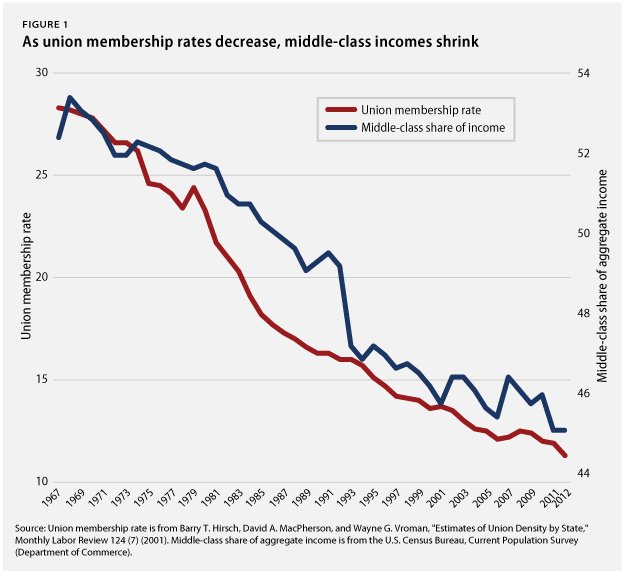
- Caroline Fairchild reports on the obvious link between unionization and reasonable middle-class wages.

- Finally, Lana Payne discusses the dangers of allowing any level of government to silence both dissenting opinions and the people who hold them.

Monday, January 28, 2013

Monday Morning Links

Assorted content to start your week.

- Maude Barlow offers some background to the Common Causes protests happening across Canada this week:
Over the last two years, we have witnessed amazing organizing and mobilizing in Canada -- from student movements in Québec, to the “Defend Our Coast” struggle against tar sands pipelines in British Columbia, to scientists speaking out against the “Death of Evidence,” to the environmental community standing together through the “Black Out Speak Out” campaign. Courageous doctors have stepped forward to challenge the attacks on refugee benefits, and librarians and archivists have marched to save our collective history. Workers are fighting for their rights. First Nations have taken direct action through the “Idle No More” movement, and Chief Theresa Spence of the Attawapiskat First Nation launched a hunger strike to protest unjust omnibus bills.

The time has come for Canada-wide coordinated action against the Harper government's agenda, which is fundamentally changing our society and our country. Common Causes will work to support the many mobilizations and campaigns that already exist, but also to create a strategic, coordinated plan to ensure that the Harper agenda is stopped at the next election and replaced with a progressive alternative. Common Causes will work cross-sectorally, locally, provincially and nationally to create an extended network for solidarity, resistance, action and change. Through this coordination, we will shape priorities for common action and maximum impact.
- And if we're looking for reasons to protest, the Cons have offered up a couple of noteworthy ones - including their suppression of details about oil spills caused by neglect in oversight, the presumably-related departure of an environment commissioner who found no apparent value in highlighting issues for a government which wouldn't listen, and their advertising to tell potential Roma refugees in Hungary they're not welcome in Canada.

- But while taking to the streets, we should make sure to focus on what we can plausibly accomplish. And Murray Dobbin seems to be headed in entirely the wrong direction - demanding a one-time electoral reform pact with little prospect of success, while ignoring the reality that a two-year gap in progressive work on substantive policy will only facilitate the rightward drift he takes as a given.

- Finally, it's good to see plenty of much-needed pushback against the City of Regina's plans to shut down the pool and recreation facilities which actually allow citizens to gather and keep fit while pouring millions upon millions of dollars into a new site for passive viewing purposes.

Thursday, July 28, 2011

Thursday Morning Links

This and that for your Thursday reading.

- Andrew Jackson attacks the myth of expansionary austerity, particularly from a Canadian perspective:
(T)here is very rarely any such thing as expansionary austerity, according to IMF staff economists.

In a careful review of the historical evidence, they find that, typically, a 1 percent of GDP fiscal consolidation reduces real private consumption over the next two years by 0.75 percent, while real GDP declines by 0.62 percent.
...
For Canadians this is surely sobering. We face no fiscal crisis – our net debt is far below the OECD average. Austerity cannot produce lower interest rates – short term rates are near zero and the 10 year Government of Canada bond rate is at a near historic low of under 3%. And, with the dollar hugely over-valued and the US teetering on the edge of another downturn, there will be no offset to fiscal contraction from higher exports this time around.

As we begin the 2012 federal Budget debate, Flaherty must be asked why his planned cuts do not risk derailing an already very fragile recovery.
- Maude Barlow highlights the sad truth that third-world conditions - including a lack of running water - are still a reality in Canada, while our government is using its energy holding out against a global consensus on the right to water and sanitation.

- Linda McQuaig points out some of the pluses of the NDP's decision to make Nycole Turmel its interim leader:
"I think (it's) a great choice," said Linda McQuaig, a Toronto-based journalist and writer who recently co-authored The Trouble With Billionaires. "She's a union person, and a public sector union, at a time when the public sector is really under attack. She's a woman, and a staunch defender of pay equity."

She said that the appointment of Turmel sends "a good, clear message where NDP is coming from," in light of Prime Minister Stephen Harper's series of cutbacks to women's programs.
- The Fraser Institute runs into reality yet again. And the results aren't any prettier than usual.

- Finally, for those looking for a fix of political information to pass the summer, Kagro's 2011 election maps are well worth a look.

Thursday, May 05, 2011

Thursday Morning Links

This and that for your Thursday reading.

- Maude Barlow comments on what's needed to rein in the worst instincts of the Cons' new majority government:
What is needed now is a coming together of progressive forces in civil society and the labour movement as never before in our country's history. Social and trade justice groups, First Nations people, labour unions, women, environmentalists, faith-based organizations, the cultural community, farmers, public health care coalitions, front line public sector workers, and many others must come together to protect and promote the values that the majority of Canadians hold dear. And we must work with, and demand the active representation of, the opposition forces in the House of Commons. In particular, the NDP must oppose the Harper agenda with the full weight of its new power and the Liberals must redeem themselves by working alongside the NDP in defending the interests of the people of Canada.
...
(S)upport for the Harper agenda is paper-thin, as most Canadians do not share the values of this agenda. This then is our task: to work hard over the next four years to protect the laws, rights and services that generations of Canadians have fought for from being dismantled; fight the corporate-friendly, anti-environmental, security obsessed agenda that will come at us; and prepare the way for the kind of government in four years that does in fact, express the will of the people -- one with an agenda of justice and respect, of care for the earth, of the more equitable sharing of our incredible bounty.

This will be hard work and will take a great deal of courage and commitment. But really, what more important thing do we have to do?
- Paul Wells' review of the campaign is of course a must-read. But I'll take particular note of this observation:
When Ignatieff hired them, Donolo and Sorbara had asked for a year to get ready for the next election. By the fall of 2010, the year was up. Liberals started to tell one another it would soon be time for an election, and then, being Liberals, they began to tell reporters. Late last fall, La Presse ran a column by Vincent Marissal in which he quoted senior Liberals who said they didn’t intend to let the next Harper budget pass a confidence vote if they could help it.

The Conservatives took Marissal’s column as gospel, and pounced. “If the Conservative party wins again, I think the single biggest strategic mistake the Liberal party made was telegraphing their intentions to bring down the government in the fall of 2010,” a senior Harper strategist said. “This basically gave the Conservative party and the operatives and the people who control the money licence to do two things: one, delay the budget as long as possible; and two, start an attack-ad campaign as early as possible and run it as long as possible.”

Jim Flaherty had delivered the 2009 budget on Jan. 27, a not unusual time. This year he waited and waited before finally admitting he would deliver one on March 23. The Conservatives filled the space with by far the longest and heaviest anti-Ignatieff advertising barrage they had ever run. Earlier campaigns had run a few weeks. “This one went on for part of January, all of February and almost all of March,” the Harper strategist said. “And the Grits actually did that to themselves.”
- Of course voters weren't allowed to find out about a massive oil spill which by all rights should have constituted a major late-campaign discussion point until after the election was done with. After all, who can accept having such an inconvenient disaster influence public opinion when it counts most?

- Just a thought, but if a party is at the point where it has six steps to pass through before getting to "finding a purpose for existing", doesn't that speak rather poorly for the likelihood it's worth anybody's time?

- Finally, Glen Pearson's post-mortem is well worth a read in general. But I'd highlight in particular how Pearson's late-campaign revelation about the Cons' tactics fits with Stephen Harper's view of politics as a one-way flow of information:
At doors I canvassed I kept hearing certain stories about how I spent too much time in Africa, or that my voting presence in the House wasn’t too impressive. When I informed them that I only spent one week a year on that continent (Sudan), and that I take it on my holiday time over New Years and on my own dime, I could sense the hesitation in their voice. “Oh … that’s not what we heard when the Conservatives phoned us last night.” Something that hadn’t been an issue heretofore was suddenly looming large in the final days. It was frustrating, but I didn’t know who to talk to. It was only when the election was over that a good Conservative friend informed me that they had actually been utilizing a central office for phone calls and that none of them emanated from London itself. They had poured big money from afar into influencing my riding. What I had thought to be a local campaign had suddenly taken on national dimensions.

I should have figured it out earlier. While the opponents from the other parties were front and centre in the campaign, the Conservative candidate had been AWOL, appearing at only one televised debate in the entire five weeks. Instead, the Conservatives opted for phone calls and signs – no replacement for flesh and blood candidates, but they were looking to win from a distance.

It’s hard to describe this. Across the country, news trickled in that Conservative candidates refused to be present at debates; what was supposed to be an exercise in local democracy had become a faceless excuse for a campaign. It’s never easy being so accessible, but all the other candidates believed it to be their democratic duty. Not the Conservatives, however.
Now, I'd hope that most candidates (Pearson included) would see direct public engagement as more than just a matter of duty, but also as an essential opportunity to interact with constituents and potential supporters. And while the Cons unfortunately managed to win by launching smears at as many opponents as possible through mechanisms which left no opportunity for correction or accountability, there's surely some reason for hope that a concerted effort to cultivate real and direct links to voters over the next four years will beat out any attempt to replicate their campaign.

[Edit: fixed link.]